


When I finally stepped off the train in Bayreuth, I expected a town orbiting entirely around Richard Wagner. His name appears on street signs, bus routes and souvenir mugs, but over the course of a single day I discovered that Bayreuth’s most compelling story belongs to an eighteenth-century woman: Margravine Wilhelmine. Her Baroque theatres, palaces and gardens quietly predate Wagner by a century, and by the time I left that evening it was her world, not the Festspielhaus, that defined the city for me.
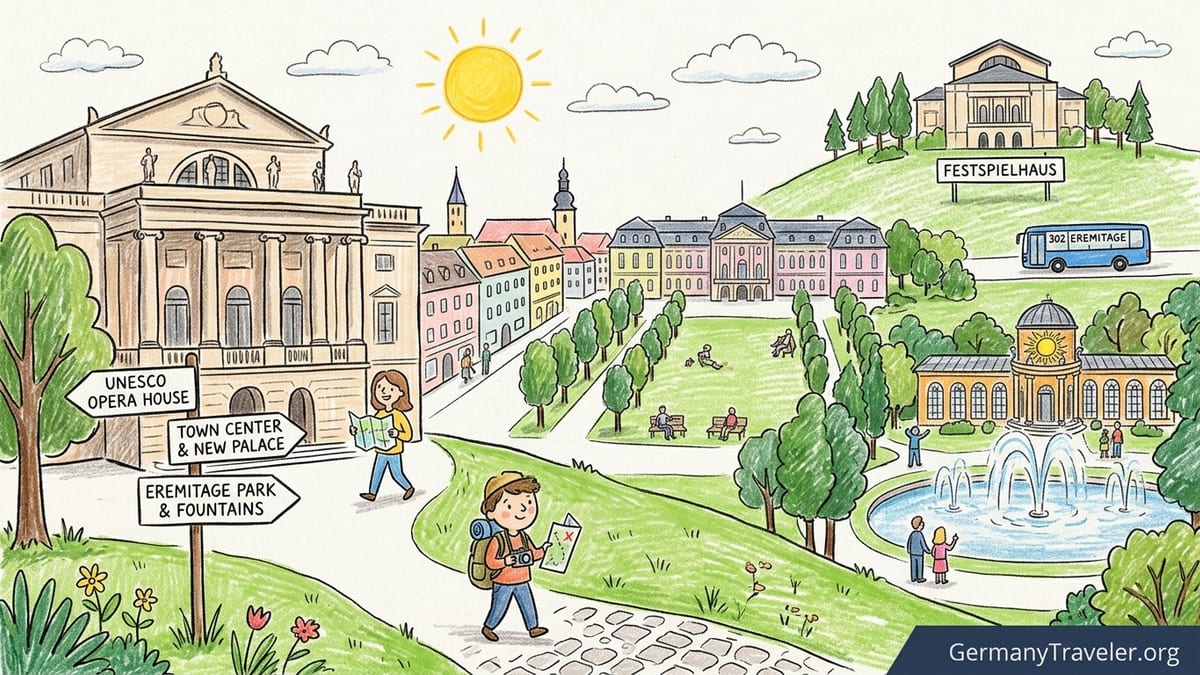
Arriving With Wagner On My Mind
My day in Bayreuth began at the main station on an early summer morning, with thin cloud cover, cool air and the forecast promising a dry, mild day in the low twenties Celsius. Walking from the station toward the compact historic center took roughly 15 minutes, the streets still quiet apart from a few commuters and schoolchildren. All the clichés were there: a Lohengrinstraße, posters advertising the Bayreuth Festival and the silhouette of Wagner’s Festspielhaus on brochures in the tourist information office near the central bus hub, the ZOH. It felt, at first glance, like a one-composer town.
At the tourist information counter I asked about visiting the Festspielhaus and the staff member smiled knowingly. “You can walk up there in about twenty minutes,” she said, “but if you really want to understand Bayreuth, start with the Margravial Opera House.” She circled Opernstraße on a city map and then another cluster of highlights: the New Palace, the Hofgarten and the Eremitage gardens a little way out of the center. It was the first hint that there was another story layered beneath the Wagnerian surface.
Armed with the map and a day’s bus ticket from the Stadtwerke Bayreuth system, I decided to follow her advice. The Festspielhaus could wait. My first stop would be the UNESCO-listed Margravial Opera House, just a few minutes’ walk from the central squares. I expected something grand, of course, but I did not yet realize that this wooden Baroque interior would do more to shape my impression of Bayreuth than Wagner’s famously dark auditorium ever could.
The streets tightened as I entered the old town, with pastel façades and cobblestones leading me toward Opernstraße. Despite its world heritage status, the Margravial Opera House still appears almost understated from the outside, set in a row of buildings rather than crowning a hill. There was none of the solemn pilgrimage feeling that often surrounds the Festspielhaus. It felt instead like approaching a hidden theatre that locals had always known and visitors were only slowly rediscovering.
Stepping Inside the Margravial Opera House
At the entrance, signs directed me through a modern glass door marked as the museum access, not the imposing historic portal. Inside, the ticket counter displayed clear pricing: admission to the Margravial Opera House “World Heritage & Museum” at 10 euros for an adult, and a combination ticket with the New Palace for 15 euros. The broader “World of Wilhelmine” combination, covering several additional sites around Bayreuth, was listed at 21 euros, but for a focused single day I opted for the 15 euro ticket, which felt like excellent value for two major interiors.
Before entering the auditorium, a compact exhibition explains how the opera house was built in the 1740s for Margravine Wilhelmine, designed by the famous theatre architect Giuseppe Galli Bibiena and his son. Panels and models help you understand that this was not merely a venue but a statement of princely prestige. Yet none of this quite prepares you for the moment when you step through the doors and into the wooden Baroque theatre itself.
The interior is a revelation. Unlike Wagner’s Festspielhaus, with its fan-shaped seating and darkened, ascetic atmosphere, Wilhelmine’s opera house is an explosion of painted wood, gold tones and illusionistic architecture. The auditorium is made entirely of timber, rising in several tiers of boxes that curve around a narrow horseshoe. Up close you see that what looks like carved stone is carefully painted wood, with columns, pilasters and balustrades rendered in perspective to stretch the space visually beyond its physical limits.
Standing in the parterre and looking toward the stage, I took in the soft light filtering through windows above, the pale blue and green tones of the painted decorations, and the profusion of family emblems and allegorical figures. Guides ask visitors to sit for a few minutes while a short lighting sequence and film presentation evokes how performances once felt here. There is a distinct theatrical perfume in the air, a mix of old wood and careful conservation rather than dust, that makes it surprisingly easy to imagine eighteenth-century audiences gossiping in their boxes. It is intimate, almost fragile, and the strict rules about limiting visitor numbers suddenly make perfect sense.
Opera House vs. Festspielhaus: Two Very Different Worlds
Because I had arrived with Wagner so firmly in mind, I found it useful to compare the Margravial Opera House with what I knew of the Festspielhaus. Wagner’s theatre sits on the Green Hill, outside the center, and is famous for its democratic seating plan, the hidden orchestra pit and its almost austere interior focused entirely on sound. The decorative program is minimal, the colors subdued. In Wilhelmine’s house, everything is reversed: hierarchy is written visibly into the stacked boxes, decoration is exuberant and the orchestra would have been fully on display.
In practical terms, too, the experience is different. The Festspielhaus is primarily a working festival venue, so access to the auditorium outside the summer season and scheduled tours can be limited or involve separate guided visits. At the Margravial Opera House, on the other hand, visiting functions more like a museum. Opening hours are broad, often from 9 in the morning to late afternoon or early evening depending on the season, and information boards allow you to explore at your own pace. Staff are present, but the focus is on quiet observation rather than rehearsal schedules.
What struck me most was how the UNESCO-listed opera house reframed Bayreuth as a Baroque project rather than a purely nineteenth-century one. The Bibiena design connects Bayreuth to an international network of princely theatres stretching from Italy to Central Europe, and the survival of this all-wood interior, largely untouched by war, feels almost miraculous. I left the building with a new mental map of the town, one in which Margravine Wilhelmine, not Wagner, sat firmly at the center.
From a visitor’s perspective, paying 10 euros for this experience alone would have felt justified. The combination ticket that cost me around 15 euros, bundling the Opera House with the New Palace, started to look like one of the better cultural deals in Bavaria, especially given that both sites are within easy walking distance of each other in the historic center.
Through the Historic Center to the New Palace and Hofgarten
Leaving Opernstraße, I walked a few minutes along the pedestrian streets toward the New Palace. The route passes typical Franconian townhouses, bakeries selling pretzels still warm from the oven and small boutiques. The New Palace complex appears almost suddenly, a broad façade backing directly onto the Hofgarten, with the ticket office near the entrance courtyard. Thanks to the combination ticket I had already purchased at the Opera House, I could walk straight in without queuing.
The New Palace was rebuilt after a devastating town fire in 1753, with Margrave Friedrich and Wilhelmine shaping it into a showcase residence. Inside, the sequence of state rooms is richly varied. One highlight is the so-called Palm Room, where walls painted with palm trees and exotic motifs create a whimsical, almost stage-like environment. Another is the Japanese Cabinet, decorated with lacquer panels and East Asian art, tangible evidence of the eighteenth-century fascination with distant cultures. Throughout, Wilhelmine’s taste is visible in the interplay of pastel colors, gilded stucco and mirrored surfaces.
Visiting both the Opera House and the New Palace back to back made the price of the combined ticket feel even more reasonable. For only about 5 euros more than the Opera House alone, I had access to a substantial series of historic interiors and an informative permanent exhibition about Wilhelmine’s life, including her correspondence and artistic ambitions. If you have a full day and a basic interest in architecture or court culture, the combination easily pays off; only extremely time-pressed travelers might consider visiting just one of the two.
Stepping out from the palace into the Hofgarten, I found a calm green rectangle at the edge of the old town. Gravel paths trace formal lines through grass and rows of old trees, with a long, straight allée creating a central axis. Office workers used the park for their lunch breaks, students lounged on benches and the occasional cyclist drifted past. The palace façade forms a backdrop on one side, with other civic buildings and churches peeking over the trees on the others. It is not an extravagant garden, but as a buffer between Baroque residence and modern city it works beautifully.
Midday Pause and Planning the Eremitage
By late morning the clouds had thinned and the light grew brighter, though still softened by a light haze. I found a small Franconian restaurant a few streets from the Hofgarten and ordered a simple lunch: bratwurst with sauerkraut and a non-alcoholic beer. Prices in the historic center are comparable to other medium-sized Bavarian towns; a hearty plate came in well under 15 euros. With the afternoon ahead of me, I unfolded my transit map and planned the trip to the Eremitage, the historic park complex northeast of the city where Wilhelmine left another strong mark.
Reaching the Eremitage without a car is straightforward. City buses run from the central stops at ZOH and the main station toward the park, with lines 302 and 303 serving stops labeled “Eremitage” or “Parkplatz Eremitage.” Services are fairly regular during the day, usually at intervals of around 20 to 30 minutes, though exact times change seasonally. I caught a mid-afternoon bus from near the center; the ride took roughly 15 minutes as the urban fabric gradually gave way to quieter residential areas and wooded edges.
At the “Parkplatz Eremitage” stop, the bus set me down in a large parking area shared by private cars and occasional tour coaches. From here, a level path leads into the historic gardens in just a few minutes on foot. It is possible to walk all the way from the city center to the Eremitage, but the distance is several kilometers and would take about an hour each way at a relaxed pace. For a single-day visit I was grateful for the simple bus connection, which saved both time and energy for exploring the park itself.
The temperature had risen slightly, but the mix of open lawns and wooded paths around the Eremitage kept things comfortable. I layered a light jacket over a T-shirt in the morning and was able to carry it easily once the day warmed up, a useful reminder that even in summer, Franconian weather can shift quickly between cool shade and warm sun.
Exploring the Eremitage: Old Palace, Orangery and Water Features
Entering the Eremitage feels like stepping into a different chapter of Bayreuth’s history. The park originated in the early eighteenth century and was later expanded under Wilhelmine, who transformed it into a blend of courtly retreat and theatrical landscape. The first focal point is the Old Palace, a relatively modest building from the outside, arranged around a courtyard with arcades. The interiors, when open to visitors, reveal rooms decorated with a mix of rustic elements and refined ornament, reflecting the idea of retreating from courtly life while never fully leaving luxury behind.
From the Old Palace, paths radiate out into the park, leading toward grottos, pavilions and water basins. The most striking ensemble is the long Orangery with its central Sun Temple. Approaching it from the side, the building’s length only gradually reveals itself, framed by clipped hedges and geometrically laid-out flowerbeds. The Sun Temple itself, with its round pavilion and statue-topped balustrade, looks out over a large basin used for the park’s famous water displays.
The fountains at the Eremitage are a seasonal spectacle. Information on site and from the local authorities notes that the main water features usually operate between May and October, with specific activation times during the day. However, the schedule can be affected by weather conditions or ongoing maintenance, so it is wise to check at the tourist information office or on notice boards earlier the same day. On my visit some jets were playing steadily, while others remained dry, a reminder that historical hydraulic systems are both precious and temperamental.
A little further along, I followed a shaded path to an artificial grotto adorned with shells and stonework, another stage-like space typical of eighteenth-century garden design. Here, nature is not left wild but carefully orchestrated into scenes. Couples sat on benches beneath old trees, and a few families with children explored the tunnels and steps around the grotto. The atmosphere contrasted strongly with the formal Hofgarten: the Eremitage is at once more theatrical and more relaxed, with wooded sections offering moments of near solitude even on a pleasant afternoon.
Wilhelmine’s Bayreuth Before Wagner
Spending an extended afternoon in the Eremitage made it easier to understand Wilhelmine’s imprint on Bayreuth as a whole. Long before Wagner and his patron King Ludwig II arrived on the scene in the nineteenth century, Bayreuth was already being refashioned into a kind of stage for princely life. The Margravial Opera House provided the literal stage, the New Palace served as an urban residence and the Eremitage functioned as an out-of-town retreat, all within a short distance of one another.
Wilhelmine, herself a writer, composer and lettered woman, used architecture and landscape as instruments of self-expression. The Italianate lines of the opera house, the exotic motifs of the New Palace interior and the playful hermit imagery at the Eremitage form a coherent program once you recognize her hand. Compared with the heavy mythological weight of Wagner’s operas, her world feels lighter, more curious, but no less intentional.
This realization altered the way I regarded Wagner’s later presence in Bayreuth. Rather than founding a cultural city out of nothing, he inserted himself into a town already accustomed to using art and performance as tools of representation. His Festspielhaus on the Green Hill, with its singular focus on musical drama, is in some respects a radical departure. Yet it also mirrors Wilhelmine’s willingness to reshape the urban and natural environment according to a personal artistic vision.
For travelers who arrive expecting only a pilgrimage site for Wagnerians, discovering this deeper Baroque layer can be a surprise. It certainly changed my own priorities. While I still recommend at least seeing the Festspielhaus from the outside if time allows, I would argue that a day structured around Wilhelmine’s legacy offers a more rounded, visually varied and, for non-opera fans, more accessible introduction to Bayreuth.
Timing, Practicalities and The Value of a Day
Logistically, fitting all of this into a single day is realistic, but it benefits from an early start and a bit of planning. I arrived in Bayreuth shortly after 9 in the morning and went first to the Margravial Opera House, which typically opens in the morning hours. Allow about 60 to 90 minutes there, including time for the introductory exhibition and simply sitting in the auditorium to absorb the details. From there, the walk to the New Palace is under 10 minutes, and a visit inside, combined with a stroll through the Hofgarten, can comfortably fill the late morning.
After a midday break for lunch in the historic center, catching an early afternoon bus to the Eremitage leaves several hours to explore the gardens, the Orangery area and, if interior opening hours align, the Old Palace. I spent roughly three hours in the park, walking at a relaxed pace but covering most of the main axes and side paths near the historic core. Including bus travel to and from the city, the Eremitage portion of the day took around four hours in total.
Public transport proved efficient and inexpensive. A day ticket valid for the city bus network cost less than many single admissions to major sights in larger German cities, and the routes to and from the Eremitage were straightforward, with the bus stop names clearly announced and displayed. Walking distances within the center are short; the station, Opera House, New Palace and Hofgarten all sit within a compact area that feels manageable even for those not keen on long urban walks.
Weather is always a variable, especially if the Eremitage is a priority. On my visit, bright but slightly hazy conditions made for comfortable walking and pleasant photographs, but the experience would be different in heavy rain. Because the main attractions in the center are largely indoors or partially sheltered, it is possible to adapt: focus more on the Opera House and New Palace on poor-weather days and treat the Eremitage as a bonus when the sky cooperates. The fact that the seasonal fountains can be switched off during high winds or technical work is another reason not to pin your whole visit on a specific show time.
The Takeaway
By the time I caught an early evening train out of Bayreuth, my perception of the city had shifted completely. I had arrived thinking first of Wagner and his festival, yet the images that stayed with me belonged to Margravine Wilhelmine: the painted wooden tiers of her opera house, the palm-filled chamber of the New Palace, the long Orangery façade and playful waterworks of the Eremitage.
For travelers with only a passing interest in opera but a strong appreciation for architecture and gardens, Bayreuth works remarkably well as a day trip. The combination ticket at around 15 euros for the Margravial Opera House and New Palace provides access to two substantial Baroque ensembles within easy walking distance, while the free Hofgarten offers a green pause between them. Add the relatively short bus ride to the Eremitage, and you have a full, varied day that feels coherent rather than rushed.
That said, Bayreuth also rewards an overnight stay. Spending a night would allow you to see the Festspielhaus and perhaps join a tour there without sacrificing time at Wilhelmine’s sites. It would give you a chance to experience the historic center in the evening, when day-trippers have left and the cafés and beer gardens fill with locals. For those tracing broader themes of European Baroque, court culture or garden design, a slower pace also makes sense, because details reveal themselves best without constant clock-watching.
If your itinerary is tight and you can afford only one full day, you will still come away with a strong sense of Bayreuth as a small Franconian city with an outsized cultural legacy that long predates Wagner. If you can stretch to a night, you gain layers: Baroque and Romantic, Wilhelmine and Wagner, urban palace and wooded retreat. Either way, it is Margravine Wilhelmine, not the more famous composer, who lays the groundwork for what you see. Once you have stood beneath the painted balconies of her opera house or watched the fountains play at the Eremitage, it is difficult to think of Bayreuth as Wagner’s stage alone.
FAQ
Q1. Can I see Bayreuth’s main Baroque sights and the Eremitage in one day?
Yes, with an early start you can visit the Margravial Opera House, New Palace, Hofgarten and spend several hours at the Eremitage using city buses.
Q2. Is the combination ticket for the Margravial Opera House and New Palace worth it?
For around 15 euros, the combination ticket offers good value, giving access to two major Baroque interiors within easy walking distance of each other.
Q3. How do I get from Bayreuth’s city center to the Eremitage without a car?
City bus lines such as 302 and 303 run from central stops like ZOH and the main station to stops named Eremitage or Parkplatz Eremitage in about 15 minutes.
Q4. When do the fountains at the Eremitage operate?
The main water features usually run seasonally from May to October, but specific times can change or be canceled due to weather or maintenance.
Q5. How different is the Margravial Opera House from Wagner’s Festspielhaus?
The Margravial Opera House is an intimate Baroque wooden theatre rich in painted decoration, while the Festspielhaus is a later, larger, more austere festival venue.
Q6. Do I need to book tickets for the Margravial Opera House in advance?
For most regular visits you can buy tickets on site, though checking current visitor information is sensible in busy periods or when events are scheduled.
Q7. Is Bayreuth a good destination if I am not an opera fan?
Yes, the city offers significant Baroque architecture, palaces, museums and landscaped gardens that appeal to travelers more interested in history and design than performances.
Q8. How much walking is involved in visiting Bayreuth’s central sights?
The main attractions in the center lie within a compact area; expect short walks of 5 to 15 minutes between the station, Opera House, New Palace and Hofgarten.
Q9. Can I visit the Eremitage gardens for free?
The historic park grounds are generally accessible without charge, though separate admission may apply for specific palace interiors or exhibitions within the complex.
Q10. Should I stay overnight in Bayreuth or is a day trip enough?
A well-planned day trip covers the main Baroque highlights, but staying one night allows time for the Festspielhaus, slower garden walks and a more relaxed pace overall.