


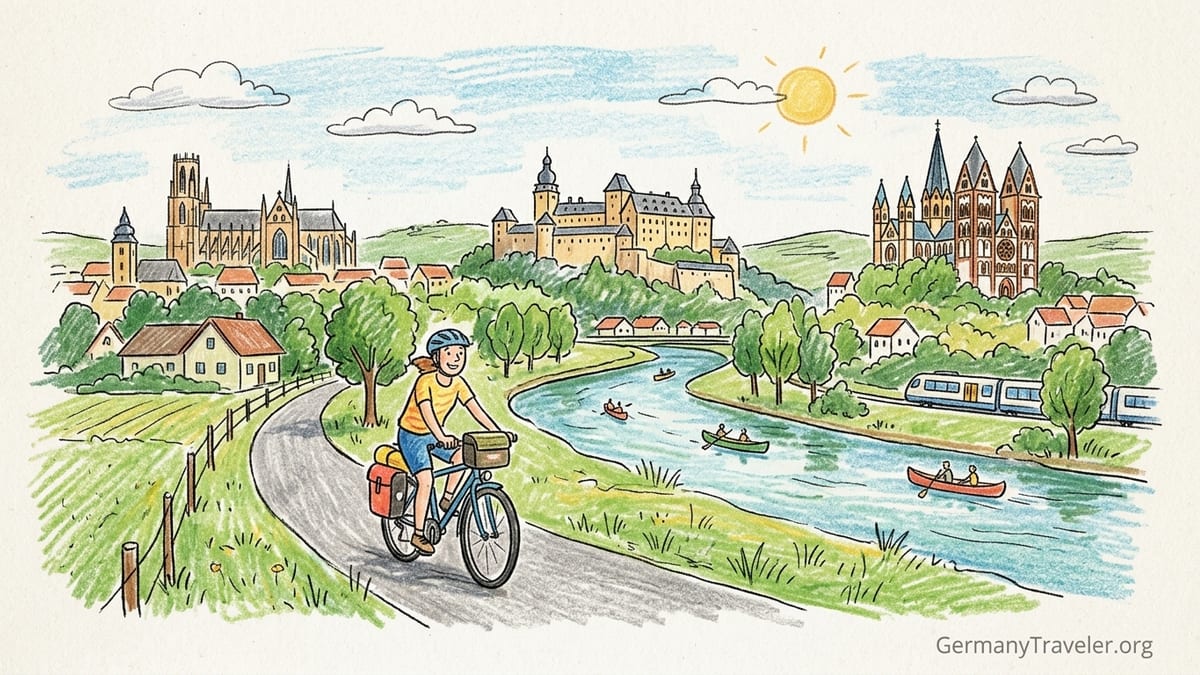
I did not ride the full Lahn Cycle Route from its spring in North Rhine-Westphalia to its mouth on the Rhine, but instead chose a very manageable, very rewarding window onto it: the stretch between Wetzlar, Weilburg and Limburg. Over three unhurried days along roughly 80 kilometers of river, I discovered why this classic German river route has become such a favorite among leisure cyclists, e-bike riders and families.
Understanding the Lahn Cycle Route Before You Go
Before turning a pedal, I spent some time understanding the bigger picture of the route I was about to dip into. The official Lahn Cycle Route, often still called Lahntalradweg in German, follows the river for about 245 kilometers from its source near Netphen in the Rothaargebirge to its confluence with the Rhine at Lahnstein. Roughly 169 of those kilometers lie in the state of Hesse, where the route is listed as a dedicated themed cycle route in the state’s own route planner and is rated as largely easy, with modest overall climbs and descents.
That larger framework mattered to me for one simple reason. It meant I could be honest with myself about what I had time and energy for. Instead of trying to “conquer” the entire 245 kilometers in one go, I decided to focus on a highlight section: from Wetzlar to Limburg via Weilburg. These towns are on the middle Lahn, served by the Lahntalbahn railway, which makes it practical to ride one direction and take the train back or to skip sections if needed.
Official descriptions describe the Lahn Cycle Route as mostly flat, predominantly asphalted and often on car-free or low-traffic routes close to the river. That is accurate, but there is an important footnote. Even in this “easy” middle section between Wetzlar and Limburg, there are occasional short climbs and descents, including one stretch that regional planners explicitly describe as steep, with a signed alternative using either the train or a shuttle. I wanted to see how that felt in real life under loaded panniers.
With that in mind, I framed my trip not as an endurance ride but as a slow, exploratory journey. My plan was three stages: Wetzlar to somewhere near Weilburg on day one, Weilburg to a village outside Limburg on day two, then a short and flexible final ride into Limburg’s old town on day three, with time to actually see each place rather than just ticking it off.
Planning, Packing and Choosing Between Bike and E-bike
I arrived in Wetzlar by regional train, rolling my touring bike into the dedicated bicycle section. Many of the regional trains along the Lahn corridor have bike areas marked with a large bicycle symbol on the doors, though capacity and reservation rules can vary, so I checked the current timetable and conditions in advance. The short step from platform to carriage reminded me that traveling light matters. For this three-day ride, I limited myself to two rear panniers, a small handlebar bag and a lightweight cable lock for quick stops alongside a sturdier primary lock.
My bike was a conventional trekking bicycle with 700c wheels, 38 mm tires, a triple chainset and pannier rack. It is not the latest gravel machine or high-tech touring rig, but it is familiar, easy to repair and more than adequate for a route that is mostly paved. Along the Lahn, e-bikes are very common. At virtually every café terrace, I saw mid-motor step-through models lined up, often from well-known German brands sold in local bike shops. The route’s gentle gradients lend themselves perfectly to e-bike touring, particularly for riders who want to cover longer daily distances or who have less cycling fitness.
There is no universal right answer to the e-bike versus conventional bike question here, but my experience suggested some guidelines. If you plan to ride only this Wetzlar to Limburg section, stay under 50 kilometers a day and are comfortable with a few short climbs, a conventional bike in good mechanical condition will be fine. If you want to bolt on extra detours, climb up to viewpoints or simply know that you can cruise into a headwind without worrying about your knees, an e-bike is a forgiving choice. The key is to think about where you will charge. Many guesthouses along the route now advertise e-bike friendliness, often meaning access to an outlet in a garage or bike room, but it is still worth checking at the time of booking.
Packing reflected both the easy access to services along the way and the fact that I would be on the bike for several hours each day. I carried a basic tool kit with multi-tool, tire levers and one spare tube, a compact pump, a lightweight waterproof jacket, padded cycling shorts, a casual change of clothes for evenings in town and a simple first-aid kit. For navigation, I relied on a mix of the signposted Lahn Cycle Route waymarks and an offline map app on my phone. Reception in the valley is generally good, but downloading maps in advance meant I was not anxious about dead spots.
First Impressions of Wetzlar: Old Town, Cathedral and Goethe
Rolling into Wetzlar, I was surprised how quickly the city transitions from practical modern outskirts to an almost storybook core. The old town rises above the river on a hill, a dense tangle of half-timbered houses and narrow cobbled lanes. The dominant landmark is Wetzlar Cathedral, a striking mix of Romanesque and Gothic stonework that has never been completely finished, giving its western front a distinctive, slightly irregular silhouette. The cathedral square is a good place to let your legs recover after the journey and to see the contrast between medieval stone, timbered facades and the occasional Leica camera slung around the neck of a visitor.
Goethe’s presence here is quieter but very real. He stayed in Wetzlar in the 1770s, and his infatuation with Charlotte Buff eventually became woven into his novel “The Sorrows of Young Werther.” The Lottehaus, the Buff family home, now operates as a museum dedicated to this connection. Inside, you find rooms that explore both Goethe’s work and the real life of the family. Walking through the modestly sized rooms helped me place the fictional drama in a very tangible domestic setting, which lent an unexpected literary extra layer to what was primarily a cycling trip.
For this journey I chose to spend a night in Wetzlar rather than immediately jumping on the route. I checked into a small hotel just across the river, close enough to walk into the Altstadt but slightly removed from the cobbled lanes so that leaving with a loaded bike the next morning would be straightforward. When you book in Wetzlar, it is worth asking specifically about bicycle storage. My hotel offered a locked courtyard where guests could chain bikes to a metal rail behind a gate. Others have indoor bike rooms or allow storage in a basement.
That first evening set a tone for the trip. I strolled across the stone bridge back into the old town, grabbed a simple plate of schnitzel and potatoes at a traditional tavern and topped up my water bottles from the tap in my room, confident that potable water would be easy to find along the route. Back in my room, I laid out the next morning’s ride: Wetzlar to Weilburg, nominally around 35 kilometers, leaving room for stops and minor detours.
Day One: Wetzlar to Weilburg Along the River
Leaving Wetzlar the next morning, I quickly found the Lahn Cycle Route signs: green lettering with a stylized river motif and direction arrows. My route began on a separate cycle path near the river, set away from traffic and on smooth asphalt. Early on, the surface quality set the pattern for much of the ride. In and near towns, the path often runs on dedicated asphalt tracks beside local roads or directly on the riverside embankment. Between settlements, it alternates between quiet country lanes, paved farm access tracks and well-compacted gravel. My 38 mm tires were more than sufficient; riders on narrower road tires would want to watch for the occasional rougher section but should still manage comfortably.
The river itself is a calm presence. Often I was riding almost level with the water, watching canoe groups gliding downstream toward small weirs and locks. On this first day, the route felt almost entirely flat, more like rolling along a slightly tilted tabletop than climbing or descending. Official profiles confirm that the overall gradients are gentle here, and I only really changed into my lower gears when short ramps carried the path up to cross a road or bridge.
Navigation, for the most part, was straightforward. Whenever there was a junction, a Lahn Cycle Route sign pointed the way, and where local detours existed due to construction or flood protection work, temporary yellow signs guided cyclists around. I passed several small villages, each with at least a bakery or café by the main street. In one of them, I pulled off to refill water and pick up a sandwich, leaving my bike in direct line of sight outside. In this part of Germany, it is still common to see expensive e-bikes casually leaned against a café wall while their owners sit inside. I still locked mine, but the relaxed atmosphere made breaks easy.
As I approached Weilburg, the valley narrowed and became more dramatic. Forested slopes pressed closer to the river, and the town itself appeared perched on a ridge above a pronounced loop of the Lahn. The final kilometers into Weilburg ran on a combination of riverside path and low-traffic streets, with occasional short climbs as the route threaded under rail lines and around small industrial zones. Nothing was long enough to count as a serious ascent, but I did find myself thinking that a heavily loaded rider on a hot day might appreciate an e-bike on these little ramps.
Weilburg: Castle, Ship Tunnel and a Hill Between River and Old Town
Weilburg is where my river ride briefly turned vertical. The historic town center and the large Renaissance castle complex sit roughly 40 meters above the Lahn on a narrow rocky ridge. The official Lahn Cycle Route runs at river level, but most visitors want to see the town itself and the unique ship tunnel. Going up means a genuine, if short, climb. From the riverside path, I pushed my bike up a moderately steep street into town. Local planning documents confirm that the difference between riverbank and old town plateau is around those 40 vertical meters, and you feel it in your legs, particularly with luggage.
Once in the upper town, the effort is rewarded quickly. The castle complex stretches almost the length of the ridge, a succession of courtyards, façades and terraced gardens with views down into the Lahn valley. Even without paying to tour the interiors, simply walking the grounds gives a strong sense of Weilburg’s former status as a residence town. I parked my bike in a courtyard designated for visitors and used a simple cable lock, then wandered on foot for an hour, taking in the sandstone details and the view to the triple tunnel ensemble below, where road, rail and water all pierce the ridge side by side.
The ship tunnel itself sits back down at river level and is arguably the most unusual built structure on this whole stretch. Opened in the mid-nineteenth century, the roughly 195-meter tunnel was constructed so that boats could avoid a tight river loop and two weirs by cutting straight under the hill on which the town stands. Today it is the oldest and longest still navigable ship tunnel in Germany and a magnet for canoe groups and excursion boats. From the cycle path, you can ride almost right up to its mouth and watch vessels disappear into the darkness and re-emerge minutes later on the other side.
For my overnight in Weilburg, I chose a guesthouse toward the edge of the old town, conscious that I would be rolling downhill in the morning. When booking I had asked about bicycle storage and was told they kept bikes either in a small inner courtyard or in a ground-floor room next to the breakfast area. In practice, I wheeled mine through an archway and leaned it against an interior wall, where several e-bikes were already charging. Dinner was a simple affair at a nearby restaurant, with local beer and a pasta dish that felt well deserved after the push up from the river. I fell asleep with the windows open to cool air, listening to the faint echo of trains on the opposite riverbank.
Day Two: Weilburg to the Villages before Limburg
Leaving Weilburg the next morning began with that satisfying glide back down to the Lahn. Once on the riverside path, the riding returned to its earlier character: mostly flat, often directly beside the water, with occasional excursions slightly inland where the railway, the river and the cycle route negotiate space in a narrow valley. The surface was again predominantly asphalt, with stretches of well rolled gravel between fields and patches of shade where the route slipped under trees along the bank.
On this day I noticed just how closely the Lahntalbahn railway accompanies the route. Every so often a regional train slid past on the opposite side, its carriages briefly visible through the trees. This parallel infrastructure is far more than an interesting backdrop. It is what makes shorter, rail-assisted stages so practical here. In several of the small stations along the way, platforms are accessible directly from the cycle route or via a short signed link. That means if your legs tire, if weather turns bad or if you simply decide you would rather spend an extra afternoon in a particular town, you can simply board a train with your bike and adjust the itinerary.
My plan for this second day was flexible. I aimed for a village a manageable distance from Limburg, so that the final day would be a short roll into the city. The ride unfolded at a casual pace, with regular stops at benches overlooking quiet backwaters of the Lahn. Several times I passed canoe rental stations with boats pulled up on grassy banks, and small campsites where touring cyclists had pitched tents next to caravans. Water was rarely an issue. In addition to cafés and guesthouses, many of the small towns had public fountains or at least easily accessible restrooms at train stations where I could refill bottles.
Mechanically, this day was my only test. Somewhere between two villages, I noticed a soft feeling from my rear wheel. It turned out to be a slow puncture, likely from a small shard of glass picked up on a section of roadside cycle track. I pulled off onto a grassy verge, flipped the bike and replaced the tube. It took about twenty minutes in total, made easier by the fact that passing cyclists always seemed willing to check in with a friendly “Alles gut?” and the knowledge that, in the worst case, I was never far from the next station. This incident confirmed my feeling that carrying at least one spare tube and a pump is worth the small weight penalty, even on a route that many describe as easy and beginner friendly.
Day Three: Rolling Into Limburg and Weighing Towns Against Landscape
The final morning began in a small family-run guesthouse where my bike had spent the night in a locked backyard shed next to a stack of firewood. Breakfast was the familiar German spread of bread rolls, cold cuts, cheese and jam, and I topped up my bottles with tap water before rolling back onto the path. Compared with the previous days, this last stretch felt even more clearly like a shared space between different types of leisure users. Walkers, dog owners, families on children’s bikes and e-bike touring groups all moved along the same ribbon of asphalt beside the river.
As Limburg approached, the valley widened slightly again. Traffic noise increased at times, with regional roads and the autobahn audible in the distance, but the cycle route itself maintained a comfortable distance from heavy traffic. Waymarking into the city center was good, although in a couple of spots urban complexity meant paying closer attention to the signs and my offline map. At one junction near a bridge, the Lahn Cycle Route arrows pointed up and over the river, while a parallel local bike sign offered a riverside alternative. I followed the official route over the bridge, then quickly rejoined the riverbank path leading toward the historic core.
Limburg’s cathedral revealed itself gradually. At first it was just a glimpse of pale stone on a hill. Then, as I moved closer, the seven towers of the St. George’s Cathedral rose clear above the Lahn, perched on a rock spur that drops steeply down toward the water. It is one of the most striking cathedral silhouettes in Germany, not grand in size but almost theatrical in its placement. The old town clusters around it, a compact warren of half-timbered houses and narrow lanes that feel almost stacked above the river.
Arriving by bike has one special advantage here. You can roll directly along the river promenade, find a spot to lock your bike in sight of the water, and then walk up into the old town unencumbered. I did exactly that, pushing my bike the last few meters up a cobbled lane and securing it to a sturdy metal stand in a small square. From there it was a short, steep walk up to the cathedral itself, where the view back across the Lahn and down to the rooftops of the town gave a satisfying sense of completion. I did not attempt to ride further down the Lahn toward its confluence with the Rhine. Instead, I treated Limburg as the natural end of this particular journey.
So, was the trip more rewarding for the river landscapes or for the towns? In truth, it was the combination. The Lahn itself is not a dramatic alpine torrent; it is a gentle, meandering river framed by wooded hills and meadows. The towns along it, particularly Wetzlar, Weilburg and Limburg, provide the vertical punctuation points: hilltop cathedrals, castle complexes and old towns lifted above the valley floor. The cycling in between ties these together at a human speed, slow enough to register each bend of the river yet efficient enough to feel that the landscape is unfolding steadily under your own power.
Bikes, Surfaces, Gradients and the Role of the Train
By the time I boarded the train home from Limburg with my bike, I had a clear sense of how this Wetzlar to Limburg section feels from the saddle. Surfaces were predominantly good. I would estimate that the majority of the distance was on asphalt, either on dedicated cycle paths or very quiet lanes. The remainder was on fine gravel or compacted dirt that stayed rideable even after a light shower. There were isolated short sections where roots or older pavement produced bumps, but never for long enough to be more than a brief inconvenience.
Gradients remained gentle overall, in line with the route’s official classification as easy on many tourism sites that present the Lahn Cycle Route. However, the mention in planning documents of individual steeper segments matches reality. The climb from the riverside to Weilburg’s old town is the clearest example, and while it is entirely possible to ride, many touring cyclists will feel no shame in walking the steeper meters, particularly with panniers. Elsewhere, short ramps to bridges, underpasses or town centers punctuate the flat sections. On a conventional bike, I appreciated having a wide gear range. On an e-bike, these little climbs practically disappear.
Comparing experiences, I would describe three main ways to tackle this section. One is my approach: a conventional touring bike, 30 to 40 kilometers per day, with overnight stays in Wetzlar, Weilburg and a village outside Limburg. A second is the e-bike touring style I saw often: similar daily distances but with more flexibility to include detours up to viewpoints or side valleys and less concern about loading. The third is a rail-assisted variant. Because the Lahntalbahn runs directly along this section, you can, for example, stay in a single base such as Limburg or Wetzlar and use the train to reach the start of each day’s ride, returning again by rail.
In all three versions, trains play a key role. At the time of my journey, regional trains on the line accepted bicycles outside of peak commuter times, often without a surcharge within regional tickets, though conditions can change and checking current rules is necessary. Platforms are generally bike friendly, with ramps or lifts, and conductors are used to handling cyclists, especially in summer when the Lahn region receives many visitors. Knowing that I could always bail out to the next station significantly lowered the psychological barrier to setting off, especially given the variable weather one can encounter in central Germany.
Stage-by-Stage Itinerary and Practical Riding Times
Looking back, the actual hours in the saddle were modest but satisfying. On day one, Wetzlar to Weilburg took me around three and a half hours of moving time. My bike computer showed an average speed of roughly 15 kilometers per hour, which reflects a relaxed touring pace with regular photo stops and a coffee break. Door to door, including the climb into Weilburg’s old town and a few navigational pauses, the day’s cycling occupied perhaps five hours total, leaving plenty of time to explore the castle area and the ship tunnel surroundings.
Day two, from Weilburg to my village stop before Limburg, was slightly longer in distance but actually similar in riding time, again around three to four hours of motion at an easy pace. Flat riverside riding and good surfaces made for steady progress. The puncture repair added a short enforced rest. Including lunch and several breaks at benches by the river, I spent six to seven hours between leaving Weilburg and checking into my guesthouse.
Day three was intentionally short. From the village into Limburg, I rode less than two hours, stopping often to watch the river and to avoid arriving too early to check into my pre-booked train back home. This final stretch could easily be combined with part of the previous day by stronger riders or shortened by catching the train from any of the intermediate stations into Limburg.
If I were to formalize this into a suggested itinerary for other cyclists, it would look something like this, always with the caveat that you can adjust stages using the train. Stage one: arrive in Wetzlar by train, explore the old town and cathedral, stay overnight. Stage two: ride from Wetzlar to Weilburg, allowing three to five hours including breaks, climb or push up into the old town, visit the castle and ship tunnel, stay overnight. Stage three: ride from Weilburg to a village within 15 to 25 kilometers of Limburg, stay in a guesthouse with secure bike storage. Stage four: ride into Limburg, explore the cathedral and historic center, and depart by train with your bike.
The Takeaway
I set out to ride only a manageable stretch of the Lahn Cycle Route, and I finished with my curiosity about the entire 245 kilometers very much alive. The Wetzlar to Limburg section, around 80 kilometers through Hesse, proved to be an ideal introduction. It combined almost stress-free riding on well-maintained paths with three distinct towns that each added their own character: Wetzlar with its unfinished cathedral and literary associations, Weilburg with its castle and unique ship tunnel, and Limburg with its hilltop cathedral and compact medieval core.
The journey confirmed that you do not need to tackle an entire long-distance route to have a rich experience of it. Choosing a subsection that fits your schedule and fitness, and allowing time for both cycling and exploration, can be more rewarding than rushing from source to mouth. On this middle Lahn stretch, the river landscape is quietly beautiful rather than spectacular, and the rhythm of flat riverside cycling is punctuated just enough by short climbs, historic hill towns and the constant presence of the railway to keep things interesting.
For anyone considering a similar trip, the key decisions are straightforward. Choose the bike that best matches your comfort and plans, whether that is a conventional touring machine or an e-bike. Pack light but include a basic tool kit. Reserve accommodation that offers secure storage and, if needed, e-bike charging. And embrace the flexibility the Lahntalbahn gives you, whether you want to shorten stages, skip ahead or simply know that an early train home is an option if the weather turns.
In the end, my memories of this route are less about distance totals and more about moments: the silhouette of Wetzlar’s cathedral at dusk, the cool air at the mouth of the Weilburg ship tunnel, the first glimpse of Limburg’s towers above the river. The Lahn Cycle Route is long enough to sustain weeks of exploration, but even a three-day window between these towns can deliver a complete and satisfying story from the saddle.
FAQ
Q1: How long is the full Lahn Cycle Route compared with the Wetzlar to Limburg section?
The officially described Lahn Cycle Route is about 245 kilometers from the source near Netphen to the mouth at Lahnstein, with roughly 169 kilometers in Hesse. The section I rode between Wetzlar, Weilburg and Limburg covers only around 80 kilometers of that total.
Q2: Is the Wetzlar to Limburg stretch suitable for beginner cyclists?
Yes, this section is generally suitable for beginners with basic bike handling skills. The gradients are mostly gentle, surfaces are predominantly asphalt or well-compacted gravel, and the route is clearly signposted. Short steeper ramps, such as the climb into Weilburg’s old town, can be walked if needed.
Q3: Do I need an e-bike for this part of the Lahn Cycle Route?
An e-bike is not necessary but can add comfort. A conventional touring or trekking bike with gears is entirely adequate for daily stages of 30 to 40 kilometers. An e-bike is helpful if you prefer longer days, want to tackle extra detours or simply like the reassurance on short climbs or in headwinds.
Q4: How many days should I plan for cycling between Wetzlar and Limburg?
Three to four days is a comfortable timeframe. That allows you to ride shorter daily stages, spend time in Wetzlar, Weilburg and Limburg, and still have room for breaks, photo stops and weather delays. Fit riders could cover the distance faster, but they would have less time to explore the towns.
Q5: What are the surfaces like on this stretch of the Lahn Cycle Route?
Most of the route between Wetzlar and Limburg runs on asphalt, either on dedicated cycle paths or quiet lanes. There are also stretches on fine gravel or compacted dirt, which are comfortable with medium-width tires. Only occasional short sections are rougher, and they do not last long.
Q6: How easy is it to find accommodation that can store bicycles safely?
Accommodation along this section is generally used to cyclists. Many hotels and guesthouses offer locked courtyards, bike rooms or sheds. When booking, it is wise to ask specifically about secure bike storage and, for e-bikes, about access to an electrical outlet for charging.
Q7: Can I combine cycling with train travel along the Wetzlar to Limburg route?
Yes, the Lahntalbahn railway closely follows this part of the river. Many stations are near the cycle route and have regional trains that accept bicycles. This makes it easy to shorten stages, skip ahead if the weather is bad or return to your starting point by train at the end of the trip.
Q8: Are there many places to refill water and buy food along the way?
Water and food are relatively easy to find. Most towns and villages along the route have bakeries, cafés or small supermarkets, and tap water in accommodation and many public facilities is potable. Carrying two bottles is still sensible, but you are rarely far from a refill.
Q9: What mechanical preparation should I do before riding this section?
Make sure your bike is recently serviced, with good brake pads, properly inflated tires and a working gear system. Carry at least one spare tube, tire levers, a pump and a basic multi-tool. Along this route you are rarely far from a town or station, but having the basics lets you handle minor issues like punctures yourself.
Q10: Is this section of the Lahn Cycle Route more about scenery or historic towns?
It is a balanced mix of both. The river offers gentle, green valley scenery with wooded hills, while Wetzlar, Weilburg and Limburg add striking historic elements such as cathedrals, castles and old towns perched above the water. The charm lies in how the easy riverside riding links these places together.