


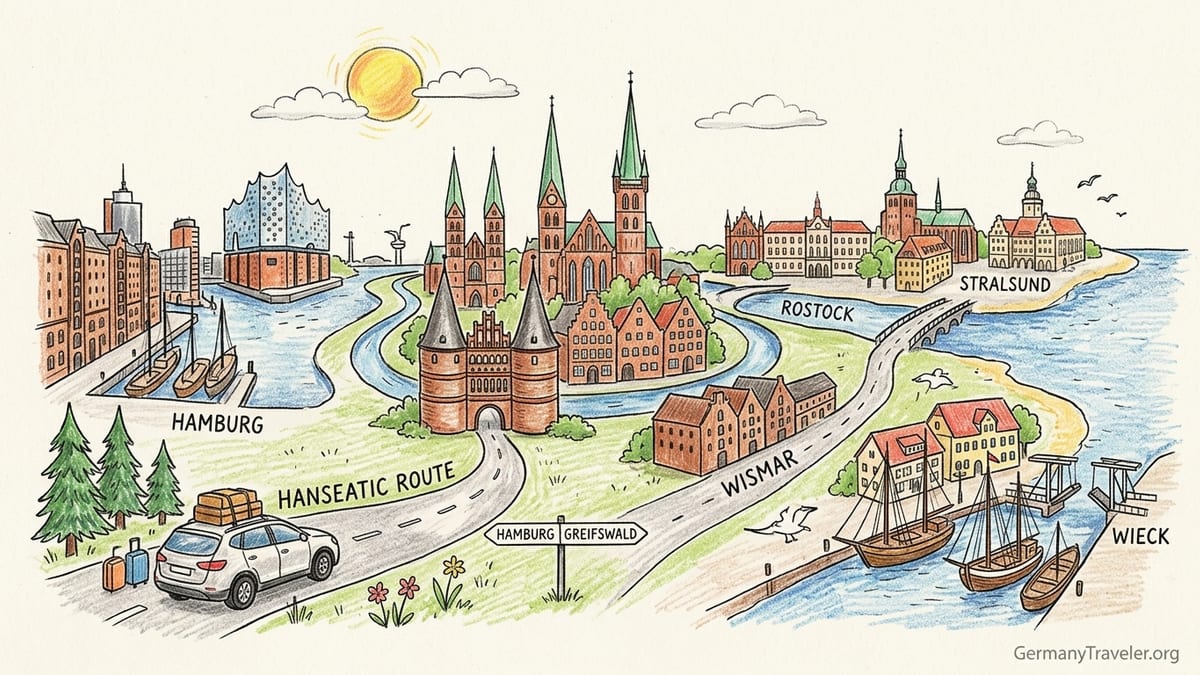
Tracing the merchant power of the Hanseatic League by road along Germany’s Baltic coast is one of northern Europe’s most rewarding short trips. This itinerary links major former trading centers between Hamburg and Greifswald, balancing Hanseatic history with relaxed Baltic sightseeing. It is designed as a practical self-drive route with realistic driving times, parking strategies, and enough time for museums and old town exploration, plus shorter five-day and slower ten-day versions.
Understanding the Hanseatic Focus of This Road Trip
This itinerary connects major Hanseatic cities, but it does not attempt to recreate any medieval shipping or overland trading route. Instead, it follows today’s road network in an efficient eastbound arc from Hamburg to Greifswald, with an optional initial detour to Lüneburg. What unites the stops is their shared history as trading centers of the Hanseatic League, reflected in brick Gothic churches, gabled warehouses, merchant courtyards and reconstructed harbors.
It is important to keep the Hanseatic storyline distinct from general Baltic sightseeing. Places like Lübeck’s European Hansemuseum, Stralsund’s Old Market and Greifswald’s museum harbor directly interpret Hanseatic trade, while beach time in Warnemünde or a sunset walk along Wismar’s waterfront are more about contemporary Baltic leisure. A good trip balances both, but this plan always identifies which stops primarily serve the historical purpose.
Road travel is the backbone of this trip. The core seven-day version focuses on one-night or two-night bases in Hamburg, Lübeck and Stralsund or Greifswald, with drive segments rarely longer than two hours. Where useful, train alternatives are mentioned, especially for travelers uncomfortable with city driving or high parking costs in historic centers. All driving times are approximate and based on normal traffic under current conditions in 2026.
While this is a compact slice of northern Germany, the route crosses several federal states and passes through areas of low population density, especially east of Rostock. Booking accommodation with on-site parking, checking closing times of key museums one or two days ahead, and watching local fuel prices are all part of making the logistics run smoothly.
Core 7-Day Hanseatic Road Trip: Hamburg to Greifswald
Day 1 begins in Hamburg, which was a leading Hanseatic city but is also a large modern port. Focus today on the historic Speicherstadt warehouse district and the brick office blocks of the Kontorhausviertel to anchor the Hanseatic theme, then add a late-afternoon wander around the Elbphilharmonie area for contemporary harbor views. For most travelers, staying near the central station (Hauptbahnhof) or in the Speicherstadt/Altstadt area works well because you can leave the car in a hotel garage and explore on foot; typical inner-city hotel parking in 2026 is often around 20 to 30 euros per night.
Day 2 covers Hamburg to Lübeck, roughly 70 kilometers by the A1 motorway, usually about one hour of driving in light traffic. Plan a relaxed morning departure and park in one of the edge-of-center car parks such as those near Holstentor or at larger multi-storey garages just outside the medieval core, where day rates are often around 10 to 15 euros. This keeps you close enough to walk into the old town but avoids narrow inner streets with limited spaces. Use the rest of the day for a first orientation in Lübeck and an evening stroll along the Trave River.
Day 3 is a full Lübeck day, because this city deserves at least one overnight stay and ideally two nights for serious Hanseatic travelers. Day 4 then runs Lübeck to Wismar with an optional detour along the coast, followed by Wismar to Rostock on the same afternoon or after a morning in Wismar. The 60 to 70 kilometer stretches between these cities usually mean 1 to 1.5 hours of road time. Day 5 spends more time in Rostock, clearly separating the historic center from the seaside district of Warnemünde, which today is better known for its beach and cruise port than in its Hanseatic heyday.
Day 6 brings you east from Rostock to Stralsund, about 120 kilometers and roughly 1.5 to 2 hours of driving along the A20 and feeder roads, leaving enough time for the Old Market, the harbor and short walks on the remaining fortifications. Day 7 finishes in Greifswald, less than 40 kilometers and around 40 minutes by road from Stralsund, so you can spend the morning finishing Stralsund and still have several afternoon hours at Greifswald’s museum harbor and in the village-like quarter of Wieck before staying the night.
Lüneburg Optional Detour and Alternative Five-Day Version
Lüneburg lies southeast of Hamburg and was historically a major salt trading center within the Hanseatic network. It is not on the direct route to the Baltic ports, but its dense brick architecture and compact old town make it an attractive optional first stop. The drive from Hamburg to Lüneburg is around 55 kilometers, often 45 to 60 minutes via the A39, and there are several edge-of-center car parks where day tickets usually cost under 15 euros. Staying one night in Lüneburg allows for exploration of the old salt quarter and the historic harbor on the Ilmenau River before returning to Hamburg or continuing north towards Lübeck.
If your total holiday time is limited, the five-day version of this trip sacrifices depth in each city but preserves the historical thread. Start with one night in Hamburg, devoting the afternoon and evening to Speicherstadt and the nearby maritime heritage. On Day 2, drive to Lübeck in the morning and dedicate the afternoon to Holstentor and the European Hansemuseum, staying overnight in Lübeck so you can explore the Gänge und Höfe courtyards early the next day when they are quiet.
Day 3 of the five-day version compresses Wismar and Rostock into a single long day. Leave Lübeck after breakfast, spend three to four hours focusing on Wismar’s Hanseatic highlights, then continue on to Rostock for a late-afternoon walk in the old town and a quick evening visit to Warnemünde if daylight allows. You would then overnight in Rostock or at an airport-style hotel on the outskirts to simplify parking and next-day departure. Parking at large shopping-center garages or park-and-ride lots in Rostock often remains under 10 euros per day in 2026.
On Day 4, travel from Rostock to Stralsund, using the afternoon for the Old Market and harbor district. Day 5 finishes in Greifswald with a focus on the museum harbor, Wieck and the university quarter. This short version works best for travelers using trains for long intercity jumps and renting a car only for specific days, or for those continuing by train from Greifswald towards Berlin or Poland.
Slow Ten-Day Hanseatic Route with Extra Baltic Time
The ten-day version allows for two-night stays in key cities and more relaxed Baltic sightseeing without losing the Hanseatic storyline. Days 1 and 2 remain in Hamburg, but now you can add a harbor boat tour, which puts the modern container port in context with historic trade. Staying near the Landungsbrücken or in the Portuguese Quarter combines good public transport with walkable evening dining. Many mid-range hotels here charge parking between 20 and 30 euros per night, so consider leaving the car in a park-and-ride lot if you are comfortable with the S-Bahn network.
Day 3 becomes the Hamburg to Lüneburg detour, with an overnight in Lüneburg. This is where you lean into the salt-trade heritage: the German Salt Museum, the historic crane on the old harbor and the narrow merchant streets south of the main square. Driving is straightforward, and because Lüneburg’s center is smaller than Hamburg’s, you may find central hotels with parking included or at lower daily rates than in the big city.
From Day 4 to Day 6, base yourself in Lübeck for three nights. One full day is given over to the core Hanseatic elements such as Holstentor, the European Hansemuseum and the labyrinth of Gänge und Höfe, while another day can be spent exploring nearby Travemünde for beach time or taking a side trip to smaller former Hanseatic towns like Ratzeburg or Bad Schwartau by car. A third day offers flexibility for additional museums, church towers, or a rest morning in one of Lübeck’s cafes. With a longer stay, renting an apartment or guesthouse within walking distance of the old town can be economical, though you should budget around 10 to 15 euros per day for residential-street parking permits or public lots just outside the center.
Days 7 and 8 break the journey between Lübeck and Stralsund by inserting leisurely overnights in both Wismar and Rostock. That allows a full afternoon and evening in Wismar, plus a relaxed morning for coffee on the market square before leaving. In Rostock you gain enough time to see both the historic center and Warnemünde without feeling rushed. Day 9 and 10 are then shared between Stralsund and Greifswald, with two nights that you can allocate according to preference. History-minded travelers might spend two nights in Stralsund and visit Greifswald on a day trip, while those drawn to university-town atmosphere and quieter evenings may prefer to base in Greifswald instead.
Lübeck, Wismar, Rostock, Stralsund and Greifswald in Detail
Lübeck is the intellectual and symbolic heart of this route. For the Hanseatic story, three elements should be non-negotiable. First, the Holstentor city gate, one of the most famous symbols of Lübeck, offers both external photo opportunities and an interior museum. Plan at least one hour here, and note that morning or early evening visits help avoid mid-day coach groups. Second, the European Hansemuseum on the Trave waterfront provides a modern, immersive explanation of the Hanseatic League; you will want two to three hours inside, and current adult admission in 2026 is commonly in the mid-teens of euros. Third, the Gänge und Höfe system of narrow alleys and courtyards reveals how merchants and poorer residents lived behind the main facades; take an hour simply to wander several signposted courtyards just off the main streets.
Wismar’s Hanseatic core sits tightly around its old harbor and large market square. Once you park near the port area or in a central garage, concentrate first on the old harbor with its restored warehouses and small boats. Then cross into the market square dominated by the Wasserkunst waterworks structure. St George’s Church, heavily damaged in the Second World War and later reconstructed, showcases the monumental scale of Baltic brick Gothic. One long afternoon is usually enough for these main sights along with a sit-down meal, so Wismar may be a several-hours stop in the seven-day version and an overnight in the ten-day version.
Rostock requires travelers to consciously distinguish between the inland historic center and the separate seaside district of Warnemünde. From a Hanseatic perspective, the old town with its university buildings, town hall and city walls holds the real interest. Driving into the center and using one of the large multi-storey car parks near the Kröpeliner Tor area makes it easy to walk the main pedestrian street. Later you can drive, take a suburban train, or use a local tram-and-bus combination out to Warnemünde for beach and lighthouse views. If time is short, prioritize at least three to four hours in the old town before treating Warnemünde as bonus Baltic sightseeing.
Stralsund is another highlight for Hanseatic enthusiasts. Its Old Market is framed by the richly decorated town hall and several brick churches, and the compact size of the historic center makes walking simple. Elements of the old fortifications, such as preserved gates or wall segments, can be seen on short loops from the market. The harbor, opposite the Rügen Island bridge, mixes ferry services, museum ships and waterfront promenades. Parking possibilities include harbor-front lots, where day prices in recent years have often been in the lower tens of euros. Greifswald, further east, has a quieter charm with its university squares, museum harbor lined with historic ships, and the fishing village atmosphere of Wieck, where a wooden bascule bridge crosses the Ryck River. A half-day is enough to see the key Hanseatic sights, but staying overnight adds the pleasure of evening walks in an uncrowded old town.
Driving Logistics, Parking Strategy and Train Alternatives
The road network between these cities is modern and usually straightforward. The A1 connects Hamburg and Lübeck, while the A20 runs parallel to the Baltic coast between Lübeck, Wismar, Rostock and Stralsund. Greifswald lies a short distance off the A20 on secondary roads. Distances are modest: Hamburg to Lübeck about 70 kilometers, Lübeck to Wismar approximately 60 to 70 kilometers, Wismar to Rostock around 60 kilometers, Rostock to Stralsund roughly 120 kilometers and Stralsund to Greifswald under 40 kilometers. Actual driving time depends on traffic but often ranges from 45 minutes to 2 hours for each segment.
Parking is one of the main practical concerns on this trip, especially in UNESCO-listed old towns with narrow streets. A consistent strategy is to use edge-of-center car parks and walk into the core. Many cities operate park-and-ride systems where you can leave the car at an outer lot for a few euros per day and continue by tram or bus into the center. In 2026, all-day parking in central multi-storey garages in these cities typically runs between about 8 and 20 euros. Some hotels include parking in the room rate or offer it at a reduced fee, which can be a deciding factor when choosing accommodation.
Travelers who prefer trains can still follow the Hanseatic arc, since Hamburg, Lübeck, Wismar, Rostock, Stralsund and Greifswald are all connected to regional and intercity rail services. For example, trains between Hamburg and Lübeck often run at least hourly, with journey times around 45 minutes. Regional trains link Lübeck and Wismar, while Rostock, Stralsund and Greifswald are part of the east-coast line that continues towards Usedom and Poland. A hybrid strategy is to use trains for the main leaps between cities and rent a car locally for one or two days to reach outlying sights. Be aware that some smaller car rental branches close early on weekends, so advance booking and checking pick-up hours is important.
Driving in these regions is generally straightforward for visitors, but speed limits can change quickly near villages and construction zones. Fuel stations are plentiful near motorways and major junctions but thinner immediately along rural coast sections. Using well-known brand chains and paying by card remains standard practice. To keep the trip relaxed, avoid planning more than one major museum and one city-to-city drive on the same day, especially if you also want to enjoy evening walks or restaurant dinners without rushing.
Budgeting the Trip and Choosing Where to Sleep
Budget planning for this road trip depends on hotel category, car type and how many museums you include. A mid-range estimate for two people traveling in 2026 with a compact rental car might include around 60 to 100 euros per night for accommodation in smaller cities such as Wismar, Rostock or Greifswald, and somewhat higher rates in Hamburg and Lübeck, where central hotels can easily run into the low or mid hundreds of euros per night during busy months. Parking often adds 10 to 25 euros per night in city centers. Car rental prices vary widely, but a compact car hired for a week commonly falls in the few-hundred-euro range, not including fuel.
For museums and attractions directly tied to the Hanseatic theme, such as the European Hansemuseum in Lübeck, many travelers should expect to spend several tens of euros on entry fees over the entire route. Additional costs include local public transport tickets if you choose to park outside centers and ride in, harbor boat tours in Hamburg or Stralsund, and optional activities like church tower climbs. Restaurant prices in these cities are not as high as in some major European capitals, but dinner in a mid-range place with drinks can easily reach several tens of euros for two people.
Choosing overnight bases affects both cost and experience. Hamburg and Lübeck clearly justify stays of at least one night, and in the ten-day version two or three nights. Stralsund or Greifswald also repay a full day and evening each, which argues for at least one overnight. On the other hand, Wismar and Rostock can be covered in an extended half-day or one long day if time and budget are tight, though staying overnight in Wismar, in particular, adds the pleasure of seeing the market square and harbor lit up after day-trippers have left.
Apartment-style accommodation with kitchen facilities can save money over a week, especially in Lübeck, Rostock or Greifswald, where there are residential districts within walking distance of the center. When choosing such lodging, check whether on-street parking regulations allow overnight stays and whether a permit is required. In some areas, short-term parking meters switch off at evening hours, making overnight parking free. However, rules vary between cities, so reading local signage or asking hosts for clear instructions is essential to avoid fines.
Advantages and Drawbacks of Exploring the Hanseatic Route by Car
Traveling this Hanseatic arc by car offers several distinct advantages. You can easily stop in smaller towns or viewpoints between the main cities, reach harbor districts that lie slightly outside railway stations, and carry luggage without constantly hauling it through stations and onto trains. The flexibility to adjust your schedule for weather, staying longer on sunny days in harbor areas or beaches like Warnemünde, is also a strong plus. For those interested in photography, driving allows early-morning or late-evening visits to landmarks such as Holstentor or Stralsund’s Old Market without being tied to train timetables.
At the same time, there are clear drawbacks. Parking in historical centers is not only expensive but sometimes stressful, particularly when navigating narrow streets or construction zones. Drivers must remain sober for evening movements, which matters in countries with strict blood-alcohol limits for motorists. Environmental considerations also play a role, since a rental car has a higher carbon footprint than traveling exclusively by train. Finally, some travelers simply find urban driving tiring, especially in a large city like Hamburg, which may make a train-plus-local-car combination more attractive.
Another factor is that several of these cities are very walkable once you arrive. In Lübeck, Wismar, Stralsund and Greifswald, the historic centers are compact, and having a car becomes more of a liability than a benefit inside the old town. Therefore, the most efficient way to combine the advantages of driving with the pleasures of pedestrian exploration is to treat the car mostly as an intercity tool. Park once upon arrival, leave it for 24 hours or longer, and then retrieve it only when moving on to the next base.
For travelers who prefer not to drive, it is entirely possible to design a Hanseatic rail itinerary across the same cities, using taxis or local buses for the last kilometer from station to old town. In some cases, especially between Hamburg, Lübeck and Rostock, trains can be faster than driving during peak traffic hours. However, stitching together museum opening times and seasonal train timetables does require more advance planning than a fully flexible rental car trip.
The Takeaway
This German Hanseatic cities road trip is not a reconstruction of medieval shipping lanes, but a modern, practical route that strings together former Baltic trading centers in a way that makes sense for today’s traveler. Hamburg, Lübeck, Wismar, Rostock, Stralsund and Greifswald each contribute a specific chapter to the story of the Hanseatic League, from major port warehouses to intimate courtyard dwellings.
The seven-day core version offers a concentrated experience for travelers with limited time, while the five-day and ten-day variants show how the route can be compressed or stretched without losing its narrative. Along the way, clear driving distances, realistic road times, parking strategies and train alternatives keep logistics under control so you can focus on the museums, harbor promenades and old town streets that bring history to life.
Choosing where to linger is part of the pleasure. Lübeck and at least one of Stralsund or Greifswald merit overnight stays, while Wismar and Rostock can be either quick highlights or slow-burn overnights depending on your schedule. Whether you travel entirely by car or mix road segments with train journeys, this itinerary provides a solid framework for exploring northern Germany’s Hanseatic heritage with enough flexibility to fit different budgets and travel styles.
FAQ
Q1. Is it better to start the trip in Hamburg or Lübeck?
Starting in Hamburg gives more international flight options and introduces the Hanseatic story at a major port. Lübeck works as a starting point if you are already in Germany or arriving by train from other cities.
Q2. Do I really need a car for this itinerary?
You can reach all the main cities by train, but a car offers more flexibility for timing, side trips and easy access to harbor districts and beaches, at the cost of parking fees and city driving stress.
Q3. How many nights should I spend in Lübeck?
Two nights are ideal for a serious Hanseatic focus, allowing one full day for Holstentor, the European Hansemuseum and the Gänge und Höfe, plus extra time for churches and river walks.
Q4. Can Wismar and Rostock be done as day trips instead of overnights?
Yes, both cities can be visited in several hours each, especially in the seven-day version, but an overnight stay in Wismar or Rostock adds a more relaxed evening atmosphere.
Q5. Is driving and parking difficult in these historic centers?
Driving into old towns can feel tight due to narrow streets and one-way systems, but using edge-of-center car parks and walking in keeps the experience manageable for most drivers.
Q6. Are there good train alternatives if I do not want to drive between every city?
Yes, regional trains connect Hamburg, Lübeck, Wismar, Rostock, Stralsund and Greifswald, and a hybrid approach of trains plus a short-term local car rental works well.
Q7. How much should I budget per day for this trip?
For two people with a mid-range hotel and compact rental car, a rough starting point might be a few hundred euros per day including accommodation, fuel, parking, meals and admissions.
Q8. When is the best season to drive this Hanseatic route?
Late spring to early autumn generally offers the best combination of mild weather, longer daylight and open attractions, although peak summer brings more crowds and higher prices.
Q9. Which city is the best base if I can only choose one overnight stop in the east?
If you must choose a single eastern base, Stralsund works well because it has a strong Hanseatic core and sits within easy driving distance of Greifswald and the Rügen area.
Q10. Is this itinerary suitable for families with children?
Yes, especially the ten-day version, as you can mix museum visits with harbor boat trips, beach time in Warnemünde and relatively short driving segments between cities.