


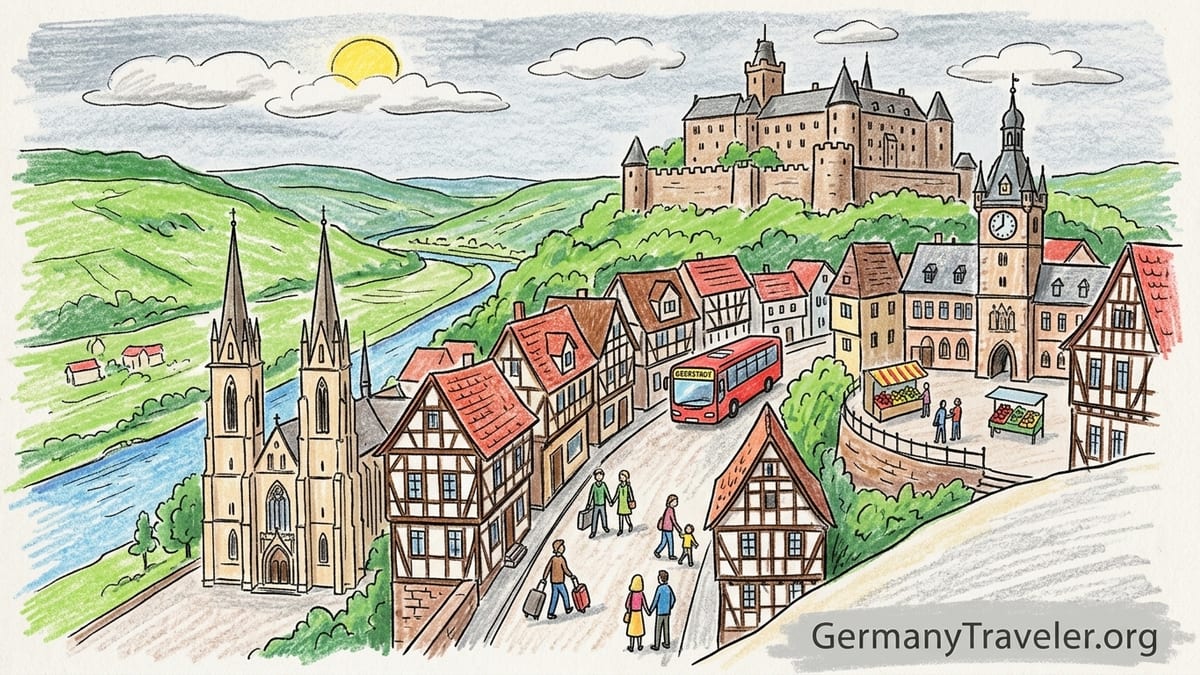
Marburg is not a city you simply stroll through. It is a city you climb. From the moment I stepped out of Marburg (Lahn) station and looked up at the slopes packed with houses, church spires and, high above everything, the Landgrafenschloss on its hilltop, I knew this day would be measured less in kilometers and more in vertical meters. What follows is my honest account of conquering Marburg’s stairways and cobbles in one long walking day, from the station to the Elisabethkirche, up into the Oberstadt and on again to the castle on the Schlossberg.
Arriving in Marburg: First Impressions from the Station
Stepping out of Marburg (Lahn) station on a cool, overcast morning, I turned my back on the platforms and faced what looks, at first, like any medium-sized German city. Buses idle in front of the station, a supermarket sits to one side, and Bahnhofstraße runs straight ahead toward the center. Only when I tilted my head back did Marburg’s true character reveal itself: half-timbered houses perched on the slope, a church tower rising on one side, and, far above, the thick silhouette of the Landgrafenschloss crowning the ridge at around 287 meters above sea level. The entire city seems stacked in layers, and I was about to spend the day climbing through them.
From the station forecourt I could have taken a bus straight into the old town. Local lines 1, 2, 4, 5, 6 and 7 stop right outside and run up Bahnhofstraße toward the center, with a standard single ticket in late 2026 costing about 2.90 euros. I made a mental note of that price for later, in case my legs rebelled on the way back down. For now, though, I wanted to feel the incline beneath my feet, so I set off along Bahnhofstraße, sharing the pavement with students wheeling suitcases and locals heading to work.
The first stretch from the station to the edge of the old town is deceptively gentle. The street passes cafes, fast-food counters and small shops that feed off student life. Marburg’s university, founded in 1527, is everywhere here, not in the form of a single grand campus but as buildings scattered between ordinary streets. As I walked, I passed students huddled around takeaway coffees, swapping lecture gossip in a mix of German and English. Even before I saw any medieval stonework, the academic energy was obvious.
About ten minutes later, Bahnhofstraße bent into Elisabethstraße and the city’s mood changed. Ahead, through a gap in the trees, two slender towers in pale sandstone came into view, drawing my gaze upwards. Marburg’s famous Elisabethkirche was waiting at the end of the street, and I felt the slope steepen slightly as I moved toward it.
Elisabethkirche: Gothic Stone and a Saint’s Story
The Elisabethkirche stands just north of Marburg’s densest old town, close to the Lahn. Up close, the church looks both austere and delicate, built in warm sandstone stone that glows slightly even under thick grey clouds. Construction began in 1235, just two years after the death of Saint Elizabeth of Thuringia, who had founded a hospital in Marburg in 1228 and died here in 1231. Her canonization in the same year that work started turned this into one of the most important pilgrimage sites in medieval Europe, and the church quickly became a model for Gothic architecture in the region.
Architecturally, Elisabethkirche is significant as one of Germany’s earliest purely Gothic churches and an important early example of the hall church form. Instead of a towering nave with small side aisles, its main space rises to almost the same height across all three aisles. Standing inside, this creates a feeling of a single, unified hall of stone rather than a layered hierarchy of spaces. The light filters in through lancet windows and colored glass that pick out the ribs and vaults overhead. I paid a small voluntary donation at the entrance, then fell into a slow loop around the interior, joining a handful of visitors and a couple of students sheltering from the drizzle outside.
In a side chapel, I found the golden shrine associated with Saint Elizabeth, heavily restored across the centuries but still the symbolic core of the church. Panels and information boards, some in English, explained her life as a Hungarian princess, her marriage into the Thuringian landgraves, her widowhood and her decision to devote herself entirely to charity here in Marburg. It was strange to step out again into the traffic of Elisabethstraße and remember that the buses rumbling past now follow routes that once would have been crowded with pilgrims on foot.
Back outside, I circled the church once to appreciate its mass. Around the apse, the view opens a little toward the rest of the city. From here you can already see your next destination: the Oberstadt, or upper town, climbing the hill beyond the Lahn. The way up is neither direct nor gentle. Marburg’s historic center was built in layers along the slope, and moving from the river level of the Elisabethkirche up to the market square and castle means threading through a tangle of streets, lanes and staircases. I zipped my jacket against a light wind, tightened my backpack straps and set off south on Pilgrimstein, following the line of the hillside.
Into the Oberstadt: Climbing Lanes, Stairs and Viewpoints
From the church I walked along Pilgrimstein, then cut across toward Steinweg, one of the classic ascents into the Oberstadt. Here, Marburg’s vertical nature becomes impossible to ignore. Steinweg itself rises in a series of short ramps broken by small landings, flanked by shops whose entrances sit at slightly different heights. It feels almost like a stepped terrace rather than a single street. On one side, a bakery offered Brezeln and still-warm Brötchen for around 1.50 to 2 euros each, while further up a student-filled café advertised cappuccinos at about 3.50 euros. Even in late morning, the pavement was busy: locals pulling shopping trolleys, cyclists walking their bikes rather than trying to ride, and visitors like me pausing often to catch breath and admire the half-timbered houses leaning over the ascent.
As the incline sharpened, I turned into the narrower lanes branching upward: through parts of Wettergasse, then onto Reitgasse, one of the steepest and most atmospheric approaches to the very heart of the Oberstadt. Here the cobblestones loosen underfoot, small steps are cut into the slope, and handrails appear along the walls. Marburg’s tourism office sometimes quotes a 15-minute climb from the Elisabethkirche to the Oberstadt market square, and for a fit walker that is realistic, but it feels longer when the stones are slick with drizzle and your backpack is heavier than it should be.
Reitgasse is also where the modern university city shows itself. At street level, small independent bookshops and stationery stores display textbooks and language guides in their windows. A poster advertising a philosophy lecture is taped to a door, while a flyer for a concert at a student bar flaps in the wind. A group of undergraduates in hoodies crowded outside a café called out greetings across the lane, turning what could be a museum-like old town into something that is still clearly lived in. The rent may be historic, but the conversations are about seminars, part-time jobs and weekend plans.
Halfway up, I paused at a small opening where the buildings fall back and the view opens across the roofs toward the Elisabethkirche’s twin towers. From here, Marburg reveals its stacked nature: church at one level, houses climbing above it, and, in the distance, the castle walls still higher. Photography-minded visitors might recognize this as one of the city’s classic postcard angles, often recommended among Marburg’s top photo spots. I snapped a photo, then pushed on up the last stretch toward the Markt.
Market Square and Town Hall: Life in the Steep Heart of Town
The Oberstadt’s market square arrives almost abruptly after the climb, like stepping into a bowl scooped out of the hillside. On three sides, tall, half-timbered houses lean over the cobbles; on the fourth sits the late-Gothic town hall, a striking sandstone building whose main block was constructed between 1512 and 1527. Its steep roof, dormers and clock tower dominate the small square, creating a surprisingly grand focal point for such a compact space.
It was close to lunchtime by now, and the square had come alive. A vegetable van sold apples and local produce from the back of a truck, while a flower stall brightened a corner with buckets of tulips and chrysanthemums. Tour groups in rain jackets clustered near the town hall steps, listening to guides explain how the building once anchored civic life in this small Hessian city. Marburg’s market square is more than a postcard. It remains a working meeting point and, crucially for this walking day, an ideal place to refuel.
I ducked into a café just off the square, where a blackboard outside advertised a lunch menu with a large bowl of potato soup for 7.50 euros and coffee from around 3 euros. I ordered a simple combination: a filter coffee, which appeared in a thick white mug for 3.20 euros, and a slice of Apfelkuchen for 4.20 euros. The staff moved briskly between tables filled mostly with students and a few older locals, laptops open and lecture scripts spread out alongside plates and cups. I overheard discussions of exams, module registrations and weekend shifts in part-time jobs. Many visitors describe Marburg as a “fairytale town” because of its steep half-timbered streets, but sitting there amid open laptops and half-finished essays, it felt firmly anchored in contemporary student reality.
After lunch I stepped back onto the cobbles and took a slow lap around the Markt to look at the town hall more closely. The stonework still bears rich sculptural details, and the clock on the façade pulls eyes upward, emphasizing yet again that everything in Marburg seems to lead above. Behind the town hall, narrow lanes like Schuhmarkt and Kugelgasse snake deeper into the Oberstadt, each one either climbing or dipping, rarely level. Turning in any direction, you realize how complicated this topography must be for anyone pushing a pram or managing limited mobility.
Climbing to the Landgrafenschloss: Steep Paths and History
From the market square, the final climb to the Landgrafenschloss begins. Several routes thread upwards. I followed a classic combination: first along Ritterstraße and then into the narrower Landgraf-Philipp-Straße, which quickly tilts toward the Schlossberg. Here the pavement gives way to tighter cobbles, and short sections of steps cut into the lane mark the steepest parts. A signpost confirmed what my lungs already knew: the castle sits high above the old town, and the ascent from the Markt, while not long in distance, is intense in gradient.
Along the way, I passed bursts of student life that made it clear the castle district is not purely historical. A small bar advertised a poetry slam later in the week. Posters on a noticeboard near a gateway promoted everything from environmental groups to choirs. Between the houses, glimpses of the valley opened in stages, rewarding the effort. At one bend, a view over the red roofs of the Oberstadt framed the twin towers of the Elisabethkirche, now far below. A local walking a dog, leaning momentarily on the handrail, caught my eye and joked that in Marburg “you pay for the view with your knees.” I could not disagree.
The final approach to the castle takes you either along the curved access road or up the Ludwig-Bickell-Stufen, a staircase that rises sharply to the south gate. I opted for the stairs, counting them in my head until I lost track somewhere above fifty. The stones were slightly wet, slick with a fine mist, and I was glad of the metal rail. Travelers here in autumn and winter, when rain is common, should be prepared for slippery surfaces. Good soles and a steady pace matter more than usual in this city. Eventually the stairway spat me out by the castle walls, solid and pale against a low sky.
Inside the courtyard, the Landgrafenschloss feels part fortress, part residence. The earliest fortifications on this hill date back to at least the 11th and 12th centuries, but the structure visible today grew largely under the landgraves of Hesse, especially in the 13th to 16th centuries. It was not only a symbol of their power but also a stage for major historical events. In 1529, the castle hosted the Marburg Colloquy, a famous religious disputation where Martin Luther, Philipp Melanchthon, Huldrych Zwingli and other reformers debated core questions of Protestant belief. Standing in the courtyard with the wind tugging lightly at my jacket, it was striking to think of such theological and political stakes being argued within these walls overlooking a then much smaller town.
Above the City: Views from Schlossberg versus Streets Below
Walking to the edge of the castle terrace, I looked out over Marburg and finally understood the city’s vertical structure in a single glance. Directly below, the compact Oberstadt wrapped itself around the hill like a crescent, all half-timbered facades and red-tiled roofs. Beyond it, the Elisabethkirche’s twin towers rose from the lower level near the Lahn, clear and pale even in flat light. Further still, the station area and newer neighborhoods stretched along the river, flatter and less picturesque but undeniably part of the same urban organism.
From this vantage point, the path I had taken that morning traced itself in reverse. I could follow the line from the station to the church, up Pilgrimstein, into the winding routes of Steinweg and Reitgasse, then to the Markt and finally here. The climb that had felt fragmented when lived as a sequence of streets now made coherent sense as a stacked city. Marburg is essentially a vertical corridor, with the Lahn as its base and the Schlossberg as its crest.
Compared with the busy, almost crowded feeling of the lanes below, the atmosphere up here on the Schlossberg was spacious and calm. A small group of schoolchildren listened to their teacher explain the significance of the Marburg Colloquy. A couple leaned on the parapet taking photos, careful to keep smartphones away from the drop. There is a small museum in parts of the castle, but I chose to stay outdoors, walking the paths that ring the hilltop. On a clearer day, the view extends deep into the surrounding hills and countryside. Even under clouds the panorama was rewarding, and worth every slippery cobble on the way up.
From the castle park, narrow paths lead through patches of woodland and back down toward the Oberstadt. I descended cautiously, feeling the strain in my calves. It became clear that the steepness that provides such stunning views from above is precisely what makes daily life here physically demanding. Imagining this route in ice or snow, it is not hard to see why locals talk about the city’s stairways with a mix of affection and exasperation.
Marburg as a Living University Town, Not a Museum
Back in the Oberstadt, I let myself wander without a strict route, zigzagging between Kugelgasse, Barfüßerstraße and Untergasse. This is where Marburg’s university character becomes most tangible. In shop windows, secondhand bookshops offer worn copies of sociology readers and linguistics textbooks, while nearby cafés attach power strips to every wall and advertise student discounts. One small place on Barfüßerstraße had a chalkboard listing a student lunch deal: a plate of pasta and a soft drink for around 9.50 euros, available on weekdays until 3 p.m. Inside, nearly everyone was under thirty, shoulders hunched over lecture notes.
On another corner, a music bar advertised live jazz nights and open mic sessions. Down a side lane, a vegetarian bistro served falafel bowls and soups around the 12 to 15 euro mark. In the late afternoon, as the rain finally broke into pale sunshine, the pavements filled with students drifting between seminars, errands and coffee dates. Marburg may have the silhouette of a medieval storybook town, but the soundtrack is contemporary and academic: fragments of English, Spanish and Arabic mingling with German as international students navigate their adopted city.
I took a second coffee at a small café on Reitgasse, this time an espresso for around 2.50 euros, and listened to a pair of students at the next table argue politely over a philosophy essay, referencing Kant and Foucault as casually as the weather. Outside, the constant movement up and down the steep lane continued: a parent coaxing a pram up a short staircase with obvious effort, an older man planting his feet carefully on the cobbles, and a student racing downhill perhaps a little too fast. The stairs and slopes that charm visitors also impose daily, unavoidable workout routines on residents.
These details prevent Marburg from slipping into the category of “beautiful but static.” Unlike some old towns that feel preserved only for tourism, the Oberstadt here still houses people, lectures and late-night bars. The university’s presence is not a footnote; it is the city’s pulse. Even with sore legs, I felt energized by the youthful pace around me.
Dealing with Steepness and Finding Easier Routes
By mid-afternoon my enthusiasm was intact, but my knees were less sure. This is the moment when Marburg’s vertical layout can turn from charming to challenging, especially in wet weather. The combination of steep lanes like Reitgasse, stepped approaches such as the Ludwig-Bickell-Stufen and smooth cobblestones means that anyone with limited mobility, balance issues or a stroller will face genuine obstacles. This is not just a matter of mild inconvenience. Some of the key connections between lower and upper town cannot be negotiated easily without climbing or descending multiple staircases.
For visitors who want to experience the Oberstadt and castle with less strain, there are a few practical options. From the station or the Elisabethkirche area, the most straightforward help comes from the city buses that run up to stops near the Oberstadt edge and the Rudolphsplatz/Biegenstraße area. From there, you can access an upper-town elevator system that links lower streets with higher levels, easing the climb to certain parts of the center. Journeys within the central zone usually cost the same as the station fare, around 2.90 euros for a single trip as of late 2026. Buying a day ticket can make sense if you plan multiple bus hops rather than walking everything.
Another welcome option in recent years is the Schlossbahn, a seasonal small train service that connects the lower town near the Elisabethkirche and old botanical garden area with the castle or its vicinity. It does not eliminate every steep step, but it significantly reduces the vertical distance you must climb under your own power. Exact schedules and fares vary by season, but expecting a modest few euros per ride is reasonable. For travelers with small children or limited mobility, planning to use the Schlossbahn uphill and then walking down at your own pace can make the day more enjoyable.
Even with these aids, some parts of the Oberstadt and the castle remain challenging or impossible for wheelchairs and prams, particularly narrow stairways and sharply tilted alleys. If mobility is a concern, it can be wise to focus on the more accessible sections around Elisabethkirche, the riverfront and the lower parts of the center, then supplement with selective excursions upward by bus, lift or Schlossbahn rather than attempting every classic staircase on foot. Marburg’s romance is real, but so is its gradient.
The Takeaway
By the time I made my way back toward the station in the early evening, the city’s lights were coming on one terrace at a time. The day had been short on flat ground but rich in vertical impressions. I had walked from the relatively level surroundings of Marburg (Lahn) station to the Gothic sanctuary of the Elisabethkirche, climbed through the layered lanes of Steinweg and Reitgasse, caught my breath in the market square under the late-Gothic town hall, and pushed on up to the Landgrafenschloss at nearly 287 meters above sea level, where the entire city lay stacked beneath me.
Throughout, what kept Marburg from feeling like a museum was the steady presence of student life. Cafés full of open laptops, bookshops selling academic texts, posters for lectures and concerts and the hum of multiple languages turned the historic setting into a liveable, lived-in city. My modest spending for the day, excluding train fares, came to roughly 25 to 30 euros: two coffees for a total of around 5.70 euros, cake for 4.20 euros, a simple lunch under 10 euros, and a few extra euros for donations and small snacks. You could easily spend more with a sit-down dinner, but it is also possible to keep costs relatively low by leaning into the city’s student-oriented options.
As for whether Marburg deserves a dedicated day trip from Frankfurt, my answer is yes, provided you are prepared for the climbs. Direct regional trains connect Frankfurt (Main) Hauptbahnhof and Frankfurt Airport to Marburg in roughly one to one and a half hours, making a full day here very feasible. Arrive by mid-morning, follow a route similar to mine from station to Elisabethkirche, then up into the Oberstadt and on to the castle, and you will have experienced the essential vertical choreography that defines the city. If you fall in love with the atmosphere or want to explore surrounding nature, a longer stay of one or two nights gives you time for side trips to viewpoints and quieter neighborhoods.
What sets Marburg apart from other pretty German towns is not only its half-timbered charm, but the way height shapes every moment. You are always either climbing toward a new vantage point or descending back into the shelter of the streets. It is a city that demands something of your legs and rewards your effort with layered history and far-reaching views. If that sounds like a fair trade, then Marburg is more than worth the journey from Frankfurt, and its stairways may stay with you long after your calves have forgiven you.
FAQ
Q1. Is Marburg manageable for visitors with limited mobility?
Marburg’s core sights sit on steep slopes with many stairways and uneven cobbles, so complete step-free access is difficult. Buses, hillside lifts and the Schlossbahn help reduce climbing, but some parts of the Oberstadt and the castle remain challenging or unreachable for wheelchairs and prams.
Q2. How long does it take to walk from Marburg station to the Elisabethkirche?
At a relaxed pace, the walk from Marburg (Lahn) station along Bahnhofstraße and Elisabethstraße to the Elisabethkirche typically takes around 10 to 15 minutes, mostly on gentle gradients and good pavements.
Q3. How difficult is the climb from Elisabethkirche to the Oberstadt market square?
The ascent involves several steep, sometimes slippery lanes such as Steinweg and Reitgasse and usually takes around 15 minutes of steady uphill walking. While not long in distance, the gradient and cobbles can make it demanding for anyone not used to hills.
Q4. What makes the Elisabethkirche in Marburg special?
The Elisabethkirche is one of Germany’s earliest purely Gothic churches and an important early hall church, built between 1235 and 1283 over the grave of Saint Elizabeth of Thuringia, whose life of charity made Marburg a major medieval pilgrimage destination.
Q5. Can I visit the Landgrafenschloss without climbing all the way on foot?
Yes, you can reduce climbing by combining city buses, hillside lifts and, in season, the Schlossbahn, a small train service that connects lower areas near the old town with the castle vicinity. Some walking and short stair sections are still usually required at the top.
Q6. How much should I budget for a simple day in Marburg excluding train fares?
For coffee, a light lunch, cake and small extras, a practical budget is around 25 to 35 euros per person. This covers a couple of café stops and a modest meal in student-friendly venues, with room for donations or a small museum visit.
Q7. Is Marburg worth a day trip from Frankfurt?
Yes. With regional trains taking roughly one to one and a half hours, Marburg works very well as a dedicated day trip from Frankfurt, especially if you enjoy walking, historic architecture and university-town energy in a compact, vertical setting.
Q8. When is the best time of year to explore Marburg on foot?
Spring and early autumn offer comfortable temperatures and generally safer footing on the city’s cobbles and stairs. Winter and wet days can be atmospheric but bring slippery surfaces, so appropriate shoes and extra care are important.
Q9. Are there good food options for budget-conscious travelers?
Yes. Because Marburg is a major university town, many cafés and small restaurants offer affordable dishes, student lunch specials and reasonably priced coffee, making it possible to eat well without spending heavily.
Q10. How much time should I plan to visit both the Oberstadt and the castle?
To walk from the station to Elisabethkirche, climb through the Oberstadt, visit the market square and reach the castle with time for views and a café break, plan on at least five to six hours. A full day allows for a more relaxed pace and extra stops.