


If you are planning a first or repeat trip to the German Alps, choosing the right base matters more than almost anything else. Distances look short on the map, but winding mountain roads, limited parking and seasonal crowds can turn a simple day trip into a full-day expedition. The good news is that a handful of towns work exceptionally well as hubs. This guide compares Garmisch-Partenkirchen, Grainau, Berchtesgaden and Schönau am Königssee, Füssen, Mittenwald, Oberstdorf and Tegernsee, with a focus on how they work in real life: train connections, where you actually park, how easy the hikes and ski areas are to reach, rough hotel price levels and whether you really need a car.
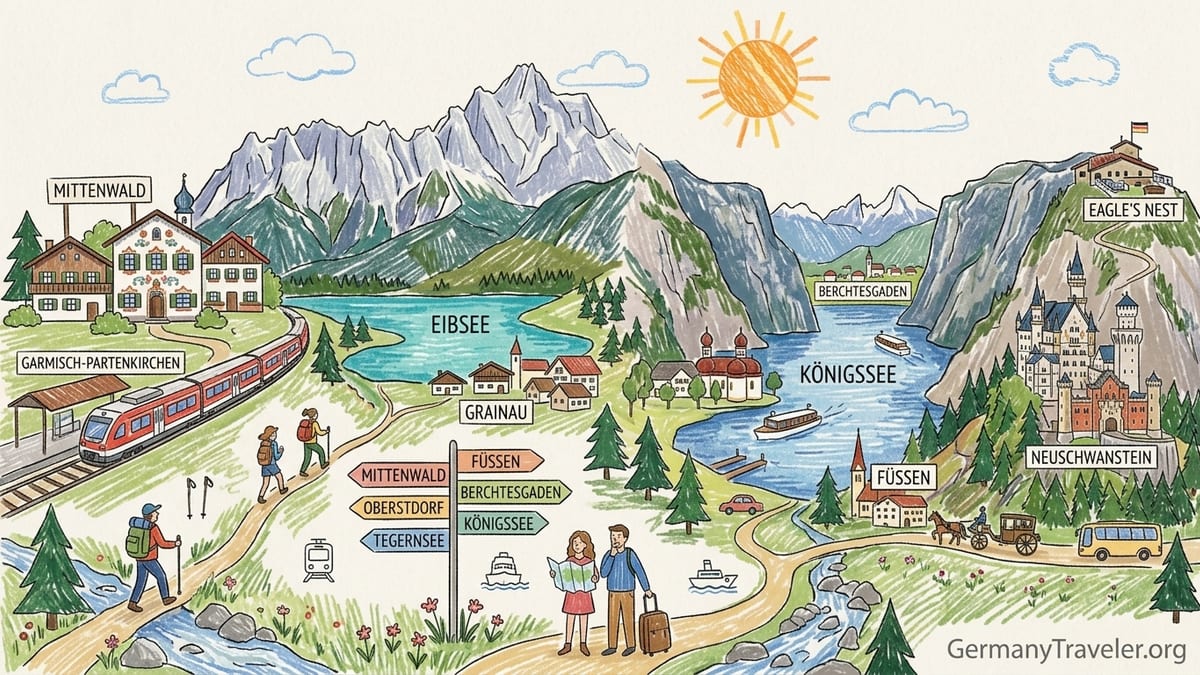
How to Choose Your Base in the German Alps
All of the destinations in this article sit within a broad arc of the Bavarian and Allgäu Alps, yet each feels different on the ground. For a first trip focused on big-ticket sights like Zugspitze and classic Alpine scenery, Garmisch-Partenkirchen usually makes the best all-round base. It has a major train station with direct regional trains from Munich, frequent buses and the cog railway toward Zugspitze, so it works well even if you do not want to rent a car.
If your priorities are more specific, other bases start to make sense. Grainau is a quiet village directly below Zugspitze and on the shore of Eibsee. Berchtesgaden and neighboring Schönau am Königssee are better if you want dramatic fjord-like lake scenery and easy access to Königssee and the Eagle’s Nest. Füssen is ideal if seeing Neuschwanstein and Hohenschwangau castles is the focus and you are happy to combine that with lakeside walks instead of serious mountain hiking.
Mittenwald, Oberstdorf and Tegernsee work well for travelers who care less about headline castles and more about atmosphere and outdoor time. Mittenwald feels like a picture-book small mountain town on the train line between Munich and Innsbruck. Oberstdorf, at Germany’s southern tip, is a true outdoor sports hub with extensive hiking and skiing terrain. Tegernsee and the villages around its lakeshore suit those who want a more upscale lake-and-spa stay, with stylish hotels and day hikes rather than big alpine ascents.
When comparing these bases, think about how often you want to move. Because train lines radiate from Munich rather than connecting Alpine valleys efficiently, it often makes sense to pick one or two bases for a week rather than try to day trip everywhere from a single town. For example, a one-week trip could combine three nights in Garmisch-Partenkirchen with three nights in Berchtesgaden, or pair Füssen for the castles with Tegernsee for lakeside downtime.
Garmisch-Partenkirchen: The Classic First Base and Gateway to Zugspitze
Garmisch-Partenkirchen is usually the easiest serious mountain base to reach from Munich. Direct regional trains run from Munich Hauptbahnhof to Garmisch-Partenkirchen station in about 1 hour 20 minutes, and the same station is the hub for onward trains toward Mittenwald and Innsbruck, as well as the Bavarian Zugspitze Railway that climbs toward Germany’s highest peak. For many visitors, that combination of good access and big mountain scenery makes Garmisch the obvious first choice.
Once in town, you can reach most highlights without a car. The cogwheel train to Zugspitze starts in Garmisch and stops in Grainau and at Eibsee on its way up to the Zugspitzplatt. From Eibsee, a modern cable car rises to the summit. In practice, many travelers ride the cog train up from Garmisch and descend by cable car to Eibsee, then stroll a short distance back to the train for the ride down. The same local trains and buses connect you to the Garmisch-Classic ski area above Hausberg and Alpspitze, and to trailheads like Partnach Gorge.
Hotel prices in Garmisch-Partenkirchen reflect its popularity but still cover a wide range. Simple guesthouses and holiday apartments on the Partenkirchen side of town can start around what most travelers consider lower midrange rates per night for a double room in high season, while classic four star hotels with pools and mountain views can be three or four times that. In winter and around Christmas markets, demand spikes, and you may find that central parking garages are busy by late morning on weekends. If you stay in the center, you can usually walk to dinner at traditional Bavarian restaurants near Ludwigstrasse or around the Kurpark and avoid driving entirely on some days.
Garmisch works best without a car if your plans are focused on local hikes, cog railways and cable cars. You can walk or bus to Partnach Gorge, take the train to Mittenwald for a day of valley walks, or ride regional trains to Munich for a city day. A car becomes more useful if you want to drive over passes into Austria, visit places like Ettal Abbey or Linderhof Palace on your own schedule, or if you are traveling with bulky ski equipment and prefer the flexibility of a trunk rather than the train.
Grainau and Eibsee: Quiet Alternative at the Foot of Zugspitze
Grainau is technically a separate village from Garmisch-Partenkirchen, though in practice it feels like part of the same valley. It lies a few minutes further up toward the mountains, directly on the route of the Bavarian Zugspitze cog railway and on local bus lines. Travelers who want early-morning access to Eibsee and Zugspitze, or a quieter stay surrounded by forest and meadow, often choose Grainau instead of Garmisch itself.
The main practical advantage of Grainau is proximity. From many guesthouses you can walk to a Zugspitzbahn stop, ride the short hop to Eibsee, and be on one of the first cable cars of the day, which matters in peak summer when midday queues can lengthen. The lakeside walking path around Eibsee is one of the most photographed in Germany, so staying nearby means you can enjoy the mirror-calm water early in the morning or close to sunset, when most day trippers have already left.
Accommodation in Grainau skews to smaller hotels, guesthouses and holiday apartments. You will find fewer large spa hotels than in Garmisch, but plenty of midrange places with balconies and mountain views. Prices are often slightly lower than in Garmisch for equivalent quality, especially outside school holidays, though lakeside hotels near Eibsee itself can be priced at a premium due to the setting. Dining is more limited than in Garmisch, with a handful of village restaurants and hotel eateries, so serious foodies may prefer to base in Garmisch and come up to Eibsee for the day.
Grainau can work well without a car, since the cogwheel train and local buses connect you to Garmisch and on to Munich. That said, if you plan to explore beyond Zugspitze and Eibsee, such as driving to nearby Austrian valleys or to lesser-known trailheads above the Loisach Valley, having a car in Grainau gives you far more flexibility. Parking at the lake itself is in high demand on fine summer weekends, so even with a car it pays to arrive early or rely on the train.
Berchtesgaden and Schönau am Königssee: Alpine Drama and Lakeside Scenery
On the far southeastern edge of Germany, the Berchtesgaden region feels more remote from Munich on the map than it actually is in practice. Trains from Munich usually require a change, often in Freilassing, and take roughly 2.5 to 3 hours to reach Berchtesgaden station, where buses fan out to Königssee, Ramsau and the Eagle’s Nest access point. For travelers who prefer mountain lakes and national park trails over castles, Berchtesgaden and neighboring Schönau am Königssee often rival Garmisch as a favorite base.
Schönau am Königssee is the village at the head of the valley, directly beside the boat dock on Königssee. If your image of the German Alps is a narrow emerald lake flanked by vertical cliffs and onion-domed chapels, this is likely where you are thinking of. Taking the electric boats along Königssee is a highlight in almost any weather, and several hikes begin at or near the lakeshore, including trails to viewpoints over the water and paths toward Malerwinkel or up side valleys. Buses connect Schönau back down the valley to Berchtesgaden in under 20 minutes.
Accommodation here ranges from simple guesthouses with breakfast to polished spa hotels with indoor pools and saunas. Rates through summer and early autumn are similar to or slightly below those in Garmisch for like-for-like properties. Staying in Schönau puts you near the first boats of the day on Königssee, while Berchtesgaden itself has more restaurants, supermarkets and a traditional town center. Many visitors compromise by staying somewhere near the middle of the valley on a bus line, with easy access in both directions.
You can manage in Berchtesgaden without a car, especially if you are happy to rely on buses and boats. Public transport is set up with visitors in mind, and local guest cards often include free or discounted bus rides within the region. A car becomes more useful if you want to explore beyond the main valley, drive scenic routes across the nearby border into Austria, or reach early trailheads before the first buses. Parking around Königssee can be crowded on sunny weekends, so arriving early or choosing to walk or bus from your accommodation can save time and stress.
Füssen: Best Base for Neuschwanstein and the Royal Castles
Füssen itself sits slightly north of the highest peaks, in the Allgäu foothills, but it is the most practical base for visiting Neuschwanstein and Hohenschwangau castles. Regional trains reach Füssen from Munich with at least one change, usually in Buchloe or Kaufbeuren, and from the station frequent buses continue to Hohenschwangau village, where the castles and ticket center are located. This set up allows travelers to see the famous castles without a car, although journey times from Munich make it feel long for a single day trip.
In Hohenschwangau village you will find several large parking lots for cars and coaches, with posted day rates that are typical for major attractions in Germany. From there, it is not possible to drive up to the castles themselves. Instead, most visitors either walk the steep but manageable road to Neuschwanstein, use the shuttle bus that climbs toward Marienbrücke, or ride a horse-drawn carriage part of the way. Visiting both Hohenschwangau and Neuschwanstein, plus viewpoints and the Museum of the Bavarian Kings, usually takes the better part of a day even if you are staying nearby.
Füssen makes a better base than Hohenschwangau for most travelers because it is a real town rather than a pure resort village. Its compact old town has a hilltop castle, riverfront walks along the Lech and plenty of restaurants, from casual Bavarian inns to pizzerias and simple international options. Accommodation ranges from budget hostels on the edge of the center to guesthouses and midrange hotels in town, and lakeside holiday apartments at nearby Hopfen am See and Weissensee. Prices vary widely depending on season and proximity to the lakes, but in shoulder seasons you can often find midrange doubles at more moderate rates than in the flagship Alpine resorts.
Without a car, Füssen works well for a short stay focused on the castles and local lakes. Buses covered by local guest cards often serve Neuschwanstein, Hohenschwangau and cable cars like Tegelberg, so you can combine culture with easy walks and viewpoints. With a car, your options widen to include short drives along the Romantic Road, trips to Austrian towns just across the border, and access to less crowded trailheads in the Allgäu hills. Parking at the castle lots is regulated by time and fee, so factor that into your day’s timing and budget.
Mittenwald: Small-Town Alpine Charm on the Train Line
Mittenwald lies south of Garmisch-Partenkirchen on the scenic railway toward Innsbruck, and feels distinctly smaller and more traditional than its larger neighbor. Many houses in the center are decorated with Lüftlmalerei, the colorful fresco-style paintings typical of this part of Bavaria, and the backdrop of the Karwendel range gives the town a dramatic mountain wall. Travelers who want a quieter base within easy train reach of Munich and Innsbruck often find Mittenwald appealing.
From Munich, regional trains usually take around two hours to reach Mittenwald, often with a change in Garmisch-Partenkirchen. Once there, you can walk from the station into the compact center, where most hotels and guesthouses are located within a 10 to 15 minute stroll. A cable car rises from the edge of town to the Karwendel area, where high-level hiking trails and panoramic viewing platforms look down over the valley. Lower level walks follow the Isar River or cross to nearby villages.
Accommodation stock in Mittenwald is dominated by small family-run hotels, pensions and apartments. There are fewer large spa properties than in Garmisch or Tegernsee, and price levels tend to be slightly lower outside peak summer and winter calendars, especially if you are willing to stay a few blocks beyond the painted center. Dining options reflect the town’s size but still cover several decent Bavarian restaurants, a few cafes and pastry shops, and simple takeout options.
Mittenwald works very well without a car for travelers focused on local hikes and scenery. You can use the train to day trip to Garmisch-Partenkirchen, Grainau and even across the border to Innsbruck, and rely on local buses for nearby valleys. If you are planning to chase more remote trailheads or hop between overlooked lakes and passes, then a car makes your life easier, but you do not need one for a classic three-night stay built around the cable car, valley walks and the painted old town.
Oberstdorf: Outdoor Hub for Hikers and Skiers
Oberstdorf sits at the southernmost end of Germany, surrounded by higher peaks and long valleys that make it one of the country’s best all-round outdoor bases. Trains from Munich usually involve at least one change, often in Immenstadt, and take around three hours to reach Oberstdorf station. From there, local buses and in some cases walking paths deliver you to gondolas and trailheads serving nearby mountains like Nebelhorn, Fellhorn and Söllereck.
The town itself has the feel of a well-established resort, with a mix of traditional chalets and modern lodges, a pedestrianized center and many shops catering to hikers, skiers and families. In summer, hundreds of kilometers of signposted hiking trails in several altitude bands make it easy to plan anything from a lakeside stroll to a full-day ridge hike. In winter, Oberstdorf links with the Kleinwalsertal area in neighboring Austria to form a sizable ski region, with multiple lifts and runs suited to a range of abilities.
Accommodation options run the full spectrum from simple guest rooms and farm stays near the edge of town to four star spa hotels that market themselves as wellness retreats, with pools, saunas and extensive breakfast spreads. Prices reflect this variety. You can often find modest rooms at lower midrange levels if you book early outside school holidays, while upscale spa hotels in peak ski weeks or mid-August command higher nightly rates. Many properties include a local guest card that offers discounted or seasonal free use of some cable cars and buses, so it is worth checking details when you compare rates.
Oberstdorf works for travelers without a car, particularly if you are comfortable timing your days around bus and lift schedules. The main valleys and gondola bases are well served by public transport, and walking back into town from some lifts is realistic for fit visitors. A car becomes more attractive if you want to explore side valleys at off-peak times, reach parking lots early in peak seasons, or string together day trips to nearby Allgäu villages. As in many Alpine resorts, parking in central Oberstdorf is regulated, so confirm whether your accommodation includes a space.
Tegernsee: Lake-and-Spa Stays Close to Munich
Lake Tegernsee lies south of Munich, framed by modest but pretty mountains and ringed by villages that have long attracted weekenders from the Bavarian capital. For visitors who want a softer Alpine experience built around lakeside walks, spa hotels and easy day hikes rather than big alpine summits, Tegernsee and neighboring villages like Rottach-Egern and Bad Wiessee make appealing bases.
From Munich, regional trains and Bayerische Oberlandbahn services run to stations around the lake, usually with a final leg by short bus or a short walk depending on where you stay. Travel times are often around one hour from Munich Hauptbahnhof to the Tegernsee area, which makes this an easy add-on to a city trip or a gentle landing spot after a long international flight. Once at the lake, local buses and seasonal boat services connect the villages in a loop, allowing you to explore without a car if you choose.
The Tegernsee region is known for its high-end and wellness-focused accommodation. Lakeside spa hotels with indoor-outdoor pools, saunas, and extensive treatment menus are common, and room rates often sit at the upper end of the Bavarian average, especially for direct lake views. There are also midrange hotels and guesthouses a few blocks back from the shore, and self-catering apartments in side streets and neighboring hamlets. As a rule of thumb, if your priority is a luxury spa stay and lakeside sunset views, budget more here than you might for a similar category in a less famous valley.
Because the lake is the main attraction, Tegernsee works particularly well without a car. You can spend days combining lakeside promenades, boat trips, short hikes such as the paths to nearby lookouts, and long lunches at brewery inns and hotel terraces. A car is helpful if you want to use Tegernsee as a base for exploring deeper into the Alps, driving to trailheads outside the main valley or connecting it with places like Garmisch-Partenkirchen or Füssen in a wider road trip.
Do You Need a Car in the German Alps?
One of the most common planning questions for the German Alps is whether to rent a car. The honest answer is that you can visit all of the bases in this article without driving, but your experience will feel different. If you focus on Garmisch-Partenkirchen, Grainau, Berchtesgaden or Füssen, and plan around headline attractions like Zugspitze, Königssee and Neuschwanstein, the combination of regional trains, local buses, cog railways and cable cars works well, particularly in summer and early autumn when schedules are busiest.
Staying within walking distance of a main station or bus hub simplifies a car-free trip. In Garmisch, that often means choosing accommodation within a 15 minute walk of the main station or convenient bus stops toward Zugspitze and Partnach Gorge. In Berchtesgaden and Schönau, being near the valley’s core bus routes makes it easy to reach Königssee or the Eagle’s Nest access point. In Füssen, the compact town center around the station works well if you plan to ride the bus to Hohenschwangau for the castles.
A car adds value when your plans involve more remote trailheads, multiple valleys in a short time or off-season travel when bus frequencies drop. For example, if you hope to link Oberstdorf, small Allgäu villages and lesser-known lakes on a four or five day hiking trip, or to drive scenic byways between Garmisch, Mittenwald and Tegernsee on your own schedule, a rental car makes that much easier. It also gives you more freedom when the weather is changeable, allowing you to chase clearer skies between valleys.
On the other hand, driving comes with trade-offs. Paid parking is the norm at major sights like Neuschwanstein, Königssee and Eibsee, and spaces can fill on peak days. Many historic centers, including parts of Garmisch’s old Partenkirchen district and Mittenwald, limit traffic, so you may end up walking from edge-of-center parking zones regardless. Winter drivers should also be comfortable with snow and ice if they plan to visit between November and March, since smaller roads and mountain passes can be challenging in fresh snow.
FAQ
Q1. Is Garmisch-Partenkirchen or Berchtesgaden better for a first trip to the German Alps?
For most first-time visitors, Garmisch-Partenkirchen is more convenient because it has direct trains from Munich and easy access to Zugspitze, a major ski area and famous gorges. Berchtesgaden and Schönau am Königssee are better if you prefer dramatic lake scenery and national park hikes over castles and want to ride the boats on Königssee.
Q2. Can I visit Zugspitze, Neuschwanstein and Königssee all as day trips from Munich?
It is technically possible but not recommended, because each destination involves several hours of travel time from Munich. A more relaxed plan is to pick one or two bases, such as Garmisch-Partenkirchen for Zugspitze and Füssen for Neuschwanstein, or Berchtesgaden for Königssee, and spend at least two or three nights in each.
Q3. Do I need to rent a car if I stay in Garmisch-Partenkirchen or Grainau?
No, you do not need a car for classic sights like Zugspitze, Eibsee, Partnach Gorge and the Garmisch-Classic area, because trains, buses and cog railways link them. A car is optional and becomes more useful only if you plan to explore side valleys or Austrian passes outside the main public transport network.
Q4. Where should I stay if Neuschwanstein Castle is my main priority?
If the castles are your top goal, staying in Füssen usually works best. From there, frequent buses run to Hohenschwangau village, and you still have a real town with restaurants, river walks and other lakes nearby instead of being in a pure resort settlement.
Q5. Is Mittenwald a good base without a car?
Yes, Mittenwald is an excellent small-town base for car-free travelers. It sits directly on the train line between Munich, Garmisch-Partenkirchen and Innsbruck, and local buses and a cable car serve nearby valleys and hiking areas, so you can fill several days without driving.
Q6. How expensive are hotels in the German Alps compared with the rest of Germany?
In popular Alpine towns like Garmisch-Partenkirchen, Berchtesgaden and Tegernsee, hotel rates are often higher than in many German cities, especially in peak summer and ski seasons. You can still find modest guesthouses and apartments at more moderate prices if you book early or look a few blocks away from the absolute center or lakefront.
Q7. Is Tegernsee a good choice if I want a spa-focused trip rather than serious hiking?
Tegernsee is one of the best choices for spa-focused travel in the German Alps region. The lakeshore is lined with wellness-oriented hotels offering pools and saunas, and there are plenty of gentle walks and viewpoints rather than demanding alpine climbs, all within about an hour of Munich by train and bus.
Q8. Which base is best for skiing in winter?
For downhill skiing, Garmisch-Partenkirchen and Grainau give you access to the Garmisch-Classic area and the glacier slopes on Zugspitze, while Oberstdorf offers a large network of ski areas shared with Kleinwalsertal. Both regions also support cross-country skiing and winter hiking trails, so they work well for mixed-ability groups.
Q9. How many nights should I plan in each base?
As a rough rule, two or three nights in a base like Garmisch-Partenkirchen, Berchtesgaden or Füssen allows you to see the main sights without rushing. If you also want multiple hikes, spa days or ski outings, stretching to four or five nights in one place creates a more relaxed rhythm.
Q10. Can I combine several of these bases in one itinerary without a car?
Yes, you can combine places like Munich, Garmisch-Partenkirchen, Mittenwald, Füssen and Berchtesgaden by regional train and bus, although the routes usually lead back toward Munich or major junctions. Expect some travel days to take most of a morning or afternoon, and try to limit yourself to two or three bases in a week for a smoother trip.