


The Black Forest is one of those places that sounds almost too storybook to be real, and a lot of writing about it leans heavily on that fantasy. When I finally based myself in Freiburg and spent several days fanning out into the surrounding valleys, lakes and spa towns, what mattered most in the end was not the postcard moments but the specific days and choices that actually felt worth the time and money. This is a first-person account of the experiences I would repeat without hesitation, the ones I would tweak, and the couple I would only recommend under certain conditions.
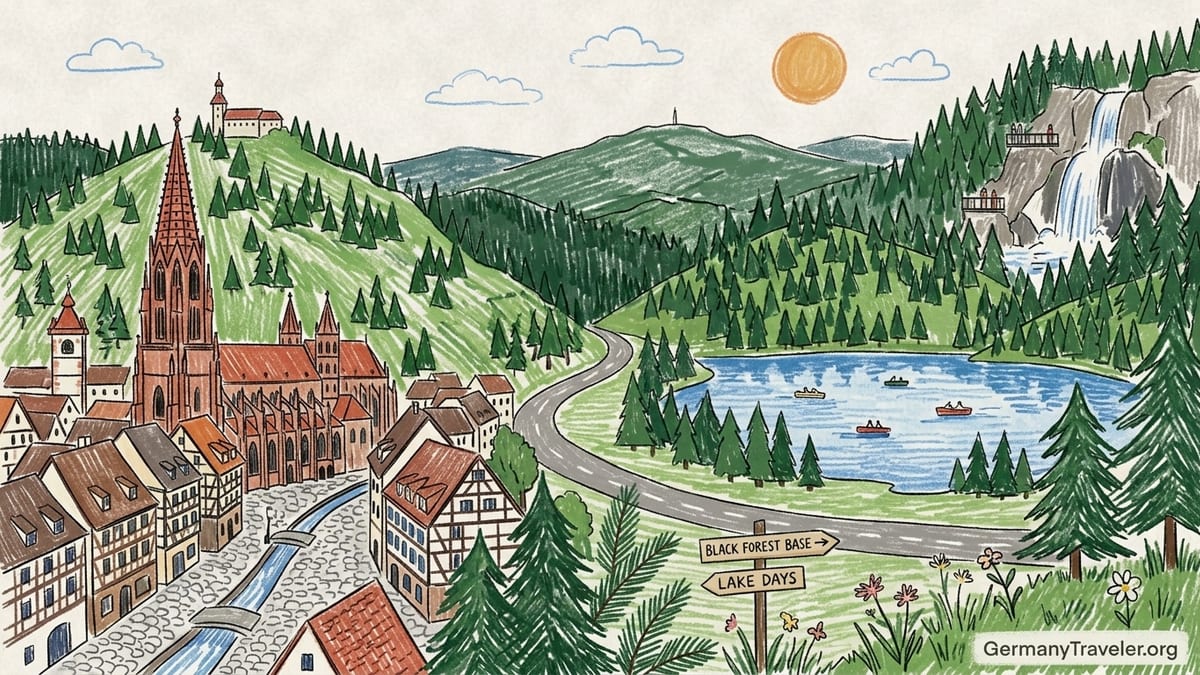
Freiburg Old Town: My Ideal Black Forest Base
I started and ended my Black Forest days in Freiburg, and if I went back tomorrow, I would do the same. Freiburg’s compact old town made it very easy to combine city wandering with quick escapes into the surrounding hills and forests. I spent one full afternoon and evening exploring the area around the Freiburg Minster, walking the cobbled lanes lined with Bächle, the narrow water channels that run through the streets, and climbing up the Schlossberg hillside behind the center for views over the green plain. The old town is flat and walkable, and moving from the cathedral square to the edge of the forest on Schlossberg took me around 20 minutes on foot at a relaxed pace.
My main paid activity in Freiburg’s center was visiting the cathedral tower. The Minster’s viewing platform involves several hundred steps in a tight spiral staircase, and I allowed roughly 45 minutes from paying at the entrance to being back down on the square, including plenty of time for photos at the top. When I visited, the ticket price for adults was in the range of a modest single-digit euro fee, comparable to other German church towers, and I found that reasonable for the views over the red rooftops and the first ridges of the Black Forest beyond. I went on a cloudy afternoon in late spring, with temperatures around 18 degrees Celsius, and still found visibility good enough to make it enjoyable.
In terms of crowds, Freiburg felt pleasantly lively rather than overrun. The cathedral square market was busy around midday, especially near the sausage stands and vegetable stalls, but nothing like the crush you find at major capital city sights. By late afternoon, most day-trippers had thinned out and it was easy to get a table at a brewery terrace for a beer and Flammkuchen. I paid around 10 to 15 euros for a simple meal with a drink in the center, which matched what local menus showed. I would absolutely repeat Freiburg as a base: the combination of walkable history, affordable food and extremely easy public transport links into the surrounding Black Forest made the city feel like an anchor rather than a distraction from the nature I had come to see.
If I were doing it again, I would try to arrive on a clear day to make more of the Schlossberg viewpoints and perhaps ride the Schlossbergbahn funicular instead of hiking up. Even without that, the simple act of wandering from the old town lanes into the trees within half an hour demonstrated exactly what Freiburg’s tourism board promises: you really can move quickly from medieval squares to genuine Black Forest hillside, which is why I recommend planning at least two nights here before radiating out to the rest of the region.
A Lake Day at Titisee: Boats, Ice Cream and an Easy Escape
From Freiburg, Titisee made for one of the most relaxed days of my trip. I caught a regional train from Freiburg Hauptbahnhof and stepped off at Titisee station about 40 minutes later, then walked five minutes down to the lakeshore. I gave myself a full day here, from late morning to early evening, which was the right call because the experience is less about ticking off must-see sights and more about stringing together small, low-pressure activities: a lakeside stroll, a boat ride and unhurried time at the water’s edge.
My main paid activity on Titisee was renting a pedal boat from a local operator by the promenade. As of the 2024 season, typical rates for a small pedal boat carrying up to four people are around 16 euros for 30 minutes and 23 euros for one hour, according to posted price boards from companies like Bootsbetrieb Schweizer on the lakeshore. I chose 30 minutes, which was enough to pedal out into the middle, pause with the engine-free quiet and mountain reflections, and circle back without feeling rushed. Counting the short wait to board, the whole experience took under an hour. I also considered one of the larger electric boat cruises, which were priced in the high single digits per adult for a roughly half-hour circuit, but decided I preferred the independence of paddling at my own pace.
Titisee was busy but not unbearable. I visited on a warm weekend in late May, around 22 to 24 degrees Celsius and mostly sunny. The promenade was full around lunchtime, especially near the souvenir shops and ice cream stands, and there were short queues for the more popular boat rentals. Once I stepped onto the lakeside path that loops away from the central cluster of shops, though, things calmed down very quickly. Within 15 minutes of walking I was seeing more trees and reeds than people, and I could usually find a free bench to watch the water. Aside from the boat rental, my main expenses were an ice cream and a simple lunch, altogether under 20 euros.
I would definitely repeat a Titisee day, but with two tweaks. First, I would arrive on a weekday rather than a weekend to avoid the thickest crowds near the promenade. Second, I would pack light swim gear and a towel. While there are regulated swimming areas and the water is cool, on a warm day it is refreshing and free, and a quick dip would have rounded out the experience. Overall, Titisee felt like a very accessible lake escape from Freiburg that justifies an unhurried day if you enjoy being near the water more than chasing dramatic summits.
Triberg Waterfalls: Classic Black Forest Scenery With Caveats
Triberg’s waterfalls are marketed as among the highest in Germany, and they are very much on the classic Black Forest circuit. I visited as a half-day trip from Freiburg, combining a regional train ride of about 75 to 90 minutes with a walk through the small town and up along the waterfall paths. From the station, it took me roughly 15 minutes on foot, uphill through streets lined with cuckoo clock shops, to reach the main waterfall entrance.
At the ticket booth I paid the posted summer season rate for adults, which in 2024 sits around 8 euros for full-price entry and 6 euros in winter, according to current information from regional tourism sources. Once inside, I spent about two hours walking the signed paths that climb alongside the falls and loop back through the forest. The route is not long in raw distance, but there are plenty of steps and viewpoints where I paused to take photos of the cascades and the mossy boulders. I visited in early June on an overcast day with light drizzle, around 16 degrees Celsius, which kept the air pleasantly cool and made the surrounding forest feel more atmospheric.
Crowds are the main trade-off here. The lower part of the waterfall, near the first bridges, was very busy with tour groups and families when I arrived late morning. There were pockets of congestion where people were waiting to take photos at the railings, and it took patience to get a clear shot. As I climbed higher and followed some of the side loops, foot traffic dropped sharply, and by the time I reached the upper viewing platforms, I was often alone or with only a handful of other visitors. Triberg town itself felt heavily oriented to tourism, with multiple cuckoo clock shops and souvenir stores, and I did not linger long after my hike.
Would I repeat Triberg? Under certain conditions, yes. The waterfalls are attractive, and the wooded paths above them give a genuine Black Forest feel once you clear the lower crowds. I would, however, only go back on a less busy weekday and aim to arrive right when the site opens to enjoy the lower pools before the tour buses arrive. I would also pair the visit with a longer forest hike starting from the upper trails to get more value for the entry fee. If your time in the region is very short and you are already planning visits to other scenic gorges or waterfalls, you may find Triberg less essential than its marketing suggests.
Hiking Near Feldberg: High Ridges and Variable Weather
For a more elevated Black Forest experience, I headed to the Feldberg area, which includes the highest peak in the region at just under 1,500 meters. From Freiburg, the regional train to Feldberg-Bärental took under an hour, followed by a short bus ride up to the Feldberg lifts and visitor center. I dedicated almost a full day here, from mid-morning to late afternoon, to account for the changing mountain weather and the network of trails radiating from the top.
I chose a moderate circular hike that started at the top station of the cable car, went over rolling alpine meadows and small forest sections, and looped back via a lower track with views of nearby lakes. In the summer season, the cable car and lifts operate as part of the Feldberg ski area infrastructure, and day tickets for uphill transport are priced in line with other German mountain resorts, generally in the low to mid 20-euro range for adults depending on the exact product and current offers. My own visit combined a single uphill ride with hiking back down, so I paid a smaller one-way fare, then spent around four to five hours on the trail network, including breaks.
The weather on Feldberg can shift quickly. I started my day in Freiburg in sunshine around 20 degrees Celsius and arrived at the top station under a mix of clouds and wind, with temperatures closer to 12 degrees. Over the course of the hike, I experienced patches of sun, passing fog and even a short light shower. Proper layers and a light waterproof jacket were essential, and I repeatedly saw less-prepared visitors turning back when the wind picked up. Trails were well marked, and on a weekday in shoulder season, I encountered a steady but not overwhelming stream of other walkers, with the busiest sections closest to the cable car stations and near the most popular viewpoints.
I would absolutely repeat a Feldberg hike, though I would plan even more flexibly around the forecast. On a clear day, the views reach far across the surrounding Black Forest ridges and, on some days, toward the Alps in the distance. Even in mixed weather, the high meadows, grazing cattle and dense patches of fir forest offered a landscape very different from the lower valleys. If you are budgeting, one way to keep costs down is to ride up once and walk all the way back to a lower bus stop instead of paying for multiple lift rides, which was the approach I took. Including the one-way uphill ticket and snacks I brought from Freiburg, my Feldberg day came in under 30 euros of on-the-ground expenses, not counting transport covered by my regional rail pass.
Spa Time in Baden-Baden: A Classic Thermal Day
Baden-Baden sits on the edge of the Black Forest, and although it has a very different feel from the smaller mountain towns, its thermal culture fits neatly into a multi-day regional trip. I visited specifically for an afternoon and evening at the Caracalla Therme, the large modern thermal complex in the center. From Freiburg, I traveled by regional train with one change, taking around 90 minutes in total, then walked about 15 minutes from Baden-Baden station to the spa area using local buses for part of the trip.
At Caracalla, I opted for a 3-hour ticket, which in 2024 is priced in the mid- to high-20 euro range for adults according to the operator’s current price list, with options for 2-hour and full-day stays at slightly lower and higher prices respectively. I added a small surcharge to use the sauna area, which is a textile-free zone and common in German spa culture. In total, I paid just under 40 euros for my time-limited wellness session. That bought me access to indoor and outdoor thermal pools, hot and cold baths, whirlpools and several different saunas. I arrived around 2 pm on a weekday in spring, stayed until early evening and found that 3 hours was just enough to move through the pools, a couple of saunas and some resting time without feeling rushed.
Crowds at Caracalla followed a predictable pattern. When I checked in, the complex was moderately busy, with free lockers and enough loungers to find a spot after a short look. By late afternoon, particularly between 4 pm and 6 pm, more after-work visitors arrived, and the outdoor pools became livelier. However, even at its busiest, the atmosphere remained calm, with a clear expectation of quiet in certain relaxation areas. The water temperature in the main outdoor pools sat comfortably warm, while some indoor sections were hotter and one cold plunge pool was brisk enough to make my eyes water, in a good way.
I would gladly repeat Caracalla Therme as part of a Black Forest trip, especially if I had been hiking in the preceding days. The cost is not insignificant, particularly once you add a sauna supplement or a massage, but as a half-day splurge it felt worthwhile. To get the most value, I would recommend arriving outside weekend peak times, bringing your own flip-flops and towel to avoid rental fees, and planning a light, early dinner afterward in town. Baden-Baden itself, with its grand casino and 19th-century facades, can feel a little formal compared to villages like Gengenbach, but pairing its spa with at least a brief stroll through the gardens gives a good sense of why it has been a health resort for so long.
Gengenbach and Scenic Driving Through Storybook Valleys
One of my favorite Black Forest days combined a visit to Gengenbach with a loosely planned scenic drive through the surrounding Kinzig valley. Gengenbach is a small historic town on the western edge of the Black Forest, known for its tightly clustered half-timbered houses and former abbey buildings. I arrived late morning by train, stepping out after about an hour’s ride from Freiburg, and walked into the old town in under ten minutes. The central square, framed by pastel facades and the town hall that doubles as a giant Advent calendar in December, felt instantly cinematic.
I gave myself two to three hours in Gengenbach itself. That was enough time to wander the alleys radiating out from the square, climb a short distance up to a small chapel above the town for views over the rooftops and vineyards, and stop for coffee and cake at a café on one of the side streets for under 10 euros. Entry to the town is free, of course, and aside from any museum visits or food, the main currency here is your time. I visited on a sunny weekday in late spring. The temperature was around 20 degrees Celsius, and there were other visitors in the square but plenty of empty corners just a block or two away. It felt like a place where locals still live and work, not just a backdrop for tour buses.
In the afternoon, I picked up a small rental car in Offenburg, which is a short hop from Gengenbach, and set off on a loop through the Kinzig valley and nearby side valleys. Over four to five hours, I drove on a mix of regional roads that wound through villages, meadows and forested hillsides, stopping at signed viewpoints and small farm shops. Fuel and rental costs will vary, but for my single-day rental of a compact car plus fuel, I paid the equivalent of around 70 to 80 euros. The reward was the flexibility to pull over whenever a stretch of half-timbered farmhouses or a hillside of mixed forest caught my eye, something that is harder to do spontaneously by bus.
I would repeat both Gengenbach and the scenic driving in a heartbeat, though if I were trying to keep costs down, I would lean more on regional trains and buses, which serve many of the valley towns on regular timetables. What made this day special was not any single big-ticket sight but the combination of an exceptionally pretty town and the slow accumulation of roadside scenes: laundry hanging from balconies, church spires appearing around bends, and sun patches moving across fields. For anyone who wants to feel the Black Forest as much as see it, dedicating at least one unhurried day like this pays off.
Europa-Park: A Full-Throttle Day From Freiburg
Europa-Park in Rust sits just outside the traditional Black Forest mountains, but in reality it is one of the biggest draws for visitors staying in Freiburg or the surrounding region. I decided to devote an entire day to it and approached it as a contrast to my hiking and spa time. From Freiburg, I took an early regional train toward Ringsheim and then a short shuttle bus to the park entrance, which altogether took around one hour. I arrived before the official opening time and stayed until park close, making this a true full-day outing of roughly 10 to 11 hours including transport.
Ticket pricing at Europa-Park is dynamic and depends on the date. For the 2024 season, dated one-day tickets for adults bought online fall roughly in the high 50 to mid 70 euro range, with cheaper and more expensive brackets depending on the expected crowd level. I purchased my ticket in advance in the lower end of that spectrum by choosing a weekday outside peak holidays. Once inside the park, nearly all rides and shows were included in the base admission, and my main additional expenses were food and snacks, which totaled around 25 to 30 euros for the day.
The park itself is large enough that you cannot realistically do every major ride in one visit. I focused on a mix of newer roller coasters and atmospheric themed areas, including several of the European country zones with detailed architecture and landscaping. Crowds peaked between late morning and mid-afternoon, when wait times for headline rides could stretch beyond an hour. I used a simple strategy of riding the most popular coasters early in the day, switching to shows and smaller attractions during midday peaks, and then returning to big rides in the last two hours when queues shortened again. Weather on my visit was cloudy with sunny breaks, around 22 degrees Celsius, ideal for being outside all day.
Would I repeat Europa-Park? Yes, with some caveats. If you enjoy theme parks and detailed theming, the park justifies the cost and time, and staying in Freiburg makes the logistics straightforward for a long day trip. I would only go again on a carefully chosen date, avoiding school holidays and weekends, both for price and for crowds. I would also consider spending the night in or near the park to break up the long day and enjoy the atmosphere after closing. For travelers who are primarily interested in nature, Europa-Park may feel like a separate type of trip, but if you have the budget and curiosity, folding one high-energy day into a week of lakes and forests gives the region a surprising variety.
The Takeaway
Looking back at my Black Forest days from a Freiburg base, what stands out most are not the famous superlatives but the specific combinations of place, time and weather that worked. Freiburg’s old town gave me a human-scale city with genuine access to the surrounding hills. Titisee provided an easy lake day where a simple pedal boat rental and a long shoreline walk made the trip worthwhile. Triberg’s waterfalls delivered photogenic cascades, but I would time a repeat visit more carefully to sidestep crowds. Feldberg showed me how quickly the landscape shifts to high meadows and changeable mountain skies, while Baden-Baden’s Caracalla Therme turned a gray afternoon into a restorative spa experience.
The smaller town of Gengenbach and the unstructured scenic driving around it gave me perhaps the purest sense of the Black Forest’s quiet valleys and everyday rhythms. Europa-Park, finally, proved that a Freiburg-based itinerary does not have to be all pines and spa robes; one big theme park day can coexist happily with hiking boots and lake swims. If I returned tomorrow, I would repeat nearly all of these experiences, adjusting for season and crowd levels, and still feel I was discovering new angles on a region that rewards both careful planning and time left deliberately unfilled.
FAQ
Q1. How many days should I base myself in Freiburg for a Black Forest trip?
I found three to four nights in Freiburg ideal, giving me time for one full city day and at least two or three day trips to places like Titisee, Feldberg or Gengenbach.
Q2. Is it better to explore the Black Forest by car or public transport?
I used both and would repeat that mix: trains and buses worked well for Freiburg, Titisee, Triberg and Baden-Baden, while a one-day car rental added freedom for scenic valley drives around Gengenbach.
Q3. When is the best season to visit the Black Forest for these activities?
Late spring to early autumn gave me the widest range of options, from lake days and hikes to outdoor theme park visits, with generally mild temperatures and longer daylight.
Q4. How expensive is a typical day trip from Freiburg into the Black Forest?
On my own trips, most days cost between 30 and 80 euros on the ground, depending on whether I added higher-priced items like spa entry, lift tickets or Europa-Park admission.
Q5. Are the Black Forest sights very crowded in summer?
Some, like Triberg waterfalls and Europa-Park, were busy in high season, while hikes near Feldberg, lakeside paths at Titisee and small towns like Gengenbach felt much calmer, especially on weekdays.
Q6. Do I need to book tickets in advance for Europa-Park and Caracalla Therme?
For Europa-Park, I strongly recommend buying dated tickets online ahead of time, while for Caracalla Therme I was able to buy on the day but would still check current guidance before traveling.
Q7. Can I swim in Titisee and other Black Forest lakes?
Yes, there are designated swimming areas at Titisee and some other lakes, and in warm weather I saw many people in the water, though temperatures remained refreshingly cool.
Q8. Is Baden-Baden suitable if I am not familiar with German spa culture?
Caracalla Therme felt very accessible as a first-timer, with clear signage and staff; just be aware that the sauna area is textile-free while the main pools require swimwear.
Q9. Are hikes around Feldberg suitable for beginners?
Several marked trails near the Feldberg lifts are manageable for reasonably fit beginners, though the weather can change quickly, so good footwear and layers are important.
Q10. Which experience would you prioritize if you only had one full free day from Freiburg?
If I had just one day, I would choose a combination of Titisee and Feldberg in good weather, or Freiburg’s old town plus a relaxing spa visit in Baden-Baden if the forecast was poor.