


On a clear day in late September 2025, I set my alarm in Freiburg for an early train into the Southern Black Forest, determined to finally see Lake Titisee and the Feldberg summit in one long push. What follows is exactly how that day unfolded, from the moment I stepped onto the platform at Freiburg Hauptbahnhof to the tired ride back that evening, including what I paid, how crowded it really was, what I ate, where I walked, and whether combining the lake and Feldberg in one day actually made sense.
Getting There from Freiburg: Trains, Timing and First Impressions
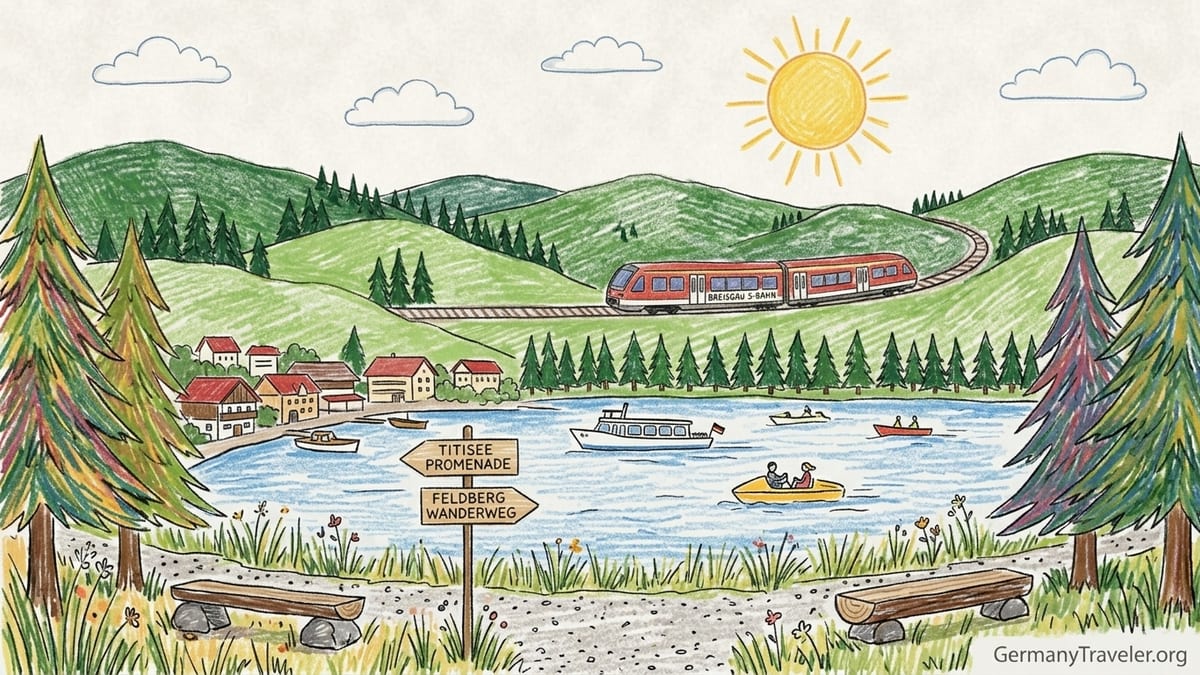
I started at Freiburg Hauptbahnhof on a Saturday, aiming for a morning train on the Höllentalbahn toward Titisee. Regional trains on this line typically run every 30 minutes between Freiburg and Titisee, operated by DB Regio as part of the Breisgau S-Bahn, and the journey itself takes about 35 minutes, depending on the exact service and stops. I used a regional day ticket that covered the Regio-Verkehrsverbund Freiburg area, which meant I could hop on and off trains and buses in the region without worrying about single fares.
The train pulled out of Freiburg just before 9:00 a.m. The city blocks slipped away quickly and gave way to fields, then low forested hills. By Kirchzarten the carriage was already noticeably fuller with day-trippers: families with foldable strollers, a couple of groups in hiking boots with printed GPS routes, and a few mountain bikers standing near the doors. By the time we reached Titisee station, almost half the carriage stood up.
Stepping off at Titisee around 9:35 a.m., the air felt cooler than in Freiburg, with that faint smell of wet wood and pine resin that hits you in many Black Forest valleys. The station is set slightly back from the lake, so there is no postcard view when you arrive. Instead, you get a practical mix of platforms, a small station building and signs pointing toward Seestraße and the lakefront. It took me about 8 minutes on foot to reach the water, following the flow of people down a slight slope past small shops and guesthouses.
Already at that hour, Seestraße, the main lakeside promenade, was busy but not packed. Souvenir shops had their cuckoo clocks and carved wooden thermometers already outside, and the smell of grilled sausages from a stand near the promenade was surprisingly strong for that time of morning. It felt like a resort town that had woken up early for the day-trippers arriving from Freiburg and further afield.
Finding the Lake: Crowds, Atmosphere and First Walk
My first view of Lake Titisee came as I stepped onto the paved lakeside path that runs parallel to Seestraße. The water was calm, with a slight ripple from a light breeze, and the far shore was lined with dark fir trees. A few small electric boats were already out, leaving gentle V-shaped wakes under a pale blue sky. It was not the isolated mountain lake of brochures, but it was undeniably pretty.
At this time in late September, the crowd felt mixed. Next to me on a bench an older German couple unwrapped sandwiches from wax paper. To my left, a group speaking Spanish compared boat options. A school group with high-visibility vests trailed behind a teacher holding a small sign aloft. It was busy enough that I had to occasionally step aside on the path, but not so crowded that it felt stressful. Had I arrived closer to midday, I suspect the experience would have been different, with many more tour buses and louder promenading along Seestraße.
Instead of sitting immediately at a café, I decided to walk east along the shore. There is an almost continuous lakeside path that, in several sections, hugs the water closely and in others rises slightly into the trees. The terrain is gentle gravel and pavement, fine for sneakers. I followed it for about 25 minutes, passing a small bathing area with a grassy lawn, changing cabins and a few brave swimmers in the cool water. Signs indicated official bathing zones and requested that dogs stay out of the swimming area, something that seemed to be respected while I was there.
The further I went from Seestraße, the thinner the crowd became. Ten minutes out, I was mostly passing joggers and other walkers. The lake itself kept changing subtly: in one segment, the surface was dappled with shade from overhanging trees, in another it opened up into wide reflective water, with the far tree line mirrored almost perfectly, interrupted only by the occasional passing tour boat.
On the Water: Renting a Boat on Titisee
By late morning, the sun had strengthened and the paved path near Seestraße was starting to feel warm. That was my cue to head back toward the main boat rental area close to Seestraße 33, where Bootsbetrieb Schweizer operates both lake cruises and rental boats. Their posted prices in 2024 listed pedal boats and rowboats at 10 euros for half an hour and 18 euros for one hour, and small electric motorboats starting around 25 euros for half an hour and 45 euros for a full hour, with capacity for several people.
I opted for a simple pedal boat for half an hour. There was no booking system for rentals. Instead, I waited in a short, loosely organized queue that snaked along the pier. On this Saturday, around 11:15 a.m., the wait from joining the line to stepping onto a boat was roughly 20 minutes. The staff were efficient and straightforward, explaining in German and then in English where to return, reminding people not to cross an imaginary line near the far shore, and checking life jackets for children.
Once out on the water, the perception of Titisee changed. The promenade and its dense line of shops receded, and the noise of the crowd became a low, indistinct hum. The lake felt wider from this perspective, framed by the rounded slopes of the surrounding forest. The water had that slightly green, slightly brown tinge common to forest lakes, with sunlight catching small floating pollen grains and the occasional leaf. We pedaled toward the middle and then let the boat drift, watching the white tour boat pass at a distance with its upper deck filled but not overflowing.
The half hour felt just long enough without becoming repetitive. On the way back toward the pier, I could see the swell of people on the promenade had grown. Piers for the cruise boats were busier, with one departure apparently boarding every 20 to 30 minutes in the favorable weather. Back on land, I felt that I had experienced Titisee from the three most common vantage points in a single morning: promenade, lakeside path and lake surface.
Lunch at the Lake: Food, Prices and Pace
By 12:30 p.m., my energy level and the growing crowds convinced me it was time to sit and eat. I wanted something that felt rooted in the region but did not require a long, drawn-out restaurant meal, because I still planned to reach Feldberg that afternoon. I aimed for a restaurant along the lakefront near the boat pier that had both indoor seating and a sheltered terrace. The terrace was about three-quarters full, mainly with German-speaking guests, but the staff switched into English easily when needed.
I ordered a plate of Käsespätzle, the soft egg noodles baked with cheese and onions that you see all over southern Germany, and a small side salad. On the drinks side, I chose a half liter of local wheat beer. The food prices in this cluster of lakeside restaurants tended to sit around the upper mid-range for the region, with main dishes between about 16 and 24 euros and cakes between 4.50 and 6.50 euros per slice, based on menus I checked along Seestraße and guidance from regional travel resources that track café prices.
The Käsespätzle arrived bubbling in a small metal pan, with crispy onions on top and a noticeable but not aggressive cheese aroma. It was solid, hearty food, perhaps not life-changing but exactly right for a day of walking and later hiking. The salad was fresh, with a lightly sour dressing, and the beer was cold and slightly cloudy, with a smooth, yeasty finish. Service was brisk. From sitting down to paying the bill took just under 45 minutes, which felt appropriate for a day trip where every hour counted.
As I left the restaurant at roughly 1:15 p.m., the lakeside promenade felt almost saturated. Lines formed at ice cream stands, and a cluster of tour groups had begun to assemble near the bus parking area behind Seestraße. It was at this moment that I was glad I had experienced my lakeside walk and boat ride earlier in the day. Titisee in early afternoon in good weather is lively and engaging, but not especially peaceful.
Up to Feldberg: Buses, Chairlifts and Mountain Weather
To head up toward Feldberg, I walked back to Titisee station, which took about 10 minutes at a brisk pace. From there, I caught a regional train further up the Höllental toward Bärental, one of the stops that act as gateways into the high Black Forest. The train ride was short, less than 10 minutes, and from Bärental I connected to a local bus running toward Feldberg, using the same regional ticket. The combined transfer time, including waiting for the bus, sat at around 25 minutes.
The bus climbed steadily through mixed forest and small clusters of houses, passing guesthouses that advertised themselves as bases for both skiing and hiking. By this point, around 2:00 p.m., some clouds had begun to build over the ridge. Arriving at the Feldberg area near the Haus der Natur visitor center, I could see the upper slopes partially covered in a drifting gray lid of cloud. This is typical for Feldberg, which, at just under 1,500 meters, can generate and trap its own weather even when the valleys see clear skies.
I decided not to use the cable car on this visit and instead took one of the signed hiking paths that climbs from near the visitor center toward the Feldberg Tower and main summit area. Many organized routes in the region, including official pocket guides from Hochschwarzwald tourism authorities, start from this same cluster of buildings, heading sharply uphill past waymarkers and a monument before leveling out toward the summit plateau.
The path I followed was a mix of gravel forestry road and narrower trails. Initial gradients were steep enough to raise my heart rate, and the Käsespätzle at lunch briefly felt like a miscalculation. Within about 35 minutes, I emerged onto a more open section of hillside where low grasses had replaced dense forest. Here, the wind picked up, and the temperature dropped noticeably compared with Titisee. Layers were essential. Even in late September, I was glad for a light jacket and a thin hat.
On the Ridge: Views, Visibility and the Reality of a Day Trip
When people talk about Feldberg, they often mention the wide views across the Black Forest and, on very clear days, toward the distant Alps. On my visit, visibility sat somewhere in the middle. Patches of low cloud drifted across the ridge, sometimes fully obscuring the view, then parting enough to reveal layered hills stretching off toward the horizon in soft, muted greens and blues.
Reaching one of the main viewpoints near the summit tower, I joined perhaps 30 or 40 other hikers and day-trippers. Some had come up with small children using the lift, others, like me, had walked. The atmosphere was relaxed. People were sipping thermos coffee while sitting on the grass, others were checking maps on their phones. The radio mast and tower on Feldberg itself reminded me that this is not a wilderness summit but a well-developed, well-visited high point that balances infrastructure with the surrounding nature reserve.
The best moments were when the clouds broke for longer stretches. Looking south, I could trace the line of other Black Forest ridges. To the east and north, distant villages flashed white between trees. It was not the crystal-clear panorama you see in promotional photos, but it felt more honest. The shifting light and visibility gave the afternoon a slightly restless, transient quality. Knowing I had to catch a train back to Freiburg that evening added a subtle time pressure to the enjoyment.
I followed a short loop from the summit area that dipped slightly down one side of the ridge and then back again, taking in a combination of gravel paths and narrow, root-threaded trail sections. Signage was clear, with yellow direction boards at regular intervals pointing back toward Feldberg-Ort, the lift station and the visitor center. By the time I descended to the starting point, it was around 4:30 p.m., and the bus stop already had a handful of people waiting for the next departure down toward Bärental and Titisee.
The Journey Back: Fatigue, Timings and Second Thoughts
The return from Feldberg to Freiburg involved three legs: bus back down from the Feldberg area to Bärental, short train ride to Titisee, and then the longer regional train run down the Höllental to Freiburg. Because services are relatively frequent, I did not have to plan every minute in advance, but missing a connection by just a few minutes could easily add 30 minutes of waiting at one of the intermediate stops.
On my particular day, the timing was mixed. The bus from Feldberg to Bärental arrived roughly on time at about 4:45 p.m. I then waited around 10 minutes for the train to Titisee. Once there, however, I had almost a 25-minute wait for the Freiburg-bound train, during which the fatigue of the day really set in. Seated on a bench on the Titisee platform, I had a clear view of the lake through a gap between buildings, now glowing softly in the lower evening light. It highlighted how little unstructured time I had actually spent that day simply sitting by the water.
The train back to Freiburg was busy but not uncomfortably so. Many passengers were sunk into the quiet tiredness that follows an active day outdoors. Boots were dusty, children were dozing, and screens glowed dimly above folded jackets used as pillows. I reached Freiburg Hauptbahnhof shortly after 6:30 p.m., having left Feldberg about two hours earlier, including connections and waiting time.
Only at this point, walking back through Freiburg toward my accommodation, did the full shape of the day settle in my mind. I had fit in a lakeside walk, a pedal boat session, a full sit-down lunch, multiple train and bus legs, a hike up to Feldberg and back, plus all the small transitions between. It had been satisfying and rich in impressions, but also unquestionably full. For travelers who like to linger, sketch or sit with a coffee and simply watch the water, this kind of day trip leaves little unscheduled space.
Would I Stay Overnight Next Time?
Short answer: yes, I would stay overnight in the Titisee or Feldberg area rather than compressing everything into a single day from Freiburg. The day trip was manageable, but it felt like skimming the surface of two places that both benefit from slower pacing. An overnight stay would change the rhythm entirely.
If I were to repeat the trip, I would probably base myself either in Titisee-Neustadt or near Feldberg for one or two nights. That would allow an early-morning walk around parts of the lake before the main wave of visitors arrives on day-tripper trains and buses. It would also open up the possibility of an evening stroll along the shore when Seestraße is quieter and lights from restaurants and hotels reflect in the water in a softer way.
On the Feldberg side, staying overnight would mean the option to pick a clearer forecast window for the summit. With my day-trip timing, I had no flexibility: if the clouds sat stubbornly on the ridge, that was simply how it would be. With even one night in the area, you can study local forecasts and choose the clearer of two mornings or afternoons to be up on the mountain. It would also allow for longer routes that include side trips toward places like Feldsee, the glacial cirque lake below Feldberg that many regulars describe as one of the prettiest spots in the high Black Forest.
There is a more subtle benefit too. Without the requirement to be back on a specific late-afternoon bus from Feldberg, the whole experience would feel less like threading a series of connections and more like inhabiting the landscapes for their own sake. The convenience of Freiburg as a base is undeniable. Its rail hub and lively old town make it a fantastic place to stay. Yet in this case, that very convenience tempted me into a day plan that left almost no margin for weather, fatigue or simple serendipity.
The Takeaway
Looking back on that September day, the Southern Black Forest gave me exactly what I had hoped for in terms of variety. I began with the soft edges of Lake Titisee, the quiet of a morning lakeside walk and the novelty of viewing the water from a pedal boat. I then traded that watery calm for the open, shifting sky and broader horizons of Feldberg. Trains and buses linked it all together with impressive efficiency, creating a loop that revealed how compact yet diverse this part of Germany can feel.
At the same time, the day exposed the trade-offs that come with ambitious one-day itineraries. The mid-day crowds at Titisee were manageable but diluted the sense of escape that many people seek in the Black Forest. On Feldberg, the compressed timetable meant that when the clouds rolled in, I could only accept them rather than wait them out. By the time I sat on the train back to Freiburg, I felt not only that I had had a full day, but also that I had hurried through moments that deserved more attention.
If your time in the region is limited to a single day, combining Titisee and Feldberg is absolutely possible and can be rewarding, especially if you are comfortable moving at a steady pace and paying attention to train and bus schedules. My experience showed that you can fit in a meaningful sample of both in about ten hours door to door from Freiburg. If, however, you have the option to slow down, I would strongly recommend dedicating at least one overnight in the high Black Forest. A slower approach would let you experience Titisee before the tour buses arrive, walk a little further along the shore, pick a clearer window for Feldberg and perhaps sit longer over a slice of Black Forest cake without glancing at your watch.
Ultimately, what my day in the Southern Black Forest was really like was both energizing and slightly rushed. It left me grateful for the region’s accessibility and infrastructure, but it also left me wanting to return in a different way: with fewer fixed points in the day, more time to wander, and at least one evening spent watching the last light fade over the lake instead of the reflection of fluorescent tubes in a train window.
FAQ
Q1. Can you visit both Lake Titisee and Feldberg in one day from Freiburg?
Yes, you can visit both in one day from Freiburg by combining regional trains and local buses, but it results in a very full schedule with limited time for lingering.
Q2. How long is the train ride from Freiburg to Titisee?
The regional trains on the Höllentalbahn usually take around 30 to 40 minutes between Freiburg Hauptbahnhof and Titisee, depending on the specific service and stops.
Q3. How crowded is Lake Titisee during the day?
In good weather, mornings feel moderately busy, but by early afternoon, especially on weekends and holidays, the promenade and boat piers can be quite crowded with day-trippers and tour groups.
Q4. How much does it cost to rent a boat on Lake Titisee?
Typical recent prices for rentals from major operators are about 10 euros for half an hour and 18 euros for an hour for pedal or rowboats, with electric motorboats costing more.
Q5. Do you need to book boat rentals at Titisee in advance?
For small pedal, row and electric rental boats, advance reservations are generally not available. You simply queue at the pier and wait for the next available boat.
Q6. What is the weather like on Feldberg compared with Titisee?
Feldberg is significantly higher than Titisee, so temperatures are usually cooler, wind can be stronger, and clouds often form around the summit even when the lake area is sunny.
Q7. Is the hike up Feldberg suitable for casual walkers?
Marked routes from the visitor center include steeper sections but use well-maintained paths and gravel roads. Fit casual walkers with proper shoes usually manage them without technical difficulty.
Q8. Can you reach Feldberg by public transport from Titisee?
Yes, you can travel from Titisee via short regional train and bus connections through stops such as Bärental, using regional tickets that cover both trains and local buses.
Q9. Is it better to stay overnight near Titisee or in Freiburg?
Freiburg works well as a hub for day trips, but staying overnight near Titisee or Feldberg gives you quieter mornings and evenings and more flexibility with weather and hiking times.
Q10. What kind of food can you expect around Lake Titisee?
Around the lake and along Seestraße you will find hearty regional dishes like Käsespätzle, grilled meats, trout, and plenty of cafés serving slices of Black Forest cake and other pastries.