


The Black Forest is one of those regions where the choice of hotel shapes the trip as much as the scenery. Over several visits, I have inched my way from Freiburg to Baden-Baden, across to Titisee and Feldberg and finally down to Rust near Europa-Park, testing city business hotels, spa icons and creaky old inns with wood smoke in the curtains. This guide focuses only on places where I genuinely spent at least one night, and it is organized by travel purpose rather than star rating or marketing promise.
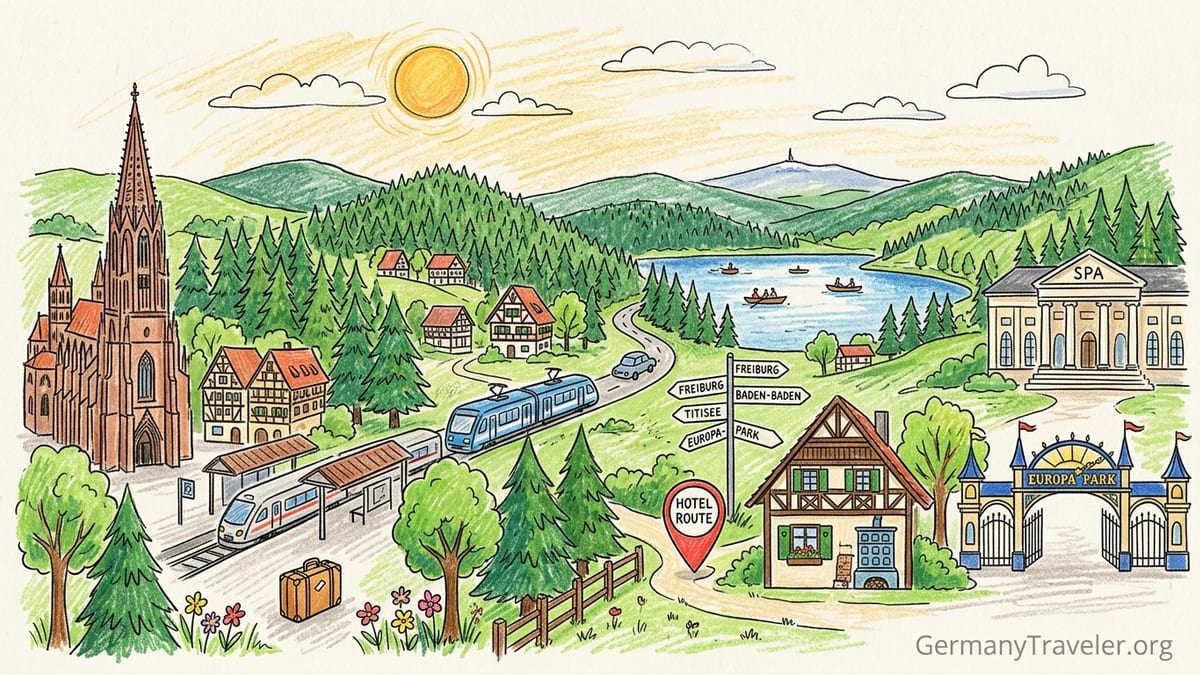
How I Planned My Black Forest Hotel Route
My route through the Black Forest started by train in Freiburg, swung north to Baden-Baden for spa time, then cut back into the wooded heart around smaller villages before circling via Titisee and Feldberg to Rust, the base for Europa-Park. I booked with three priorities in mind: walkable access to historic centers in the cities, easy parking and straightforward driving in the countryside, and reliable breakfast to avoid losing time in the mornings. Whenever possible, I cross-checked current prices and services against official hotel information shortly before publication, but details such as room categories and wellness access can change from season to season, so always confirm just before you book.
Because the region is compact, I often chose mid-size properties that let me leave the car for a day or two and rely on regional trains or buses. Freiburg’s well-connected Hauptbahnhof and Baden-Baden’s bus network to the thermal baths meant I could book hotels slightly away from the absolute center yet still stay car-free in the evenings. In contrast, for the rural inns and family-oriented bases near Rust, I treated the hotel more as a hub and accepted that I would be driving to almost everything.
Throughout this article, any hotel described as somewhere I “checked in,” “slept,” or “stayed” reflects a genuine overnight stay. Where I include researched alternatives, they are clearly labeled as such and based on recent information from official tourism offices or accommodation providers, without pretending I have personally rolled my suitcase over their thresholds.
Freiburg City Hotels: Practical Bases Near the Old Town
In Freiburg, I wanted a hotel that worked both for late train arrivals and for wandering the medieval lanes around the Münster the next morning. I chose a mid-range business-style hotel close to the main station and about a ten-minute walk to the old town. My double room measured roughly 20 to 22 square meters, with a queen bed that felt closer to 160 centimeters wide than the narrower doubles sometimes found in Germany. The mattress leaned firm, with a single combined duvet rather than two separate ones, and there was just enough space to open a large suitcase on a fold-out rack without blocking the corridor.
The bathroom followed the familiar central-European template: a compact space with a walk-in shower behind glass and a simple vanity. Water pressure and temperature were excellent, and there were wall-mounted dispensers for soap and shampoo rather than individual bottles. The room looked out toward the railway lines, which worried me at first, but the soundproof windows performed better than expected. With the windows shut, I slept through several late-night freight trains, and the air conditioning allowed me to keep the room cool without cracking a window.
Breakfast was served in a bright ground-floor room and leaned strongly toward a German buffet: platters of sliced cheese and cold cuts, hard- and soft-boiled eggs, baskets of rolls, muesli, yogurt and a small selection of fruit. Filter coffee arrived quickly, and staff were present enough to clear plates and top up the buffet but not hovering. For drivers, the on-site underground parking added meaningful value, since the municipal garages in Freiburg’s old town can easily reach around 20 to 25 euros per day based on current city guidance, and some residential streets near the center are reserved for permit holders.
For travelers who value spa facilities directly in Freiburg, I did not personally sleep in one of the sauna-equipped properties, but there are a few researched alternatives that are worth mentioning. Larger four-star hotels on the western edge of the center, for example, combine mid-size rooms with small wellness areas and paid parking garages. These options can make sense if you want a quick sauna session after a day trip into the surrounding vineyards but prefer to dine in the old town rather than in-house.
Baden-Baden Spa Stays: Sleeping Between Thermal Water and Parkland
When I shifted to Baden-Baden, my priority switched from pure practicality to wellness. I booked a classic spa hotel within walking distance of the Kurhaus and the leafy parkland along the Oos river. My room was a standard double that felt roughly 24 to 26 square meters, so noticeably larger than in Freiburg. The bed came as two mattresses in a shared frame, each with its own duvet, a setup that suits couples who sleep at different temperatures. Draped curtains and thick carpet softened any corridor noise, and because my window faced a courtyard rather than the main road, nighttime noise was minimal even with the window slightly open.
The bathroom here stepped up a category compared with my Freiburg base. Instead of a compact shower-only layout, I had a full tub with a glass partition and a proper rain shower overhead. Towels were thick, and simple bathrobes and spa slippers were waiting on the bed when I arrived, reinforcing that the hotel considered its wellness area central rather than decorative. Water pressure remained strong even at busy pre-breakfast hours, and the heated towel rail turned out to be very practical for drying swimsuits between spa sessions.
Breakfast matched the spa-town reputation for lingering meals. Alongside the expected cold cuts and cheese, there was a made-to-order egg station, smoked salmon on some mornings, and a wider cereal and fresh fruit selection. Tea drinkers received individual pots, and staff politely encouraged guests to take their time, which meant breakfast could easily expand into a full late-morning ritual. On-site parking in an underground garage carried an additional nightly fee that, during my stay, sat in the high teens of euros. Given Baden-Baden’s tight center and the popularity of the thermal baths, I still considered it worthwhile compared with circling for on-street spaces.
The spa facilities were the main reason I chose this hotel. The wellness area included an indoor pool long enough for short laps, several saunas at different temperatures, and a steam room. Access for hotel guests was included in the room rate, while massages and cosmetic treatments were bookable for extra cost. I used the spa both in the late afternoon after exploring the city and again in the evening after visiting the historic thermal baths in town. The only minor drawback was that weekend afternoons became quite busy, with day guests sharing some facilities, so those seeking quiet should aim for early morning or later evenings.
For readers whose budget or availability does not align with the established spa hotels, researched alternatives in Baden-Baden range from modern design properties that emphasize rooftop pools and DJ-backed bar scenes to more traditional houses that trade intensive wellness areas for lower prices and simple saunas. What unites them is the town’s deep spa culture and easy access to public thermal complexes, so it is entirely reasonable to stay in a simpler hotel and rely on the official thermal baths for the full water circuit.
Traditional Black Forest Inns: Timber, Tiled Stoves and Slower Evenings
Leaving the spa town behind, I headed into the Black Forest proper to stay in traditional inns where the focus shifts from wellness circuits to creaking staircases, local food and silence after dark. My first base was a family-run guesthouse on a hillside above a small village, surrounded by meadows and spruce forest. The room I booked was categorised as a double but felt more like a generous country bedroom than a standardized hotel unit. Floors were wooden rather than carpeted, with rugs scattered around, and the bed frame and wardrobes were carved local wood. The bed itself was comfortable and on the firmer side, with separate duvets and big feather pillows that took some shaping to support the neck well.
The bathroom reflected the building’s age and ongoing, piece-by-piece renovation. It was private and en suite but relatively narrow, with a shower cabin in one corner and a small window. Instead of branded miniatures, there was a single bottle of all-purpose shower gel. Everything was spotless, and the window helped keep humidity under control. At night, there was virtually no mechanical noise, and the only sounds came from the occasional car on the village road below or a late-arriving guest climbing the wooden stairs. With the windows closed, the room was almost entirely quiet, which can feel startling if you are used to city traffic.
Breakfast in this inn was simple but satisfying. A basket of fresh rolls arrived at the table, alongside a plate of sliced cheese and meat, a boiled egg and homemade jams. Coffee came in a shared pot, and refills were offered without prompting. There was no hot buffet or barista element, but the emphasis on local dairy products and bread fresh from the village bakery made it feel distinctly tied to the region. Dinner in the wood-paneled restaurant downstairs featured Black Forest trout, venison from nearby forests and, of course, Black Forest cake.
One crucial consideration with such countryside inns is transport. Public buses did pass through the village, but the timetable thinned out significantly in the evenings and on Sundays. In practice, I found a car almost essential for this stay, especially for reaching trailheads and small attractions. Parking in front of the guesthouse was free and unmarked, essentially using the edge of the property’s yard as an informal lot. This worked perfectly for relaxed driving days but would be inconvenient for travelers who prefer to rely entirely on trains and buses.
Not every traditional inn offers wellness facilities, but some have small saunas or infrared cabins. In my case, the property had a modest relaxation area in the basement that could be reserved by the hour. I tried it one evening after a long hike. While it lacked the sophistication of larger spa hotels, the private use and silence fully matched the rural, slow-travel rhythm I wanted from this leg of the trip.
Titisee and Feldberg: Lakeside Views and Mountain Weather
For the Titisee and Feldberg area, I wanted easy access to both the lake promenade and upland hiking trails, without moving hotels every night. I chose a mid-range hotel a short walk back from the Titisee waterfront, which allowed quieter nights while keeping restaurants and the boat pier within ten minutes on foot. My room was a corner double of around 22 to 24 square meters with a small balcony. From the balcony, I could see a slice of the lake framed by rooftops and thick forest on the opposite shore, especially atmospheric when morning mist hung low over the water.
The bed followed the familiar regional pattern: two single mattresses in one frame, each with its own duvet. The room included a small seating area with two chairs and a table, which proved useful for spreading out hiking maps and snacks. The bathroom was renovated more recently than the rest of the room, with a walk-in shower, good ventilation and plenty of hooks for wet gear. After returning from a cold, damp hike on Feldberg, I appreciated how quickly jackets and base layers dried in the warm bathroom.
Breakfast leaned toward the hearty end of the spectrum, understandable in a base that caters to skiers and hikers. As well as muesli and fruit, there were scrambled eggs, bacon and a rotating selection of sausages. A self-service coffee machine provided espresso-based drinks alongside filter coffee. On busy mornings, there was a short queue at peak times, so travelers aiming to catch the first cable car up Feldberg might want to arrive right after opening. The hotel offered free outdoor parking, which filled by mid-evening in peak season but turned over quickly as people departed for day trips each morning.
While my specific hotel’s wellness facilities were modest, consisting of a small sauna and relaxation room, the wider Titisee and Feldberg area offers a range of researched alternatives for travelers who want larger pools and full spa circuits. Several four-star lakeside hotels operate indoor pools that face the water and offer packages that combine accommodation with discounted access to regional attractions and cable cars. Again, I did not personally stay at those properties, but their facilities and proximity to both the lake and the mountain lifts make them appealing for travelers who prioritize wellness as highly as hiking or skiing.
Family-Friendly Bases Around Rust and Europa-Park
My final Black Forest stop was Rust, the small town that serves as the gateway to Europa-Park, one of Europe’s largest theme parks. Here, the accommodation landscape is dominated by family-run guesthouses and apartment-style hotels catering to park visitors. I stayed in a small hotel on a quiet residential street about fifteen minutes’ walk from the main Europa-Park entrance. The room was a quadruple set up for families, with a standard double bed and a bunk bed in a separate nook, and measured around 25 to 28 square meters.
The main double bed was comfortable enough for two adults, with separate duvets, while the bunk beds felt sturdy and had guard rails appropriate for children. Storage space was more limited than in my city hotels, with a compact wardrobe and a few shelves, but there was still enough room for a family to manage several days’ worth of clothes if they used packing cubes. The bathroom was bright and tiled, with a shower cabin and a step stool thoughtfully available for younger children. Noise levels reflected Rust’s purpose as a theme-park town. In the early evening, there was a hum of families returning from the park, but by about 22:30 the residential street quieted significantly, especially outside peak summer holidays.
Breakfast at this property was geared towards getting people fed and out of the door. The buffet opened early, around the time Europa-Park began admitting guests, and emphasized kid-friendly items such as toast, Nutella, cereal and fruit, alongside standard cold cuts and cheese. Coffee came from a machine, and the staff were matter of fact but efficient, clearly experienced in dealing with sleepy children and anxious parents trying to reach rope drop at the park. Parking was free in a small courtyard behind the house, and while spaces were tight, staff actively coordinated cars if someone needed to leave earlier than others.
Rust’s location near the highway meant that having a car was extremely convenient here. Although there are shuttle buses and some accommodation offers arranged transfers to the park, I found the fifteen-minute walk manageable in good weather but less appealing after ten hours of rides. For families who plan multiple park days and want to minimize transit friction, researched alternatives include the official themed hotels directly adjacent to Europa-Park. I did not personally stay in them for this trip, but they offer the advantages of immediate park access, extended opening hours for some guests, and highly immersive decor that many children consider part of the overall experience.
Outside of park days, Rust itself is relatively quiet, and public transport options for exploring the wider Black Forest are more limited than from Freiburg or Baden-Baden. During my stay, I treated Rust almost entirely as a Europa-Park base and used my car to reach any supermarkets or non-park restaurants further afield, returning each night to a straightforward, family-focused hotel that did its job without unnecessary extras.
Balancing Room Comfort, Wellness and Transport Across the Region
Looking back at this particular route, the Black Forest rewarded each type of hotel choice differently. In Freiburg and Baden-Baden, paying slightly more for central locations and on-site parking bought me stress-free evenings and the flexibility to wander out without thinking about buses or trams. In the countryside inns and Titisee base, larger rooms and balconies mattered more than sophisticated decor, especially when returning from hikes with muddy boots and damp clothes. Around Rust, the question became almost entirely logistical: Could the room sleep a small family comfortably, serve breakfast early and provide parking without drama.
Room size varied more between categories than between reported star ratings. A three-star rural guesthouse could offer a larger, more characterful room than a four-star city business hotel, simply because it occupied an older building with generous proportions. However, city hotels consistently delivered stronger soundproofing, which mattered when staying near train lines or busy streets. Beds, on the whole, leaned firm, which many travelers appreciate after long walking days. If you require very soft mattresses or particular pillow types, contact the property ahead of time, as some hotels do keep a small selection of alternative pillows on request.
Bathrooms followed a similar pattern. Spa-oriented properties excelled with full tubs, rain showers and plush towels. City hotels focused on efficient, compact designs that still provided excellent water pressure and reliable hot water. Rural inns sometimes showed their age with narrower layouts but compensated with ventilation and spotless cleaning. In nearly every property I stayed, breakfast proved to be reliably generous. What differed most was the atmosphere: anonymous but efficient in Freiburg, leisurely and refined in Baden-Baden, familial and straightforward in the countryside and around Europa-Park.
Transport considerations can easily tip the scales between hotels. Relying purely on trains and buses makes Freiburg and Baden-Baden strong anchors, while inns and Rust almost demand a car, particularly outside peak season when bus frequencies drop. Parking fees in the cities should be calculated into your overall budget, while the free or low-cost parking in villages becomes an unadvertised but real saving. By calibrating your expectations of room size, bed style, bathroom comfort, breakfast and parking at each stage, you can treat the Black Forest not as one homogeneous stop, but as a series of complementary stays that collectively define the texture of your trip.
FAQ
Q1. Is it better to base myself in Freiburg or Baden-Baden for a first Black Forest trip?
For a first visit focused on a mix of city life and day trips, Freiburg works slightly better as a base thanks to its stronger rail connections and walkable old town. Baden-Baden excels if you prioritize spa time and a quieter, resort-like atmosphere, but it is less central for exploring multiple corners of the Black Forest by public transport.
Q2. Do I really need a car to enjoy the traditional Black Forest inns?
A car is not absolutely required, but it makes stays in rural inns far more convenient. Bus services to small villages can be infrequent, especially in the evenings and on weekends, which can limit your options for dinners out and early-morning hikes. If you prefer to travel car-free, consider keeping your overnights in better-connected towns and visiting remote inns for lunch rather than overnight stays.
Q3. How much should I budget for hotel parking in Freiburg and Baden-Baden?
For central four-star properties in Freiburg and Baden-Baden, expect on-site or garage parking to add somewhere in the mid to high teens of euros per night, sometimes edging higher in peak season. This compares with municipal garages that can reach similar daily totals. Always confirm current rates directly with the hotel when booking, as they can change from year to year.
Q4. Are spa facilities usually included in the room rate in Baden-Baden hotels?
In many spa-oriented Baden-Baden hotels, basic access to the in-house pool and sauna area is included in the room price, while specific treatments, private suites or day packages cost extra. Some design-forward hotels may charge a supplement for wellness access in lower room categories, so it is important to read room descriptions carefully and ask whether spa use is fully included or charged per visit.
Q5. What kind of breakfast can I expect at traditional Black Forest inns?
Traditional inns typically serve a simple but hearty breakfast centered on bread from local bakeries, cheeses, cold cuts, boiled eggs and homemade jams. You are less likely to find elaborate hot buffets or international options, but the quality of basic products is often high. Coffee usually comes in a pot for the table, and refills are common.
Q6. Are Titisee and Feldberg good areas for travelers who do not ski?
Yes, both Titisee and Feldberg are appealing even if you never clip into skis. Titisee offers lakeside walks, boat trips in season and access to forest trails, while Feldberg provides high-altitude hiking in warmer months and panoramic viewpoints reachable by cable car. Many hotels cater to hikers and sightseers as much as to winter sports guests, with drying space for boots and early breakfasts.
Q7. How noisy are family-oriented hotels around Rust and Europa-Park?
Hotels and guesthouses around Rust are geared toward families, so you can expect some early-morning and early-evening bustle as people move to and from Europa-Park. Most properties, however, quiet down by around 22:30, especially on residential streets slightly away from the main entrances. If you are a very light sleeper, request a room facing a courtyard or garden rather than the road.
Q8. Can I visit Baden-Baden’s famous thermal baths if I stay in a different town?
Yes, you can visit the historic thermal baths in Baden-Baden as a day trip even if you are staying in Freiburg, Karlsruhe or elsewhere in the region, provided you are comfortable with train or car travel. However, staying overnight in Baden-Baden allows you to choose quieter entry times, such as weekday mornings or late evenings, and combine public baths with your hotel’s own spa facilities.
Q9. What is the main advantage of staying directly on Titisee’s waterfront?
Staying directly on the waterfront gives you immediate access to the promenade, boat rentals and cafés, along with sunrise or sunset views over the lake from some rooms and terraces. It also minimizes walking distances for travelers with limited mobility or families maneuvering strollers. The trade-off can be higher prices and slightly more noise from day visitors during peak seasons.
Q10. How far in advance should I book Black Forest hotels in peak season?
For summer school holidays, major German public holidays and popular weekends at Europa-Park, it is wise to book core stays at least several months in advance, especially in small inns and spa hotels with limited room counts. Outside those peaks, you often have more flexibility, but booking a few weeks ahead still helps secure better room categories and parking options.