


For a week in late summer I crossed the Black Forest without ever renting a car, relying entirely on the free KONUS guest card plus regional trains, trams and buses. I wanted to see how far the card would really take me, and whether the romantic villages, deep valleys and high plateaus of the Schwarzwald were realistically accessible with luggage and a normal travel schedule. What I discovered was a public transport network that was far better than its reputation in some places, but still frustratingly awkward in others.
Checking In and Receiving the KONUS Card
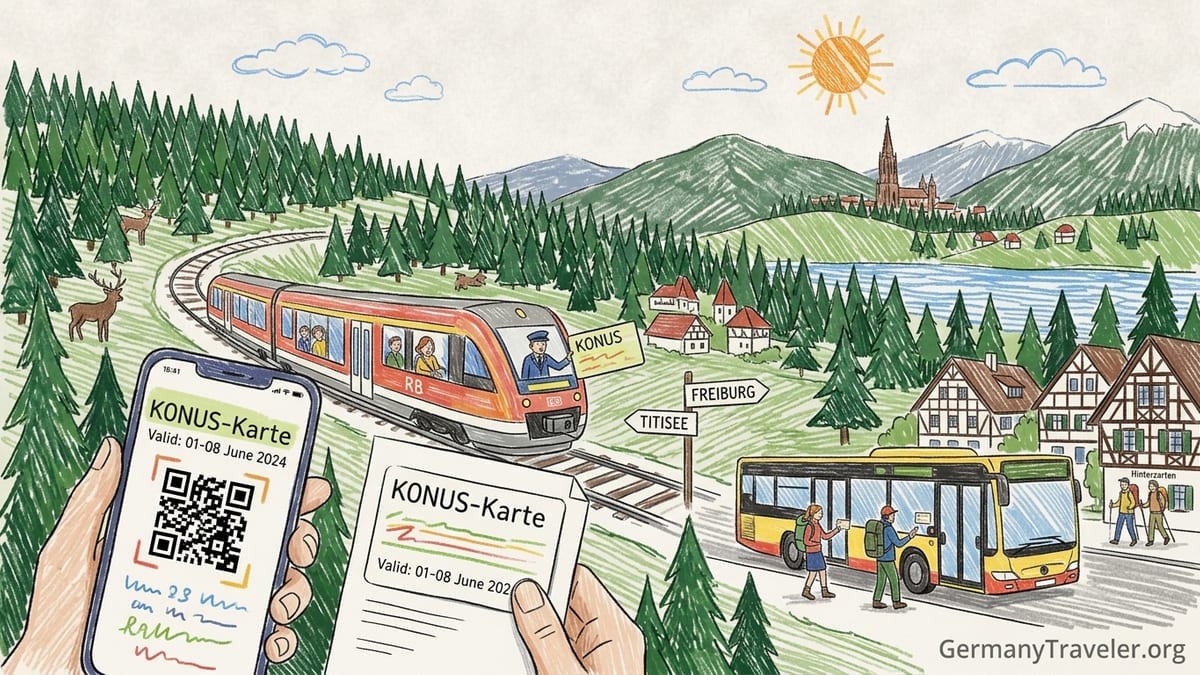
My experiment started in Hinterzarten, one of the classic Black Forest resort villages and part of the official KONUS network. When I checked in at a small guesthouse near the station, the owner took my passport, calculated the local visitor tax and printed a combined guest registration and KONUS card on A4 paper. The card showed my name, dates of stay and a barcode along with the familiar Black Forest logo. There was no extra charge for the card beyond the visitor tax, which is how the local authorities finance the scheme across roughly 150 participating towns and villages.
Alongside the paper card, I received an email inviting me to activate a digital version in the regional app that many hosts now use. On my phone the KONUS card appeared as a QR code with the same validity dates as the paper copy. During the week I used both: the paper version stayed in my daypack as a backup, while the digital card became my default for quick checks by bus drivers and train conductors.
The conditions were explained clearly in a short English leaflet from the local tourist office. The KONUS card was valid for unlimited second class travel on regional trains and buses across participating transport networks and also on trams and buses in Freiburg and Karlsruhe. Long distance and high speed services such as ICE, IC, EC and ECE were explicitly excluded, which meant every journey I planned had to stick to the slower but far cheaper regional network.
Crucially, the card was valid only for the duration of my registered stay and for personal travel. Staff at the tourist office reminded me it could not be used on the day I arrived in the Black Forest, only from my first overnight, and it would stop being valid on the day I checked out. That constraint shaped how I structured the itinerary, starting and finishing in cities just outside the KONUS system and planning my longer regional hops in between.
First Journeys: Hinterzarten to Freiburg and Back
My first test of KONUS came on the Höllentalbahn, the famous valley railway linking the Upper Black Forest with Freiburg. From Hinterzarten station I boarded a double deck regional train heading west through Titisee to Freiburg, a route specifically named in KONUS material as being covered for card holders. On the platform I kept half expecting to fumble with a ticket machine, but instead I simply stepped on, sat down in second class and kept my KONUS card ready for inspection.
Ticket checks on this line were regular. On the first journey a DB Regio conductor came through the upper deck about ten minutes after we left Titisee, scanning barcodes and checking passes. When I handed over the KONUS card on my phone, he glanced at the dates and the printed “2. Klasse” note and nodded me through without a separate ticket. On later trips different conductors reacted in exactly the same way. Nobody questioned the card for regional trains on that route, which did a lot to increase my confidence in using it further afield.
Arriving in Freiburg, the KONUS advantage continued. The card included the local tram and bus network run under the Regio-Verkehrsverbund Freiburg, so from the main station I transferred straight to a city tram without buying another ticket. The card behaved like a day pass in practice: I rode into the old town for a market visit, then later out towards the university quarter and finally back to the station, all on the strength of that same QR code.
What struck me most on this first day was how low-friction the whole process felt. There were no barriers to tap through and no need to figure out unfamiliar machines in German. Conductors and drivers clearly knew about the KONUS scheme and treated the guest card as a legitimate pass, so after one or two checks I stopped feeling like I was gaming the system and started planning longer side trips with some ambition.
Catching Buses to Trailheads and Handling Luggage
With the basics tested, I turned to what most visitors actually want to do in the Black Forest: get to hiking trailheads without a car. From Hinterzarten I used the KONUS card on regional buses heading up toward the Feldberg area, changing at Titisee to a bus that climbs past Bärental to the nature reserve. The bus was a standard low floor regional model with plenty of space for daypacks and a few larger suitcases in the standing area near the middle doors.
Drivers checked the card almost every time. In many smaller villages, you board at the front, greet the driver and show your ticket or pass. Holding my phone screen flat with the KONUS QR code visible proved the quickest method. Drivers generally glanced at the dates and sometimes the place of stay printed on the card, but I never had anyone question the fact that I was using a card issued in one town to ride buses far beyond its immediate surroundings.
Travel with luggage was more mixed. On the train legs between Freiburg, Hinterzarten and Titisee, handling a standard suitcase and backpack was easy. The double deck regional trains on the Höllentalbahn have wide doors and dedicated multi purpose areas at the carriage ends where suitcases and even prams can be parked without blocking the aisle. On one transfer day I moved accommodation from Hinterzarten down to the lakeside resort of Schluchsee using only regional trains, managing the entire move with a single change of platform and no stairs thanks to lifts at the interchange station.
Buses were more complicated on days when I was switching bases entirely. On a move from Schluchsee to a guesthouse near Todtnauberg, the route involved a regional train back to Titisee and then a bus that threaded through several small villages on narrow roads. The bus had limited luggage space, and several hikers were boarding with rucksacks, so I ended up standing with my suitcase braced between my legs, trying not to let it roll while the vehicle swung through hairpins. It was still manageable, but for anyone with bulky gear or mobility issues, planning these transfers at quieter times of day would make a big difference.
Where Public Transport Surprised Me in a Good Way
Across the week, there were several moments when KONUS plus the regional network dramatically exceeded my expectations. One was the sheer frequency of trains on the main valley routes. On sections like Freiburg to Titisee and onward toward Donaueschingen via the Höllental and Schwarzwald lines, regional trains operated at least hourly during the day, with extra services in peak periods. That meant I could finish a hike, check the stop timetable and usually expect a connection within half an hour without obsessively planning each leg days in advance.
The integration between trains and buses was another pleasant surprise. Around Titisee and Feldberg, bus timetables were visibly coordinated to meet arriving trains, often waiting on the station forecourt so that hikers could step off one mode and straight onto another. On one afternoon return from the Feldberg summit area, the bus pulled into Titisee just as a regional train to Freiburg was boarding on the opposite track. I crossed the platform, jumped on with my KONUS card in hand and found a seat without any stress, effectively turning what could have been a complicated mountain return into a smooth through journey.
Freiburg itself demonstrated how powerful the card can be in an urban setting. With trams and city buses fully included, I used the city as a base for a day that combined urban sightseeing with a rural excursion. I spent the morning in the old town, then used the tram network to reach the valley station of the Schauinslandbahn cable car for broad views over the Black Forest ridges. The KONUS card did not cover the cable car itself, but by removing all costs for the connecting legs it turned what might have been a fiddly combination of single tickets into an easy, low friction day out.
In Karlsruhe, another city where KONUS covers the local trams and buses, the card transformed a simple transit stop into a short city visit. Breaking the journey for a few hours, I left my luggage in a station locker, hopped on a tram into the center for a quick look at the palace and surrounding gardens, and came back again later, all still on the same KONUS card that had brought me there from the Black Forest interior. That seamlessness between deep rural valleys and mid size cities was one of the biggest strengths of the system.
Missed Connections, Delays and How Flexible KONUS Really Is
Public transport rarely runs perfectly, and my KONUS week was no exception. The biggest stress test came on a cloudy afternoon return from Schluchsee to Hinterzarten. A regional train arriving from the east was delayed by about fifteen minutes due to a signal fault, which meant the planned connection at Titisee for Hinterzarten looked at risk. In a country where some long distance trains leave to the minute, I braced for an enforced wait of an hour on the platform.
Instead, the regional train toward Freiburg was held for several minutes to protect the connection from the late arrival. Conductors made announcements explaining that passengers from the delayed service should cross to the waiting train, and staff on the platform directed people to the correct carriage doors. In practice, it meant I still reached Hinterzarten only a few minutes later than planned, with the KONUS card covering the whole chain without any manual rebooking or compensation claims.
A more awkward episode happened on a Saturday when I tried to stitch together a long cross country route using only regional trains and buses. My plan was to travel from the central Black Forest village of Hausach toward the northern spa town of Bad Wildbad in time for an afternoon soak. On paper, the route looked feasible: Schwarzwaldbahn regional service toward Offenburg, a connection toward Karlsruhe, then a local train up the Enz valley. In reality, a minor delay of ten minutes on the first leg meant I missed the intermediate connection in full, turning what should have been three changes into a drawn out chain of alternative regional trains and an extra change at Pforzheim.
The KONUS card helped in one important way here: every alternative regional leg I cobbled together was still covered, so I never had to worry about buying a new ticket after a missed train. However, the experience highlighted a structural limitation. Because KONUS excludes long distance ICE and IC trains, I could not simply pay a modest supplement to jump on the next fast service and catch up. I had to stay within the web of regional services, which are cheaper but more vulnerable when trying to cross the region diagonally on a tight schedule.
At the micro level, there were also missed buses, some my fault and some down to timing. In one small village above Todtnau, the return bus to the valley departed from a stop signposted a few hundred metres from where my hiking trail emerged. I arrived at the road with the bus already visible in the distance and watched it disappear around the corner. The next service was almost an hour later, and there were no alternative lines. In such moments, the KONUS card is powerless. It will pay for the bus you catch, but it cannot make rural frequencies any higher than the local authority has scheduled.
Where You Still Feel the Lack of a Car
Despite the strengths of the KONUS system, several areas of the Black Forest still felt awkward or impractical to reach without a car. The first category was dispersed farm stays and remote guesthouses that lie a few kilometres above the main valley roads. In tourist brochures these often appear under a KONUS participating municipality, which is accurate, but in practice they might sit at the end of a steep lane far above the nearest bus stop. On one occasion near Todtnauberg, my guesthouse was almost forty minutes’ walk uphill from the last bus, a fine approach with a light daypack but much less appealing on departure day with full luggage.
Certain panoramic ridge roads were similarly difficult. Routes like the Schwarzwaldhochstrasse near Baden Baden or some of the lesser known ridges in the central Black Forest are aligned more to motorists than bus passengers. Where buses exist, they often run only a few times per day and primarily to connect school children and commuters rather than hikers. During my week, I had to rule out several tempting ridge walks simply because the outward and return buses would have left me with either an unreasonably early start or a finish in near darkness, with no taxi rank or lit village nearby.
Large theme parks and commercial attractions presented their own complications. For example, Europa Park lies within reach of some KONUS issuing towns via a combination of regional train to Ringsheim and a connecting bus toward the park gates. However, how much of that last leg is currently treated as part of the KONUS network varies by the specific bus line and operator, and not all staff are accustomed to visitors using a guest card instead of a normal ticket on what is effectively a theme park shuttle. Because of that uncertainty, I chose to focus my KONUS week on landscapes and smaller villages rather than theme parks, and I would still recommend double checking the latest local conditions if such a visit is central to your plans.
Finally, the northern edges of the KONUS area near the transition to other regions sometimes felt like administrative patchwork. Towns in the official list may be separated by small gaps where the card is not valid, especially near state borders or outside the main Black Forest valleys. When planning a long diagonal journey, I regularly cross checked my intended bus or train line with KONUS maps and regional network information to confirm that every leg was included. In most cases it was, but this extra step is worth building into your planning; without it, you may be tempted to hop on whatever bus appears, only to discover later that a short section fell outside the cooperative scheme.
Practical Lessons for Planning a KONUS Based Trip
After a week of relying on KONUS instead of a car, several practical lessons stood out. The first is to choose bases that align with good transport hubs. Places like Freiburg, Titisee, Hinterzarten, Schluchsee, Hausach, Freudenstadt and Baden Baden sit on important regional train or bus corridors and also belong to the list of KONUS issuing municipalities. From these nodes, the combination of at least hourly trains and regular feeder buses opens up a wide radius of hiking routes, lakes, small towns and viewpoints without the need to shuffle accommodation every night.
Second, it pays to respect the boundary between regional and long distance services. Train timetables in Germany often show both ICE or IC trains and the slower regional services on the same line. Since the KONUS card excludes the faster categories entirely, you must be careful when boarding at intermediate stops where both types pass through. On at least two occasions I saw visitors moving hurriedly from one train to another once they realised the sleek long distance service they had boarded would not be covered. The safest habit is to look for regional designations like RB or RE on departure boards and to avoid any connection that lists a long distance category, especially for cross country legs.
Third, think in terms of half day chunks rather than micro scheduled minutes. The freedom of unlimited regional travel within the KONUS area means you are usually better off giving yourself generous windows between key legs and then filling any spare time with a short lake walk or coffee near the station rather than trying to thread together five tight five minute changes. At hubs such as Freiburg, Offenburg or Karlsruhe there are plenty of cafes and bakeries around the station, and in smaller places like Titisee the lake shore is only a short stroll away, which softens the feeling of waiting for the next train if you have just missed one.
Finally, build some walking tolerance into your expectations. Even in areas with good buses, the most scenic guesthouses and trailheads are often one or two kilometres from the nearest stop. On my KONUS week, it was perfectly normal to finish a bus ride and then walk twenty or thirty minutes uphill on a quiet lane before reaching the start of a hike or the door of a farmhouse inn. For me that was part of the charm, but anyone hoping to step straight from bus door to hotel lobby may find the reality more physical than anticipated.
The Takeaway
Traveling the Black Forest without a car using the KONUS guest card is not a theoretical experiment. It is a practical and often enjoyable way to cross the region if you are prepared to lean into the rhythm of regional trains and valley buses. I used the card on railways ranging from the deep cut of the Höllentalbahn to the classic Schwarzwaldbahn, on buses to small villages perched above Todtnau and around the lakes of Titisee and Schluchsee, and on trams in Freiburg and Karlsruhe. At every stage, conductors and drivers recognised the card, checked dates and class, and waved me through without discussion.
The trade offs are real. You surrender the ability to improvise long detours at the last minute on fast motorways, and you must accept that some panoramas, farm stays and ridge roads remain difficult to reach in a single day by public transport. Yet you gain something just as valuable: the chance to watch villages roll past your window, read trail descriptions while you ride, and arrive at town centers instead of looking for parking on the edge of the forest.
If your idea of a Black Forest holiday is a fast moving tick list of scattered attractions, a car will still serve you better. But if you like the thought of settling into a handful of well connected bases, using regional trains and buses as your backbone and your KONUS card as a quiet, frictionless passport across valleys and ridges, then traveling without a car is not just possible. It is, as I discovered over a week of real world trial and error, one of the most rewarding ways to understand how this forested corner of southwest Germany really fits together.
FAQ
Q1. How do I get a KONUS guest card for the Black Forest?
The KONUS card is issued by participating accommodation providers in around 150 Black Forest towns and villages. You receive it when you check in and complete the local registration form, usually after paying the visitor tax that finances the scheme.
Q2. Which trains and buses can I ride with the KONUS card?
The KONUS card is valid for second class travel on participating regional trains and buses across the Black Forest, plus trams and buses in Freiburg and Karlsruhe. High speed and long distance services such as ICE, IC, EC and ECE are not included.
Q3. Can I use the KONUS card on the day I arrive in the Black Forest?
No. The card becomes valid from the first overnight of your stay. Often you will need a separate ticket to reach your first KONUS base, then you can use the card for all subsequent regional journeys during your stay.
Q4. Is the KONUS card enough for visiting theme parks like Europa Park?
The KONUS card can usually cover the regional train to nearby stations such as Ringsheim, but coverage of dedicated shuttle buses and last mile services can vary. It is safest to check current local information and be prepared to buy a separate ticket for any section that falls outside the KONUS area.
Q5. How often are ticket checks when traveling with the KONUS card?
On main regional lines such as the Höllentalbahn and Schwarzwaldbahn, ticket checks are quite regular, and bus drivers commonly check passes when you board. You should always carry your KONUS card, either on paper or digitally, and be ready to show it when asked.
Q6. Is it realistic to move hotels in the Black Forest using only KONUS and public transport?
Yes, provided you choose bases near train stations or main bus routes. Moves between hubs like Freiburg, Titisee, Hinterzarten and Schluchsee are straightforward by regional train, though moves to remote farm stays or ridge top pensions can involve uphill walks from the nearest stop.
Q7. How should I plan for missed connections when relying on regional trains and buses?
The KONUS card itself remains valid on alternative regional routes if you miss a connection, so costs are not the issue. The main challenge is time. Allow generous margins for cross country journeys and avoid itineraries that depend on long chains of tight connections.
Q8. Are there parts of the Black Forest that are still hard to reach without a car?
Yes. Dispersed farm stays high above the valleys, some panoramic ridge roads, and a few peripheral areas near the edge of the KONUS zone can be awkward with public transport, especially on weekends or in the evening when services thin out.
Q9. Can families with luggage comfortably use KONUS on buses and trains?
Regional trains usually handle suitcases well thanks to multi purpose areas near the doors. Buses have less space, particularly on winding mountain routes, so families with bulky luggage may find transfers easier outside peak times or by choosing bases close to train stations.
Q10. Is a car still useful in the Black Forest if I already have the KONUS card?
A car remains useful for very dispersed sightseeing and spontaneous long detours, especially to remote trailheads or ridge roads with few buses. However, if you focus on well connected hubs and are willing to walk a little from stops, the KONUS card plus regional transport can comfortably replace a rental car for many trips.