


On a warm weekday in early July 2026, I finally spent a full day at Europa-Park, Germany’s largest theme park on the edge of the Black Forest. I went in as a planner with spreadsheets, crowd calendars and a carefully chosen ticket date. I came out with sore feet, a phone full of photos and a much clearer sense of what actually matters when you are on the ground in Rust: how early to arrive, which ticket to book, where to eat, and whether one day really does Europa-Park justice.
Booking Europa-Park Tickets For Summer 2026
I booked my Europa-Park ticket about three weeks before my visit, for a weekday in the middle of the 2026 summer season. In 2026, the official summer period ran from 28 March to 25 September, with the park open daily from 9:00 a.m. to at least 6:00 p.m., and often later in high season. Buying online in advance is heavily encouraged and, in practice, feels close to mandatory for popular dates because same-day availability can disappear quickly on school holidays and Saturdays.
For 2026, standard online adult day tickets were date-based and dynamic, with most summer weekdays falling somewhere between about 67 and 76 euros for one day, and roughly 127 to 143.50 euros for two days, depending on the specific date and demand. My early July weekday landed right in the middle: I paid just under 72 euros for a one-day adult ticket booked directly via Europa-Park’s own ticket portal. That price included access to all the park’s main attractions and shows, from family boat rides in the Scandinavian area to headline roller coasters like Silver Star and Voltron Nevera.
The booking process itself was straightforward. I selected a fixed date, added a digital ticket to my account and received a QR code within minutes. A useful detail for planners: once you lock in a dated ticket, changes are limited. You can normally move to a different date within the same price category if availability exists, but you cannot simply show up on any random day. For a park where summer weekends can feel close to capacity, picking the right date in advance is one of the most important decisions you will make.
In hindsight, I was happy I chose a Tuesday. Weekdays outside German and French school holidays tend to be noticeably calmer. On my visit, headline coasters rarely exceeded about 45 to 60 minutes, while many family rides hovered in the 10 to 25 minute range for much of the day. A friend who went on a Saturday in the same period reported queues that were easily half again as long for the same attractions.
Getting There: Driving, Parking and Train Options
Europa-Park sits just outside the small village of Rust in southwest Germany, in the Rhine valley between Freiburg and Offenburg. You really feel the Black Forest as you approach; the last stretch is a patchwork of fields and low hills with wooded ridges in the distance. I chose to arrive by rental car from Freiburg, an easy drive of roughly 35 minutes along the A5 motorway followed by a short local section into Rust.
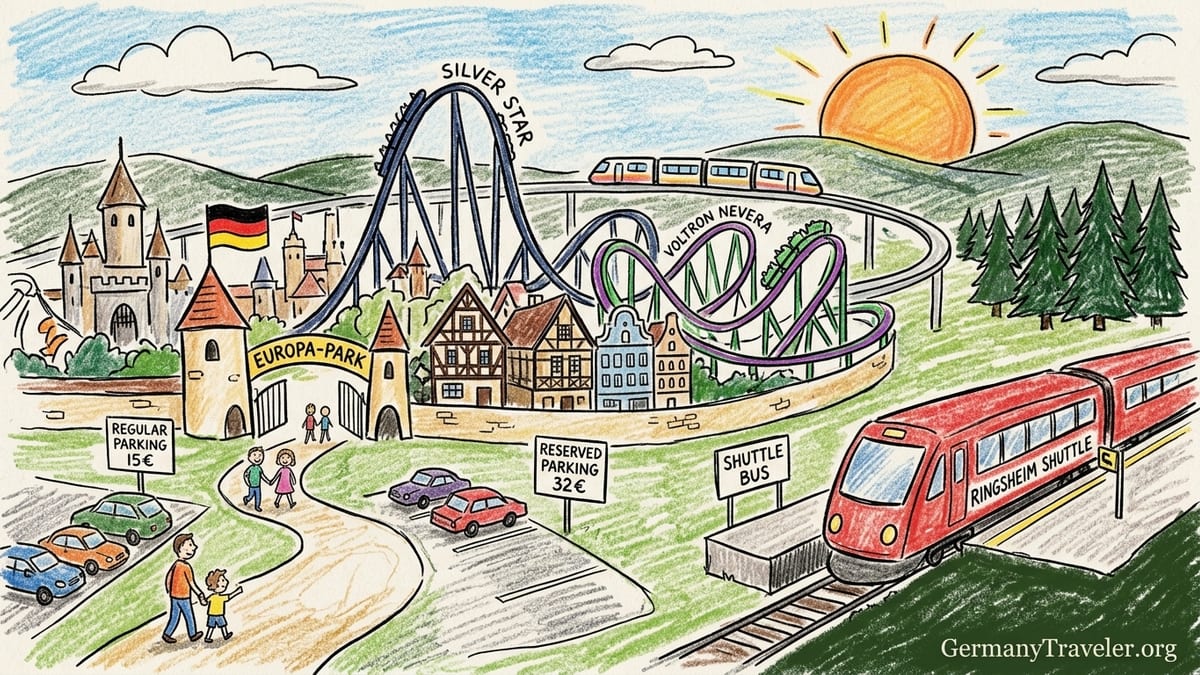
Parking is a significant but predictable extra cost. For the 2026 season, Europa-Park’s standard day parking for cars was around the mid-teens in euros for a full day in the main car park near the main entrance. There is also a reserved parking option with closer spaces that the park priced at 32 euros for 2026, sold online in advance or at the gate in limited numbers. I opted for regular parking, arrived around 8:10 a.m., and was directed to a spot in one of the closer rows, only a five to seven minute walk from the turnstiles.
Travelers without a car have more options than I expected. The Ringsheim/Europa-Park railway station on the main Mannheim–Karlsruhe–Basel line is the park’s rail gateway, with regional trains from Freiburg, Offenburg and beyond. From there, dedicated shuttle buses run to Europa-Park, Rulantica and the resort hotels, taking roughly 10 to 15 minutes depending on traffic. In 2026, local bus services operated frequently during opening hours, and on my way out in the evening I watched a steady stream of buses loading train travelers for the short ride back to Ringsheim.
If you stay in Rust itself, you are likely to move around using a mix of walking and local buses. The municipality, in partnership with the park, funds a free Rust Bus that circles between Europa-Park, the resort hotels, Rulantica and various stops in the village. I rode it the evening before my visit, from a guesthouse near the church to the hotel district, and was surprised to find departures every 20 to 30 minutes in the early evening. It made staying off-site feel almost as convenient as staying in one of Europa-Park’s own hotels.
Rope Drop: Arriving Before Opening And First Queues
Although Europa-Park’s published hours for the 2026 summer season listed opening at 9:00 a.m. and closing at 6:00 p.m. or later, the experience on the ground starts earlier. On my visit day, the main gates were already processing early arrivals shortly after 8:30 a.m. Guests staying in the resort hotels had access to selected areas even earlier, but regular day visitors like me were held just inside the gates until the official opening.
By 8:45 a.m., a decent crowd had formed just beyond the turnstiles, with many people clustering toward Germany and France, the first themed areas on the left and straight ahead, ready to speed-walk to their chosen headliners. I decided on a variant of the classic rope-drop strategy: skip Silver Star first thing and instead head deeper into the park toward Greece and the new Voltron Nevera coaster while most people were still being entertained near the entrance.
At exactly 9:00 a.m., the internal ropes were removed, and the controlled shuffle became a polite rush. I walked directly to Voltron Nevera, arriving around 9:07 a.m. The posted wait was 25 minutes, but in reality I was in the station in about 18 and seated in the second half of the train. This early ride set the tone for the rest of the morning: by targeting a top attraction in the back half of the park at opening, I avoided the crowd that instinctively stopped at the first big ride they saw.
Following Voltron, I looped back toward Switzerland and France. By 10:00 a.m., Silver Star had climbed to a posted 40 minute wait, which was still reasonable compared with peak afternoon times. I joined the queue, which wound neatly through shaded switchbacks. The actual wait ended up close to the posted time. In that first two hour window, I managed to ride Voltron Nevera, Silver Star and the classic indoor-powered coaster Alpenexpress in Austria. For a park that can easily overwhelm first-timers with size and choice, those early hours are where careful planning pays off.
Midday Crowds, Ride Waits And Children’s Suitability
From late morning onward, Europa-Park’s size becomes both a blessing and a challenge. With more than a dozen themed European areas and over 100 attractions and shows, there is always something to do, but popular rides develop substantial queues between about 11:00 a.m. and 4:00 p.m. On my weekday visit, Blue Fire Megacoaster in Iceland hovered around 40 to 50 minutes most of midday. Arthur, the suspended family coaster in the indoor “Kingdom of the Minimoys” area, was consistently near an hour at peak, thanks to its broad appeal and limited capacity.
I traveled without young children, but I deliberately tested how family-friendly the park felt by observing height checks and spending time in areas like Ireland, Grimm’s Enchanted Forest and the junior coasters. The general impression: families with kids in the 4 to 12 age range may find Europa-Park close to ideal. Many headline attractions have height limits in the 120 to 130 centimeter range, but there is a long list of gentle boat rides, carousels, play areas and smaller coasters with lower or no height requirements. I watched one family with a five-year-old bounce cheerfully between the Wodan Timburcoaster viewing area and the nearby playgrounds, while their older child rode the wooden coaster with a parent.
Queue management felt more old-school than at some parks that rely heavily on paid line-skipping services. Europa-Park does not run a universal, all-day fast pass, and that creates a relatively level playing field. Instead, the park leans on sheer ride capacity and long operating days. In practical terms, this meant I had to make peace with a few 40 to 60 minute waits for signature rides but enjoyed many sub-20 minute queues for mid-tier attractions and almost walk-on conditions for several indoor shows and dark rides in the late afternoon.
For visitors with younger children or anyone sensitive to long queues, an effective strategy is to concentrate your thrill rides before 11:00 a.m. and after 5:00 p.m., then devote the busiest slice of the day to shows, water rides, walk-through attractions and meal breaks. During my own visit, I ducked into a 30 minute ice show just as the sun baked the queues outside, then followed it with a leisurely boat trip through the Scandinavian fjords. My step count still climbed, but my patience level remained surprisingly intact.
Eating Inside The Park: Prices, Quality And Timing
Food in Europa-Park is both a practical necessity and part of the thematic experience. Throughout the day I made a point of sampling different options to understand the range in price and quality. Early in the morning, not long after Silver Star, I grabbed a simple breakfast-style snack at a bakery counter in the German main street area: a pretzel and a coffee for just under 6 euros total. It was not a bargain by supermarket standards, but for a theme park entrance street it felt relatively fair, and the line moved quickly.
For lunch, I headed to the Italian area and chose a self-service pizzeria. A substantial slice of margherita pizza, a small salad and a soft drink came to around 15 euros. Seating was plentiful on the terrace, but the ordering area grew busy by 12:30 p.m. The pizza was exactly what you want in the middle of a theme park day: hot, straightforward and filling. Looking at neighboring tables, families of four were spending somewhere in the mid 40s to low 50s in euros for lunch here, depending on how many drinks and desserts they added.
In the afternoon, as temperatures peaked, I sought shade in the Scandinavian area and tried a fish-and-chips counter. A portion of fried fish, fries and a non-alcoholic drink cost me a little over 17 euros. Portions here were larger than at lunch, and I probably could have shared if I had not been quite so hungry. Throughout the park, basic snacks like ice cream, crepes and churros hovered around the 4 to 6 euro mark, while bottled drinks were usually in the 3 to 4 euro range. You are allowed to bring your own snacks and non-alcoholic drinks, and I saw plenty of families unpacking sandwiches at shaded picnic tables to keep costs under control.
One subtle but useful tip is to shift your mealtimes slightly off the peak. When I ate lunch closer to 11:45 a.m. and my big afternoon snack around 3:00 p.m., I often found shorter queues at food counters and could use traditional meal times, like 1:00 p.m., to ride attractions with temporarily reduced waits. At 1:15 p.m., for example, Wodan dropped from a posted 45 minutes to closer to 30, and I was on and off the wooden coaster well before most people had finished their main meals.
Afternoon Slump, Evening Energy And Showtime
By mid-afternoon, a kind of collective fatigue settles over Europa-Park. The early-morning energy dissipates, heat builds in the concrete plazas, and parents begin to negotiate with children about which rides are realistic and which will have to wait until next time. For me, this period between roughly 2:30 p.m. and 4:30 p.m. was when I shifted gears from aggressive ride-hopping to a more relaxed circuit of the park, prioritizing shade, water and atmosphere.
I used the panoramic monorail, which follows an upper-level route with multiple stops, as moving shade and transport. From its vantage point, you feel just how sprawling Europa-Park is, with roller coaster track weaving between hotel facades, waterways and landscaped gardens. I disembarked in the Spanish area and slipped into a late-afternoon stunt show that offered air conditioning and seating, exactly the respite my feet wanted. While the show itself is included in the ticket price, it also functions strategically as a way to reset and cool down.
Energy returns after 5:00 p.m., when temperatures soften and some day visitors start to leave for long drives home. On my July weekday, Europa-Park extended its closing time beyond the baseline 6:00 p.m., and ride queues visibly shortened from about 5:30 p.m. onward. I re-rode Blue Fire with a posted 25 minute wait that delivered more quickly than promised, then circled back to Arthur for a final suspended glide through its glowing indoor world, waiting about 35 minutes instead of the hour I had seen earlier.
The biggest surprise of the evening was how beautiful the park felt once the sun dropped behind the Black Forest hills. Lanterns lit the walkways in the Swiss and Austrian areas, fountains turned golden, and the ambient noise mellowed from frenetic to almost festive. If your schedule allows, it is worth planning to stay until closing not just to maximize ride count but to experience this calmer, almost romantic version of Europa-Park that appears after the day-tripper rush fades.
Was One Day Enough For Europa-Park?
The question I had before arriving, and the one most friends asked afterward, was whether one day at Europa-Park is enough. After a full open-to-close visit, my honest answer is: one well-planned day is sufficient for a strong first taste, but two days are ideal if you want to experience most headline attractions without feeling rushed.
In my single day, I managed to ride seven major coasters, several mid-tier thrill rides, multiple family dark rides, and fit in two full shows plus unhurried meals. I did not feel I had wasted time, yet entire areas such as the more detailed corners of Grimm’s Enchanted Forest and some smaller flat rides in Spain and France went untouched. Stepping onto the Rust Bus that evening, I had the distinct feeling of unfinished business.
From a cost perspective, the two-day ticket prices for 2026, typically between about 127 and 143.50 euros for adults depending on exact dates, represent better value per day than buying two single-day tickets separately. If you are traveling with children or a mixed group with different ride appetites, that extra day can transform the tone of the trip. Instead of rushing from Silver Star to Blue Fire in one marathon, you can devote one morning to the bigger coasters and another to family-oriented areas, with time left over to explore Rulantica on a separate ticket if water parks appeal.
That said, not everyone can spare two full days, and Europa-Park remains a worthwhile one-day destination if you accept its limits. For short trips, I would suggest prioritizing either thrill rides or family experiences rather than trying to do absolutely everything. If your group includes coaster enthusiasts, design the day around Silver Star, Blue Fire, Wodan and Voltron. If you travel with younger children, anchor your visit around Arthur, the Irish and Scandinavian areas, and the shows, letting the biggest coasters be optional extras for those who meet height requirements and enjoy intense rides.
The Takeaway
Looking back on my July 2026 visit, what stands out most is not a single ride or meal, but the overall rhythm of the day. Europa-Park rewards early arrivals, flexible plans and respect for its scale. The combination of dynamic ticket pricing, long opening hours and high-capacity rides means that the experience you have is directly shaped by the choices you make in the weeks and hours leading up to your visit.
Booking in advance, ideally on a calmer weekday, locks in a fair price in the current 67 to 76 euro band for adult single-day tickets and avoids unpleasant surprises at the gate. Choosing how you arrive, whether by car and paid parking or by train to Ringsheim/Europa-Park followed by a short bus ride, can make the difference between starting your day stressed in a traffic queue or relaxed with coffee in hand, watching the gates open.
Inside the park, success is less about conquering a checklist of rides and more about understanding how crowds move. Headliners fill up mid-morning and soften in the last hours before closing. Meal queues spike right when ride queues dip. Children who tire early may be happier with repeated laps of a smaller area than with cross-park treks in search of the next big thing. There is no single perfect route through Europa-Park, only versions of a day that suit different groups and energy levels.
If you are considering a visit during the 2026 operating year, which stretches from the March summer opening through Halloween and winter seasons, think about what kind of memories you want to create. For some, that will be a blur of airtime hills and inversions against a backdrop of the Black Forest. For others, it will be a lazy boat ride through miniature European villages, a shared pizza in the Italian square, and the glow of lanterns over the lake at closing. Either way, a little planning goes a long way in turning a day at Germany’s biggest theme park into a genuinely satisfying short break.
FAQ
Q1. How far in advance should I book Europa-Park tickets for 2026?
For summer 2026, I found that booking two to four weeks ahead gave a good balance of price and availability, especially for weekdays. Peak Saturdays and school holidays can sell out earlier, so families tied to those dates should book as soon as they fix travel plans.
Q2. How much did a typical adult day ticket cost during your 2026 visit?
On my early July weekday, I paid just under 72 euros for an adult one-day ticket booked online directly with Europa-Park. In 2026, most adult day tickets fell between about 67 and 76 euros, depending on the specific date and demand level.
Q3. Is it better to visit Europa-Park by car or by train and bus?
Driving offers maximum flexibility, especially if you are staying off-site in the Black Forest, but comes with parking fees and potential traffic near opening and closing. Taking regional trains to Ringsheim/Europa-Park and then a short shuttle bus ride removes parking stress and can be faster for solo travelers or couples coming from cities like Freiburg or Offenburg.
Q4. How early should I arrive at Europa-Park before opening time?
On my visit, arriving around 8:10 a.m. put me near the front of the regular parking area and through the turnstiles by about 8:30 a.m. Being at the internal ropes before the 9:00 a.m. opening allowed me to ride a major coaster within 20 minutes, which set a positive tone for the day.
Q5. What kind of queues should I expect for the biggest rides in summer?
On a mid-season weekday, headliners such as Blue Fire, Wodan and Arthur often posted 40 to 60 minute waits in the middle of the day, while thrill coasters like Voltron Nevera and Silver Star were closer to 30 to 45 minutes outside absolute peak times. Many family and mid-tier attractions stayed in the 10 to 25 minute range.
Q6. Is Europa-Park suitable for younger children under 8 years old?
Yes, there are extensive family areas, gentle boat rides, playgrounds and smaller coasters designed for younger children, along with clear height restrictions at each attraction. Families I observed with children between about 4 and 8 years old were able to fill the day comfortably without relying on the biggest thrill rides.
Q7. How expensive is food inside Europa-Park?
Expect to spend around 12 to 18 euros per person for a main meal with a drink at quick-service locations, and 4 to 6 euros for basic snacks like ice cream or crepes. Bringing your own snacks and reusable water bottles can significantly reduce total food spending for the day.
Q8. Are one or two days better for a first-time visit?
One well-planned day is enough to experience several major coasters, a few shows and some quieter areas, but two days allow for a far more relaxed pace. If your budget and schedule allow, two-day tickets, typically between about 127 and 143.50 euros in 2026, provide better value per day and reduce the pressure to rush.
Q9. Do I need any kind of fast pass to enjoy Europa-Park?
Europa-Park does not rely on a universal paid fast pass system. During my visit I managed a full list of rides without any line-skipping products by arriving early, targeting popular attractions at opening and again in the evening, and using the busiest midday window for shows, meals and lower-demand rides.
Q10. Which seasons in 2026 offered the best experience at Europa-Park?
The 2026 summer season ran from 28 March to 25 September, followed by distinct Halloween and winter periods. Summer brings longer days and full ride availability, Halloween adds seasonal decorations and darker moods, while winter offers a more atmospheric, festive park experience. The best choice depends on whether you value maximum ride time, seasonal events or holiday ambiance.