


I thought I was prepared for Triberg Waterfalls. I had checked the 2026 ticket prices, read that the paths could be steep, and told myself it would be a simple Black Forest stroll. Instead, my visit turned into a surprisingly physical walk, a mini logistics puzzle with parking and entrances, and a lesson in how to squeeze maximum value out of a single Triberg ticket. Here is exactly how my day unfolded, what I learned about tickets and terrain, and what I would do differently next time.
Starting the Day: Getting to Triberg and Finding Parking
I arrived in Triberg by car, driving the B33 through the Kinzigtal, a route that already feels like a Black Forest postcard. My goal was simple: park once, walk the waterfalls, and still have enough time and energy for the town’s cuckoo clock shops and cake. Triberg is compact but hilly, so where you park quietly shapes your whole visit.
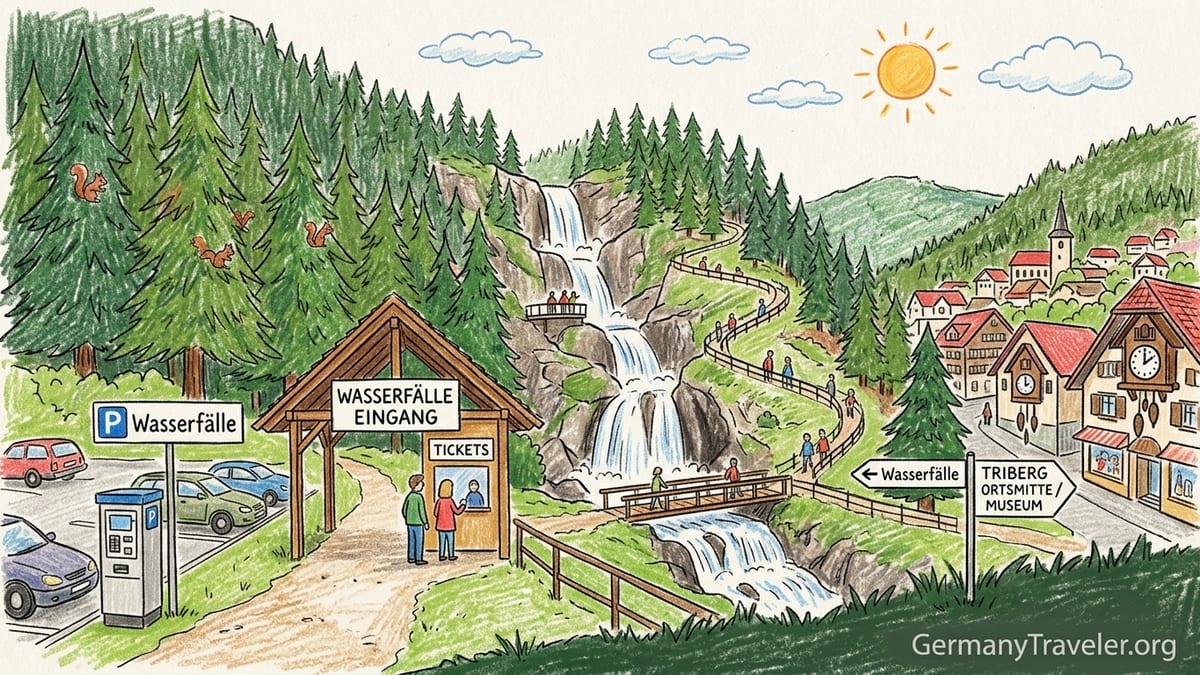
Because I wanted the classic experience, I headed straight for the main waterfall entrance on Hauptstrasse, near the tourist information office. Around this central area you will find several public car parks that are signed for Wasserfälle. I chose a small pay-and-display lot just a short walk above the main entrance, so I could reach both the ticket office and the old town without driving again. Fees when I visited were in line with other small tourist towns in southern Germany, and I paid at a standard parking machine with coins and card.
If you arrive by train, Triberg station sits above the town on the famous Black Forest railway line. From the station it is roughly a 15–20 minute downhill walk into the center, and then just a few more minutes along Hauptstrasse to the main waterfall gate. The route is paved the whole way, but with luggage it feels long and steep, so I was quietly relieved to have left my big bags at a previous stop. For anyone staying overnight, it makes sense to drop bags at your guesthouse first, then walk down lightly to the waterfalls.
In hindsight, the most important thing about arrival is deciding whether you want to start from the bottom, like I did, or park higher up near Bergsee or Scheffelplatz and walk down through the forest first. Triberg has several signed access points, and that flexibility is useful once you understand how the paths connect.
Buying Tickets in 2026: Prices, Guest Cards and What Is Included
At the main gate I joined a short line of day trippers and coach groups. The ticket board confirmed what I had checked in advance: in 2026, adult admission is 9 euros in summer and 7 euros in winter, with slightly reduced pricing for holders of local guest cards issued by participating accommodations. Children, families and groups have their own discounted categories, but it was the adult price that mattered to me as a solo traveler.
The pleasant surprise came when I asked about what the ticket included. Staff explained that my waterfall ticket did not only cover the paths and viewing platforms. On the same day, it also granted free access to the Schwarzwaldmuseum, the small Triberg-Land model world with interactive layouts, and the Instagram-focused Triberg-Fantasy photo attraction. All three are within walking distance in town. For the same 9 euros I was essentially getting a half-day of nature and a half-day of indoor sightseeing for when the weather turned.
Because I was staying in a local guesthouse, I also had a guest card that slightly reduced the ticket price. The reduction was modest, but it is still worth presenting your guest card at the window. In a region where many travelers stay two or three nights and repeat attractions add up, shaving a euro or so off multiple tickets can quietly pay for a slice of Schwarzwälder Kirschtorte later on.
If I were visiting again in peak summer, I would strongly consider arriving early in the morning to avoid the largest coach crowds at the ticket office. Around late morning, the area in front of the main gate was already busy with tour groups, and while the line moved quickly, the noise level and jostling for the best path up the first section made the entrance feel more crowded than the rest of the trail.
Choosing the Entrance: Main Gate, Bergsee, and the Asklepios Clinic Access
Triberg Waterfalls has more than one way in, something I only fully appreciated once I saw the area map in person. There is the main entrance on Hauptstrasse, where I started, and additional access points at Bergsee, Scheffelplatz, Adelheid and behind the Asklepios clinic. Each changes how steep your first steps feel and how quickly you reach the higher cascades.
The main entrance is the most obvious and atmospheric. You walk under a gate, buy your ticket at a traditional booth, and see the lower section of the falls almost immediately. That instant payoff is the reason so many day trippers start there. The trade-off is gradient. From this point, the path zigzags up the gorge. Even though it is well surfaced, you gain height quickly. I watched several visitors in casual city shoes stop to catch their breath within the first ten minutes.
There is also an entrance near the Asklepios clinic at Ludwigstrasse 1 which provides a largely level, more accessible path to the first major platform. This is useful if you or someone in your group uses a stroller or wheelchair, or simply prefers to avoid steep initial climbs. Staff at the main gate can point you to this entrance, and it is signposted around town. In person, I saw how much gentler this section looked compared with the first zigzags from Hauptstrasse.
Some visitors drive up to the small parking areas at Bergsee or Scheffelplatz and walk down into the waterfall area from above, then later exit at the main gate and use local buses or a longer town walk to return. On my visit I stayed with the classic bottom-up route, but after feeling the burn in my calves, I understood why many repeat visitors plan a top-down walk instead.
On the Trail: Path Conditions, Steepness and Slippery Sections
The first thing you notice after passing the ticket checkpoint is the sound. Even on a relatively dry day, the Gutach river roars as it drops roughly 160 meters in a chain of seven cascades. The air is cooler and damper than in town. Within a minute or two, the smooth pavement of Hauptstrasse gives way to stone and gravel paths edging the water.
In summer conditions like I had, the main route up from the bottom felt like a moderate city hike. The path is wide enough for two people side by side in most sections, fenced with wooden rails, and regularly broken up by viewpoints and benches. Still, the gradient is consistent. Over about 45 minutes of walking, with frequent stops for photos, I gained considerable height. Anyone with knee issues should be ready for frequent short climbs and descents between platforms. Trail shoes or trainers with grip are genuinely helpful here. I saw more than one person in smooth-soled sandals shuffle cautiously down wet stone steps.
Water spray makes certain corners of the path slick even in summer. One stepped platform built slightly out over the water was especially damp, and the rock beneath showed the polish of tens of thousands of boots. Handrails help, but I found myself slowing down, especially while passing other visitors. This becomes more pronounced in shoulder seasons after rain, when leaves or pine needles add another slippery layer underfoot.
In winter, which I experienced on a separate short visit months later, access is generally limited to the lower section of the falls. The town confirms that during the winter opening period, from roughly November until early April, the area is cleared and gritted only up to the lower main fall and first platform. Higher circular circuits are blocked for safety when paths are icy or snow-laden. Under those conditions the lower path felt safe but undeniably slick in patches, and I was thankful for boots with good tread and warm layers as spray turned to a fine icy mist near the water.
Crowds, Atmosphere and How Long the Walk Really Takes
Official descriptions sometimes talk about leisurely strolls and suggest that the waterfalls can be seen in under an hour. That is technically true if you walk directly up and back down with minimal stops. My experience, and what I saw most visitors actually do, is different. To enjoy the views fully, you will almost certainly pause at multiple platforms, wait patiently while people take photos, and perhaps detour along one of the signposted thematic routes such as the Naturweg or Kulturweg.
From the main entrance to the highest accessible platform and back down, including plenty of photos and short breaks, my total waterfall time was just under two hours. That did not feel rushed. It allowed me to linger at viewpoints, watch red squirrels dart through the trees, and simply listen to the water. Families with younger children took a little longer, especially when stopping at every bridge, while fitter hikers who treated it as a workout moved faster.
In summer the gorge can feel busy. On my mid-morning visit, clusters of tour groups moved in waves. The trick I found was to pause at a bench or minor side viewpoint and let a group walk ahead. Within minutes, the section behind them thinned out, and I had quiet stretches of trail almost to myself. Early morning and late afternoon are noticeably calmer times, especially outside school holidays.
The atmosphere changes dramatically at night. The waterfalls are lit until late in the evening, and on my second, shorter winter visit I walked to the first platform after dark. The path was quieter, the town’s neon cuckoo clock signs receded into the background, and the illuminated, partly frozen water felt almost theatrical. Even if you visit only the lower section in winter, this nighttime view alone can justify the entry fee for photographers or anyone who enjoys moody landscapes.
Beyond the Ticket Gate: Making Use of the Included Attractions
Back in town, it is easy to forget that your waterfall ticket still has value after you exit the gorge. I held onto my stub and used it for a relaxed circuit of the included attractions that same afternoon. The Schwarzwaldmuseum, just a short walk from the main gate, offered a surprisingly thorough look at regional history, from traditional costumes and music to the Black Forest railway that brought so many visitors to Triberg in the first place.
Triberg-Land, the model world, was another low-pressure stop. It will appeal most to families and anyone with a fondness for miniature railways and landscapes. The staff scanned my already-used ticket without issue, and I appreciated having a weather-safe activity on a day with passing showers. Triberg-Fantasy, the Instagram-oriented space filled with themed rooms and backdrops, is clearly designed for visitors who want playful, staged photos rather than in-depth cultural content, but it is also included and easy to pop into for a few minutes.
What struck me about this combination is how well it fills out a full day in such a small town. Instead of driving in only for an hour at the falls and leaving immediately, I felt the ticket encouraged me to linger. I punctuated my indoor museum time with coffee and cake at a nearby café, then walked slow loops through the cuckoo clock shops without feeling rushed back to the car.
If you are traveling on a tight budget, this bundled access noticeably increases the value of your 9 euro summer ticket or 7 euro winter ticket. You could, for example, visit the waterfalls in the cool morning, spend midday in the Schwarzwaldmuseum, and end the afternoon at Triberg-Land before catching an evening train, all covered by a single admission fee.
Was It Worth the Detour, and What I Would Do Differently Next Time
Triberg has a reputation in some circles as a tourist trap, with souvenir shops and coach groups packed into a small valley. That stereotype is not entirely unfair. The main street is lined with clock shops, and on busy days you will share viewpoints with plenty of other visitors. Yet when I stepped just a little away from the crowds, I found a genuinely impressive, classic central European waterfall in a steep forested gorge that felt much wilder than the shopfronts suggested.
For me, the detour was justified, especially when combined with other Black Forest stops like nearby lakes and small towns. The waterfalls themselves are not as broad as something like the Rhine Falls in Switzerland or as tall as some alpine cascades, but the combination of height, multiple drops and the intimacy of the gorge creates a satisfying half-day outing. The ticket price felt fair once I factored in the additional attractions and nighttime lighting.
If I were planning the same trip again, I would change three things. First, I would arrive either at opening time or later in the afternoon to avoid the busiest late-morning crush at the lower platforms. Second, I would seriously consider a top-down approach, parking near Bergsee or Scheffelplatz and walking down into the gorge to spare my knees and enjoy slightly quieter upper paths. Third, in winter I would bring traction aids or at least boots with aggressive tread to make that lower, partially icy section feel more secure.
I would also leave more deliberate time just to sit and watch the water rather than treating every platform as another photo stop. On my second visit I chose one bench with a side view of the main fall, stayed put for twenty minutes, and watched clouds move across the trees as the light shifted. In that moment, the tourist buses and souvenir shops felt very far away.
Practical Tips for Tickets, Timing and Comfort
On a transactional level, Triberg Waterfalls in 2026 are straightforward if you prepare for a few key details. Bring cash or a bank card for parking and tickets; most machines and the ticket office accept both, but it is never wise to rely on just one payment option in a small town. Keep your waterfall ticket physically with you for museum entry later in the day, and consider asking at your accommodation about guest cards or regional passes that may reduce prices or grant free admission.
Plan your timing around both crowds and light. A late-morning start from nearby Black Forest towns like Gutach or Hornberg will drop you into Triberg just as touring coaches arrive, while an 8 or 9 a.m. start can give you a quieter first hour on the trail. In winter, remember that days are short and that although the falls are lit in the evening, higher paths may be closed completely, so it is safer to enjoy the lower, prepared section while there is still some daylight.
In terms of comfort, dress as if you were going for a real walk rather than a quick city stroll. Closed shoes with good grip, a light waterproof jacket for spray and passing showers, and perhaps a small backpack for water and snacks made my experience more pleasant. There are benches and small rest areas along the path, but they fill quickly in high season, so carrying your own drink instead of relying on reaching the next café is sensible.
Finally, be realistic about mobility. The main route is not suitable for everyone. Anyone who dislikes steeper paths should consider the Asklepios clinic entrance to the first platform or focus on the lower section only. In winter, recognize that the restricted access exists for a reason. When I stood by the signs blocking the higher trail under snow, I could clearly see how one misstep on an icy, slanted boardwalk could end badly.
The Takeaway
Triberg Waterfalls turned out to be both more commercial and more rewarding than I expected. The town around the gorge leans heavily into cuckoo clock imagery and coach tourism, yet the waterfalls themselves remain an authentic and dramatic slice of Black Forest nature. With 2026 adult admission at 9 euros in summer and 7 euros in winter, including entry to several additional attractions in town, the ticket delivers solid value if you give yourself enough time to use it fully.
From a traveler’s perspective, the experience is shaped less by the raw height of the cascades and more by decisions about entrance, timing and footwear. Start at the main gate if you want instant views and do not mind a steeper climb. Choose a higher access point or the Asklepios clinic entrance if you prefer a gentler approach. Avoid the tightest crowd peaks by arriving early or late, and keep your ticket handy for museums once you have had your fill of forest and spray.
Most of all, treat Triberg as more than a quick photo stop between other sights. Give yourself the two or three hours it really takes to climb, linger and descend, then balance the outdoor drama with quieter time in town. Do that, and Germany’s famous falls feel far less like a box to tick and much more like a satisfying, well-rounded Black Forest day.
FAQ
Q1. How much are Triberg Waterfalls tickets for adults in 2026?
Adult admission in 2026 is 9 euros in summer and 7 euros in winter, with slightly reduced pricing available for holders of local guest cards issued by participating accommodations.
Q2. What does the Triberg Waterfalls ticket include besides the falls themselves?
The standard ticket includes access to the waterfall paths and viewing platforms and also grants same-day entry to the Schwarzwaldmuseum, the Triberg-Land model world and the Triberg-Fantasy photo attraction in town.
Q3. How long does it take to walk the Triberg Waterfalls?
A direct up-and-down visit can be done in under an hour, but most visitors who stop for photos and viewpoints spend about 1.5 to 2 hours walking from the main entrance to the upper platforms and back.
Q4. Are the paths at Triberg Waterfalls very steep or difficult?
The main route from the Hauptstrasse entrance is moderately steep, with stone and gravel paths and some stepped sections. It is manageable for reasonably fit visitors in good shoes, but those with knee or mobility issues may find it challenging and should consider the gentler access near the Asklepios clinic.
Q5. Is Triberg Waterfalls suitable to visit in winter?
Yes, but with limitations. In winter the prepared and gritted section usually runs only from the main entrance up to the lower main fall and first platform, while higher circular trails are often closed for safety due to ice and snow.
Q6. How crowded do Triberg Waterfalls get, and when is the best time to visit?
Triberg can be quite busy with coach groups in late morning and early afternoon, especially in summer. The quieter times on the trail are typically early morning soon after opening and later in the afternoon toward early evening.
Q7. Can I reach Triberg Waterfalls easily by train?
Yes. Triberg has a railway station on the Black Forest line. From the station it is roughly a 15–20 minute downhill walk into the town center and then a short additional walk along Hauptstrasse to the main waterfall entrance.
Q8. Is the Triberg Waterfalls trail accessible for strollers or wheelchairs?
Full access to the entire trail network is not barrier-free, but there is a more level entrance near the Asklepios clinic at Ludwigstrasse that leads along an almost flat path to the first platform, which is generally considered the most accessible section.
Q9. What should I wear and bring for a visit to Triberg Waterfalls?
Closed, grippy footwear, a light waterproof jacket and a small daypack for water and snacks are recommended. The paths can be damp from spray even in summer, and in winter warm layers and shoes with good traction are essential.
Q10. Is Triberg Waterfalls worth the detour compared with other waterfalls in the region?
Triberg is one of the best-known and most easily accessible waterfalls in the Black Forest, with good infrastructure and added attractions included in the ticket. While some travelers prefer quieter, less commercial falls elsewhere in the region, Triberg offers a strong combination of dramatic scenery, convenient access and bundled cultural experiences that many visitors find worth a dedicated stop.