

I went into my last Black Forest trip with a notebook full of advice but no clear answer to the question that actually mattered: where should I base myself. So I did what travel writers often end up doing. I tried all three of the obvious hubs in one loop, staying in Freiburg, Baden-Baden and Titisee on the same journey and using each as a base for hikes, spa days and train trips deeper into the Schwarzwald. What follows is written from that firsthand experience, and where I add extra details from later research, I label those clearly.
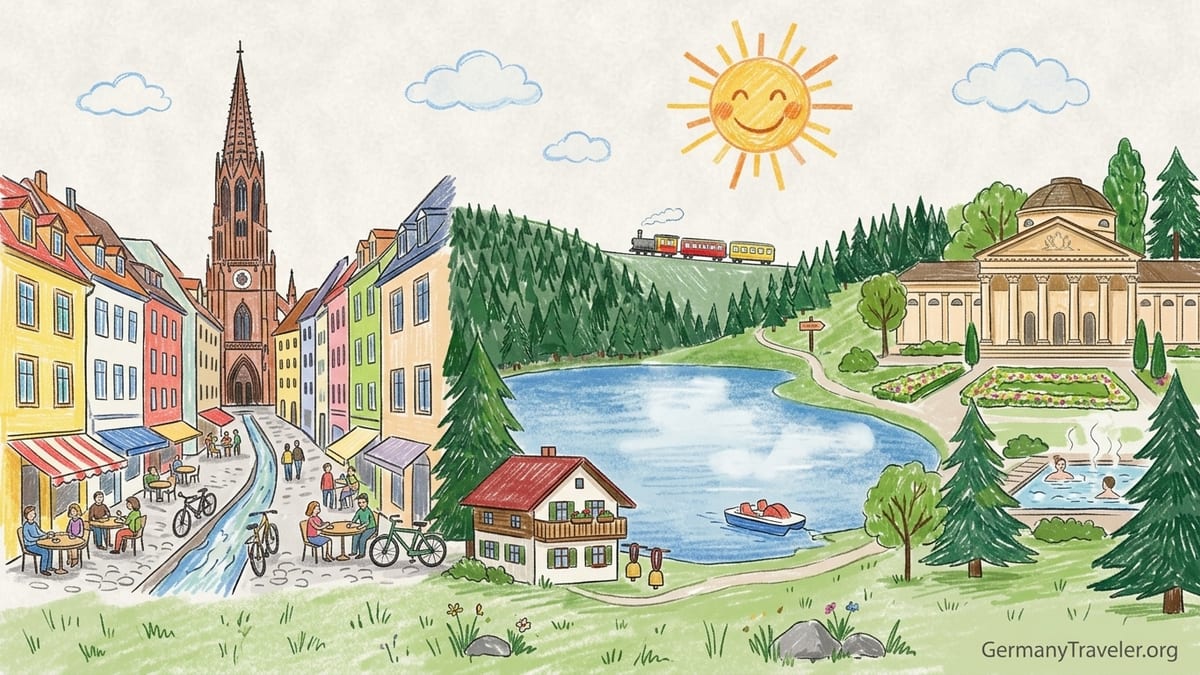
How the Three Bases Feel on the Ground
Walking out of Freiburg Hauptbahnhof on a warm evening, tram bells and bicycle lights were the first things I noticed. Within ten minutes I had wheeled my carry-on across the pedestrian bridge and into the compact old town, where people were sitting at pavement tables beside the shallow Bächle streams that run along many streets. That first night I ate Flammkuchen near the cathedral, and at about 10 pm simply strolled home through well-lit lanes, passing late-opening ice cream counters and groups of students. Freiburg felt like a real city rather than a resort, but one scaled gently enough that I never needed a taxi.
Baden-Baden, in contrast, greeted me with colonnades and quiet. I arrived on a Sunday afternoon, took the city bus up from the station, and stepped out practically in front of the Kurhaus. The streets around the Lichtentaler Allee were immaculate, lined with grand hotels, designer shops and manicured flower beds. That evening, after an early dinner in a wine bar near the Trinkhalle, the town felt more like a genteel spa village than a nightlife spot. The atmosphere was soothing and slightly formal, better for long conversations than bar-hopping.
Titisee felt different again. I reached it on the Höllentalbahn from Freiburg, watching the valley tighten into forested slopes and then open suddenly onto the lake. My guesthouse stood just behind the Seestraße promenade. On my first morning, I woke to cowbells and the faint sound of a boat motor carrying across the water. When I stepped onto the small balcony there was mist hanging over the lake and only a few joggers on the shore path. Titisee is unmistakably touristy during the day, with souvenir shops and day-trippers, but at breakfast time and again after dinner it shrinks back into a simple lakeside village.
From those first impressions alone, Freiburg suited me when I wanted energy and variety, Baden-Baden when I wanted a polished spa atmosphere, and Titisee when I craved early-morning quiet and quick access to trails.
Getting Around Without a Car
During this trip I traveled entirely by train, tram and bus. Freiburg worked best as a public transport hub. The city has its own tram and bus network and sits on east–west and north–south rail lines, with regional trains heading into the Black Forest, toward Basel and toward Offenburg. Official transport information confirms that the local operator, VAG Freiburg, runs an extensive tram system feeding into the main station, so I could roll out of my hotel after breakfast, step on a tram and be at the platform in minutes, with no need to plan around parking.
From Freiburg I used the Höllentalbahn line toward Titisee several times. On one day I rode as far as Titisee, connected onto the short Dreiseenbahn branch to Schluchsee, and then returned in the evening. On another I got off earlier at Hinterzarten for a gorge hike. Regional information and ticket machines at the station make these day trips straightforward, and trains on the Freiburg to Titisee stretch typically run at least hourly, with extra services in busy periods. In practical terms that meant I never stressed about missing a specific departure. If I arrived to see a train pulling away, I simply got a coffee and boarded the next one.
In Titisee itself I did not need a car either. The station sits about a five to ten minute walk from the lakeshore promenade, and the same Höllentalbahn trains that brought me from Freiburg continue toward Donaueschingen. Another short branch line, the Dreiseenbahn, starts in Titisee and runs along the smaller lakes to Seebrugg, which opened up easy walks along Schluchsee without worrying about parking. I also used a local bus up to Feldberg-Bärental for a ridge hike, following a route that local hiking leaflets and regional tourism sites describe as a standard car-free access point to the Feldberg area.
The extra twist in Titisee and many nearby villages is the KONUS guest card. On this trip I received a KONUS card from my Titisee guesthouse at check-in, which meant that for the rest of my stay I simply showed that card on regional trains and buses across a large part of the Black Forest instead of buying individual tickets. The official KONUS information confirms that the scheme covers second class travel on participating buses and regional trains between towns such as Titisee-Neustadt, Freiburg, Baden-Baden, Karlsruhe and many others across the region, for the duration of a stay with a participating host. That benefit heavily favored basing in a KONUS town for car-free travelers.
Baden-Baden also worked without a car, but with some caveats. The main station sits outside the historic center, so each arrival started and ended with a local bus ride up into town. Services were frequent enough that I never waited more than about fifteen minutes, yet the extra step made spontaneous side trips feel less effortless than in Freiburg, where trams pass right outside the station. For Black Forest hiking from Baden-Baden, the easiest option was a bus up to the Merkur mountain and its funicular, and another day I used a combination of bus and regional train along parts of the scenic Black Forest Railway. It all functioned, but if my main goal had been an intensive hiking week without a car, Freiburg or Titisee would have been more convenient bases.
Accommodation, Prices and Practicalities
In Freiburg I stayed in a mid-range hotel near the old town, paying a nightly rate that sat roughly in the middle between my later nights in Baden-Baden and Titisee. Within ten minutes on foot I had the cathedral square, several tram stops and a supermarket. During a morning of hotel scouting for future articles I saw a good range of options within a walkable radius of the station and Münster, from budget guesthouses to business hotels. Later research confirmed what I had seen on the ground: Freiburg offers many more rooms than Titisee, which helps keep average prices moderate outside major trade fairs and events.
Baden-Baden was different. I booked a small room in a family-run hotel between the Kurhaus and the Caracalla spa. The nightly rate there was noticeably higher than in Freiburg for a comparably sized room, and when I checked walk-in prices at two of the classic grand hotels they were in a different league again. This fit the town’s positioning as a luxury spa and casino destination. You can still find simpler pensions a short walk away from the main spa complex, and I met several travelers who were combining a budget room with one planned splurge day in the Caracalla or the older Friedrichsbad, but as a base for a longer stay it is worth expecting higher prices.
In Titisee I chose a guesthouse slightly back from the main promenade. My room looked toward a meadow rather than directly onto the lake, but I paid less per night than in Freiburg, received a substantial breakfast and the KONUS card, and walked to the lakeshore in a few minutes. After checking in I spent an hour wandering through the village and noticed that accommodation clusters into three types. There are a few lakefront hotels with balconies directly over the water, several larger family resorts with pools further up the slope, and many small pensions like mine on quieter back streets. Later research in local accommodation guides suggested that winter ski weeks, school holidays and summer weekends push prices up, but shoulder seasons remain reasonable.
On parking I can only report secondhand observations, since I arrived everywhere by train. In Freiburg I walked past multi-storey garages with space indicators near the center and saw signs for park-and-ride facilities at tram termini. In Titisee I noticed that central parking lots filled up by late morning on a sunny Saturday, with cars circulating for spaces near the lake. Baden-Baden had underground garages around the Kurhaus and spa quarter, but rates on the boards outside made it clear that leaving a car all day could become expensive. For travelers who bring a vehicle, Freiburg’s park-and-ride plus tram arrangement looked the least stressful in daily use.
Food, Nightlife and Atmosphere After Dark
Food and atmosphere were where Freiburg clearly came out ahead for me. On my second night there I joined a friend who lives in the city for a simple dinner at a beer garden near the river. We sat under chestnut trees, sharing a Flammkuchen and a salad, and watched a mix of locals, students and visitors drift in and out. Later we walked through the streets around the university and found a small wine bar with outdoor tables still lively after 10.30 pm. That kind of spontaneous, late-ish evening felt natural in Freiburg. The student population keeps prices in check and ensures that cafés, kebab stands, bakeries and bars all survive alongside traditional restaurants.
Baden-Baden has excellent restaurants, but the mood is quieter and a little more formal. One evening I had dinner in a bistro near the Kurhaus where most tables were dressed with white cloths and candles. Afterward I stepped into the casino building simply to admire the interior. When I came back outside, the surrounding streets were tasteful but largely calm, with only a few people walking between hotels and the spa complex. There are of course bars and lounges, some of them inside the grand hotels, but as a solo traveler who wanted to drift between several venues without a plan, I found Freiburg more approachable.
Titisee, like many small resort villages, runs on a day-trip rhythm. Lunchtime around the lake was busy, with Bratwurst and cake being carried across picnic tables, and guesthouse restaurants started serving dinner from early evening. By about 9.30 pm, though, the promenade thinned quickly, and by 10 most lights were off apart from hotel bars. One night I took a post-dinner walk along the lakeshore path. I passed a few couples on benches and heard music from a single hotel terrace, but otherwise the village had turned in. If you enjoy early nights and quiet mornings or are traveling with children who wake at dawn, that calm can be a feature.
On everyday food costs, Freiburg offered the widest range. I could pick up an inexpensive takeaway lunch from a bakery at the station before boarding a train into the mountains, or sit down to a more elaborate dinner back in town. Titisee’s lakeside restaurants charged slightly more for similar dishes, which tracks with their location on a heavily visited promenade, and Baden-Baden’s spa quarter restaurants sat higher again. For travelers doing a longer stay, having access to supermarkets and budget-friendly snacks in Freiburg made it easier to balance occasional splurge meals.
Hiking, Nature and Day-Trip Potential
One of my Freiburg days started straight from the city edge. I took a morning tram toward Günterstal and walked into the woods south of town, climbing gradually until Freiburg shrank behind me and the views opened toward the Rhine valley. It struck me how quickly I had gone from tram stop to forest path. Local hiking forums and regional guides confirm that Freiburg is ringed by low summits such as Schauinsland and the Kybfelsen area, all accessible without a car. On this trip I limited myself to half-day outings, but I met hikers in my hotel who were stringing together sections of longer Black Forest trails with regional bus and train connections.
The real mountain day of this trip began from Titisee. After breakfast I walked to the station, boarded a short train ride, then transferred to a bus up toward Feldberg, the highest summit in the Black Forest. Regional tourism sites describe this combination of train and bus as the standard car-free approach, and that matched my experience on the ground. I stepped off at the high pass, followed waymarked paths onto the ridge, and by late morning I was looking down over both Titisee and the smaller Feldsee lake. In the afternoon I walked a loop through forest and meadows back to the bus stop and retraced my route to Titisee, using only public transport and my KONUS card.
Another Titisee day was softer. I woke early, watched mist lift from the lake, then walked the shore path. The northern side, close to the road, felt busy, but as I reached the quieter southern stretch, I heard mostly birds and the ripple of small waves. Later, after research for this article, I saw that long-distance routes such as the Freiburg–Lake Constance Black Forest Trail pass through this area, linking Freiburg to Titisee, Hinterzarten and onward toward the Wutach Gorge. That matched the on-the-ground impression that Titisee is a gateway to longer hikes, not just a lakeside stroll.
From Baden-Baden my main outdoor day combined the town’s spa focus with a short hike. In the morning I rode the bus to the base of Merkur, then took the funicular up for views over the Rhine plain and the northern Black Forest. Several paths radiate from the summit, and I followed one along the ridge before dropping back toward town in the late afternoon. For longer and wilder hikes, Baden-Baden also serves as a useful entry to the northern Black Forest ridge road, known as the Schwarzwaldhochstraße, but making the most of that stretch without a car would have required more advance bus timetable planning than I wanted to do on this particular trip.
As for day trips beyond the immediate surroundings, Freiburg offered the broadest menu. From there, regional trains connect not only to Titisee and Schluchsee but also to destinations such as Triberg and the waterfall country around Todtnau, as noted in several regional transport and tourism guides. Baden-Baden’s rail connections work well for exploring the northern Black Forest corridor toward Freudenstadt and Offenburg, and Titisee’s lines are perfect for lake-centered and high-mountain days. If I had to choose a single base specifically for a week of varied car-free day trips, Freiburg would win that category comfortably.
Spa Time and Thermal Baths
I went into this trip with high expectations for Baden-Baden’s baths, and they delivered. One damp afternoon I walked from my hotel to the Caracalla Therme, passing the Corinthian columns of the Trinkhalle and the Kurhaus gardens. Inside Caracalla I paid for a standard block of time, which gave me access to indoor and outdoor thermal pools of varying temperatures, a lazy river section, and multiple saunas in the upper levels. Official information from the Caracalla operator confirms that visitors are advised to park in the underground Bädergarage beneath the complex if arriving by car, which fit with the local focus on integrated spa and parking services for day visitors.
That afternoon became a highlight of my stay. I moved between hot outdoor pools as light rain fell into the steam, then cooled off indoors before repeating the cycle. Later I sat in the café area in a bathrobe, drinking a Radler and watching people drift between loungers. If your idea of a Black Forest break centers on thermal baths, Baden-Baden is the natural base. The town also holds the more traditional Friedrichsbad, with its set sequence of bathing rooms, though on this trip I chose to focus my limited time on Caracalla.
Freiburg itself does not offer a spa complex on the same scale, but it does have municipal pools and smaller wellness facilities, and thanks to its rail position it pairs well with spa towns within a day-trip radius. With more time I could have ridden a morning train to Bad Krozingen or Bad Bellingen for hot springs, then returned to Freiburg for dinner. In practice, I prioritized hikes and city wandering, using Freiburg as my urban base rather than a wellness outpost.
In Titisee, water meant lake rather than thermal baths. One clear morning I rented a small pedal boat on the lakeshore and spent half an hour out on the water with forested hills on all sides. There are also simple lakeside saunas and hotel wellness areas, especially in the larger family resorts above the village, but these are more about relaxation after hikes or ski days than full-scale thermal destinations. For a classic spa weekend with domes and marble, Baden-Baden clearly outperformed both Freiburg and Titisee in my experience.
Which Base Worked Best for Different Types of Trip
After staying in all three places on the same loop, I would pick different bases for different kinds of Black Forest trip, rather than naming a single universal winner.
For a car-free trip that leans heavily on public transport, I personally preferred Titisee as my main base, with Freiburg as a secondary hub. Having the KONUS card in my pocket in Titisee meant that the trains and buses I needed for hikes around Feldberg and Schluchsee felt effectively prepaid. I could step onto a train, show the card and not think about zones or tickets for the rest of the day. At the same time, I liked finishing the trip with a night in Freiburg, where the tram outside the station and wider restaurant scene gave me one last city evening before moving on.
For a pure spa weekend, though, Baden-Baden was the clear choice. The ability to walk from my hotel room to Caracalla Therme in a few minutes, then drift from warm pool to sauna without any other logistical thinking, made that part of the trip feel almost like being on a cruise ship dedicated entirely to wellness. Freiburg and Titisee can offer saunas and smaller wellness areas, but they do not match the scale, architectural drama or sheer variety of pools and heat rooms concentrated in Baden-Baden.
When I think about a focused hiking break, my preference shifts again. In that case I would choose Freiburg or Titisee depending on mood. Freiburg gives direct access to a wider range of day hikes, from low vineyards around the Kaiserstuhl to forested ridges above town and longer Black Forest trails reachable by regional train. It also lets you return each evening to a lively city with many dining options. Titisee, on the other hand, puts you right in the middle of the high Black Forest, with quick connections to Feldberg and Schluchsee and trailheads often a short train or bus ride away. For a week where hiking is the main goal and nightlife does not matter, I would probably base in Titisee and add a final night in Freiburg as a coda.
For a first Black Forest visit that needs a bit of everything, my honest answer is Freiburg. On this same trip I met several first-time visitors who were staying there and taking day trains up to Titisee, down to the Rhine wine country and across to smaller Black Forest towns. Freiburger residents I chatted with in cafés pointed out that they can be in the heart of the mountains in under an hour yet still enjoy theaters, museums and a full university-town atmosphere at home. That matched my own experience. If you want one base that can deliver a sense of the Schwarzwald, give you car-free mobility in multiple directions and still feel lively after dark, Freiburg fits that brief better than Baden-Baden or Titisee.
The Takeaway
Seen from a train window, the Black Forest looks like one continuous blanket of trees. Once you get off at different stations, though, the personalities of its bases become clear. Freiburg feels like a relaxed, green-edged city that happens to sit at the gateway to some of Germany’s most famous hiking country. Baden-Baden is an elegant spa town where the rhythm of days is shaped by baths, treatments and evenings under chandeliers. Titisee is a compact lakeside village surrounded by trailheads and ski slopes, anchored by the simple pleasure of waking to water and forest views.
On my own trip, I ended up using Freiburg as the cultural and culinary anchor, Baden-Baden as the indulgent spa interlude, and Titisee as the practical hub for mountain hikes and lake time. None of the three disappointed, and each made sense once I stopped trying to pick a single winner and instead matched their strengths to specific travel moods. That is ultimately the key to choosing a Black Forest base. It is less about which town is best in the abstract and more about which combination of tram bells, spa steam and lake mist you want to wake up to on any given day.
FAQ
Q1. Is Freiburg, Baden-Baden or Titisee best for a first Black Forest visit
For a first visit I would choose Freiburg, then add day trips to Titisee for lake scenery and to Baden-Baden if you want a taste of its famous spas.
Q2. Which base works best without renting a car
For car-free travel I found Titisee and Freiburg strongest, thanks to direct train lines into the mountains and, in Titisee, the KONUS guest card for free regional transport.
Q3. Where did you find the easiest access to hiking trails
For high-mountain hikes Feldberg and Schluchsee were easiest from Titisee, while Freiburg offered the best variety of low and mid-level trails directly from town or a short train ride away.
Q4. Which town has the best nightlife
Freiburg has the liveliest evenings, with student bars, wine pubs and late-opening cafés, while Baden-Baden and Titisee both become fairly quiet after dinner.
Q5. If I want a spa-focused weekend, where should I stay
For a classic spa weekend stay in Baden-Baden, within walking distance of Caracalla Therme or Friedrichsbad, and build the rest of your schedule around long sessions in the baths.
Q6. How expensive are hotels in each base
On my trip Baden-Baden was noticeably pricer for central hotels, Freiburg sat in the middle with a broad range of options, and Titisee offered good-value guesthouses slightly away from the lakefront.
Q7. Can I visit all three places on one trip by train
Yes, I did exactly that, using regional trains between Freiburg and Baden-Baden and the Höllentalbahn line between Freiburg and Titisee, with schedules easy to manage in a single loop.
Q8. Is Titisee too touristy to use as a base
Titisee is busy around midday with day-trippers, but mornings and evenings feel much calmer, and I appreciated waking close to the lake and main hiking routes.
Q9. Which base is best in winter
For winter sports I would lean toward Titisee, since ski areas around Feldberg are closest, while Freiburg works well if you want occasional snow trips combined with city comforts.
Q10. Do I need to book spas and accommodation far in advance
For Baden-Baden spas and central hotels anywhere, it is wise to reserve ahead for weekends and holidays, while in shoulder seasons I found same-week bookings easier to secure.