


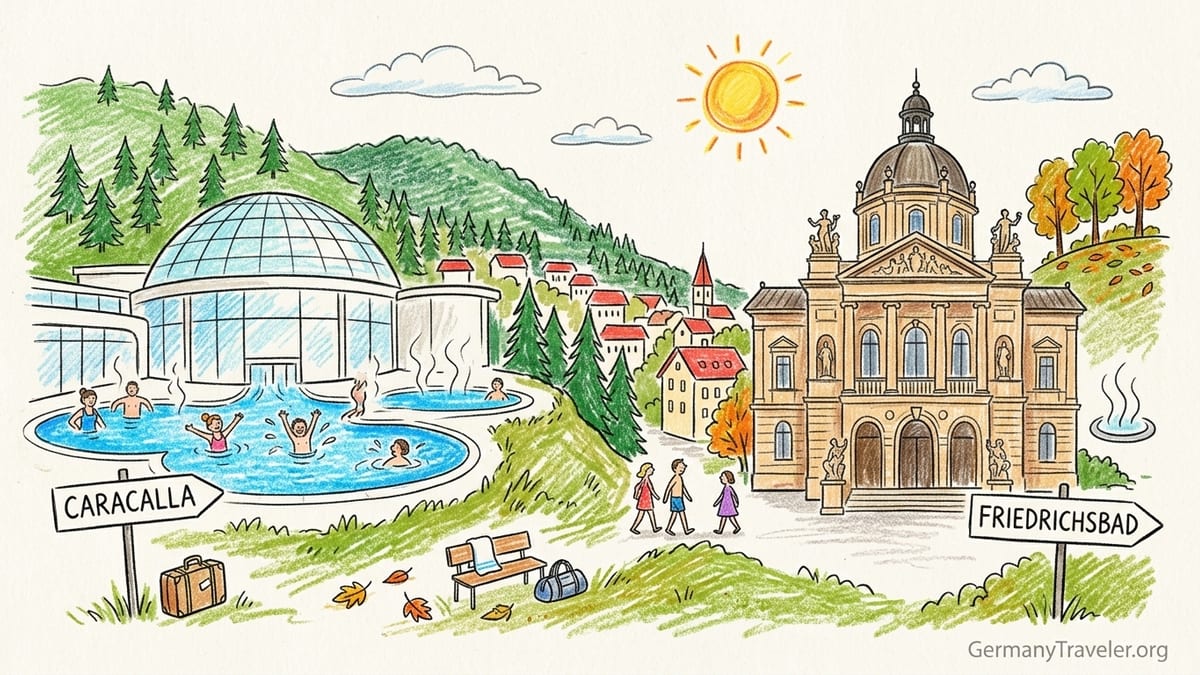
From street level, Baden-Baden looks like a handsome Black Forest town with pastel facades and clipped parks. The surprise is what you cannot see. Beneath the cobbles, thermal water bubbles up from twelve springs at up to 68 degrees Celsius, feeding two very different temples of relaxation: the modern Caracalla Spa and the historic Friedrichsbad. I spent one long day moving between both and came away with a clear sense of how they really feel, minute by minute, for a first-time visitor.
Arriving in Baden-Baden and Understanding the Thermal Water
I arrived in Baden-Baden on a cool weekday morning in early autumn, when the air in the old town still had that misty Black Forest edge to it. From the train station it was a short bus ride to the town center and then a ten-minute walk into the Bäderviertel, the historic spa quarter. Here the streets narrow, the domes of Friedrichsbad rise behind the rooftops, and the modern glass curves of Caracalla sit just across a small square. It is striking how close the two worlds are: one rooted in 19th-century bathing culture, the other in contemporary wellness design.
All of this exists because of the thermal springs beneath the Florentinerberg slope. Official information explains that around twelve artesian springs rise from depths of roughly 2,000 meters, delivering in total hundreds of thousands of liters of mineral-rich water every day, with temperatures measured between about 56 and almost 69 degrees Celsius. The water is cooled and distributed through both Caracalla and Friedrichsbad, which gives the town a coherent identity. Whether you are standing in a hot dome in Friedrichsbad or floating in an outdoor pool at Caracalla, you are connected to the same underground source.
Even before stepping inside, I noticed practical touches that show how integrated spa-going is in local life. Signs for the multi-storey Bädergarage parking lead directly into the shared foyer area, and local residents wandered in with gym bags as casually as if they were going to the supermarket. The atmosphere is not luxury in a flashy sense, but instead serious and slightly understated, the way a town feels when it has been doing one thing well for a very long time.
For my visit I decided to start at Caracalla in late morning, when I expected it to be lively but not yet busy with after-work visitors, and then book Friedrichsbad for a timed afternoon session. This way I could move from the flexible, do-what-you-like environment of Caracalla into the more structured ritual of Friedrichsbad, all while paying attention to the details that matter to a first-time traveler: where you change, what to wear, how hot the pools feel and how much time you realistically want inside.
Booking Caracalla: Tickets, Prices and First Practical Steps
Caracalla presents itself as a drop-in spa rather than a tightly booked attraction. The official information and the signs at the entrance were consistent on one point: for regular bathing, you do not need to reserve a time slot. You simply arrive during opening hours, pay at the counter, and receive an electronic wristband that acts as your locker key and tracks how long you stay. For peace of mind I checked prices online the day before. In late 2026 a 3-hour bathing ticket was listed in the region of the mid-20 euro range, with a small surcharge if you wanted access to the sauna area on top. Day tickets were available for a higher fee if you planned a long, slow visit.
At the reception desk I chose a 3-hour ticket for the thermal pools and added the sauna supplement, which was slightly under ten euros extra. The staff member switched seamlessly into English when she heard my accent, and explained that any overtime beyond the 3 hours would simply be charged on exit in 15-minute blocks, so I did not need to worry about rushing out of a pool with my hair still dripping. This flexibility turned out to matter later, when I found myself unwilling to leave the outdoor hot pool as my time ran low.
Right in the foyer, next to reception, is the Caracalla shop where visitors who misjudge their packing can buy swimwear, bathing shoes and basic toiletries. I watched one traveler buy a simple black swimsuit for roughly the cost you would expect from a mid-range sports brand. Bath towels can be rented on site for 6 euros per towel, a fee clearly marked on the price board and confirmed again by the staff member handing them out. I chose to rent one large towel and brought my own flip-flops, since the website had strongly recommended non-slip footwear for moving between wet areas.
With wristband on my arm and towel over my shoulder, I passed through the turnstile into the changing area. This is where Caracalla quickly feels familiar if you have visited modern European wellness centers: long rows of individual changing cabins line a central corridor, with open shelves and two large banks of lockers beyond. The wristband opened any free locker; a small digital screen confirmed the number. Inside my locker I could comfortably fit a daypack, jacket, shoes and a small camera. I changed fully into swimwear here, because Caracalla’s bathing area is strictly textile, and then walked, barefoot, through the showers into the bright, tiled main hall of pools.
Inside Caracalla: Swimwear Rules, Pool Temperatures and Crowd Levels
The first thing that hits you in Caracalla is the warm blue glow. The main pool area is a big, open space under high glass, with several circular and freeform pools at staggered levels. Quiet jets bubble in corners, and the soundscape is a steady murmur of conversations in German, French, English and a softer hush where people simply float. Compared to many city pools, it is noticeably calm. Signs remind guests to speak quietly and forbid running or diving, and the staff occasionally walk through to reinforce this in a polite but firm way.
Swimwear rules here are clear and non-negotiable. The house rules explicitly state that bathing is allowed only in standard swimwear made from appropriate textiles. Examples are helpfully listed: bikini, one-piece swimsuit, classic swimming trunks or fitted swim shorts up to roughly knee length, as well as close-fitting swim shirts or swim dresses that reach no longer than the knee. Street clothes, underwear or loose cotton garments are not allowed in the water. Looking around, I saw everything from basic sports bikinis to modest short-sleeve rash guards, but the overall impression was functional rather than fashion-driven. This has the effect of flattening social differences; you are just another person in a bathing suit, drifting between warm pools.
The thermal water temperatures in Caracalla’s pools step up in gentle increments. Near the entrance there is a large main pool in the mid-30s Celsius, warm but not overwhelming, good for slow laps or simply leaning on the edge to gaze through the glass at the trees outside. Off to one side I eased into a smaller pool marked around 38 degrees Celsius, where the heat soaked in quickly. Short bursts in this hotter water felt deeply relaxing, but I found myself intuitively limiting each visit to ten or fifteen minutes before moving back to a cooler basin or to the outdoor area for fresh air. There are also cooler plunge pools and foot baths where the temperature drops to the low 20s, which become invaluable if you plan to visit the sauna later.
As for crowd levels, late morning on a weekday delivered exactly the balance I had hoped for. There were enough people to feel a quiet buzz, but I never had trouble finding a spot under a neck jet or a bench seat in the bubble zones. I spent the first hour simply cycling between three or four favourite places: lying under the dome of the central pool watching condensation gather on the glass, then stepping outside into the steaming outdoor basins where cool air met hot water at shoulder height, then back indoors to let the gentle current of a circular flow channel push me in slow loops. After that first hour I checked the clocks posted discreetly on the walls and realized I had not looked at my wristband once. Time at Caracalla begins to slide.
Caracalla’s Sauna World: Textile-Free Zones and Realistic Comfort Levels
Up a staircase and through a separate access gate lies Caracalla’s sauna area, which is a different cultural space from the main pools. Here the rule reverses: it is a textile-free zone, in line with German sauna tradition. The signs at the entrance make this explicit in both German and English, and there is a bank of hooks and shelves where people leave their swimsuits before wrapping themselves in towels. Some guests move entirely nude between saunas; others drape themselves in towels in corridors and relaxation rooms, and only sit or lie fully on a towel once inside each cabin, as hygiene rules require.
The sauna complex is larger than photographs suggest, particularly outside. Indoors there are classic Finnish saunas with temperatures up around 90 degrees Celsius, a softer bio-sauna in the mid-60s, aromatic steam rooms, and a quiet zone with loungers and dimmed lighting. Outdoors, set in a landscaped garden, you find several wooden saunas, including a log-cabin style house, plus a plunge pool and cold-water buckets. During my visit sauna infusions were scheduled at regular intervals throughout the afternoon. On the board I saw entries like “Aufguss: 14:00 Citrus, 15:00 Forest” with symbols showing whether they would take place indoors or outside.
As a first-time visitor to this specific spa, I appreciated the structure. I started with the milder bio-sauna for eight minutes, focusing on breathing and paying attention to how my body handled the heat after already spending time in the thermal pools. After a cool shower I braved one of the hotter cabins, found an upper-bench spot and lasted just under ten minutes before the dry heat encouraged me out into the garden for a deliberate, slow cold plunge. This alternation of extremes left me clearer in the head and heavier in the limbs, a kind of pleasant exhaustion that travelers rarely allow themselves when racing between museums.
Culturally, the sauna world at Caracalla felt relaxed and unselfconscious. There are clear etiquette expectations but little performance. People of all ages and body types used the facilities: older local couples who obviously have a routine, groups of friends murmuring in German, solo travelers like me clutching towels and water bottles. I never felt stared at. If anything, the shared nudity stripped the experience of awkwardness, and the focus was on the heat, the ritual of cooling down, and the simple pleasure of lying in a quiet room afterward listening to your heartbeat slow. After nearly two hours of this, including time to sit by a window with a glass of tap water between sauna rounds, my 3-hour time limit for Caracalla was approaching, and it was time to check out and turn toward Friedrichsbad.
Between Baths: Transitioning From Caracalla to Friedrichsbad
Leaving Caracalla is as frictionless as entering. After showering and changing back in the same cabin, I returned my rented towel in a designated bin and walked to the exit gates. A digital reader scanned my wristband and displayed my total time; I had run about twenty minutes over the 3-hour ticket and paid a small surcharge on the spot, which was in line with the per-quarter-hour fees listed at reception. The staff could see at a glance on their screen that I had also used the sauna area, so there was no need to explain anything. It felt almost like closing a bar tab, but here the indulgence was measured in heat and water instead of food and drink.
From Caracalla’s glass facade it is literally a one-minute walk across the small Römerplatz to Friedrichsbad’s stately entrance. The mood shift is immediate. Where Caracalla is airy and modern, Friedrichsbad rises in sandstone curves and statuary, with the kind of heavy doors you push open knowing you are entering a building that was grand even in the 19th century. It has been operating for well over a hundred years, and today it still markets itself as a Roman-Irish bath, a term that hints at its combination of Roman-style hot and cold pools with Irish-style dry-air hot rooms.
Unlike Caracalla, Friedrichsbad works on more structured time blocks. The official information indicated that visits last around three hours if you follow the 17-stage ritual at a gentle pace. In 2026, the basic entry price for the classic circuit was posted in the mid-30 euro range, with add-ons available for optional soap-and-brush massages or special treatments that pushed the price higher. When I checked availability online the day before, I noticed that same-day visits are usually possible on weekdays, but slots can fill at weekends or during holidays, particularly for the massage options. To be safe, I made a reservation for a mid-afternoon start time and added the traditional brush massage to experience the full historic program.
One important detail for many travelers is Friedrichsbad’s approach to nudity and mixed-gender bathing. Historically it was strictly nude and separated by gender on some days and mixed on others. In recent years, the schedule and rules have been simplified but can still change for operational reasons. When I checked directly, the current policy described the main ritual as nude in most areas, with guests receiving a sheet or towel to drape over themselves in certain stages. Some days or specific times feature mixed-gender bathing, others are separated. This is not a place where you wear swimwear; the tradition is textile-free, and the staff are clear about this at booking and on arrival.
Inside Friedrichsbad: The 17 Stages, Changing Process and Brush Massage
Check-in at Friedrichsbad happens in a high-ceilinged foyer with wooden counters, marble busts and a faint echo of footsteps. At reception I confirmed my booking, paid for the entry plus the brush massage supplement, and was given a numbered wristband along with a neatly folded sheet that would serve as my modesty wrap in the early stages. The attendant spoke English fluently and asked if I had visited before. When I said no, she slid across a laminated card outlining the 17 stages, each with a recommended time and temperature. This sheet became my roadmap for the next few hours.
The changing process here feels more old-world than at Caracalla. A staff member directed me to a small wooden changing cabin off a corridor lined with frosted glass doors. Inside was a simple bench, hooks, and a wire basket. I undressed completely, placed my belongings into the basket, wrapped myself in the provided sheet and pressed a bell. Within a minute an attendant opened a hatch, took the basket and handed me back the wristband with my cabin number attached. From here on, I moved barefoot, with just the sheet, into the first stage of the ritual.
The 17 stages combine warm-air rooms, hot-air rooms, progressively warmer thermal pools, sitting baths and optional treatments. The early dry-air rooms are gentle, in the mid-40s Celsius, letting your body begin to warm and pores open without the intense humidity of a steam bath. The card suggested spending 10 to 15 minutes in each. Attendants circulated silently, reminding anyone who stayed too long or guiding newcomers forward. Next came slightly hotter rooms and then the entrance to the optional soap-and-brush massage, which I had booked. Here, on a stone slab, a therapist used warm suds and a firm-bristled brush to exfoliate my skin in practiced, rhythmic strokes. The pressure is brisk but not painful, and the sensation of being thoroughly scrubbed from shoulders to feet before being rinsed with warm water feels both archaic and oddly intimate, as if borrowing a ritual from another century.
After the treatment the circuit flows into a series of thermal pools at different temperatures. Roughly speaking, these stepped from about 36 degrees Celsius through 38 and up to around 40 in the hottest sitting bath. Unlike at Caracalla, where you can wander freely, Friedrichsbad encourages you to follow this sequence, lingering in each basin for the time printed on your card. The architecture here is the real star: tiled domes, columns and stained glass that catch the water’s reflection. In one of the central pools I floated on my back, looking straight up into a painted dome lit from above, and felt the history of all the other bodies that have done the same, from aristocrats to everyday visitors. The water is the same thermal spring water that circulates through Caracalla, but here it is framed like a ritual rather than a playground.
Comparing Atmosphere, Comfort and How Long I Wanted to Stay
By the time I reached the final stages of Friedrichsbad, which include a series of cooler pools, a thermal steam bath and then a rest area wrapped in warm sheets, I had lost track of clock time in a different way from Caracalla. Here, the sequence itself becomes the measure. You do not decide spontaneously to hop from one pool to another; you submit to the rhythm of the 17 stages and trust that someone else has already thought about the optimal order and duration. After roughly three hours I found myself lying in a relaxation room under a light blanket, on a lounger that creaked softly when I shifted. An attendant offered a small cup of mineral water. My skin felt scrubbed, my muscles loose, my mind surprisingly quiet.
If Caracalla had left me wanting just a bit more time to float under the outdoor jets, Friedrichsbad left me exactly done at the three-hour mark. I did not want to rush out, but nor did I feel any wish to rewind the ritual and do it again immediately. This contrast is important if you are planning your own visit. Caracalla is the kind of place you could easily return to every day for shorter sessions. With its mix of warm pools, saunas and outdoor space, it invites repeat, casual use. I could imagine buying one of the multi-visit passes mentioned in local materials and using it like a gym membership if I lived in the region. Friedrichsbad, with its set program and layered architecture, feels more like an event or a ceremony, something you might do once per trip or once per season.
In terms of comfort and approachability, I would describe Caracalla as friendlier to first-time spa-goers, especially those unsure about nudity. The fact that the main pool area is swimwear-only makes it easy to ease into the culture. You can always add the sauna zone later if you become comfortable with textile-free spaces. Friedrichsbad, by contrast, asks you to accept nudity from the start, even if you can arrange your sheet to cover more in the initial dry rooms. For some travelers this will be liberating, for others distracting. No one was intrusive or inappropriate during my visit; the staff maintain a calm, almost clinical professionalism, and the guests seemed focused on their own experience rather than anyone else’s appearance.
Crowd levels also differed. While Caracalla’s main pools had a gentle buzz in late morning and were forecast to be busier by evening according to staff, Friedrichsbad in mid-afternoon felt almost hushed. At several stages I shared a room with only one or two other guests. The brush massage, of course, was entirely one-on-one. If your image of a spa visit includes lots of activity and people-watching, Caracalla is your place. If you are drawn instead to a sense of seclusion inside historic walls, Friedrichsbad offers that in a way that makes you lower your voice without quite knowing why.
Practical Tips: What I Would Do Differently Next Time
Looking back on the day, a few practical lessons stand out that could make another visitor’s experience smoother. First, hydration matters more than you think. I had a bottle of water in my bag at Caracalla but underestimated how quickly the combination of warm pools and saunas would dry me out. There are drinking fountains and, in some areas, a small bistro where you can buy beverages, but I would next time make a point of taking a proper water break every hour. At Friedrichsbad, where carrying a bottle along the stages is not really feasible, I would drink more in the changing area beforehand and again in the rest lounge at the end.
Second, footwear and towels are not the place to economize. Renting a towel at Caracalla for 6 euros felt fair and spared me carrying a damp towel around Baden-Baden afterward. I was glad to have my own non-slip flip-flops, both for hygiene and for confidence on wet tiles, even though some guests walked barefoot between areas. For Friedrichsbad, where you move nude and barefoot most of the time, I would still bring a pair of easy-on sandals for the journey there and back, and perhaps a lightweight robe for the walk back to my accommodation. Stepping out of that hushed interior into cool air with skin still warm from thermal water is a special feeling, but you do not want to be shivering while you search for dinner.
Third, timing the two experiences in one day worked for me, but I would not recommend it for everyone. Starting at Caracalla and ending at Friedrichsbad made narrative sense: casual exploration first, then the structured historic ritual. Physically, though, it is a lot of heat exposure. By the time I finished my Friedrichsbad session, my body felt heavy and my brain pleasantly foggy. If you are particularly sensitive to heat or prone to low blood pressure, you might prefer to split them across two days. That way you can spend longer at Caracalla without watching the clock and give Friedrichsbad’s 17 stages your full attention when you are freshest.
Finally, expectations around modesty are worth considering in advance rather than on the changing room threshold. If you are comfortable with standard swimwear and shared spaces, Caracalla’s main pools are easy. If you are curious about German sauna culture and open to textile-free areas, adding the Caracalla sauna world can be a gentle introduction, because you can always retreat back to the swimwear zone. Friedrichsbad, by contrast, requires a mental decision before booking: you are signing up for a predominantly nude ritual in a mixed or gender-separated setting, depending on the day. If that idea makes you more anxious than curious, it may be wiser to wait until you genuinely feel ready.
The Takeaway
At the start of my day in Baden-Baden I thought of Caracalla and Friedrichsbad as competitors, as if I needed to decide which was the “better” spa. By the end, I understood them instead as complementary expressions of the same thermal culture. Caracalla’s 5,000 square meters of pools and saunas, fed by thermal water that once surged straight from the ground at nearly 70 degrees Celsius, represent a modern, democratic wellness space. Families, couples, solo travelers, locals after work: everyone can find a corner to float, sweat or simply sit with their thoughts, wrapped in steam and blue light.
Friedrichsbad, a few steps away, distills the same water into a slower, more ceremonial experience shaped by historical architecture and a fixed sequence. Its 17 stages, from warm-air rooms to hot pools to final rest, create a kind of narrative arc. Add the optional brush massage and you are briefly inserted into a ritual that has changed remarkably little in more than a century. The water is identical in its mineral content, but the way you encounter it is not. Where Caracalla gives you freedom to wander, Friedrichsbad invites surrender to a script.
If your time and budget allow only one, ask yourself what you want most from Baden-Baden’s springs. If it is play, variety, the simple joy of moving from an outdoor pool under winter skies to a hot indoor whirlpool then into a log-cabin sauna, choose Caracalla and give yourself at least three hours. If it is introspection, curiosity about historic bathing culture and a willingness to be lightly guided through a semi-nude ritual, choose Friedrichsbad, perhaps with the brush massage as a once-in-a-trip indulgence. For those who can do both, spacing them over two days might offer the most generous way to let each experience settle.
Long after I left, what stayed with me were not the exact temperatures or prices, but two images. At Caracalla, standing chest-deep in steaming water while cold air misted the tops of nearby fir trees, feeling my shoulders finally drop. At Friedrichsbad, floating alone for a moment under a painted dome, my ears underwater, the outside world completely muted. Between them, these two baths make a compelling case that Baden-Baden is not just a pretty stop in the Black Forest, but one of Europe’s most satisfying places to simply be. The springs under the town may be thousands of years old, but they are still doing their quiet work on anyone willing to slide beneath the surface.
FAQ
Q1: Do I need to book Caracalla Spa in advance, or can I just walk in?
For regular entry to Caracalla’s thermal pools you can usually walk in without a reservation, especially on weekdays. However, weekends and holidays can be busier, so checking current guidance and arriving earlier in the day can reduce waiting times, and some special treatments may still require advance booking.
Q2: What are the current approximate prices for Caracalla and Friedrichsbad?
In late 2026, a 3-hour ticket for Caracalla’s pools is typically priced in the mid-20 euro range, with an extra supplement under ten euros if you add the sauna area. Friedrichsbad’s classic 17-stage ritual usually costs in the mid-30 euro range, with optional brush massages or other treatments increasing the total. Exact prices can change, so it is best to confirm shortly before your visit.
Q3: Is swimwear required or allowed at Friedrichsbad?
Friedrichsbad is run as a traditional Roman-Irish bath and is generally textile-free, meaning guests do not wear swimwear for the main ritual. You are given a sheet or towel to drape around you in certain stages, and on some days bathing may be mixed-gender while on others it is separated, but swimsuits are not part of the experience.
Q4: How hot are the pools and saunas in Caracalla and Friedrichsbad?
Thermal pool temperatures in both complexes usually range from the mid-30s Celsius in the main basins up to around 40 degrees in the hottest sitting or whirlpools, with cooler plunge pools in the low 20s. Sauna cabins at Caracalla vary from about the mid-60s Celsius in bio-saunas to around 90 degrees in classic Finnish saunas, while Friedrichsbad’s dry-air rooms follow a stepped temperature sequence that is explained on arrival.
Q5: How long should I realistically plan to stay at each bath?
A comfortable first visit to Caracalla is around three hours, especially if you use both pools and sauna world, and you may find yourself wanting extra time. Friedrichsbad’s 17-stage ritual is designed to last about three hours at a relaxed pace. Doing both in one day is possible but can feel intense, so many travelers prefer to visit them on separate days.
Q6: Are children allowed at Caracalla and Friedrichsbad?
Caracalla is family-friendly in its main pool area, and you will often see children there, though there may be minimum age or supervision requirements that you should check in advance. Friedrichsbad, with its textile-free ritual and quiet atmosphere, is generally positioned as an adult spa and is not aimed at young children; current age policies are posted by the operator.
Q7: What should I bring with me to the baths?
At a minimum bring standard swimwear for Caracalla, non-slip flip-flops, and personal toiletries for after your visit. A water bottle is useful, and an extra towel can be convenient if you prefer not to rent one, though Caracalla offers towel rental for a clearly posted fee. For Friedrichsbad you mainly need toiletries and comfortable clothes for afterward, since sheets and any needed coverings are provided.
Q8: I am nervous about nudity. Which spa should I choose first?
If you are unsure about textile-free areas, start with Caracalla’s swimwear-only pool level. You can enjoy the thermal water fully clothed in standard swimwear and decide later whether to try the separate textile-free sauna area. Friedrichsbad involves more consistent nudity from the outset, so it may be better as a second step once you are used to German spa culture.
Q9: Are there food and drink options inside the baths?
Caracalla offers a small bistro or café area where you can buy drinks and light snacks, and there are also water fountains for refilling bottles. Friedrichsbad focuses more on the ritual itself, but water is provided in rest areas, and you can eat before or after your session at nearby cafés and restaurants in the spa quarter rather than during the circuit.
Q10: Can I visit both Caracalla and Friedrichsbad in one day, and is it worth it?
It is physically possible to visit both in a single day, for example by spending a late morning and early afternoon at Caracalla and booking a mid-afternoon start at Friedrichsbad. This gives a deep dive into Baden-Baden’s thermal culture, but it is also a lot of heat and relaxation in one stretch, so you should listen to your body and consider splitting them across two days if you have the time.