


Choosing a base in Germany’s Black Forest is less about ticking off famous villages and more about how you want to spend your days and evenings. Over several trips I have stayed in Freiburg, Baden-Baden, Triberg and Titisee, and used each as a base for driving, hiking, spa days and car-free exploring. The four places feel very different once you have parked the car, found dinner after 9 p.m., or tried to get to a trailhead in the rain with only a train ticket and a daypack. This article walks through what it was actually like to overnight in each, and how I would choose between them now.
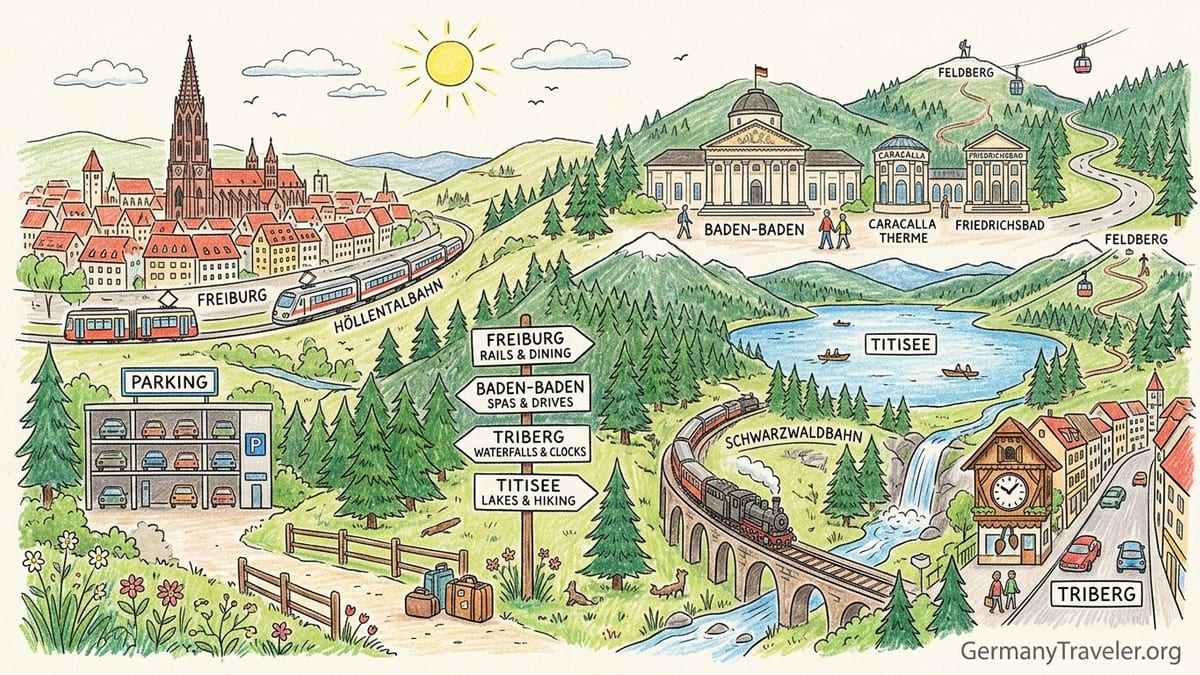
How I Tested These Four Black Forest Bases
I first came to the Black Forest as many visitors do, with a rental car, a vague plan to “see some cuckoo clocks,” and a list of pretty town names. On that first trip I stayed three nights in Freiburg without a car, then picked one up and added two nights in Triberg and two in Titisee. On a later winter visit I based myself in Baden-Baden for three nights specifically to compare the thermal spa experience and the feel of the northern Black Forest. Across those trips I stayed in central guesthouses or small hotels in each town, used local trains and buses, and did day trips by car when needed.
This means the comparisons that follow come from simple, repeatedly tested moments: how hard it was to find parking on a Friday evening, how long the walk felt from station to guesthouse with a suitcase, where I could still get a hot meal at 9:30 p.m., how early the streets emptied, and how much time I spent in the car versus on a trail or in a spa chair. I also cross-checked recent practical details, such as current transport options and spa facilities, so that the impressions are anchored in what you can expect to find in 2026.
Rather than listing hotels, I focus on what it feels like to stay in each place as a base. I assume you are choosing between them for a four to seven night trip, probably combining forest scenery with at least one of the following: spa time, hiking, family-friendly activities or a largely car-free holiday.
Freiburg: Best All-Round Base for Restaurants and Rail Connections
Freiburg is the only true city in this comparison, with a university, tram network and a compact medieval old town wrapped around its cathedral. When I stayed in a small hotel a few minutes’ walk from the Münsterplatz, it felt more like using a mid-sized French or Swiss city as a base than a rural town. Trams radiate from the Hauptbahnhof to the old town and outer districts, and the Höllentalbahn line heads straight into the Black Forest towards Hinterzarten, Titisee and beyond with half-hourly or better service on many days. Regional trains also link Freiburg with Offenburg and the Schwarzwaldbahn line towards Triberg.
Arriving without a car is painless. Freiburg Hauptbahnhof sits on the main Rhine Valley line and has frequent direct regional and long-distance trains from cities like Basel and Karlsruhe. Once you step out, there is a tram stop on the bridge above the tracks and clear signs into the old town. On my first trip, I wheeled a suitcase fifteen minutes to my guesthouse near the Martinstor gate and did not miss having a car at all for two days, using trains and trams for small excursions to places like Schauinsland and the start of Black Forest walks.
Driving in, however, requires a bit more thought. The city operates a parking guidance system and lists sixteen multi-storey garages around the Innenstadt, with zones covering the Altstadt, university quarter and station area. In practice, on a Saturday afternoon I followed the electronic signs off the B31 and ended up in the Schlossberggarage just east of the old town. Street parking close to the center is limited and time-restricted, so for an overnight stay I found it easier to budget for garage parking or to leave the car at a Park & Ride area on the outskirts and use trams into town.
Where Freiburg really stands out is evening atmosphere and dining. Even on a Sunday night in shoulder season, the lanes around the Münster had a scattering of wine bars, casual bistros and traditional Badisch restaurants serving flammkuchen, käsespätzle and local pinot wines. On a warm evening, outdoor tables fill the cobbled streets, and there is usually somewhere open until at least 10 or 11 p.m. I remember finishing a late hike on the Schauinsland, riding the tram and bus back into town, and still easily finding a plate of roast brats and a local beer at a busy Brauhaus near the Martinstor at 9:30 p.m.
Freiburg in Practice: Parking, Day Trips and Car-Free Options
For a first-time visitor who does not want to drive, Freiburg is the most forgiving base. From the Hauptbahnhof, the Höllentalbahn trains climb into the Black Forest, stopping at Hinterzarten for access to the Ravenna Gorge trail and at Titisee for lake walks and boat rentals. With a regional day ticket or a guest card that includes the KONUS logo from a participating accommodation, you can ride these regional trains and buses at no extra cost during your stay, except on long-distance services and mountain lifts. In practical terms, this meant I could decide at breakfast whether to walk the gorge, circle the lake or stay in town, and simply hop on the next train.
On one August stay, I used Freiburg as an entirely car-free hiking hub for four days. One day I took the train to Hinterzarten and walked the Ravenna Gorge trail down to the historic viaduct and Hofgut Sternen complex before looping back to the station. Another day, I stayed closer to the city, riding Tram 2 to Günterstal and the bus connection to the Schauinslandbahn cable car, then descending on foot with views over the Rhine valley. At the end of each day I was back in the old town by late afternoon, sitting on the cathedral square with a glass of Gutedel while the sun dropped behind the rooftops.
If you bring a car, Freiburg works best as a base if you are comfortable leaving it parked for long stretches. I once drove into the city on a Friday, parked in a multi-storey garage near the Schlossberg, and did not move the car until Monday morning, when I left for Triberg. This avoided navigating narrow one-way streets repeatedly and kept costs predictable. The trade-off is that for more distant corners of the forest, like the northern ridges near Baden-Baden, you may spend more time on trains or accept at least one day of longer driving from Freiburg.
In terms of scenic value, Freiburg’s charm is urban rather than alpine. The city has leafy views from the Schlossberg and river-side walks along the Dreisam, but it is not in the high mountains. For sweeping mountain panoramas, you will be riding out by train or car each day. Still, if you value lively evenings, food choice, and easy rail connections over waking up directly on a lake shore or beside a spa, Freiburg remains the most balanced and flexible base in the region.
Baden-Baden: Thermal Spa Town for Slow Days and Northern Forest Drives
Baden-Baden feels immediately different. Instead of medieval alleys, you get grand 19th century villas, a formal Kurhaus, and parks that run along the Oos River. I stayed in a small pension a ten-minute walk from the Friedrichtsbad and Caracalla Therme, and for three days barely moved the car. The town’s main draw is its thermal baths, with two very distinct experiences. Caracalla Therme is a modern complex with large indoor and outdoor pools, whirlpools and saunas, while Friedrichsbad is a more traditional Roman-Irish style bath with a fixed sequence of steam rooms, soaks and relaxation rooms.
On my winter stay, I bought a daytime ticket for Caracalla that allowed several hours in the pools and saunas, then spent a separate morning in Friedrichsbad following the classic 17-step bathing ritual. Recently published information from the spa operator shows that they still maintain a large underground “Bädergarage” directly under the Caracalla complex, with around 250 parking spaces and direct access to the baths and sister facilities. This made logistics straightforward. I drove from my guesthouse to the garage, parked with no need to search for street spaces, and walked directly into the spa reception in a matter of minutes.
Evenings in Baden-Baden are quieter than in Freiburg but feel elegant. The area around the Kurhaus and casino has a handful of higher-end restaurants and wine bars, and a short pedestrian zone near Leopoldsplatz offers more casual options. On my visit, I typically ended spa sessions around 8 p.m. and could still find a warm meal, though the vibe was more subdued and adult, with spa-goers in smart casual clothes and few families out late. If you are looking for nightlife in the sense of student bars, Freiburg will serve you better. If you enjoy a slow dinner followed by a walk through lamplit parks, Baden-Baden excels.
Access without a car is possible but slightly less straightforward than Freiburg. The main station sits a few kilometers outside the historic center, connected by city buses that run into town and to stops near the Caracalla Therme and Kurhaus. This works fine if your focus is spa time and town strolling. For accessing the northern Black Forest ridges, such as the Schwarzwaldhochstrasse scenic road, the local buses exist but are less frequent and take longer than driving. On my stay I drove up to viewpoints like the Mummelsee and the Hornisgrinde summit, appreciating the flexibility of the car when the weather changed.
Baden-Baden in Practice: Parking, Scenic Drives and Who It Suits
Parking in Baden-Baden’s core tourist area is relatively efficient thanks to the integrated garages, especially the Bädergarage under Caracalla and Friedrichsbad. On a December Saturday, I arrived mid-morning and immediately found a spot underground. Leaving the car there all day cost roughly the same as urban garages in other German cities, and I was able to pop back to the car for a change of clothes between the baths and dinner. For a spa-focused visit, it is entirely realistic to check into a central guesthouse, drive once into the garage and do all your spa, dining and strolling on foot afterward.
When used as a base for exploring the northern forest, Baden-Baden favors those with a car. The famous Schwarzwaldhochstrasse scenic route begins just above the town and runs along the high ridge with views towards the Rhine valley and Vosges. In winter I drove this road up into fresh snow within half an hour of leaving the hotel, stopping at viewpoints and trailheads. While there are bus routes along parts of this corridor, schedules are limited outside main seasons and they are not designed for spontaneous multiple stops in a single day. From Baden-Baden station, you also have mainline rail connections to cities like Karlsruhe and Offenburg, but for Black Forest hiking the train is less central than in Freiburg or Titisee.
For evening atmosphere, Baden-Baden sits between Freiburg and the small resort towns. There is usually a concert, a gallery opening or a casino event on, and the colonnades are lit attractively after dark. However, restaurant choice is skewed slightly toward higher price brackets and refined menus rather than rustic taverns. When I wanted a simple late-night snack after spa time, the options were surprisingly limited and I learned to eat a more substantial dinner earlier.
As a base, Baden-Baden best suits travelers who prioritize spa culture and comfortable town strolling, with a few day drives along the northern ridges, rather than those who want daily varied hiking without a car. It can work for a car-free spa break, especially if you are comfortable arriving by train and using buses between station, town and spa, but it is not the obvious choice for a low-budget, family-focused or highly active hiking week.
Triberg: Central Sightseeing Hub With Steep Streets and Day-Tripper Crowds
Triberg is often the first Black Forest town name foreign visitors recognize, thanks to its famous waterfalls and large cuckoo clock shops along the main street. I stayed two nights in a guesthouse above the main road, overlooking the valley and church spire. The location felt central in the region. By car, Triberg sits on the Schwarzwaldbahn rail corridor that runs between Offenburg and Singen, roughly in the middle of the forest, and by train it is directly connected to that scenic line.
Arriving by car, the first impression was of a narrow valley town dominated by one through-road, with on-street parking bays and a few small surface lots. On a sunny June afternoon, day-trippers filled many of these spaces, especially near the main waterfall entrance. My guesthouse had a small private parking area up a very steep side street, which required a confident hill start in a manual car. Once parked, I could walk to the waterfall gate in under ten minutes, but I quickly realized that Triberg, more than the other bases, demanded some uphill walking just to get around.
The famous Triberg waterfalls are a pleasant visit, with a ticketed path leading through forested cascades above town. In recent years, information from regional tourism boards describes the Schwarzwaldbahn experience trail between Hornberg, Triberg and St. Georgen, where you can walk sections alongside the historic railway and combine hiking with train rides. I followed a shorter stretch of this and appreciated the centrality: it was simple to hop on a train in one direction and walk back.
Evenings in Triberg felt quiet once the day-trippers left. The main street has several restaurants serving hearty dishes and a few hotel bars, but on my midweek stay, many shops closed around 6 p.m. and by 9:30 p.m. the town was mostly dark apart from hotel dining rooms. I enjoyed a simple schnitzel dinner on a terrace overlooking the road and then strolled up to a viewpoint above the church, but compared with Freiburg there was little in the way of late-evening buzz.
Triberg in Practice: Parking, Trains and When It Makes Sense
Triberg’s greatest strengths as a base are its central location for sightseeing and its position on the Schwarzwaldbahn rail line. By train you can ride in one direction to Offenburg and connect to Strasbourg or in the other direction towards Singen and Lake Constance, all while passing classic Black Forest scenery. For a traveler who wants one or two days of rail-based sightseeing and does not mind steep walks from station to guesthouse, Triberg can work as a car-free base.
However, in practical terms I found that having a car in Triberg increased flexibility significantly. Many trailheads, small lakes and viewpoints lie up side valleys and ridges without direct rail access. Driving out of town up the winding roads, I could reach higher plateaus in twenty to thirty minutes and then park in small forest lots before hiking. Parking at these trailheads was rarely an issue, unlike the competition for spaces near the waterfalls in town. Coming back down into Triberg in the late afternoon, I always had to factor in a final steep walk up to the guesthouse.
Parking for overnight guests depends heavily on your accommodation. Some hotels and pensions have small private lots included or for a modest fee. Others rely on public spaces, which can be busy during the day but calm later. Because the main street is also a through-road with coaches and delivery trucks, I did not enjoy driving in and out of Triberg repeatedly just for short outings. When using it as a base, I preferred to plan full-day loops that left the car either at the guesthouse or well away from the crowded center.
Triberg is strong as a two-night stop for visitors who want classic Black Forest images in a compact package: waterfalls, cuckoo clocks, railway viaducts and forest walks. As a week-long base, especially with a family, the steep terrain, limited dining choice and day-trip busyness make it less attractive than Freiburg or the lake-and-mountain combination of Titisee and Feldberg.
Titisee and Feldberg: Lake Views, High Trails and Outdoor Travel
Titisee, with its lakeside promenade and boat rentals, and the Feldberg massif above it form the heart of what local tourism bodies market as the Hochschwarzwald. I stayed in a small family-run hotel a short walk back from the lake and later in a guesthouse near Feldberg-Bärental station. These overnights felt much more like a mountain resort experience than my time in Freiburg or Triberg. The lakefront can be busy with day visitors, but a block or two behind the promenade the atmosphere turns village-like, with small bakeries and guesthouses lining quiet streets.
Arriving by train from Freiburg is straightforward. The Höllentalbahn runs from Freiburg to Titisee with frequent service, and some trains continue along the Dreiseenbahn branch around the lakes towards Seebrugg. Regional transport information indicates that guests staying in the Titisee-Neustadt and Feldberg areas often receive a KONUS guest card that allows them to ride regional buses and trains in much of the Black Forest at no extra charge during their stay. On my stays, this meant I could leave the car parked at the guesthouse and use the bus network to reach the Feldberg lifts, Schluchsee or neighboring villages.
Feldberg itself is the highest peak in the Black Forest and a major hiking and skiing hub. Tourist board timetables describe a Feldberg bus route that links Titisee station, Bärental and the Feldberg ski and hiking area, with connections timed to trains from Freiburg. In practice, I took a morning train from Freiburg to Titisee, changed to a bus at the station and was walking on high plateau trails above the treeline within an hour and a half of leaving the city center. In winter, this same corridor is used heavily by skiers heading to the lifts, and crowding on weekend buses is something to factor in.
Evenings in Titisee are low-key, especially outside the peak of summer. The lakeside promenade has a cluster of restaurants ranging from hotel dining rooms and casual German eateries to ice cream parlors and a few places serving burgers or simple international dishes. Closing times vary by season, but on my early autumn stay many kitchens closed by 9 p.m. Families with younger children seemed to dominate the scene, pushing strollers along the lakefront or letting kids play near the small beach area before dinner.
Titisee and Feldberg in Practice: Parking, Guest Cards and Driving Needs
Parking in Titisee is shaped by its role as a day-trip destination. There are several large surface lots near the lake and station, with clearly posted day rates. On a July weekend, I arrived by car around 10 a.m. and found a space with no trouble, but by midday the main lot was close to full. Guests staying overnight in lakeside hotels often have private parking included, which is valuable if you plan to take the car out daily. In my case, I left the car in the hotel’s small courtyard and treated Titisee as a semi-car-free base, using buses and trains for hiking days and the car only when I wanted to visit more distant valleys.
The KONUS guest card and, in some accommodations, the more extensive Hochschwarzwald Card made a noticeable difference to how I moved around. With those cards, I could ride regional buses and trains without buying individual tickets on each journey, and in some cases receive discounted entry at local attractions or reduced prices for a four-hour ticket at Badeparadies Schwarzwald, the large indoor pool and sauna complex near the lake. This sort of pass nudged me toward using public transport for hikes. I would often ride the bus up to a high trailhead near Feldberg, hike along the ridgeline and then descend to a different village, catching a late afternoon train or bus back to Titisee.
Compared to Freiburg, restaurant choice in Titisee is more limited but tilted toward visitors who have been outdoors all day. Menus feature hearty dishes, fish from local lakes and family-friendly options, and it is easy to eat early. After about 9:30 p.m., things quieten quickly. For many visitors this is part of the appeal. On one evening, I sat on my hotel balcony watching the last paddleboats cross the lake while the sky darkened, hearing only a few voices from the promenade.
As a base for an outdoor-focused holiday, Titisee and Feldberg are hard to beat in the Black Forest. With a car you can reach a wide network of trailheads in every direction, but even without one the combination of Höllentalbahn trains, Feldberg buses and guest transport cards gives you access to lakeside walks, ridge hikes and winter sports within a compact area. The trade-offs are quieter evenings, fewer non-outdoor cultural activities, and a more overtly touristy feel along the main promenade during the daytime.
How Much Driving Each Base Required
One of the biggest differences between these four bases is how much time I spent behind the wheel versus on my feet or on public transport. Staying in Freiburg without a car, I managed four consecutive days of varied hiking and sightseeing using only trains, trams and buses. When I did have a car there, I tended to park it once in a garage and leave it for the duration, only driving again when moving to the next base. Most of my “driving” time around Freiburg involved short hops from Park & Ride lots or trailhead car parks back to my accommodation.
In Baden-Baden, the ratio tilted more towards driving, especially for scenic explorations. On my spa-focused trip, I used the car only to reach and leave the Bädergarage and could theoretically have done everything on foot and by bus. On a later visit that combined spa days with ridge drives, I found myself driving almost every day to access the Schwarzwaldhochstrasse and more remote trailheads, since bus frequencies and journey times would have made such outings cumbersome.
Triberg fell somewhere in between. Its central location meant shorter distances to various parts of the forest, but the topography and road layout made each trip feel more involved. Climbing out of the narrow valley onto plateaus required winding roads, and I tended to combine stops to avoid repeated up and down driving. For travelers comfortable with trains, it is entirely possible to reduce driving by focusing on Schwarzwaldbahn-linked excursions, but most of the hikers I met there used cars for at least part of their stay.
Titisee and Feldberg, finally, allowed me to use the car strategically rather than constantly. With a guest transport card and the well-defined bus and train routes serving the lakes and the Feldberg area, I planned several completely car-free hiking days. On other days, I drove thirty to forty minutes to less frequented trailheads or viewpoints, parked in small forest lots and did circular walks, returning to Titisee in the evening. Over a week, I drove less total distance staying in Titisee than on a comparable week based in Baden-Baden, because so many trails start close to where you sleep.
Which Base I Would Choose for Different Types of Trip
For a first visit to the Black Forest, especially if you are unsure about driving in Germany, I would choose Freiburg as a base. It gives you the easiest arrival by rail, the widest restaurant choice, and quick train access to classic Black Forest scenery at Hinterzarten, Titisee and along the Höllental. You can decide later whether to add a short two-night stay in a smaller place like Titisee or Triberg, but Freiburg alone will already provide city life, nearby hills and access to forest walks.
For a focused spa break, Baden-Baden is the clear winner. Staying within strolling distance of Caracalla Therme and Friedrichsbad allows you to dip into the baths, walk in the Kurpark, dress for dinner and repeat. Parking once in the Bädergarage takes any stress out of having a car, and if you do not want to drive at all you can reach town by train and bus. Freiburg has some wellness facilities, but it does not compete with the density and variety of thermal spa options that Baden-Baden offers.
For a hiking trip, my personal preference is to base in Titisee or nearby Feldberg-Bärental. The ability to step out of a guesthouse and be on a lake path or in a high meadow within a short walk, combined with the Höllentalbahn and Feldberg buses, meant that I spent more time on trails and less time commuting to them. Freiburg can work very well for hikes that begin or end along the Höllentalbahn corridor, but the pure everyday convenience of Titisee and Feldberg for walking is hard to beat.
For a family holiday, I would again lean towards Titisee as a base, perhaps with a night or two in Freiburg at the start or end. Children can enjoy the lake shore, boat rides and nearby indoor pool complexes regardless of weather, and several guesthouses cater explicitly to families. Evenings are calm but not dead, and distances to kid-friendly walks and attractions are short. Triberg, while atmospheric, involves steeper everyday walking and less space for children to run safely away from traffic.
For a car-free trip, the hierarchy is clear based on my experience. Freiburg comes first, thanks to the central train station, tram network, and dense regional rail links into the forest. Titisee and Feldberg come a close second, particularly if your accommodation includes the KONUS guest card. Triberg can support a car-free stay centered on rail day trips, but its hills and more limited bus network make it less effortless. Baden-Baden can work without a car for a spa-focused long weekend, but for varied forest outings you will feel the absence of easy high-ridge connections by public transport.
The Takeaway
All four of these Black Forest bases offer strong reasons to stay, but they deliver very different daily rhythms once you move beyond postcard images. Freiburg is a lively, well-connected city that rewards longer stays and car-free explorers who still want urban comforts and food variety. Baden-Baden is a graceful spa town, at its best when you slow down and let your days revolve around the baths and park promenades, using a car or selected buses for occasional forays into the northern forest.
Triberg provides perhaps the most concentrated dose of stereotypical Black Forest sights, with waterfalls, cuckoo clocks and the historic Schwarzwaldbahn all packed into one valley. It is a good short stop rather than a long-term base. Titisee and Feldberg, finally, form an outdoor playground for hikers, families and winter sports fans, with a practical mix of guest cards, rail connections and bus routes that keep driving optional instead of mandatory.
When I return to the region now, I rarely debate the choice. For a first-timer asking where to stay, I suggest Freiburg with a strong recommendation to include a day or overnight at Titisee. For a spa weekend with a partner, it is Baden-Baden. For a week of hiking and swimming with friends or children, it is Titisee or Feldberg. The good news is that the distances between them are short enough that you can combine at least two in a single trip. The key is to decide whether your priority is evening atmosphere, thermal water, classic sightseeing, or waking up already in the high forest, and choose your base accordingly.
FAQ
Q1. Is Freiburg or Baden-Baden better for a first-time Black Forest visit?
Freiburg is better for a first visit if you want flexible day trips, plenty of restaurants and easy rail access into the forest. Baden-Baden works best if your main goal is spa time and gentle strolling, with only a couple of scenic drives or bus rides into the northern Black Forest.
Q2. Can I visit the Black Forest without renting a car?
Yes, you can. Basing yourself in Freiburg or Titisee allows you to use regional trains and buses, often with a KONUS-style guest card included by your accommodation. You can reach popular hiking areas like Hinterzarten, Titisee and Feldberg, as well as scenic routes like the Höllentalbahn, entirely on public transport, although more remote valleys and ridge walks may still be easier with a car.
Q3. Which base is best if I want to use the KONUS guest card?
Many accommodations in the central and southern Black Forest, especially around Titisee-Neustadt, Feldberg and Hinterzarten, issue guest cards that function as a KONUS ticket on regional buses and trains during your stay. Freiburg’s surrounding region also participates. If you intend to maximise this benefit, staying in Titisee or Feldberg gives particularly good value because so many key hiking and lake destinations lie along the serviced lines.
Q4. How difficult is parking in Freiburg compared to the smaller towns?
In Freiburg, you will usually need to rely on multi-storey garages or Park & Ride facilities, especially near the old town, and budget accordingly. In smaller towns like Titisee and Triberg, parking is focused in surface lots and small hotel courtyards, which can fill at peak times but are less complex to navigate. Baden-Baden sits in between, with central garages like the one under Caracalla Therme that make spa visits straightforward.
Q5. Where should I stay if I want easy access to the best hiking?
If hiking is your priority, Titisee and the Feldberg area make the most convenient bases. You are close to high-altitude trails, lakeside paths and a network of buses and trains that link villages, lakes and trailheads. Freiburg also gives good access to hikes reachable along the Höllentalbahn, but you will spend a little longer each day commuting out of the city before you start walking.
Q6. Which place has the most lively evening atmosphere?
Freiburg has the liveliest evenings, with a university population, bars, beer gardens and restaurants that stay open later into the night. Baden-Baden offers a more refined, quieter atmosphere around its Kurhaus and casino. Triberg and Titisee become quite calm after dinner, with most activity focused on hotel dining rooms and a handful of lakefront or main-street restaurants.
Q7. Is Triberg still worth staying in, or is it only for day trips?
Triberg is worth an overnight stay if you want to see the waterfalls early or late in the day, explore the Schwarzwaldbahn railway corridor and experience a traditional valley town once day-trippers leave. For longer stays, many travelers prefer to base elsewhere and visit Triberg on a day trip, because of its steep streets, limited dining options and the way traffic dominates the main road.
Q8. Where should I base myself for a spa-focused holiday?
Baden-Baden is the best base for a spa-focused holiday, thanks to its two major thermal facilities, Caracalla Therme and Friedrichsbad, both set within an easy walk of central accommodation and underground parking. You could combine Baden-Baden with a night or two in Freiburg or Titisee if you want to add more hiking or lake time before or after your spa days.
Q9. Which base is most suitable for families with children?
Titisee works very well for families, with a safe lakefront promenade, boat rentals, nearby indoor pool complexes and easy access to short walks and playgrounds. Feldberg offers more active options for older children who enjoy hiking or winter sports. Freiburg can also be family-friendly, but its strengths lie more in culture and dining than in ready-made outdoor play spaces directly at your doorstep.
Q10. How many bases should I choose for a one-week Black Forest trip?
For a one-week trip, two bases are usually ideal. Many visitors combine four or five nights in Freiburg, using trains for day trips, with two or three nights in Titisee or Feldberg for lakes and high trails. Alternatively, spa-focused travelers might spend three nights in Baden-Baden and four in Freiburg or Titisee, reducing the need to unpack repeatedly while still experiencing both urban and mountain environments.