


North Germany’s Hanseatic cities grew rich on Baltic trade, leaving behind some of Europe’s most distinctive urban landscapes in deep red brick. Today UNESCO protects five key German sites that tell this story from the high medieval Hanseatic League through to the warehouse and office complexes of the late nineteenth and early twentieth centuries. This guide focuses on what, exactly, is on the World Heritage List in Lübeck, Wismar, Stralsund, Bremen and Hamburg, how to see the best surviving medieval Brick Gothic, and where later commercial architecture takes over.
Understanding Hanseatic Brick Gothic and UNESCO Protection
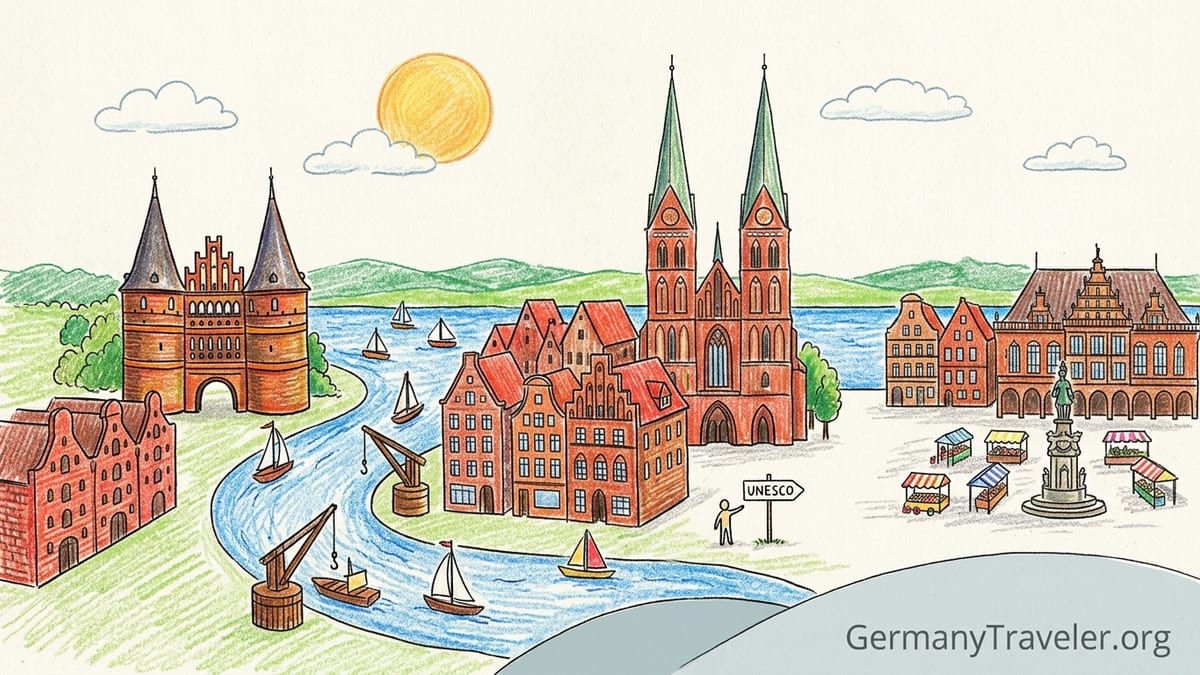
Walk almost any historic street in Lübeck, Wismar or Stralsund and the same elements repeat. Narrow merchant houses rise in rhythmic rows of red brick, their stepped or curving gables outlined in pale stone or moulded brick. Above, vast parish churches tower over the roofs, also in brick, their sheer vertical walls broken by traceried windows. This is North German Brick Gothic, the hallmark of the medieval Hanseatic world, developed in regions where building stone was scarce but clay and trade wealth were abundant.
UNESCO recognises these cities not simply for individual monuments but for the way entire urban structures preserve medieval commercial life. Lübeck’s Old Town island, on the World Heritage List since 1987, is protected for its complete street plan, patrician houses, churches, alleyways and harbour-side warehouses. Wismar and Stralsund, jointly inscribed in 2002, represent complementary medieval harbour towns whose layout, brick churches and trading houses document the Hanseatic League at its zenith. Bremen and Hamburg illustrate a different side of the story: in Bremen only the Town Hall and Roland statue are World Heritage, while in Hamburg UNESCO protects the Speicherstadt and Kontorhaus district, late nineteenth and early twentieth century ensembles tied to modern global trade rather than the medieval Hansa.
The material choice of brick shapes everything visitors see. In a landscape short on good building stone, north German patrons turned to fired clay, then invested heavily in decorative techniques. Stepped gables, pointed arches picked out with glazed bricks, friezes of patterned masonry and intricate blind tracery all express the wealth of merchant elites who controlled Baltic routes for grain, timber, furs and salt. The compact plots along narrow streets reflect the logic of trade: deep houses with warehouse space on upper floors, workshops hidden in rear courtyards, and easy access to harbourside cranes and salt storehouses.
Equally important is the historical layering. War damage and later reconstruction are part of each city’s story. Lübeck and Hamburg suffered heavy bombing in the Second World War; Stralsund and Wismar lost buildings through neglect in the twentieth century before extensive restoration after reunification. UNESCO’s inscriptions acknowledge both original medieval fabric and carefully researched rebuilding, and visitors who understand this distinction will read these streetscapes more critically and more appreciatively.
Lübeck: Queen of the Hanse and Classic Brick Gothic
Lübeck is the ideal starting point for a Hanseatic journey. Founded in 1143 and dominant in the League from the thirteenth to the sixteenth century, the city’s Old Town island has been listed by UNESCO since 1987. Protection covers three main areas: the western gateway zone around the Holstentor and salt warehouses; the residential and commercial quarters stretching between St Peter’s Church and the Cathedral; and the central ensemble of St Mary’s Church, Town Hall and market square. Together they show how a medieval merchant republic organised space for trade, worship and governance.
A practical walking route begins outside the Holstentor, the iconic twin-towered brick gate once fronting the city’s landward defences. From Lübeck Hauptbahnhof it is roughly a ten-minute walk across the Trave river to the gate. Spend around 30 to 45 minutes here and in the adjacent former salt warehouses, whose robust brick shells still define the riverfront. From the Holstentor, follow Holstenstrasse into the Old Town, then turn left along Braunstrasse and Mengstrasse. These streets are lined with patrician merchant houses, many fifteenth and sixteenth century in origin, with high stepped gables and narrow alleyways (Gänge) leading back to hidden courtyards that once housed workshops and smaller dwellings.
Continue toward the market square and St Mary’s Church, allowing at least 90 minutes to explore. St Mary’s, built in the thirteenth and fourteenth centuries, is one of the purest expressions of Brick Gothic, with soaring vaults and delicate tracery all executed in brick. Much of its interior was destroyed in a 1942 air raid, and reconstruction in the postwar decades is deliberately visible: modern stained glass contrasts with surviving medieval fragments, and bomb-damaged bells lie cracked on the floor as a war memorial. The adjacent Town Hall combines Gothic brick arcades with later Renaissance additions, showing how Lübeck’s civic pride evolved over centuries.
For the clearest view of Lübeck’s urban form, climb the tower of St Peter’s Church if it is open to visitors. The viewing platform, reached by lift and stairs, presents the famous skyline of seven spires rising from a densely packed island encircled by water. From above, the two long parallel main streets and the dense pattern of cross lanes are easy to read, underlining why UNESCO highlights the survival of Lübeck’s original twelfth century plan. Plan roughly half a day to trace this route, including time in at least one church, the Holstentor museum, and a pause in a café within the Old Town.
Wismar: A Preserved Medieval Harbour and Market Square
Wismar, on the Baltic coast of Mecklenburg, shares its 2002 UNESCO inscription with Stralsund. While smaller than Lübeck, it offers one of the most coherent Hanseatic ensembles, with a remarkably intact medieval harbour and one of northern Europe’s largest market squares. The World Heritage property covers the historic centre and harbour basin, including brick parish churches, merchant houses and administrative buildings that demonstrate Wismar’s role as a Wendish Hanseatic port and later as a Swedish stronghold.
A recommended walk starts at the waterfront. From Wismar station it is about 10 to 15 minutes on foot to the Old Harbour. Here, the medieval basin still reads clearly despite modern pleasure craft and converted warehouses. Low brick storehouses, some restored as hotels or restaurants, line the quays. The crane, originally wooden and rebuilt in the eighteenth century, recalls the loading of salt, grain and timber. Spend around 45 minutes strolling the quays, watching fishing boats land catches that often appear on menus in nearby fish stalls and casual restaurants.
From the harbour, head inland along Hinter dem Rathaus and make your way to the broad market square. This space, roughly one hectare in size, is framed by gabled merchant houses of varying dates and colours. At its centre sits the octagonal Wasserkunst, a richly ornamented seventeenth century waterworks structure installed under Swedish rule. UNESCO’s interest here lies less in the Baroque details and more in the square’s function as the commercial heart of a Hanseatic town. On market days, you can still see regional producers selling fruit, vegetables and cheeses much as traders did with grain and cloth centuries ago.
Allow another hour to explore Wismar’s Brick Gothic churches. St Mary’s retains its towering nave, though its nave walls were partly demolished under the German Democratic Republic, making its isolated tower a powerful reminder of both war damage and ideological clearance. St Nicholas, near the harbour, preserves a richly vaulted interior supported by slender brick piers, while St George’s has undergone extensive reconstruction since reunification, mixing original brickwork with new interventions. Tracing their differing conditions offers a direct lesson in destruction and restoration across the twentieth century. Realistically, visitors should plan about half a day to see the harbour, market square and at least one or two churches, with additional time if visiting museums or climbing a tower for views over the red-tiled roofs and harbour basin.
Stralsund: Medieval Urban Structure Facing the Sea
Stralsund complements Wismar within their joint World Heritage listing. Located further east, it was another key Wendish Hanseatic port, and UNESCO emphasises its well-preserved medieval urban structure, particularly the way streets, squares and harbour relate. The historic centre sits on a peninsula facing the Strelasund strait, joined to the mainland by causeways and bridges that still echo older routes to the island of Rügen.
Begin a visit at the Neuer Markt or Alter Markt, two main squares defined by monumental Brick Gothic. On the Alter Markt, the façade of Stralsund’s Town Hall is especially striking: an enormous screen of blind tracery, pinnacles and circular openings in patterned brick, behind which the actual building retreats. This façade, rebuilt and restored over centuries but retaining substantial medieval fabric, encapsulates Hanseatic civic ambition. The square is also lined with tall gabled houses whose narrow frontages conceal deep plots, many still with commercial premises on the ground floor.
From the Alter Markt, walk north toward the harbour. Within 10 to 15 minutes you reach the historic port area, where brick warehouses, granaries and the line of the old city wall show how tightly Stralsund was once defended towards the water. Here the medieval structure survived relatively well, although some warehouses were adapted in the twentieth century for different uses. Today, maritime museums occupy several buildings, explaining Baltic trade routes, shipbuilding and the city’s later naval history. Plan at least an hour to walk the waterfront and its adjacent streets, which still follow medieval lines even where individual buildings have been rebuilt.
To understand Stralsund’s urban hierarchy, include its parish churches: St Nicholas near the Alter Markt, St Mary slightly to the south, and St James closer to the harbour. Like their counterparts in Lübeck and Wismar, they demonstrate the scale achieved in brick. Interiors often show layers of history, with Baroque furnishings, nineteenth century stained glass and conservation work from the late twentieth century. Stralsund suffered bombing in 1944; postwar repairs under the German Democratic Republic and later conservation after 1990 mean many elevations mix original medieval brickwork with careful reconstruction. A full exploration of the Old Town and harbour, including one or two museum visits, fits comfortably into a long day, though architecture enthusiasts may prefer to spend a night and revisit key sites in different light for photography.
Bremen: Town Hall and Roland, A Focused UNESCO Core
Bremen tells a more selective UNESCO story. While the city has Hanseatic roots and a pleasant historic core, the World Heritage listing applies only to the Town Hall and the Roland statue on the market square, not to the entire Old Town. UNESCO recognises these as outstanding expressions of civic autonomy in the Holy Roman Empire, with the Gothic and Renaissance Town Hall documenting evolving municipal power between the fifteenth and seventeenth centuries and the Roland representing civic liberties granted to the city.
For visitors interested in UNESCO, the essential walk is compact. From Bremen Hauptbahnhof, it is roughly 15 minutes on foot or a short tram ride to the central Domsheide area. The market square opens between the cathedral and the Town Hall. Spend at least 30 to 45 minutes outside, walking slowly around the square to study the Town Hall’s richly detailed façade, which combines late Gothic structure with early seventeenth century Weser Renaissance decoration. Carved stone figures, arcades and oriel windows here contrast with the brick Gothic of Lübeck or Stralsund, underlining the diversity of Hanseatic civic architecture.
Directly in front of the Town Hall stands the Roland, more than 10 metres high including its pedestal. Carved in stone in 1404, it is the largest free-standing statue of a medieval knight in Germany and symbolises Bremen’s rights to hold markets, mint coins and administer its own justice. While the statue has undergone conservation, its core is original medieval fabric. Information panels in the square explain its meaning, and guided tours, bookable through Bremen’s tourist office, often combine visits to the Town Hall’s ceremonial halls with commentary on the Roland.
Beyond the official UNESCO elements, most visitors extend their walk to the nearby Schnoor quarter, a maze of narrow lanes and small houses, and the Böttcherstrasse, an early twentieth century brick expressionist street. These areas are not World Heritage, but they illustrate how Bremen’s merchant and artistic traditions continued into later centuries. A UNESCO-focused stop in Bremen can be comfortably achieved in half a day, particularly for travellers in transit between Hamburg and the Ruhr or the Netherlands.
Hamburg: Speicherstadt and Kontorhaus, Beyond the Medieval Hansa
Hamburg’s World Heritage site represents a chronological leap forward. Inscribed in 2015, the Speicherstadt and Kontorhaus district with Chilehaus are celebrated not for medieval Hanseatic history but for their role in global trade at the turn of the twentieth century. The Speicherstadt, built in phases from the 1880s to the 1920s as part of Hamburg’s integration into the German customs union, created an enormous complex of brick warehouses along narrow canals. The adjacent Kontorhaus district, developed mainly in the 1920s and 1930s, houses modernist office buildings for shipping and trading companies, culminating in the famous Chilehaus with its dramatic ship-like corner.
Visitors should treat this as a separate, though related, chapter to the Brick Gothic cities. The Speicherstadt’s warehouses pick up some Gothic motifs, such as pointed arches and decorative gables, but they are essentially late nineteenth century industrial architecture. Many were damaged in the Second World War and later rebuilt or adapted, yet the district still forms the largest coherent warehouse ensemble of its type. The Kontorhaus district, by contrast, showcases brick expressionism and early modernist tendencies, with large, sculptural office blocks arranged on a rational street grid.
A practical walking route begins at the edge of the Speicherstadt, reached in about 15 minutes on foot from Hamburg Hauptbahnhof or in a few minutes by U-Bahn. Allow at least two hours to explore. Start near the Brooksfleet or Kehrwieder area and cross several bridges to appreciate the perspective down narrow canals framed by tall brick blocks. This is an excellent area for photography, especially in the early morning or late afternoon when low light catches the textured brickwork and reflections in the water. Many warehouses now house attractions, cafés and design shops. Entry fees vary by venue, and travellers should check current prices locally, as they change more frequently than official heritage boundaries.
From the Speicherstadt, walk inland toward the Kontorhaus district around Messberg and Steinstraße. The ten-storey Chilehaus, completed in the mid 1920s, is the architectural highlight, its long curve and sharp corner evoking the prow of an ocean liner. Spend 30 to 45 minutes walking around and through its courtyards to observe the rhythmic brick patterns and modest ornament, then continue to neighbouring blocks such as the Sprinkenhof. Information panels placed by the city of Hamburg explain the area’s development and World Heritage status. A combined visit to Speicherstadt and Kontorhaus can fill a half day, especially if paired with a harbour boat tour that passes along the edges of the warehouse district.
War Damage, Reconstruction and Authenticity
A thoughtful visit to these UNESCO sites should not gloss over war damage and rebuilding. Lübeck, Hamburg and, to a lesser extent, Stralsund and Wismar all endured bombing in the Second World War. In Lübeck, air raids in 1942 devastated parts of the Old Town, destroying historic houses around St Mary’s and badly damaging the church itself. Postwar reconstruction aimed to restore the medieval street plan and skyline while accepting some modern infill. As you walk lanes behind the market square, look for subtle differences in brick colour and detailing. Surviving medieval gables often show irregular handmade bricks and weathered joints, while postwar houses may use more uniform units and simplified forms.
Wismar and Stralsund avoided the worst bombing but suffered from neglect and politically motivated demolition during the German Democratic Republic period. Churches like Wismar’s St George and Stralsund’s St James were left as ruins for decades or partially dismantled. After reunification in 1990, major restoration campaigns stabilised and rebuilt these structures, informed by historical research and surviving fabric. Inside, you may see clearly recognisable modern brickwork or concrete roof structures supporting restored exteriors. UNESCO’s documentation notes these interventions but accepts them as part of a broader effort to preserve urban form and key monuments.
Hamburg’s Speicherstadt was heavily hit in air raids, with some warehouse blocks destroyed. In the decades after 1945, authorities reconstructed damaged sections to match the original late nineteenth century appearance as closely as practical, while also updating infrastructure. From a visitor’s standpoint, the district today reads as a coherent historic ensemble, yet its authenticity rests as much on urban logic and function as on intact nineteenth century brickwork. Information displays in the area, prepared by Hamburg’s cultural authorities, explain which blocks retain more original fabric and which were substantially rebuilt.
Bremen’s Town Hall and Roland fared better. While Bremen’s wider historic fabric suffered during the war, the Town Hall survived with relatively limited damage and has been carefully conserved. Interior murals and wooden ceilings show patina consistent with centuries of use. Conservation reports referenced by the city note structural reinforcement, replacement of some stones and cleaning, but the core fabric remains genuinely historic. For travellers, this mix of old and new across all five cities underlines that World Heritage status does not require untouched monuments; rather, it recognises how societies choose to preserve, restore and interpret their most meaningful places.
Practical UNESCO-Focused Itinerary
A focused itinerary linking these cities can be completed in about one week using Germany’s rail network. Start in Hamburg, which has the largest international airport. Dedicate your first full day to the Speicherstadt and Kontorhaus district, using an early morning walk to photograph canals and warehouses, a late morning visit to an attraction within the Speicherstadt, and an afternoon exploring Chilehaus and its neighbours. This day frames the modern commercial chapter of the Hanseatic story and gives context for earlier cities built on trading wealth.
Travel by train to Lübeck for the next two days. The journey from Hamburg Hauptbahnhof takes under an hour on regional trains, usually with at least two departures per hour at busy times. On your first day in Lübeck, follow the Holstentor to St Mary’s and market square route described earlier, adding the Cathedral and a climb up St Peter’s tower if time and opening hours allow. Reserve the second day for deeper exploration of side streets, the alleys leading to hidden courtyards, and at least one museum focused on Hanseatic trade or city history. This allows you to experience the Old Town at different times of day, when changing light brings out new details in the brickwork and shadowed gables.
From Lübeck, continue east to Wismar and Stralsund. Regional trains connect Lübeck to Wismar in a few hours with at least one change; from Wismar to Stralsund, expect further regional connections. Allocate at least one night in Wismar and one in Stralsund. In Wismar, combine the harbour and market square walk with visits to St Nicholas and the surviving tower of St Mary’s, paying close attention to signs explaining wartime damage and later restoration. In Stralsund, focus on the relationship between the Alter Markt, Town Hall and harbourfront, then choose one or two churches for interior visits. Both towns have tourist offices in or near the main squares where you can pick up free maps highlighting World Heritage-related routes.
Finally, travel from Stralsund to Bremen, usually via Hamburg. Allow a half day for transit and another half to explore Bremen’s market square, Town Hall and Roland. Time permitting, extend your walk through the Schnoor quarter or along the Weser river promenade to appreciate how the medieval core relates to later urban expansion. Trains from Bremen back to Hamburg for onward flights run frequently and take around 60 to 90 minutes, depending on service.
The Takeaway
Seen together, these five UNESCO sites paint a rich picture of northern Europe’s trading cities. Lübeck, Wismar and Stralsund present the Hanseatic League’s medieval heart in Brick Gothic: stepped-gable merchant houses, monumental brick churches, and harbour basins knitted tightly into the urban fabric. Their protection focuses on entire townscapes, where street plans, skylines and building types still reveal a world built around Baltic trade routes and mercantile self-government.
Bremen’s more tightly defined listing, limited to its Town Hall and Roland, reminds travellers that UNESCO sometimes singles out emblematic monuments rather than whole districts. Here the focus is on civic symbolism and the continuity of self-rule, visible in carved stone and ceremonial halls rather than in a widespread medieval fabric. Hamburg, by contrast, looks forward rather than back. The Speicherstadt and Kontorhaus district document the transformation of port cities in the age of steamships, customs zones and global commodity flows at the turn of the twentieth century.
For travellers primarily interested in medieval Hanseatic architecture, Lübeck, Wismar and Stralsund are the essential destinations, with Lübeck offering the most extensive and influential example of Brick Gothic urbanism. Bremen adds a concise, powerful civic ensemble, while Hamburg is indispensable for understanding how merchant traditions and brick construction evolved into industrial warehouses and modernist offices. Approaching these cities with an eye for chronology, material and urban structure makes each lane, canal and gable part of a long story of trade, power and resilience written in brick.
FAQ
Q1. Which city is best for experiencing authentic medieval Hanseatic architecture?
Lübeck offers the most extensive and influential medieval Hanseatic fabric, with a largely intact Old Town island of Brick Gothic churches, merchant houses and historic street patterns.
Q2. How much time should I plan for Lübeck’s UNESCO Old Town?
Most travellers should allow at least one full day, and ideally two, to walk from the Holstentor through the Old Town, visit several churches and a museum, and enjoy views from St Peter’s tower.
Q3. Are Wismar and Stralsund very similar, or is it worth visiting both?
It is worth visiting both. Wismar excels in its preserved medieval harbour and vast market square, while Stralsund stands out for its compact urban structure linking market squares and harbour and its particularly dramatic Town Hall façade.
Q4. What exactly does UNESCO protect in Bremen?
UNESCO protects only the Town Hall and the Roland statue on Bremen’s market square, recognising them as symbols of civic autonomy, rather than designating the entire Old Town.
Q5. Is Hamburg’s UNESCO area medieval?
No. Hamburg’s Speicherstadt and Kontorhaus district date mainly from the late nineteenth and early twentieth centuries, reflecting industrial-era global trade and early high-rise office architecture in brick.
Q6. Can I walk the UNESCO areas without a guided tour?
Yes. All five sites can be explored independently on foot using local maps, though guided tours available from tourist offices provide deeper historical context and access to some interiors.
Q7. How accessible are church towers and viewpoints for photography?
Several towers, such as St Peter’s in Lübeck and selected towers in Wismar or Stralsund, are usually open seasonally for a fee, but opening times and access conditions can change and should be checked locally.
Q8. Are there entry fees for the main churches and museums?
Many churches suggest donations, while some charge modest entry or tower fees. Museum prices vary and are updated regularly, so visitors should confirm current costs at ticket desks or tourist offices.
Q9. How did war damage affect what I see today?
Bombing, neglect and later rebuilding mean that many elevations mix original medieval brickwork with postwar reconstruction, especially around Lübeck’s St Mary’s, Wismar’s St George’s and parts of Hamburg’s Speicherstadt.
Q10. Which cities should I prioritise with limited time?
With three to four days, prioritise Lübeck for medieval Brick Gothic, Wismar or Stralsund for a preserved harbour town, and Hamburg if you want to see how brick architecture evolved into large-scale warehouse and office districts.