


When two cities share a single UNESCO World Heritage inscription, it is tempting to treat them as interchangeable pins on a map. Wismar and Stralsund on Germany’s Baltic coast are officially bundled together as the “Historic Centres of Stralsund and Wismar,” yet on the ground they feel like distant cousins who grew up very differently. To find out which Hanseatic city I would actually recommend to different types of travelers, I spent one day exploring Wismar and another in Stralsund, traveling in by train, walking their old streets, climbing towers and comparing everything from harbor vibes to museum prices.
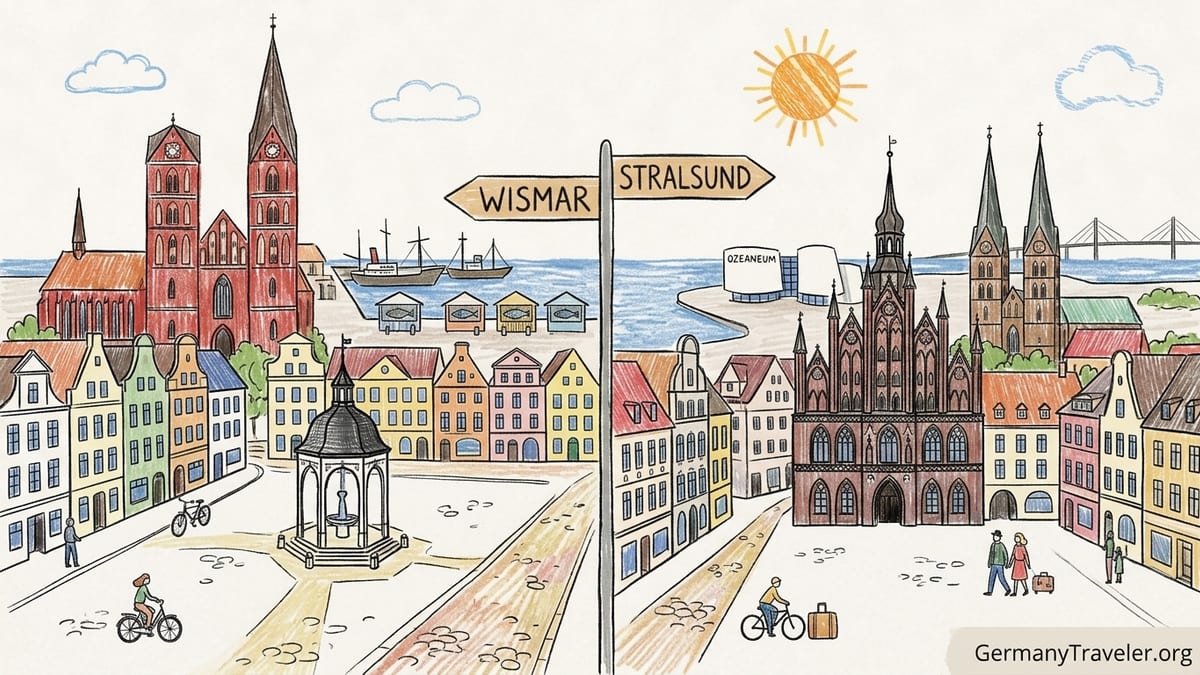
Planning the Trip: One UNESCO Listing, Two Very Different Days
I based myself in Hamburg and treated Wismar and Stralsund as separate day trips, which is a practical way to experience both if you are using Germany’s rail network. Wismar and Stralsund together form a single UNESCO World Heritage site thanks to their role as leading Hanseatic trading cities and later Swedish administrative centers, but in layout, atmosphere and even visitor traffic they feel distinctly different once you step onto their cobbles.
On my Wismar day, I caught a regional train via Schwerin into Wismar’s modest station and walked about ten minutes to the historic center. The last stretch already hinted at the city’s character: quiet streets, pastel gabled houses and hardly any crowds on a mild weekday morning. My Stralsund day started earlier, with a longer ride on a combination of Intercity and regional trains from Hamburg to Stralsund Hauptbahnhof in roughly three hours. From there it was a 15-minute walk into the UNESCO-listed old town on its almost-island core, the streets noticeably busier and the skyline tagged by multiple Brick Gothic towers.
For accommodation, I chose to stay in Hamburg rather than move hotels between the two cities, partly because fast and regional trains connect Hamburg to both Wismar and Stralsund and partly to keep the comparison fair. In practical terms that meant similar early departures, similar return times in the evening and a full unhurried day in each city. If you prefer to stay locally, both towns have a cluster of small hotels and guesthouses close to their historic centers, but Stralsund offers more waterfront options right on the harbor.
Because I wanted to compare value for money, I kept a mental tally of major paid sights. In Wismar my main expense was the viewing platform at St George’s Church, which cost around 5 euros for adults at the time of my visit. In Stralsund the big ticket item is OZEANEUM on the harbor, which currently charges 20 euros for an adult ticket. That price difference alone already hints at how differently an architecture-focused traveler and a family with children might experience each city.
First Impressions: Market Squares, Skylines and Street Atmosphere
My first view of Wismar’s market square was an almost startling sense of scale relative to the town’s current size. The Marktplatz is one of the largest in northern Germany, but on a calm weekday it felt generously empty, framed by patrician houses rather than clogged with people. The square’s tiled surface was broken only by a few café terraces and the whimsical octagonal Wasserkunst, a Renaissance waterworks pavilion that once supplied drinking water and now serves mostly as a photogenic reminder of Wismar’s prosperity.
On one side of the square stands Alter Schwede, a brick-gabled house from the late Middle Ages with its stepped façade. Today it houses a restaurant, but even if you do not stop for a meal, it functions like a visual anchor for the square. The façades around it are brightly painted but largely harmonious, and there was little advertising clutter. The overall impression was of a comfortable provincial merchant town that has kept its dignity and never entirely surrendered its center to tour buses.
Stralsund’s Old Market offers a very different arrival. The square is tighter, the edges steeper, and the faceted Brick Gothic façade of the Town Hall dominates almost every photo. Unlike Wismar’s market, which feels open and almost horizontal, Stralsund’s center reads vertically, with spires from St Nikolai and other churches punching into the sky. When I arrived in late morning, there was a distinct hum of activity: guided groups pausing with umbrellas raised, cyclists threading through and a mix of locals shopping and office workers crossing the square.
In terms of street atmosphere, Wismar felt closer to a graceful small town, the kind of place where you notice individual shop windows and door knockers. Stralsund was livelier and a little more urban. The pedestrian traffic there included more day trippers with backpacks and families pushing strollers, especially on the direct axis between the Old Market and the harbor, where OZEANEUM acts as a magnet. If you prefer a slow-breathing, almost contemplative historic core, Wismar has the edge. If you like a bit of bustle and people-watching with your UNESCO architecture, Stralsund will feel more energizing.
Exploring Wismar: Churches, Heights and the Old Harbour
I started my Wismar loop by darting down side streets from the market square toward the churches that mark the city’s Hanseatic wealth. St Nikolai, near one of the oldest artificial waterways in Germany, impressed me most inside. Stepping into the nave, the height and light immediately recalled the maritime power that financed this kind of space. The Brick Gothic pillars rise like masts, and the relative quiet on the day I visited meant I could actually absorb the details rather than shuffle along with a crowd.
From there I continued to St George’s Church, whose history as a bomb-damaged shell and subsequent reconstruction says a lot about Wismar’s postwar story. The interior today is partially restored and used for events, but the star attraction for visitors is the 35-meter-high viewing platform. I paid just under 5 euros for an adult ticket and climbed the stairs. The short workout is rewarded with a surprisingly comprehensive view of the UNESCO-listed old town, including the ribbon of roofs, the silhouette of St Nikolai and the industrial outlines of the more distant modern port. It is one of the best vantage points I found on this trip for understanding how a Hanseatic town knits church towers, market, and harbor into a coherent whole.
The walk from St George’s down to the Old Harbour took me past rows of refurbished gabled merchant houses and a few lived-in corners of the city where laundry hung in inner courtyards. Wismar’s harbor today is a compact mix of working port and leisure pier. You will see small coastal vessels, historic ships offering short cruises, and a line of simple fish snack stands selling Fischbrötchen for around 4 to 5 euros each. I ate a herring roll on a wooden bench overlooking the water, with the masts of a museum ship and the restrained hum of harbor activity as the soundtrack. Compared with Stralsund, the water’s edge here feels smaller in scale and more low-key, but also more closely integrated with the old town.
Back in the center, I circled once more through the market square in late afternoon. The cafés along the edge were running quiet outdoor service, and a handful of locals were chatting on benches around the Wasserkunst. The atmosphere was closer to that of a neighborhood plaza than an international destination, which is likely either a strength or a weakness depending on how much spectacle you expect from a UNESCO site.
Exploring Stralsund: Old Market, Town Hall, Walls and Waterfront
In Stralsund I also began at the Old Market, but the effect was less about serenity and more about drama. The façade of the Gothic Town Hall seems to have been designed to prove exactly why UNESCO singled out this place. Its perforated brick screen, ornamental turrets and blend of red and green tiles make almost every angle photographable, but it can be difficult to capture the whole thing without a wide lens simply because the square is comparatively compact. I spent a while just walking the perimeter to see how merchants’ houses slot in beside the official power building.
St Nikolai in Stralsund rises directly off the Old Market and offers interior spaces that rival or even surpass its Wismar namesake in terms of sculptural detail. Inside, intricate altars, painted galleries and a crowded collection of epitaphs compete with the sense of sheer volume. There is usually a small entrance fee or suggested donation, and on my visit a couple of tour groups filtered in, which made it harder to linger in silence. If you are passionate about ecclesiastical art, Stralsund arguably offers more depth within a smaller radius than Wismar.
From the Old Market I walked toward the remnants of Stralsund’s fortifications. While much of the medieval wall system has vanished, there are still stretches of brick walls and towers and the way the core of the town sits between the waters of the Strelasund and a chain of ponds preserves the feel of a fortified island city. Standing on one of the bridges looking back at the old town, you understand why Stralsund has such a strong story as a naturally defensive Hanseatic hub.
The harbor in Stralsund was the biggest contrast to Wismar. Here, the waterfront is broader and feels more like a stage, with views across to the island of Rügen and the modern Rügen bridge in the distance. Museum ships line the quays, cafés and kiosks serve everything from coffee to fried fish, and the white angular volumes of OZEANEUM dominate one stretch of the harbor island. Families with strollers, cyclists, photographers with tripods and small tour groups all share the wide promenade, especially in the afternoon when day-trippers arrive from Rügen or Berlin.
OZEANEUM and Museums vs Towers and Streets
I debated for a while whether to visit OZEANEUM on this trip because at 20 euros for an adult ticket it is a significant investment compared with the mostly church-based expenses in Wismar. In the end I decided to walk through the harbor district, observe the queue and talk to a couple of visitors coming out instead of going in. For many travelers, especially those with children, OZEANEUM is the centerpiece of a Stralsund visit. The complex houses large aquariums, exhibitions on the Baltic and North Seas and dramatic whale models. The current pricing reflects its position as a national-level museum rather than a local curiosity, and there is also a combined ticket with other oceanographic museums in the region for around 35 euros for adults.
However, not every traveler needs to budget for it. If your primary interest is in medieval urban form and church architecture, you can experience much of what makes Stralsund part of a UNESCO site simply by exploring the streets, churches and harbor area at ground level. Several smaller museums, including the cultural history museum in the former Catherine’s Monastery, offer more focused but lower-cost experiences, and you can easily fill a day in Stralsund without crossing the OZEANEUM threshold.
In Wismar, by contrast, the most memorable “museum” for me was the city itself as seen from the St George viewing platform. Apart from a modest ticket for the tower and occasional small fees or donations in churches, my cultural spending there was limited. There is a World Heritage information center in Wismar where you can learn more about how the town fit into the Hanseatic League and the Swedish era, but it does not dominate visitor itineraries in the way OZEANEUM shapes many Stralsund visits.
This difference affects value for money in a nuanced way. Architecture enthusiasts and budget-conscious couples might feel that Wismar offers a richer ratio of atmosphere to admission fees, since much of what you come for is simply present in the streets and skyline. Families in Stralsund who invest in OZEANEUM and perhaps a harbor cruise may spend considerably more, but they will likely come away with child-friendly memories and a much more museum-centric story of the Baltic Sea.
Eating, Drinking and Everyday Costs
In Wismar I ate very simply. My lunch was that harbor-side Fischbrötchen and a coffee from a small café just off the market square, where a cappuccino cost around 3.50 euros. Later in the afternoon I ordered a slice of cake and a drink in a café facing the square and paid under 8 euros for both. Menu boards around the center suggested that a casual main course in a sit-down restaurant was often in the 13 to 18 euro range, with fish dishes slightly higher. The clientele seemed mostly local or regional, and staff were relaxed about people lingering over one drink with a view of the Wasserkunst.
Stralsund’s food scene near the harbor felt more overtly touristic but still fairly priced for a German coastal city. Simple harbor stands sold Fischbrötchen in a similar 4 to 6 euro range, but indoor waterfront restaurants displayed mains edging closer to 18 to 24 euros, especially for fresh fish and seafood. Around the Old Market and the side streets leading toward the harbor, there is a good mix of bakeries, ice cream shops and casual eateries that work well for families. I noticed more multilingual menus here than in Wismar, which matched the more international mix of visitors I heard around me.
In terms of everyday costs, both cities are noticeably cheaper than Berlin or Hamburg in accommodation and food, but Stralsund can become the more expensive option once you factor in museum tickets and the temptation of additional activities like boat tours to Rügen or harbor cruises. Wismar encourages a slower, more economical rhythm by simply not confronting you with as many big-ticket attractions. You stroll, you look up at gables, you maybe climb one tower, and your wallet remains relatively untouched.
For café culture, I personally preferred Wismar. Sitting on the edge of its oversized market square with a coffee felt like inhabiting a well-preserved historical stage between acts. In Stralsund I often chose harbor-facing spots, trading some quiet for the pleasure of watching ferries and museum visitors drift by.
Getting Around Without a Car
Because I traveled by train and on foot, I paid close attention to how each city works for car-free visitors. Both Wismar and Stralsund are well-connected by regional rail lines that link them to larger hubs. Wismar sits on a route that ties it to Schwerin and on toward Berlin, while Stralsund lies on lines running down to Berlin and inland as well as onward across the Rügen bridge. From Hamburg, Wismar is generally the shorter rail trip, often just over two hours with a change, while Stralsund requires closer to three hours each way on most connections.
On arrival, Wismar is exceptionally compact. From the station to the market square is around ten minutes on foot, and from there every major sight mentioned here lies within another ten-minute radius. I never once felt the need for public transport or a taxi. For travelers who are not keen walkers, the distances are still modest and the terrain flat, with frequent benches and café terraces where you can pause.
Stralsund is also walkable, but it spreads wider, especially if you want to connect the station, the Old Market, various churches, the remains of the city walls and the full harbor promenade. I clocked significantly more steps there than in Wismar. Families with younger children might find themselves dipping into local buses or planning breaks more carefully. The reward for those extra steps is variety: in one direction you reach the Rügen causeway, in another the quieter pond-fringed edges of the historic island.
For car-free travelers planning a multi-day trip along the Baltic coast, Stralsund’s position as a rail and road gateway to Rügen makes it a more strategic base. You can combine its UNESCO core with day trips to seaside resorts on Rügen or nearby coastal villages. Wismar functions better as a self-contained stop or a gentle overnight on a longer rail journey between Hamburg and Berlin.
Photography, Architecture and Overall Character
As a photographer, I found Wismar slightly more challenging to shoot but very rewarding when it worked. The huge market square demands either a broad lens or a willingness to embrace empty foreground. The best views came from oblique corners where Alter Schwede, the Wasserkunst and the range of gabled houses lined up in layers. The light brick and pastel walls respond beautifully to late afternoon sun, which brings out texture without harsh contrast. Up on the St George platform, the lattice of roofs and the distant cranes of the modern port create a narrative shot that sums up the city’s past and present in one frame.
Stralsund, by contrast, is immediately photogenic from almost every angle. The Gothic Town Hall façade, reflections of church towers in the ponds around the historic core, and long views across the harbor toward Rügen all provide easy compositions. The trade-off is that you will rarely have a scene to yourself. At peak hours there always seemed to be at least one guided group or cluster of visitors in my frame, especially around the Town Hall and OZEANEUM. Early morning or late evening offers more breathing space if you are serious about architectural photography.
Architecturally, both cities display the full vocabulary of Brick Gothic that defines Hanseatic UNESCO sites: soaring parish churches, gabled merchants’ houses, and remnants of fortifications. Wismar’s character feels more unified and slightly softer, as if the city has settled into its role as a smaller regional center without needing to shout. The reconstructed sections, including St George, are well integrated, and restoration work has focused on preserving a cohesive skyline.
Stralsund’s architecture is more extrovert. There are more spikes and silhouettes, a greater density of showpiece façades, and the sense that the city was designed to impress visitors arriving by sea. The old town’s island-like layout between the sound and ponds enhances that theatricality. If you are the kind of traveler who thrives on strong skyline moments and grand gestures, Stralsund is more likely to leave you exhilarated. If you prefer subtlety and a feeling of lived-in continuity, Wismar may resonate more deeply.
The Takeaway
After walking both cities from station to harbor, climbing towers and sampling harborside snacks, my personal preference tilts toward Wismar. Its oversized market square, calm streets, affordable St George viewing platform and intimate Old Harbour combined into a day that felt unhurried yet complete. I appreciated being able to experience the core of a Hanseatic UNESCO city largely by wandering, without the pressure of time slots or high ticket prices.
That said, I can clearly see why many travelers would rank Stralsund higher. For families with school-aged children, Stralsund is the stronger choice. The combination of a dramatic old town, an engaging harbor and the big-commitment experience of OZEANEUM at around 20 euros per adult creates a layered trip that educates as well as entertains. Couples who enjoy a livelier evening atmosphere and a broader choice of waterfront restaurants may also lean toward Stralsund.
Architecture enthusiasts face a pleasant dilemma. If your focus is on coherent urban form and the relationship between a market square, churches and harbor, Wismar might be more satisfying, especially when viewed from St George’s 35-meter platform. If you collect spectacular individual buildings and love dense ensembles of brick façades, Stralsund’s Town Hall, churches and walls will probably top your list. Car-free travelers looking for a relaxed day trip from Hamburg will likely find Wismar logistically easier and physically gentler. Those planning a wider Baltic itinerary that includes Rügen or multiple museums will benefit from Stralsund’s role as a regional hub.
Ultimately, the two cities live up to their shared UNESCO inscription by telling complementary chapters of the same Hanseatic story. Wismar is the quieter, contemplative chapter where you learn to read the language of gables and market squares. Stralsund is the energetic, exhibition-rich chapter that pulls the Baltic Sea and modern museum culture into the frame. If your time or budget forces you to choose, ask yourself whether you want a day of wandering streets and climbing a modestly priced tower, or a day where a major marine museum on a busy harbor island becomes the focal point. For my own travel style, Wismar wins by a narrow but distinct margin, though I am glad UNESCO insisted that the story of this coast can only be fully told with both names on the cover.
FAQ
Q1. If I can visit only one city, should I choose Wismar or Stralsund?
For a relaxed, architecture-focused day with lower costs, Wismar is the better choice. If you want big museums, a lively harbor and do not mind higher expenses, pick Stralsund.
Q2. How much should I budget for major sights in each city?
In Wismar, you can see most highlights with minimal fees, apart from around 5 euros for the St George viewing platform. In Stralsund, allow at least 20 euros per adult if you plan to visit OZEANEUM plus additional funds for other museums.
Q3. Which city is easier to explore without a car?
Both are walkable, but Wismar is more compact, with the station, market square, churches and Old Harbour within short walking distance. Stralsund is still manageable on foot but involves longer walks between the station, Old Market, walls and harbor.
Q4. Is OZEANEUM in Stralsund worth the price?
For families and travelers interested in marine life and the Baltic Sea, OZEANEUM’s exhibitions justify the 20 euro adult ticket. If your focus is purely medieval architecture and you are on a tight budget, you can comfortably skip it.
Q5. How do the harbor areas compare for atmosphere?
Wismar’s Old Harbour feels intimate and low-key, with working boats and simple fish stands close to the historic core. Stralsund’s harbor is broader, busier and more developed, anchored by OZEANEUM and multiple museum ships.
Q6. Which city is better for photography?
Stralsund offers more instantly dramatic scenes, especially the Town Hall façade and harbor views toward Rügen. Wismar requires more careful framing but rewards you with spacious market scenes and excellent rooftop views from St George.
Q7. Are there good options for couples looking for a romantic weekend?
Yes. Wismar suits couples seeking quiet walks, long café stops and soft evening light over the market square. Stralsund is better for couples who enjoy a livelier waterfront, more restaurant choice and the option of extra excursions to Rügen.
Q8. What about families with younger children?
Families often prefer Stralsund because of OZEANEUM, harbor cruises and more varied kid-friendly activities. Wismar can work for calmer family days, but its attractions are less interactive for children.
Q9. How many hours do I need in each city?
In Wismar, five to seven hours are enough to see the market square, churches, St George platform and Old Harbour without rushing. In Stralsund, plan a full day if you want to combine the Old Market, harbor, at least one church and OZEANEUM.
Q10. Can I visit both cities in one day?
Technically it is possible by car, but it would be rushed and unsatisfying by public transport. Given their different characters, each city deserves its own full day to appreciate the streets, churches and harbor at a comfortable pace.