


Hesse is one of Germany’s most diverse UNESCO regions. Within a few hours by train from Frankfurt, you can visit seven very different World Heritage properties that range from Roman frontiers and fossil pits to baroque water gardens, Art Nouveau architecture and ancient beech forests. This guide explains what makes each site special in UNESCO’s eyes, what visitors actually experience on the ground, and how to plan time-efficient trips that make sense on a real itinerary.
Understanding Hesse’s UNESCO Map
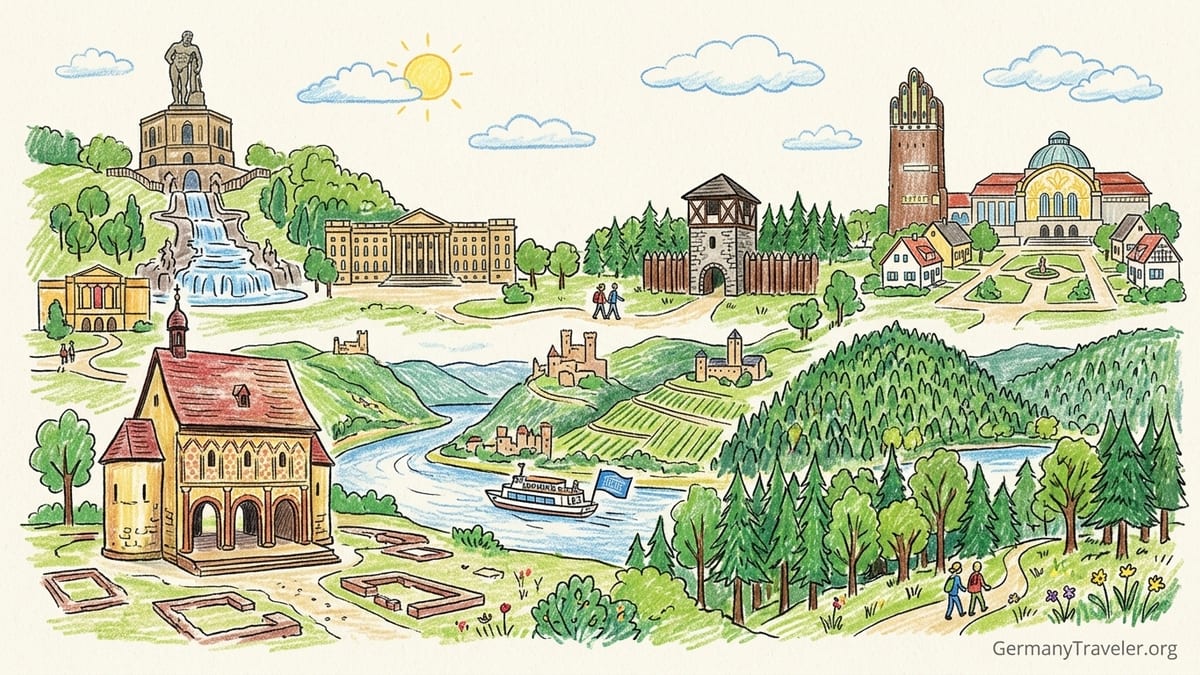
UNESCO World Heritage status in Hesse covers seven properties, each representing a distinct type of heritage. Lorsch Abbey and Bergpark Wilhelmshöhe are cultural landscapes that combine architecture, art and designed nature. The Upper Middle Rhine Valley and the Upper German Raetian Limes cover large historical corridors across several federal states, with key sections in Hesse. Messel Pit Fossil Site and the Ancient and Primeval Beech Forests of the Carpathians and Other Regions of Europe (through components in Kellerwald-Edersee National Park) are inscribed for their outstanding natural and scientific value. Mathildenhöhe Darmstadt stands out as a compact ensemble that captures a particular moment in Art Nouveau and early modern architecture.
For travelers, this means that “seeing a UNESCO site” in Hesse can mean very different things. In some places you walk into a defined monument, such as the reconstructed Saalburg Roman Fort or the exhibition halls on Mathildenhöhe. In others, such as the Upper Middle Rhine Valley or the beech forests above Lake Edersee, you move through a wider cultural or natural landscape. This article works east to west across Hesse, explaining why each site was inscribed, what you can actually see, how long to spend, and how to weave several of them into a realistic trip from hubs like Frankfurt, Darmstadt or Kassel.
It is also important to distinguish World Heritage Sites from other international designations. Parts of Hesse host UNESCO biosphere reserves and a global geopark, but those are different programs with different goals and criteria. The sites covered here are exclusively those on the official UNESCO World Heritage List that either lie fully in Hesse or have a defined component in the state.
Lorsch Abbey and Old Monastery Complex
Lorsch Abbey, between Darmstadt and Mannheim, is a compact but historically significant World Heritage Site. UNESCO recognizes it primarily for its Carolingian-era architecture and its role as a center of power, culture and learning in the early Middle Ages. The standout structure is the Torhalle, or King’s Hall, a richly decorated 8th-century gatehouse that is one of the few non-religious Carolingian stone buildings to survive in Europe. The site illustrates how monasteries under Charlemagne’s rule helped shape religious, intellectual and political life.
Visitors today find an open archaeological landscape with the Torhalle, the footprint of the former abbey church, a small museum and interpretive installations explaining daily monastic life. Instead of a single monumental church, expect foundations, reconstructions at ground level and digital media that reconstruct how the abbey once looked. A typical visit includes a short walk from the town center through the grounds, time inside the museum’s permanent exhibition and a closer look at the stonework and carved details of the King’s Hall.
Lorsch works well as a half-day trip. Many travelers spend around two to three hours on site, including a coffee in the small historic core of Lorsch itself. Coming from Frankfurt, regional trains connect via Bensheim or Heppenheim and onward buses take you into Lorsch, usually in about one to one and a half hours door to door. The area is flat and easy to navigate on foot, which makes it suitable for families with school-age children who have some interest in history, although the appeal is mostly visual and educational rather than hands-on.
Whether it deserves a dedicated full day depends on your interests. If you are fascinated by early medieval history and biblical manuscripts, you may appreciate the detailed displays enough to linger. Many visitors, however, combine Lorsch with other nearby stops such as the Bergstrasse wine villages or a brief detour to Darmstadt or Worms. As part of a broader UNESCO itinerary, Lorsch is a concise introduction to how World Heritage status can protect archaeological and architectural fragments that would otherwise be easy to overlook.
Messel Pit Fossil Site: World Heritage for Science
Messel Pit, just southeast of Darmstadt, is strikingly different from the other Hessian sites. Inscribed in 1995, it is recognized by UNESCO as one of the world’s most important fossil sites for understanding the evolution of mammals and ecosystems around 47 million years ago. The oil shale layers in the former open-cast mine have preserved exceptionally detailed fossils, from complete early horses and bats to insects and leaves, often with skin, fur or stomach contents still visible under scientific examination.
For visitors, Messel is not a place to wander freely with a hammer and chisel. The pit itself is a strictly protected research area. Entry into the excavation area is only possible on authorized guided tours, and fossil collecting is prohibited. Instead, the experience is about interpretation. A modern visitor center at the northern entrance presents large original fossils and high-quality replicas, models showing the former crater lake and volcano, and interactive displays that help non-specialists understand why the scientific community fought to save the site when it was once slated to become a landfill.
Guided tours down into the pit run on set schedules, often lasting about two hours and requiring sturdy shoes. Some excursions are tailored to families and school groups, using simplified explanations and treasure-hunt style formats without compromising the protection of the deposits. A common pattern for independent travelers from Frankfurt or Darmstadt is to spend a full morning or afternoon at Messel, combining the permanent exhibition in the visitor center with one tour slot. From Darmstadt’s main station, local trains and buses reach Messel in roughly 20 to 30 minutes, and driving via the A661 and B45 typically takes a similar time.
Messel is suitable for families, especially children interested in dinosaurs and fossils, but expectations need to be managed. You will not leave with a box of finds. The reward is seeing original fossils of early horses the size of foxes or perfectly preserved turtle shells in display cases rather than in the ground. Because visiting revolves around fixed tour times and detailed explanations, Messel generally merits at least half a day. Travelers focused on natural history or traveling with science-minded teenagers may want to allocate a dedicated day, potentially pairing Messel with Mathildenhöhe Darmstadt for a contrast between deep-time nature and early modern design.
Upper Middle Rhine Valley: A Living Cultural Landscape
The Upper Middle Rhine Valley World Heritage Site covers a 65-kilometer stretch of the Rhine Gorge between Koblenz and Rüdesheim, cutting across the states of Rhineland-Palatinate and Hesse. UNESCO recognizes the valley as a cultural landscape that has evolved over two millennia, combining dramatic river scenery with dozens of hilltop castles, terraced vineyards and historic riverside towns. It exemplifies how trade, warfare, viticulture and romantic tourism shaped a European river corridor.
Hesse’s share of the property lies primarily on the right bank around Rüdesheim and the Rheingau region. Visitors experience the World Heritage landscape most vividly on the water and from the slopes above. Regular passenger boats and hop-on hop-off river cruises stop at towns such as Rüdesheim, Bingen, St. Goar and Boppard, passing landmarks like the Loreley rock and the Pfalzgrafenstein toll station. On land, well-signposted hiking routes, including sections of the Rheinsteig long-distance trail, climb to viewpoints that overlook both the river and castle ruins such as Burg Ehrenfels opposite Rüdesheim.
From Frankfurt, long-distance and regional trains along the Rhine reach Rüdesheim or Koblenz in roughly one to one and a half hours, making day trips straightforward. Many travelers stay on the river for one or two nights, particularly during wine festival seasons when towns host local producers pouring Riesling in temporary wine gardens. Families often enjoy the combination of short scenic boat legs, chairlifts above Rüdesheim and child-friendly castle visits like Burg Rheinstein. Strollers can manage riverside promenades, but some viewpoints and castle ruins involve steep steps and narrow paths.
A dedicated day along the Upper Middle Rhine is easily justified. A practical example is a day starting with an early train to Rüdesheim, a short stroll through the Drosselgasse lanes, a cable car ride up to the Niederwald Monument for panoramic views, followed by a mid-day boat along the gorge and an afternoon train back from St. Goarshausen. Travelers combining multiple Hessian UNESCO sites can use Frankfurt as a base, pairing the Rhine one day with the Upper German Raetian Limes near Bad Homburg or Lorsch Abbey on another day.
Frontiers of the Roman Empire: Upper German Raetian Limes and Saalburg Fort
The Upper German Raetian Limes is a 550-kilometer line of Roman frontier works, part of the transnational “Frontiers of the Roman Empire” World Heritage property that also includes Hadrian’s Wall in the United Kingdom. In Hesse, the Limes runs across the Taunus hills and Wetterau plain, where it once marked the outer edge of the Roman Empire. UNESCO recognizes the Limes as an exceptionally extensive and well-documented frontier system, with watchtowers, earthworks and forts that illustrate how Rome controlled and monitored its borders.
For most visitors, the most accessible place to experience this in Hesse is the Saalburg Roman Fort near Bad Homburg. Saalburg is not a ruin frozen in time. It is a largely reconstructed fort complex, rebuilt starting in the late 19th century using archaeological evidence. Inside the stone walls, you find barrack blocks, gates, a principia (headquarters building), granaries and a small temple, many of them rebuilt to give a sense of Roman scale and layout. The museum inside displays original finds from along the Limes, including weapons, pottery and personal items, alongside models that show what the broader frontier network looked like.
Because Saalburg is reconstructed and heavily interpreted, it serves as an open-air learning environment rather than an untouched ancient fort. Families in particular benefit from this approach, as children can walk through rooms, climb some structures and watch demonstrations on busy days. English and German labels, reconstructions of soldiers’ equipment and occasional living history events help non-specialists connect with a frontier system that, in many original locations, survives only as ditches or low banks in the forest.
Saalburg is an easy half-day or day trip from Frankfurt. Trains run from Frankfurt to Bad Homburg in under 25 minutes; from there, local buses or a short taxi ride ascend into the Taunus hills to the fort. Many visitors spend two to four hours exploring the reconstructed fort and museum, then walk short stretches of the Limes trail through the surrounding woods, where you can still see reconstructed watchtowers and the line of the rampart and ditch. A dedicated day is worthwhile if you want time for a picnic and a longer forest hike. With relatively gentle paths and engaging displays, Saalburg is one of the most family-friendly World Heritage access points in Hesse.
Ancient and Primeval Beech Forests: Kellerwald-Edersee Components
The serial World Heritage property titled “Ancient and Primeval Beech Forests of the Carpathians and Other Regions of Europe” protects old-growth and near-natural beech forests across 18 European countries. Kellerwald-Edersee National Park provides one of the German component parts within this network. UNESCO recognizes these specific forest areas as outstanding examples of post-glacial forest development in Europe, showing how European beech spread across the continent when climatic conditions allowed and how near-natural beech ecosystems function.
It is essential to understand that the World Heritage status applies only to defined core forest areas within the wider Kellerwald-Edersee landscape, not to the entire reservoir region, villages or recreational facilities around Lake Edersee. The inscribed component consists mainly of steep, largely unmanaged beech-covered slopes and plateaus on both sides of the lake. These zones are left to develop with minimal human intervention, which means fallen trees, deadwood and natural regeneration are part of the experience rather than signs of neglect.
Visitors usually access the area via Kellerwald-Edersee National Park, headquartered in the town of Vöhl-Herzhausen and at visitor centers like the modern “NationalparkZentrum” near the Edersee dam. Exhibitions explain the beech forest ecology, from soil fungi to woodpeckers, and show how the World Heritage component fits within the larger protected area network. On the ground, well-marked hiking routes, including the Urwaldsteig Edersee and the designated World Heritage Route, lead walkers along ridges and down into ravines. A typical day might involve a four to six-hour loop that takes in quiet forest, lake views and interpretation panels that point out where exactly you are within the inscribed component.
Reaching Kellerwald-Edersee from Kassel by public transport usually involves regional trains to towns such as Korbach or Wabern and onward buses to Edersee communities, often taking around one and a half to two hours. With a car from Kassel, you can usually reach the main trailheads in about one hour, depending on the starting point. The terrain is hilly and some paths are narrow and rooted, so while many older children cope well, the area is less suited to strollers. Families often choose shorter educational trails near visitor centers rather than the longer ridge routes.
Because of travel times and the immersive nature of the hikes, Kellerwald-Edersee merits a full day, ideally with an overnight stay nearby if you are building a nature-focused itinerary. Travelers should be clear that they are not visiting an amusement park or lakeside resort under the UNESCO label, but selected beech forest areas that are part of a larger conservation story stretching across Europe.
Bergpark Wilhelmshöhe: Baroque Waterworks and Landscape Art
Bergpark Wilhelmshöhe in Kassel is one of Europe’s largest hillside parks and a showcase of baroque and Romantic landscape design. UNESCO inscribed it in 2013 for the way its monumental Hercules statue, cascades, water features and later landscaping demonstrate a long evolution in European garden art and engineered water displays. From the massive octagon supporting the Hercules monument at the top of the hill, a central axis of cascades and fountains runs more than two kilometers down to the ornamental lake in front of Wilhelmshöhe Palace.
Visitors experience Bergpark as a layered landscape. At the summit stands the Hercules monument, with views across Kassel and the surrounding hills. Below it, a grand baroque cascade staircase channels water in steps and basins. Farther downhill, artificial ruins, side cascades and the aqueduct create a theatrical route before the water ends in a large fountain near the palace. On certain days, the historic water displays are operated using only gravity, attracting large crowds who follow the flow from top to bottom. The park also houses the Löwenburg mock-medieval castle and an art museum in Wilhelmshöhe Palace, known for its collection of Old Masters.
From Kassel-Wilhelmshöhe long-distance train station, trams and buses reach the park entrance within minutes, and many visitors simply walk up from the station. The terraces and paths are steep in places, which can be demanding for some travelers. The water features usually operate on fixed days, traditionally Wednesday and Sunday afternoons and on Hessian public holidays in the main season, starting at the Hercules and ending at the lake roughly one and a half hours later. Families often bring picnics and choose one or two sections of the show to watch rather than following the entire route, which can be challenging with strollers on the steeper gravel paths.
Bergpark easily fills a full day if you combine the hillside walk, the water features and time inside Wilhelmshöhe Palace or Löwenburg. Even without going into buildings, half a day disappears quickly between photography stops and viewpoints. For travelers based in Frankfurt, high-speed trains reach Kassel-Wilhelmshöhe in roughly one and a half hours, making a long day trip just viable. However, an overnight in Kassel allows a more relaxed pace and time to connect Bergpark with the Kellerwald beech forests, which lie about an hour’s drive to the southwest.
Mathildenhöhe Darmstadt: Art Nouveau and the Mathildenhöhe Card
Mathildenhöhe Darmstadt offers one of Hesse’s most compact and comprehensible World Heritage experiences. Inscribed in 2021, the hilltop ensemble documents the Darmstadt Artists’ Colony founded in 1901 under the patronage of Grand Duke Ernst Ludwig of Hesse. Between 1901 and 1914, leading designers and architects such as Joseph Maria Olbrich and Peter Behrens built experimental houses, exhibition buildings and landscape features here that helped define German Jugendstil and early modern design.
The core elements visitors see today are the Wedding Tower, the central Exhibition Hall with its distinctive façade and dome, the Artists’ Colony Museum and several surviving artists’ houses arranged around gardens and courtyards. The Wedding Tower, completed in 1908, is a brick structure with a stepped crown that has become a symbol of Darmstadt; its viewing platform offers city views when open. Inside the Exhibition Hall and Artists’ Colony Museum, curated shows and permanent displays present furniture, interiors, graphic design and architectural models that explain how the colony functioned and why its holistic approach to “total works of art” attracted international attention.
From Frankfurt, regional trains reach Darmstadt Hauptbahnhof in under 20 minutes, and trams or buses continue to Mathildenhöhe in roughly another 10 minutes. The site is compact and walkable, with paved paths and limited gradients, making it suitable for visitors of all ages. Families often appreciate the outdoor sculpture and garden spaces that allow children to move between buildings without feeling confined, while design enthusiasts can spend hours studying details of railings, tiles and interior layouts.
Ticketing on Mathildenhöhe is centered around the Mathildenhöhe Card, which, as of October 2026, costs 15 euros when exhibitions are running in the main Exhibition Hall. The card typically includes entry to the Artists’ Colony Museum, access to the Exhibition Hall exhibitions and admission to the Wedding Tower viewing platform. At times when no large exhibition is on display, a reduced-price version has been available, most recently around 10 euros. Separate tickets for individual components, such as a combined ticket for the museum and a temporary exhibition without tower access, have been priced below the full card, for example around 12 euros. For travelers who intend to visit all three main elements in one day and possibly use local public transport in Darmstadt, the 15-euro Mathildenhöhe Card is generally more cost-effective and simpler than buying separate admissions.
Mathildenhöhe is ideal for a focused half-day, though serious design fans can easily dedicate a full day including café stops and time for sketching or photography. It works very well in combination with Messel Pit, less than 20 kilometers away, for travelers based in Darmstadt or Frankfurt. Together, the two sites illustrate how UNESCO in Hesse spans both the deep geological past and the artistic experimentation of the early 20th century.
Planning Geographically Sensible UNESCO Itineraries in Hesse
Because Hesse’s World Heritage properties form a loose north–south chain rather than a single cluster, planning them in logical groups helps avoid backtracking. A southern cluster revolves around Darmstadt and Frankfurt and includes Mathildenhöhe, Messel Pit, Lorsch Abbey and the Upper German Raetian Limes at Saalburg. One concrete two-day plan would be to base yourself in Darmstadt, spend the first day exploring Mathildenhöhe in the morning and Messel Pit in the afternoon, then use the second day for an early train toward Bensheim and local transport to Lorsch Abbey, returning via Frankfurt and Bad Homburg for an afternoon at Saalburg Fort.
A western river itinerary uses Frankfurt or Mainz as a base for the Upper Middle Rhine Valley. An example is a long day that starts with a morning train to Rüdesheim, a mid-day cruise through the gorge with lunch on board or in St. Goar, and an evening return by rail. Travelers with more time can add a night in a Rhine town before heading northeast by train to Kassel. This creates a logical progression from medieval castles and wine terraces to the baroque spectacle of Bergpark Wilhelmshöhe and onward to the natural beech forests in Kellerwald-Edersee.
A northern nature and landscape route focuses on Kassel and the Kellerwald-Edersee region. A practical three-day outline would send you to Bergpark Wilhelmshöhe on the first day, including the water features if they are operating, then into Kellerwald-Edersee National Park for a full hiking day on the beech forest World Heritage Route, staying in a guesthouse near the lake or in a village such as Waldeck. The third day can be flexible for weather: either another forest walk or a return to Kassel for the palace museum if rain makes hiking less attractive.
Throughout your planning, distinguish clearly between World Heritage Sites and other UNESCO designations that sometimes appear in the same marketing materials. For example, the Bergstrasse-Odenwald region that includes Messel Pit is also part of a UNESCO Global Geopark, but that program focuses on geological heritage and sustainable development; only the pit itself is on the World Heritage List. Similarly, some German landscapes, such as Rhön, are UNESCO biosphere reserves, designed as model regions for balancing conservation and human use, yet they are not inscribed as World Heritage. When building an itinerary, this distinction helps set realistic expectations about which parts of a landscape are recognized for outstanding universal value and which are managed under different UNESCO frameworks.
The Takeaway
Hesse’s seven World Heritage properties demonstrate how broadly UNESCO defines heritage. Within a single federal state, the list covers fossil beds that rewrite the history of mammal evolution, reconstructed Roman forts that bring imperial frontiers to life, baroque water gardens, experimental Art Nouveau architecture, medieval abbey remains, working wine landscapes and quiet slopes of old beech forest. No two sites offer the same type of experience, which makes it possible to build itineraries that stay varied even over a week or more.
For travelers based in Frankfurt, the majority of these sites are feasible as day trips by public transport, with the exception of Kellerwald-Edersee, which benefits from at least one overnight. Families will find the most hands-on experiences at Saalburg Roman Fort, the Upper Middle Rhine castles, the Bergpark water displays and the interactive exhibitions at Messel and the Kellerwald national park centers. Design enthusiasts should prioritize Mathildenhöhe Darmstadt, while landscape photographers will get the most from the Rhine Valley, Bergpark Wilhelmshöhe and the beech forest ridges above Lake Edersee.
As you visit, remember that World Heritage status is not a label for theme parks but a commitment to protecting places that tell important stories about human and natural history. Respect access rules at Messel Pit and in the Kellerwald beech forest core zones, keep to marked paths in Bergpark’s water features and give yourself time not only to take photographs but also to read the on-site interpretation. Approached in this way, Hesse’s UNESCO map becomes less a checklist and more a set of windows into Europe’s past and present.
FAQ
Q1. How many UNESCO World Heritage Sites have a presence in Hesse?
Seven World Heritage properties include territory or component parts in Hesse: Lorsch Abbey, Messel Pit Fossil Site, Upper Middle Rhine Valley, Upper German Raetian Limes, Ancient and Primeval Beech Forests via Kellerwald-Edersee, Bergpark Wilhelmshöhe and Mathildenhöhe Darmstadt.
Q2. Can I collect fossils at the Messel Pit Fossil Site?
No. Messel Pit is a strictly protected scientific site. Visitors may only enter as part of guided tours, and private fossil collecting is not allowed.
Q3. Is Saalburg Roman Fort an original untouched Roman ruin?
No. Saalburg is a largely reconstructed fort based on archaeological evidence. It functions as an open-air museum and interpretation center rather than a pristine ruin.
Q4. Does UNESCO status in Kellerwald-Edersee cover the whole Edersee lake and resort area?
No. The World Heritage designation applies to defined beech forest core areas within the national park, not to the entire lake, dam or surrounding recreational infrastructure.
Q5. How much time should I plan for Bergpark Wilhelmshöhe?
Plan at least half a day to see the Hercules monument and walk part of the park. A full day is advisable if you want to follow the water features and visit Wilhelmshöhe Palace.
Q6. Is the Mathildenhöhe Card worth 15 euros?
If you intend to visit the Artists’ Colony Museum, current exhibitions in the Exhibition Hall and the Wedding Tower on the same day, the 15-euro Mathildenhöhe Card is usually better value than buying separate tickets.
Q7. Which Hessian UNESCO sites are best for families with children?
Saalburg Roman Fort, Bergpark Wilhelmshöhe, the Upper Middle Rhine Valley boat trips, and the visitor centers at Messel Pit and Kellerwald-Edersee are particularly engaging for children.
Q8. Can I visit several UNESCO sites in Hesse in one day from Frankfurt?
Yes. For example, you can combine Saalburg Roman Fort with Mathildenhöhe Darmstadt, or Lorsch Abbey with a short Upper Middle Rhine Valley visit, using regional trains and buses.
Q9. Are UNESCO Biosphere Reserves and Global Geoparks the same as World Heritage Sites?
No. They are separate UNESCO programs with different objectives and criteria. This article focuses only on places that are on the official World Heritage List.
Q10. Do I need a car to explore Hesse’s UNESCO World Heritage Sites?
No. Most sites, including the Upper Middle Rhine Valley, Saalburg, Lorsch, Messel and Mathildenhöhe, are reachable by public transport, though a car offers more flexibility for Kellerwald-Edersee.