


I arrived in Kassel on a clear June morning with one goal in mind. I wanted to spend an entire afternoon doing what generations of visitors have done before me, following the famous gravity powered water features of Bergpark Wilhelmshöhe from the Hercules Monument all the way down to the Great Fountain. My plan was simple. Start at the top in time for the 14:30 release, keep pace with the rushing water for the full 2.3 kilometers downhill, and discover for myself whether this spectacle alone justified a trip to Kassel.
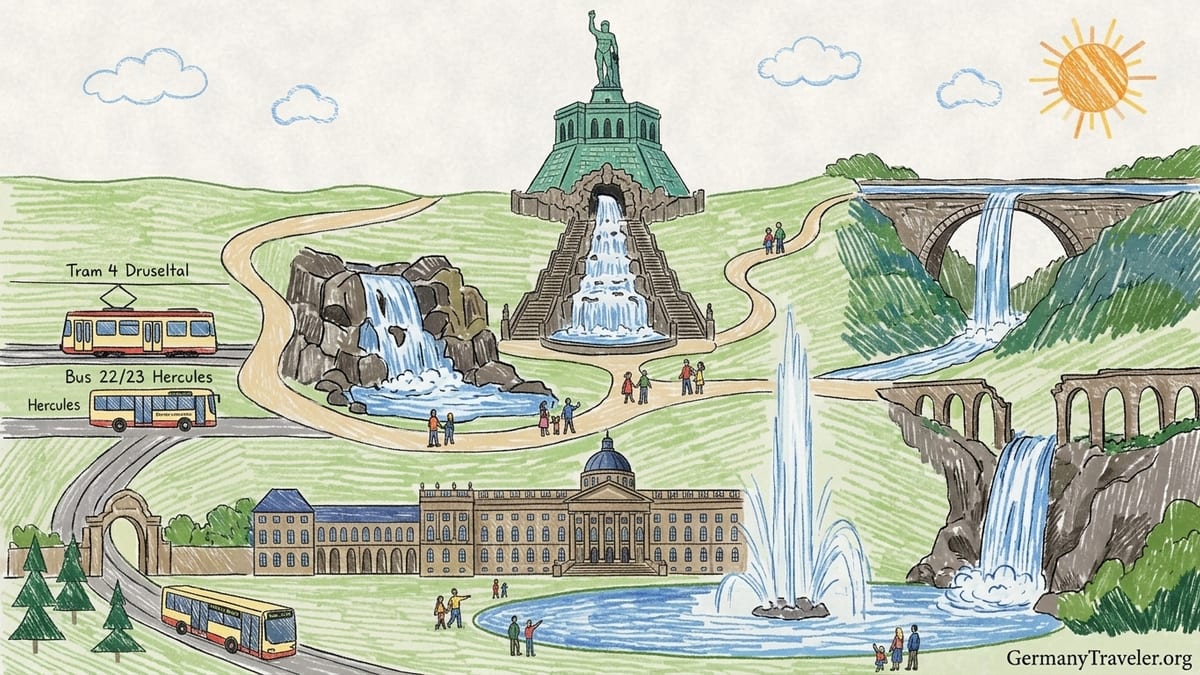
Arriving in Kassel and Aiming for the 14:30 Start
I based myself near Kassel Wilhelmshöhe station, which is the main long distance rail stop in the city and an obvious starting point if you are arriving by train from cities such as Frankfurt, Berlin, or Hamburg. From the station forecourt I followed the signs for the trams and walked down into the small transport hub where the city’s bright blue and white trams pull in. My target was tram 4 toward Druseltal, the line that climbs into the wooded hills southwest of the center and delivers you directly to the edge of Bergpark Wilhelmshöhe.
I bought a KasselPlus single ticket from a ticket machine on the tram platform, which cost a little over 3 euros for one adult journey at the current NVV tariff level. The machines accept bank cards and coins, and there is an English language option, which made the process easy even for my rudimentary German. I validated the ticket as I boarded and found a seat by the window on the right hand side to catch the first glimpses of the park’s tree line as we left the denser city streets behind.
The ride from Wilhelmshöhe station to the Druseltal terminus took around 15 minutes. We passed leafy residential neighborhoods, a local swimming pool, and the odd cafe terrace before the tram finally curved into the small loop at Druseltal. Here the city suddenly felt far away. The air was cooler, and there were more hikers with daypacks waiting on the platform than commuters in office clothes. Over the trees I could already see a distant glint of copper green that I knew was the statue of Hercules crowning the park.
I had timed my arrival so that I reached Druseltal just after 13:30, which gave me a comfortable margin to connect to the seasonal Bergpark buses up to the Hercules Monument. I did not want to risk a late start, because the water features begin exactly at 14:30 below the Hercules platform and then move steadily downhill. Missing the release would have meant chasing the spectacle instead of walking with it.
Riding Bus 22/23 Up to Hercules
From the tram loop at Druseltal I followed a small crowd of day trippers a few steps to the adjacent bus stops. On water feature days, bus lines 22 and 23 run as Bergpark shuttles, linking the lower park and Druseltal with the Hercules visitor parking area high above. The destination boards simply read “Herkules,” and both routes are included in the same KasselPlus ticket as the tram, so I did not need to buy anything extra for the connection.
My bus, a low floor city bus with large panoramic windows, arrived within about ten minutes. By this point the passengers were almost entirely families, hiking couples, and small tour groups chatting in German, Dutch, and English. I found a spot near the back where I could watch the forest thicken as we climbed. The road wound upwards in a series of bends, occasionally opening up to views back over Kassel and the hazy outlines of other hills in northern Hesse.
After roughly 15 minutes the bus pulled into the Hercules stop, which is essentially a large parking area with a small visitors’ kiosk, restrooms, and clear brown UNESCO style signs marking routes to the monument. I checked the time. It was just after 14:00, so I had around half an hour before the water was due to be released. That buffer turned out to be essential because from the bus stop it is still a short but steep walk to the foot of the Hercules Monument where the first official stage of the water features begins.
The path from the parking area to Hercules is paved but climbs sharply. There are a few benches along the way, and I saw several older visitors pause to catch their breath. I was grateful for my approach shoes with grippy soles and for having brought a light daypack instead of a suitcase. The steps here are regular and have railings, but they foreshadow what comes later in the park. If someone in your group has mobility issues, it is realistic to attend just the Hercules start and then return to the bus without attempting to follow the water all the way down.
Waiting Under Hercules and Watching the System Start
The Hercules Monument itself is extraordinary even before any water appears. The copper statue of Hercules rises from an octagonal pyramid of stone, which in turn stands on top of a monumental cascade staircase. This entire ensemble sits on a natural ridge, so when you finally step onto the lower terrace and look back you see Kassel spread out below like a miniature map surrounded by forest and gentle hills.
By 14:20 a sizable crowd had gathered along the balustrades and on the steps below the grotto where the first water basins lie. Families had claimed spots early and children leaned over the edges, pointing at the dry stone channels. Guides from the park authority were circulating in high visibility vests, reminding people in German and English not to climb onto the rocks or enter the basins. There were also clear signs explaining that the water features still operate without any mechanical pumps and that more than 750,000 liters of water will pass through the system in the space of roughly 75 minutes, driven only by gravity and historical engineering.
A few minutes before 14:30, I moved to a position slightly to the right of the main cascade where I could look up toward the octagon and also see down the grand staircase. A park employee blew a whistle, conversations dipped, and then there was a subtle but distinct roar from the grotto behind the arches. Water began to pour from hidden openings beneath Hercules, filling the horseshoe shaped basins around the grotto. It then spilled into the first cascade channels, frothing white against dark basalt stone that has been worn smooth by centuries of flow.
The spectacle at this top stage is not about a single dramatic waterfall but about the sudden animation of a huge stone structure. Dry steps and basins that a minute earlier looked purely architectural become a living water staircase. From where I stood, I could trace the path of the flow for perhaps a hundred meters before it disappeared behind a curve. This was my cue to leave the immediate Hercules area and start walking downhill. If you linger too long, the water will outpace you, and it becomes difficult to catch all the later features in sequence.
Keeping Pace to Steinhöfer Waterfall and Devil’s Bridge
I left the terraces at Hercules slightly before 14:40 and followed signposts marked with stylized water symbols that point toward the next stages of the features. The route to Steinhöfer Waterfall is partially on wide gravel paths and partially on narrower dirt trails through woodland. Even walking at a relaxed but purposeful pace, it took me around 20 minutes to reach the clearing where the waterfall is located.
Steinhöfer Waterfall is scheduled for around 15:05, and I arrived a few minutes beforehand to find people already spread out on the surrounding grassy slopes and on the rocky ledges opposite the fall. The structure looks at first like a natural crag, but closer inspection reveals carefully arranged rocks and channels. When the water finally arrives, it does so almost stealthily, first as a trickle at the top, then as a sudden curtain that breaks into multiple streams over ledges and boulders. Within moments the entire face of the “cliff” is covered in white water that plunges into a pool at the base.
I found a spot on a flat rock slightly above the main crowd, where my shoes had good purchase. From there I could look across the pool and see the water shredding itself into spray. Even on a warm afternoon the air here felt cooler, and a fine mist reached my face. Because the area is open, it was easier for children to move freely without blocking others’ views, and despite the sizable audience, I never felt crushed. That said, some of the rocks have no handrail and are polished by use, so I took care not to back up while looking through my camera.
Once the flow at Steinhöfer began to subside, the stream continued into forest channels toward the next highlight, the Devil’s Bridge or Teufelsbrücke, scheduled for around 15:20. The walk between the two stages took me roughly 10 to 12 minutes at a steady pace. Here the trail alternates between forest floor and sections of steps without handrails, often on natural stone. In damp or rainy weather these would be slippery, and I noticed several people in smooth soled fashion sneakers moving very cautiously. Good footwear with grip is more than a comfort here. It is a real safety consideration, especially for anyone with mild balance issues.
The Aqueduct, the Great Fountain and the Challenge of the Descent
Devil’s Bridge appears rather suddenly as you emerge from the trees. It is a high stone arch that seems to spring straight from the ravine, with a narrow channel carrying the water toward its apex. I arrived just as the first water was beginning to spill over the edge, breaking into a veil that fell into the ravine below. From my vantage point on the opposite side, I could see both the profile of the bridge and the drop beneath it. The crowds here were denser, partly because the viewpoint is narrower.
For a few minutes everyone simply watched the water tumble past the remains of ruined looking stone walls that frame the ravine. The name Devil’s Bridge suddenly made sense. The whole scene feels like something from a romantic painting. The engineering again remains mostly hidden. What you see is apparent natural landscape, but what you are witnessing is tightly controlled flow built on centuries old planning. I stayed long enough to watch the volume increase and then decrease again before following the water further down toward the Aqueduct.
The Aqueduct stage is scheduled for around 15:30 and lies further down the hillside. To reach it, I followed a combination of signposted forest paths and a series of stone staircases that descend quite steeply. This is one of the most physically demanding segments of the route. Over the entire water features path you lose roughly 200 meters of elevation from Hercules down to the Great Fountain, and much of that drop is concentrated in this middle portion. Some stair sections have railings, but others do not. The steps themselves vary in height and depth, which demands attention, especially if you are trying to move briskly to stay ahead of the water.
When I reached a good vantage point near the Aqueduct, a semi ruinous looking aqueduct bridge that ends abruptly in mid air, the first spectators were already in position. The approach was on rougher ground than earlier stages, and I noticed fewer families with strollers. From my spot on a grassy bank I could see where the water emerges along the top of the aqueduct, moves across the arches, and then suddenly plunges over the broken end in a 30 meter fall. For a few minutes the column of water thundered into the basin below, sending up a constant spray that caught the afternoon light. This is one of the most dramatic single drops on the route, and the collective gasp from the crowd as the first water went over spoke for itself.
Reaching the Great Fountain and Navigating Crowds
After the Aqueduct the stream continues toward the lower sections of the park through channels and smaller cascades. The final and perhaps most iconic act of the water features is the Great Fountain, or Große Fontäne, scheduled for around 15:45 in the large pond near Wilhelmshöhe Palace. To make it there in time, I left the Aqueduct stage shortly after the main surge and followed a gently descending path that eventually widened into more formal park avenues.
By this point in the afternoon I had covered approximately 2.3 kilometers from the Hercules Monument, almost entirely downhill. On paper that might not sound like much, but the combination of uneven stone steps, stretches without handrails, and constant changes in gradient made it more tiring than a flat city walk of the same distance. I was glad to have brought a refillable water bottle and a small snack bar, because there are no food stands directly along the forested middle stages. Benches do appear more frequently again as you approach the palace.
The Great Fountain area was the most crowded part of the entire sequence. The formal lawns around the pond were busy with people who had not walked down from Hercules but had instead chosen to see only the final fountain display. I found a place on the eastern bank of the pond where I could look back toward the line of sight up the park axis to the distant Hercules silhouette. At first the pond lay flat and reflective. Then the surface began to churn, and suddenly a powerful jet of water shot straight upward from the center.
The Great Fountain can reach a height of around 50 meters under ideal conditions, and on my visit it rose impressively high, briefly catching the late afternoon sun in a shimmering column. The wind was light, so the spray drifted only slightly, and a faint rainbow formed at one edge. For several minutes the jet held, then gradually sank back until the pond was calm again. As the display ended, the crowd broke into spontaneous applause. It felt less like a theme park show and more like a shared appreciation of a living historical machine that still performs its function centuries after it was built, using nothing more than gravity and carefully calculated differences in elevation.
Understanding the Gravity System in Practice
Throughout the afternoon I kept returning to the same question. How could such a complex series of waterfalls, cascades, and a towering fountain operate without any visible pumps or modern machinery. The answer, as I gathered from the information boards and a short explanation by a park guide, lies out of sight above the Hercules Monument in a network of historical reservoirs and channels. Over the course of the day water is stored in elevated basins higher than Hercules. When the time for the Wasserspiele comes, sluice gates are opened manually, and gravity does the rest.
The more than 750,000 liters of water that pass through the system follow a carefully choreographed path. The initial release feeds the grotto and basins beneath Hercules and then pours down the cascades. From there the water is diverted through underground channels and open rills to reach Steinhöfer Waterfall at around 15:05, continues to Devil’s Bridge by roughly 15:20, and then is sent across the Aqueduct at about 15:30 before finally feeding the Great Fountain around 15:45. Each feature is designed so that the water reaches it at a specific time and flows in a way that appears spontaneous and natural, even though it is the result of precise hydraulic engineering.
From a visitor’s perspective, this setup has practical consequences. Because the system is powered only by gravity and the finite volume of stored water, the timing is strict and the sequence runs only once on scheduled days. There are no “extra runs” if you miss a stage. It also means that the display is sensitive to dry spells and maintenance needs. On my visit everything ran as planned, but I noted signs explaining that in periods of drought or special conservation work, some stages may be reduced or canceled to protect the park’s water resources and historical structures.
This gravity based design also explains why there are no admission gates or turnstiles specifically for the water features. The entire spectacle unfolds within a public park that you can enter freely year round. The water display itself is free to watch, though certain museums and interiors within the park, such as Wilhelmshöhe Palace, do charge separate entry fees. For the water features you simply position yourself along the route and let the hillside do the work.
Schedules, Seasons and How I Got Back to the City
The water features operate seasonally. On my visit the schedule matched the current official information. The Wasserspiele usually run from May 1 to October 3, every Wednesday and Sunday afternoon, as well as on public holidays in the state of Hesse. The sequence begins at 14:30 below Hercules and finishes around 15:45 at the Great Fountain. Outside these dates, the park is still open and beautiful, but the water features are not in operation. If your trip to Kassel revolves around seeing the Wasserspiele, it is essential to check the exact season and dates before booking travel.
After the Great Fountain concluded and the crowd began to thin, I took a short break on a bench facing Wilhelmshöhe Palace and reflected on the route I had just covered. From Hercules down to the palace area I had spent about 90 minutes in motion, with short pauses at each water stage. Including the tram and bus rides, my total outing from Wilhelmshöhe station and back took around four and a half hours, not counting time for a coffee afterwards.
To return to the city I walked from the Great Fountain area in the lower park to the “Wilhelmshöhe (Park)” tram stop, which lies just beyond the formal gardens. From here tram line 1 runs back toward the city center, including Königsplatz and connections to other lines. I used the same fare zone as in the morning, again paying a little over 3 euros for a single adult ticket. If you prefer, you can also connect via bus 23 from the park back to Druseltal and then take tram 4 again, but I found tram 1 from the lower park more convenient after finishing the downhill walk.
Back in the city, I treated myself to a coffee and slice of cake at a cafe near Königsplatz, adding roughly 7 euros to my day’s expenses. In total my direct costs for the Wasserpsiele outing came to around 10 to 12 euros for local transport and under 10 euros for snacks, since the water features themselves are free to watch. If you are traveling on a regional ticket such as a state day pass that includes local transport, your marginal cost for the trams and buses within Kassel may be zero.
Practical Lessons: Footwear, Weather and Fitness
Walking the full route of the Bergpark Wilhelmshöhe water features in one sequence is less a gentle stroll and more a moderately demanding urban hike. Over the 2.3 kilometers from Hercules to the Great Fountain you descend about 200 vertical meters, much of it on irregular stone steps and sloping paths. Some sections have no handrails, and the stones can be smooth from centuries of wear. On my visit the weather was dry and mild, with temperatures around 22 degrees Celsius and light cloud cover, which made the walking pleasant. In wet or very hot conditions, the effort would feel different.
I wore low cut hiking shoes with a firm sole and a grippy tread, light hiking trousers, and a breathable t shirt, with a thin fleece in my backpack just in case. This combination proved ideal. I saw several visitors in casual sneakers and flat sandals manage the walk, but many of them moved more cautiously and seemed more fatigued by the constant need to watch their footing. I would not recommend the route in flip flops or dress shoes, and if you have knee issues, consider using a light trekking pole for the downhill sections.
Crowd levels also matter. On my weekday visit, which fell on a Wednesday in June, there were plenty of people but the park did not feel overwhelmed. I could always find a vantage point at each water stage without aggressive jostling. On high season Sundays or public holidays the situation can be more intense, especially at Hercules and the Great Fountain, and keeping up with the sequence may be harder if you have to fight through tightly packed paths. Allow extra time between stages on those days and consider positioning yourself slightly ahead of the main crowd to give yourself a buffer.
Finally, it helps to travel light. A small daypack with water, a snack, sunscreen, and perhaps a compact rain jacket is sufficient. Dragging a rolling suitcase or carrying heavy camera bags would quickly become frustrating on the uneven steps. The park rules also forbid climbing on structures or entering the water basins, so there is no need for swimwear or towels. Treat the whole route as you would a visit to a historic garden combined with a mild hike, and you will be well prepared.
The Takeaway
As I rode tram 1 back into central Kassel in the late afternoon, shoes dusty and phone full of photos, I found myself replaying the sequence in my mind. The day had started as a logistics exercise. Catch tram 4 to Druseltal, connect to bus 22 or 23, reach Hercules before 14:30, and then keep pace with water that never once pauses for latecomers. It ended as something more. I felt as if I had briefly stepped inside an 18th century engineering dream and walked alongside it as it came alive.
Was the experience on its own worth traveling to Kassel. For me, the answer is yes. The combination of vast hillside park, monumental baroque architecture, romantic landscape features, and the sheer improbability of a fully gravity powered show moving more than three quarters of a million liters of water without modern pumps is unlike anything I have seen elsewhere in Europe. It felt more personal and less commercial than many contemporary attractions. There are no loudspeakers blasting music, no souvenir kiosks at each stage, only the sound of water, the murmur of several hundred onlookers, and the rustle of wind in the trees.
Of course, the water features are only one part of Bergpark Wilhelmshöhe. If I had more time, I would add a tour of Wilhelmshöhe Palace and its art collections, or a quiet morning exploring the park’s side paths and viewpoints without the pressure of following a timetable. But even within the tight frame of an afternoon, this downhill journey from Hercules to the Great Fountain gave me a vivid sense of Kassel’s relationship with water, landscape, and spectacle. It is an experience that rewards preparation and comfortable shoes, yet remains free of turnstiles and plastic wristbands.
If you are contemplating a visit, I would plan at least half a day around the Wasserspiele, choose sturdy footwear, aim for a Wednesday if possible to avoid the busiest weekend crowds, and embrace the simple pleasure of walking downhill while the hillside’s hidden reservoirs quietly empty past you. When the Great Fountain finally subsides and the last ripples fade from the pond, you will know you have watched a piece of living heritage perform exactly as intended, in real time and under open sky.
FAQ
Q1. On which days do the water features at Bergpark Wilhelmshöhe usually run.
They normally operate from May 1 to October 3 on Wednesdays, Sundays, and public holidays in the state of Hesse, with one sequence each afternoon starting at 14:30.
Q2. How do I get from Kassel Wilhelmshöhe station to the Hercules Monument by public transport.
From Kassel Wilhelmshöhe station you take tram 4 in the direction of Druseltal, then change to bus 22 or 23 at Druseltal, riding up to the Herkules stop near the upper park. From there it is a short but steep walk to the monument.
Q3. How long is the walk when following the water features from Hercules to the Great Fountain.
The route is about 2.3 kilometers in length, almost entirely downhill, with an elevation drop of roughly 200 meters from the Hercules Monument down to the Great Fountain near Wilhelmshöhe Palace.
Q4. How difficult is the path for visitors with limited mobility.
The path includes several sections of uneven stone steps without handrails and some steeper slopes, so it can be challenging for visitors with mobility issues. Many people with limited mobility choose to watch only selected stages, such as the start at Hercules or the final Great Fountain, rather than walking the full route.
Q5. Do I have to pay admission to see the water features.
No, watching the water features is free. Bergpark Wilhelmshöhe is a public park without turnstiles. You only pay for any public transport you use and for separate museum entries such as Wilhelmshöhe Palace if you decide to visit them.
Q6. What kind of footwear and clothing do you recommend for the walk.
Comfortable shoes with good grip, such as light hiking shoes or sturdy sneakers, are strongly recommended because of the uneven steps and natural paths. Clothing should match the weather, with layers for cooler days and sun protection in summer.
Q7. How crowded does it get along the route during the water features.
Crowds vary by day. On Wednesdays outside school holidays the paths are busy but manageable. Sundays and public holidays can be much more crowded, especially at Hercules, the Aqueduct, and the Great Fountain, so moving between stages may take longer.
Q8. How much time should I allow for the entire outing from Kassel and back.
Including tram and bus rides, the walk between stages, and some time to linger at each feature, a realistic estimate is four to five hours for a round trip from Kassel Wilhelmshöhe station.
Q9. Are there places to buy food and drinks along the water features route.
There are kiosks and cafes near the Hercules parking area and around Wilhelmshöhe Palace and the lower park, but very few options directly beside the middle forest stages. Bringing your own water and a small snack is a good idea.
Q10. Is the water features sequence suitable for young children.
Many families visit with children, who usually enjoy the spectacle of the waterfalls and fountain. However, parents should be prepared for a downhill walk with steps and keep a close eye on children near unfenced drops and water edges. A baby stroller is practical in the lower park but more difficult on the forested middle sections.