


The Rheingau is one of Germany’s most compact yet influential wine regions, a short hop from Frankfurt but a world of river bends, steep vineyards and centuries of Riesling history. For many visitors, the name still means only Rüdesheim and its busy Drosselgasse lane. In reality the Rheingau stretches from elegant Eltville to the wild slopes near Lorch, with monastery cellars, aristocratic estates and quiet wine villages in between. This guide sets out the shape of the region, compares its key towns and shows how to explore its Riesling and Pinot Noir vineyards on foot, by boat and with limited rail service on the right bank in 2026.
Understanding the Rheingau: River Bend, Slopes and Riesling
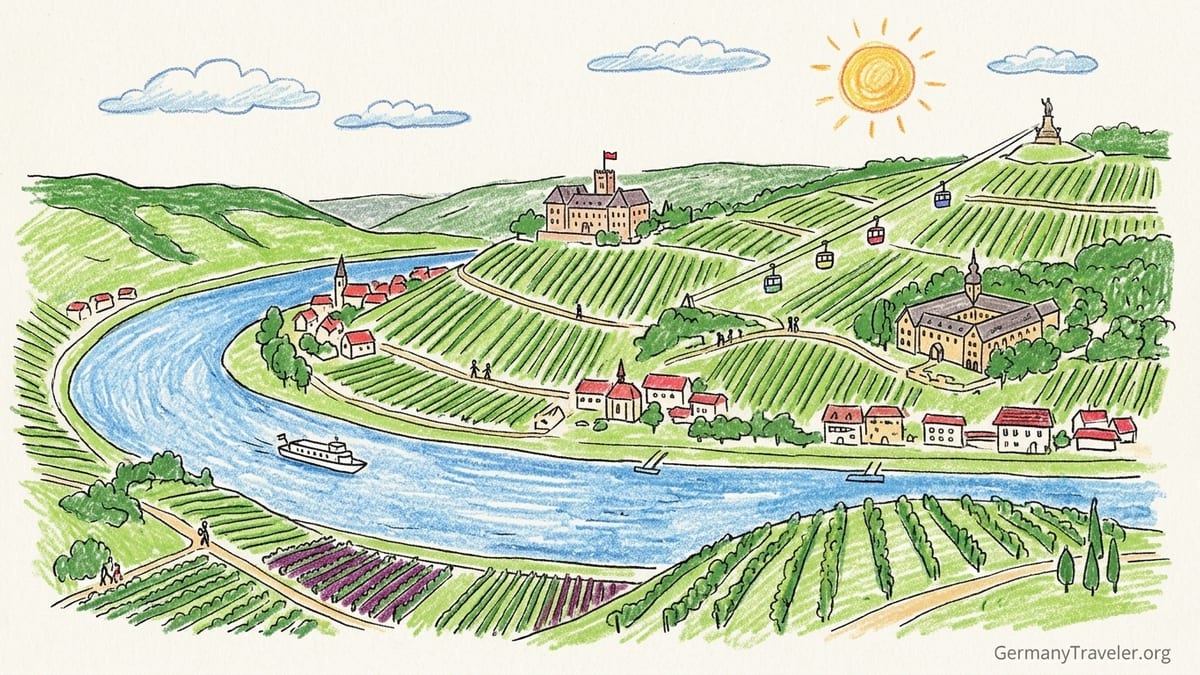
The Rheingau’s character is defined by an unusual bend in the Rhine. West of Wiesbaden the river stops flowing north and turns east to west, so that the vineyards on the right bank suddenly face south. Between Walluf and Rüdesheim the vines sit on the lower slopes of the Taunus hills, with forest behind them and the river below. This south-facing exposure, combined with reflected light from the broad water surface and shelter from cold northern winds, helps Riesling ripen reliably in what is otherwise a fairly cool climate.
Riesling dominates the vineyards here to a degree that is rare even in Germany. Official figures show that the large majority of Rheingau vineyard land is planted with Riesling, while red wine appears mainly around the so-called Rotweininsel, the “red wine island” of Assmannshausen where Spätburgunder (Pinot Noir) has long been prized. Soil varies over short distances: loess and loam are common around Eltville and Oestrich-Winkel, quartzite is typical near Rüdesheim, and slate and schist appear near Lorch. The result is a spectrum of Riesling styles from crisp and citrusy to smoky and mineral.
This small region has outsized historic importance. Cistercian monks at Kloster Eberbach and aristocratic estates like Schloss Johannisberg and Schloss Vollrads documented vineyard parcels, harvest dates and cellar practices centuries before modern wine law. Late-harvest Riesling and the classification of top vineyard sites both have roots in experiments and records from these properties. Today their courtyards, cloisters and tasting rooms give visitors unusually direct access to the places where much of Riesling’s reputation was forged.
For travelers, the compact geography and string of riverside towns make the Rheingau ideal for slow exploration. Distances between major wine villages are often under 5 kilometers, with dedicated walking paths, the Rheinsteig long-distance trail and local routes such as the Flötenweg and Eltviller Klosterweg connecting them. That means you can taste at a riverside winery, walk through vineyards to the next village and still be back at your guesthouse without needing a car.
Key Rheingau Wine Towns: How the Villages Differ
Eltville am Rhein sits toward the eastern side of the winegrowing Rheingau and works well as a romantic yet practical base. Its old town has rose gardens around the Electoral Castle on the riverfront, cobbled alleys, half-timbered houses and several wine estates with tasting rooms in walking distance. The municipality includes the wine village of Hattenheim, but Eltville itself feels more like a small riverside town than a farming village. Trains from Wiesbaden and Frankfurt are frequent, boat piers are close to the center, and buses connect Eltville to Kloster Eberbach and neighboring villages, which makes it particularly convenient for first-time visitors without a car.
Just a few kilometers upstream, Hattenheim feels noticeably quieter and more vineyard-focused. It has a small riverside promenade, a handful of restaurants and wine taverns, and streets that quickly climb toward vineyard slopes. Hattenheim is technically part of Eltville, but the atmosphere is that of a compact wine village where you are likely to walk past tractors and barrel courtyards on the way to dinner. Travelers who want evenings to be peaceful and do not mind a smaller choice of shops often see Hattenheim as a good compromise between rural calm and practical rail access.
Oestrich-Winkel lies in the central Rheingau and is a spread-out municipality that includes Oestrich, Mittelheim and Winkel. It is one of the region’s most important wine towns and home to Schloss Vollrads as well as many medium-sized family wineries. The riverside here feels wider and calmer than in Rüdesheim, with open views across to the Rheinhessen side. Oestrich-Winkel appeals to visitors who want to focus on scheduled tastings and winery visits rather than nightlife. Tourist information material from the town highlights cycling routes, local Riesling-focused festivals and a network of guesthouses tucked between villages.
Geisenheim and its district Johannisberg form the educational and historical heart of Rheingau wine. Geisenheim is home to a renowned university for viticulture and oenology, so its streets mix student life with traditional wine estates. Above it, the hilltop village of Johannisberg centers on Schloss Johannisberg, one of the world’s best-known Riesling estates and a symbol of late-harvest wine. Staying in Geisenheim gives visitors good train and bus connections, while Johannisberg offers sweeping vineyard views and a more secluded feel, though with fewer accommodation options.
Rüdesheim, Assmannshausen and Lorch: From Tourism Hub to Wild Slopes
Rüdesheim am Rhein is by far the most visited town in the Rheingau, known for river cruises, coach tours and the busy Drosselgasse alley of wine taverns. It sits where the gentle Rheingau section of the river transitions into the narrower UNESCO-listed Upper Middle Rhine Valley. Cable cars rise from the town up to the Niederwald monument above steep vineyards, and boat operators run frequent cruises. Rüdesheim suits travelers who value an extensive choice of hotels, restaurants and visitor services, even if that means sharing the streets with day-trippers and large tour groups, especially between May and October.
Assmannshausen, officially part of Rüdesheim, clings to a narrow curve of the river a few minutes downstream. Here the slopes steepen dramatically and are planted largely with Spätburgunder on heat-retaining slate and sandstone soils. Historically this red wine from Assmannshausen was poured in grand hotels across Europe. Today the village is quieter than central Rüdesheim but still has hotels lined along the river road, a small cluster of traditional restaurants and access to hiking routes leading quickly uphill into forest and vineyard. It is a good choice for visitors who are curious about German Pinot Noir and want evenings that are livelier than in Lorch but calmer than in Rüdesheim.
Lorch and nearby Lorchhausen mark the western end of the Rheingau growing area and the point where the landscape feels wilder. The river narrows, boat traffic often slows, and terraced vineyards rise above a compact historic core. Tourism infrastructure is more modest here, with a smaller selection of hotels and restaurants, but the reward is a strong sense of place. Riesling from Lorch is often described as more herbal and mineral, reflecting steeper slopes and slate-rich soils. Hikers use Lorch as a base for some of the most scenic and demanding Rheinsteig stages, with long climbs and panoramic views down the gorge.
Choosing between these three depends on travel style. Visitors who want many hotel choices, nightlife and easy cruise options gravitate to Rüdesheim. Those keen on red wine, steeper vineyards and a slightly more intimate setting may feel more at home in Assmannshausen, while Lorch suits travelers who prioritise landscape, hiking and a less polished but authentic small-town atmosphere.
Monasteries and Wine Estates: Kloster Eberbach, Schloss Johannisberg, Schloss Vollrads
Kloster Eberbach, tucked in a side valley above Eltville, is a former Cistercian monastery and one of the most atmospheric wine sites in Germany. Its cool, barrel-lined cellars and Romanesque architecture featured in the film adaptation of “The Name of the Rose.” Visitors can join guided tours that typically combine the cloister and historic press houses with a tasting of estate wines, or taste independently at the vinothek. Entry and tour prices vary by season, but a simple cellar tour with tasting has recently cost in the region of 15 to 20 euros per person. The complex also houses a hotel, restaurant and event spaces, which makes it possible to stay on site and walk directly into surrounding vineyards.
Schloss Johannisberg sits on a rounded hilltop above Geisenheim and Johannisberg village, commanding one of the classic Rheingau views. Historically, it is linked to the development of Spätlese, or late-harvest Riesling, when a delayed harvest in the 18th century produced unusually concentrated wines that became famous across Europe. Today visitors can walk through the park-like grounds, visit a chapel, and taste in a dedicated wine bar or restaurant space. Access to the outdoor areas is usually free during opening hours, and guided cellar tours are offered on specific days. Tasting is typically by the glass or through small flights, with individual glasses of estate Riesling often priced under 10 euros.
Schloss Vollrads lies slightly inland from Oestrich-Winkel and combines a moated tower, manor house and modern winery. It claims continuous wine sales from the estate for over 800 years. The property offers a restaurant with terrace, a vinothek where visitors can taste and buy wines, and walking paths through surrounding vineyards. Public access is relatively flexible: you can usually enter the courtyard and vinothek during opening hours without a formal tour, then choose a tasting flight or a couple of glasses paired with small dishes. Guided tours of the historic buildings and cellars are available on set dates, often at modest surcharges.
Comparing the three, Kloster Eberbach feels like a large, multi-layered monument where wine is part of a broader monastic story. Visitors often spend several hours here exploring architecture and grounds in addition to tasting. Schloss Johannisberg is more compact but offers a stronger sense of one single hill devoted to Riesling, with sweeping vineyard views. Schloss Vollrads balances history and comfort, with a focus on relaxed tasting and food, and is often favoured by day-trippers who want to combine a short vineyard walk with a seated tasting. All three require some planning around opening times and, in high season, advance reservations for tours or restaurant meals.
Walking and Car-Free Wine Itineraries: Flötenweg, Eltviller Klosterweg and Rheinsteig
The Rheingau’s dense trail network makes it especially welcoming for car-free travelers. A good introduction is the Flötenweg, a 10 kilometer loop walk around Oestrich-Winkel that connects riverside and vineyard slopes. The route is named after the slender Rheingau “Flöte” bottle and is designed for relaxed walking with views across the Rhine, gentle gradients and occasional refreshment stops. Local tourism descriptions note that several of the paths leading up from the river to the loop are between 2.5 and 4 kilometers long, so walkers can tailor the distance. Along the way, signs explain vineyard sites and grape varieties, and there are chances to taste in village taverns before or after the walk.
From Eltville, the Eltviller Klosterweg leads about 14 to 15 kilometers through vines and woodland to Kloster Eberbach and back. Starting near the old town and rose gardens, it passes through the wine village of Erbach and climbs gently toward the forested ridge. Waymarking highlights viewpoints over the Rhine and stops at chapels and benches. The loop can be walked in around 4 to 5 hours at a steady pace, leaving ample time to tour the monastery and taste wines before returning to Eltville. This route works particularly well for couples staying in Eltville who want a full day without transport logistics.
For those seeking longer hikes, the Rheinsteig long-distance trail runs high above the river from Wiesbaden through the Rheingau and into the Middle Rhine Valley. In the Rheingau section, popular day stages include the route from Rüdesheim to Johannisberg at about 15 kilometers, with a mix of forest, vineyard tracks and far-reaching views, and the more demanding section between Rüdesheim and Lorch, which unfolds above increasingly steep slopes. Hikers can combine a morning Rheinsteig stage with afternoon tastings by descending into villages such as Geisenheim, Oestrich-Winkel or Lorch and catching buses or boats onward.
A practical car-free itinerary might start with two nights in Eltville, using one day for the Klosterweg and monastery visit and another for short train rides to Hattenheim and Oestrich-Winkel for tastings. A second base in Rüdesheim or Assmannshausen would then allow visitors to hike a Rheinsteig section, ride the cable car to the Niederwald monument and taste local Riesling and Pinot Noir. Inter-village movement can be handled by regional buses, ferries across the river and, where available, replacement bus services along the right bank during rail works.
Right-Bank Rhine Rail Closure in 2026: How to Get Around
Major works on the right-bank Rhine railway line between Wiesbaden and Koblenz mean that through rail services on the section via Rüdesheim, Assmannshausen and Kaub are subject to long-term closures until at least late 2026. Regional transport information for the so-called “Generalsanierung Rechter Rhein” indicates that sections of the line including Wiesbaden Ost to Rüdesheim and onward toward Neuwied are fully closed for significant periods, with replacement bus services arranged for trains that normally run along this bank. This affects the popular RB 10 line that previously connected Frankfurt and Wiesbaden directly with Rüdesheim and beyond.
For visitors in 2026, this means you cannot rely on older guidebooks that suggest simply boarding a Rhine right-bank train any time of day. Instead, you should expect to combine several modes. From Frankfurt or Wiesbaden to the eastern Rheingau, trains still run via the left bank of the Rhine to towns like Mainz and then connect to Eltville and Oestrich-Winkel, or they run via other regional routes determined by current timetables. To reach Rüdesheim, Assmannshausen or Lorch, travelers may need to use designated Schienenersatzverkehr, or rail replacement buses, from hubs such as Wiesbaden or Koblenz, or cross by ferry from left-bank stations like Bingen.
In practice, many car-free visitors now plan to base themselves in towns with more robust rail links, such as Eltville, Geisenheim or Oestrich-Winkel, and then treat excursions to Rüdesheim and Assmannshausen as day trips by bus or boat. River cruise boats and local ferries continue to run and can be used not only for sightseeing but also as point-to-point transport along the Rhine. Before travel, it is important to check current schedules from regional transport associations and local tourist offices, as replacement bus patterns may change during different phases of the works.
While the rail closure introduces some inconvenience, it also has a side effect of pushing visitor flows slightly away from the busiest corridor and encouraging deeper exploration of quieter villages. With realistic expectations and updated timetable information, it is still entirely possible to travel the Rheingau in 2026 without a car, but last-minute flexibility and a willingness to adjust routes are essential.
Winery Visits, Straußwirtschaften, Festivals and Costs
Rheingau wineries range from world-famous estates with polished visitor centers to small family producers who open their courtyard only a few weeks each year. Larger estates, including those attached to Kloster Eberbach, Schloss Johannisberg and Schloss Vollrads, usually maintain regular opening hours for their vinothek, where visitors can drop in to taste a selection. Tasting formats vary: some offer fixed flights of three or four wines for a set fee, often between 10 and 20 euros, while others pour wines by the glass and waive a separate tasting fee if you buy bottles.
At smaller estates in villages like Hattenheim, Mittelheim or Lorch, visits frequently require an appointment arranged by email or phone. These private tastings may be hosted by a family member in a cellar or tasting room and often focus on current vintages of Riesling and, where relevant, Spätburgunder. A guided line-up of five to eight wines with discussion in German or English commonly costs in the region of 15 to 25 euros per person, sometimes credited against purchases. Short-notice visits are more easily accommodated outside harvest and peak festival weekends; in September and October cellar work may limit availability.
Seasonal Straußwirtschaften, or temporary wine taverns attached to wineries, remain a distinctive feature of the Rheingau. By law, these simple eateries can operate only for a limited number of weeks per year and serve the estate’s own wines alongside a short, home-style food menu, often including dishes such as Handkäse mit Musik, cold meat platters and seasonal salads. In villages like Hattenheim, Oestrich-Winkel and Kiedrich, entire “wine tavern streets” can come alive when several Straußwirtschaften open at once in spring or late summer. Glasses of house Riesling here often start at roughly 4 to 6 euros, and a filling plate of regional food may cost between 10 and 18 euros, though exact prices shift with inflation.
The region’s event calendar includes numerous wine festivals that can significantly change the atmosphere and accommodation demand. Eltville hosts a wine festival near the riverside castle in summer, with stands from local producers, live music and extended opening hours. Towns like Oestrich-Winkel and Geisenheim also organize Riesling-focused events, and Rüdesheim is known for large-scale celebrations that fill its lanes well into the night. During these weekends, room prices in central villages climb and advance booking becomes essential. Travelers who prefer quiet tasting conditions may choose shoulder seasons, such as late April to early June or late September after the peak of harvest.
Accommodation, Wine Styles and Choosing What to Drink
Accommodation in the Rheingau covers a spectrum from simple guesthouses run by winegrowing families to four-star riverfront hotels. In Eltville and Rüdesheim, visitors find larger hotels with reception desks, elevators and full-service restaurants, often in the 120 to 200 euro per night range for a double room depending on season and standard. In Hattenheim, Oestrich-Winkel, Geisenheim and Lorch, traditional Gasthäuser and small hotels are more common, with double rooms more likely to fall somewhere between 80 and 140 euros outside peak festival weekends. Some wineries also operate a handful of guest rooms above the cellar, giving guests the chance to stay directly in the vineyards.
For travelers without a car, it often makes sense to prioritize locations within a short walk of a station, bus stop or ferry pier, even if that means accepting a less dramatic view in exchange for easier transport. In Eltville and Oestrich-Winkel, many guesthouses sit only a few hundred meters from the river and public transport while still feeling residential. In Rüdesheim and Assmannshausen, the rail line and river road run close to hotels, so light sleepers may wish to request rear-facing rooms or choose accommodation slightly up the hill for less noise.
When it comes to what to drink, Rheingau Riesling comes in several sweetness levels, and labels can initially seem confusing. Travelers who prefer crisp, dry wines should look for the term “trocken” on the label or ask directly for “Riesling trocken” in tasting rooms and restaurants. These wines typically pair well with regional dishes such as grilled fish, poultry and salads and highlight the minerality of vineyards in Johannisberg, Rüdesheim or Lorch. Those who enjoy some fruit sweetness without a dessert-level sugar content can seek out “feinherb” or “halbtrocken” Rieslings, which often show peach and apricot notes and work well with spicy dishes or richly sauced pork.
Classic sweeter styles, including Kabinett, Spätlese and Auslese, are also part of the Rheingau tradition. Kabinett Rieslings from cooler sites around Lorch or higher vineyards above Hallgarten can taste light and racy despite noticeable residual sugar, making them refreshing aperitifs or companions to lightly spicy food. Richer Spätlese and Auslese bottlings from estates like Schloss Johannisberg or Schloss Vollrads are often treated as special-occasion bottles and pair naturally with blue cheese or fruit desserts. At the red end of the spectrum, Assmannshausen Spätburgunder offers a clear regional identity, with cherry fruit, subtle spice and moderate body that pairs well with game, mushrooms and grilled meats. Beginners need not master all the terminology: in most tasting rooms, staff are happy to suggest a dry, medium or sweeter style matched to your preferences.
Sample Plans for Different Travelers
Couples looking for romance and relaxed walking might choose Eltville as a base. A three-night stay could include one full day on the Eltviller Klosterweg with a long lunch or early dinner at Kloster Eberbach, a second day visiting wineries in Hattenheim and Oestrich-Winkel with tastings at a mix of Straußwirtschaften and formal estates, and a final half-day strolling Eltville’s rose gardens and riverside promenade. Evenings could be spent in wine bars around the old town, sharing flights of local Riesling and simple regional dishes before walking back through cobbled streets.
Beginners to wine who want an overview without technical detail might focus on larger estates with structured visitor experiences. A two-base approach works well: two nights in Oestrich-Winkel or Geisenheim to visit Schloss Vollrads, a couple of easy-going family wineries and perhaps a short Flötenweg hike, followed by two nights in Rüdesheim for the cable car, river cruise and a visit to Schloss Johannisberg. Booking at least one guided tasting or English-language tour at each of the major estates helps turn labels and terminology into stories rather than abstractions.
Serious wine enthusiasts often prefer to stay in quieter villages like Hattenheim, Johannisberg or Lorch and build their days around appointments. A focused itinerary might include morning tastings at top Riesling producers, a simple lunch in a Straußwirtschaft, and afternoon visits to smaller estates that bottle single-vineyard wines from sites such as Höllenberg, Rottland or Schlossberg. Enthusiasts who plan to ship wine home should clarify export and shipping options in advance. Many estates can arrange international delivery at additional cost, while others may recommend specialist retailers in larger cities.
Car-free visitors, regardless of expertise level, benefit from anchoring their trip in towns with dependable bus and replacement rail services during the right-bank closure. Eltville and Oestrich-Winkel, with their combination of rail access and central location, are strong candidates for longer stays. From there, day trips can reach Kloster Eberbach, Schloss Vollrads, Geisenheim and Johannisberg on foot or by short bus rides, while Rüdesheim, Assmannshausen and Lorch remain accessible by SEV buses and ferries. Building a small margin of extra time into each transfer allows for unexpected timetable changes while still leaving plenty of hours for tasting and vineyard walks.
The Takeaway
The Rheingau is far more than a single famous alley in Rüdesheim. It is a compact corridor of riverside villages and sunlit slopes where Riesling has been refined over centuries by monks, aristocrats and university-trained winemakers. Eltville’s roses, Hattenheim’s quiet lanes, Oestrich-Winkel’s winery clusters, Johannisberg’s historic hill, Assmannshausen’s red wine terraces and Lorch’s wild gorge all show different facets of the same region. Together with anchor estates like Kloster Eberbach, Schloss Johannisberg and Schloss Vollrads, they form a landscape where history and everyday wine culture are closely intertwined.
Travel in 2026 requires a little more planning because of the right-bank rail works, but river boats, buses, ferries and well-marked trails still tie the villages together. For many visitors, the slower pace that comes with walking between tastings or building trips around local routes like the Flötenweg or Eltviller Klosterweg becomes part of the pleasure. By choosing a base that matches your travel style, communicating your wine preferences clearly during tastings and embracing a car-free rhythm, you can experience the Rheingau as a living wine landscape rather than just a series of postcard stops.
FAQ
Q1: Can I explore the Rheingau without renting a car in 2026?
Yes. You can combine regional trains where available, replacement buses on the right bank, local buses, ferries and well-marked walking trails. Basing yourself in Eltville, Oestrich-Winkel or Geisenheim gives you good public transport access and allows day trips to Rüdesheim, Assmannshausen, Johannisberg and Lorch using a mix of buses and boats.
Q2: How many days should I plan for a first visit to the Rheingau?
A minimum of two full days allows you to visit one major estate such as Kloster Eberbach or Schloss Johannisberg and explore a couple of villages. For a more relaxed pace with walking, tastings and time to see both the eastern and western halves of the region, four to five days is ideal.
Q3: Do I need appointments for winery tastings?
Large estates and some village vinotheks welcome walk-in visitors during opening hours, especially in Eltville, Oestrich-Winkel and Rüdesheim. Smaller family wineries often require appointments, particularly for guided tastings or visits in English. If you have specific producers in mind, it is safest to email or call a few weeks in advance.
Q4: What does a typical tasting cost in the Rheingau?
Prices vary by estate and format, but simple flights of three to five wines at well-known properties often cost around 10 to 20 euros per person. More in-depth tastings of premium single-vineyard wines at top estates can be higher. Many wineries credit part of the fee against bottle purchases, so buying wine to take home often reduces the effective cost.
Q5: When are Straußwirtschaften open, and how do I find them?
Straußwirtschaften operate only for limited weeks each year, usually in spring and late summer or early autumn. Opening periods are announced locally, on village noticeboards and through tourist offices. In villages like Hattenheim and Oestrich-Winkel, several Straußwirtschaften may open at once, creating an informal evening circuit of simple wine taverns serving house wines and regional dishes.
Q6: Is it better to stay in Rüdesheim or a quieter village?
Rüdesheim offers the widest range of hotels, restaurants, tours and river cruises but can be crowded and lively late into the evening. Quieter villages such as Hattenheim, Oestrich-Winkel or Lorch offer a more local feel, easier access to specific vineyards and generally calmer nights. Many travelers choose one of each for different halves of their trip.
Q7: How do I choose between dry and sweeter Riesling in the Rheingau?
If you like crisp, refreshing wines with little or no sweetness, ask for “Riesling trocken” in tastings and restaurants. If you enjoy some fruit sweetness, ask for “feinherb” or “halbtrocken,” or try Kabinett-level wines. You can also describe your preferences in simple terms, such as “not too sweet” or “fruity with some sweetness,” and staff will suggest suitable wines.
Q8: What is special about Assmannshausen Spätburgunder?
Assmannshausen is known for steep, slate-based vineyards that favor Spätburgunder, the German name for Pinot Noir. The wines tend to be medium-bodied with cherry fruit, spice and good acidity rather than heavy tannins. They pair well with game, mushrooms and grilled meat and offer an interesting contrast to the region’s Rieslings.
Q9: Are the walking trails suitable for casual hikers?
Yes, many routes such as the 10 kilometer Flötenweg around Oestrich-Winkel and the Eltviller Klosterweg are designed for relaxed walkers with moderate fitness. They follow vineyard tracks and forest paths with some gentle climbs. Rheinsteig stages, especially around Lorch, can be steeper and require sturdier footwear and better conditioning.
Q10: When is the best time of year to visit the Rheingau?
Late April to June and September to early October are particularly attractive. Spring brings fresh foliage and often quieter villages, while early autumn offers harvest atmosphere and vibrant vineyard colors. July and August can be busier and warmer, especially around Rüdesheim, and key festival weekends anywhere in the region attract large crowds and higher room rates.