


From the terrace of my guesthouse above Edersee, I was supposed to be looking at a broad strip of deep blue water, dotted with paddleboarders and the white silhouettes of excursion boats. Every brochure and booking site had shown the same postcard view. Instead, on an August afternoon in 2026, I found myself staring at a shrunken reservoir ringed by bands of cracked mud and yellow grass. A passenger boat nudged awkwardly at an extended floating jetty, and the “beach” below the hotel was now a long walk across exposed lakebed. That was the moment I understood that Edersee is not a tranquil natural lake at all, but a working reservoir whose shifting water level will make or break your holiday if you do not plan around it.
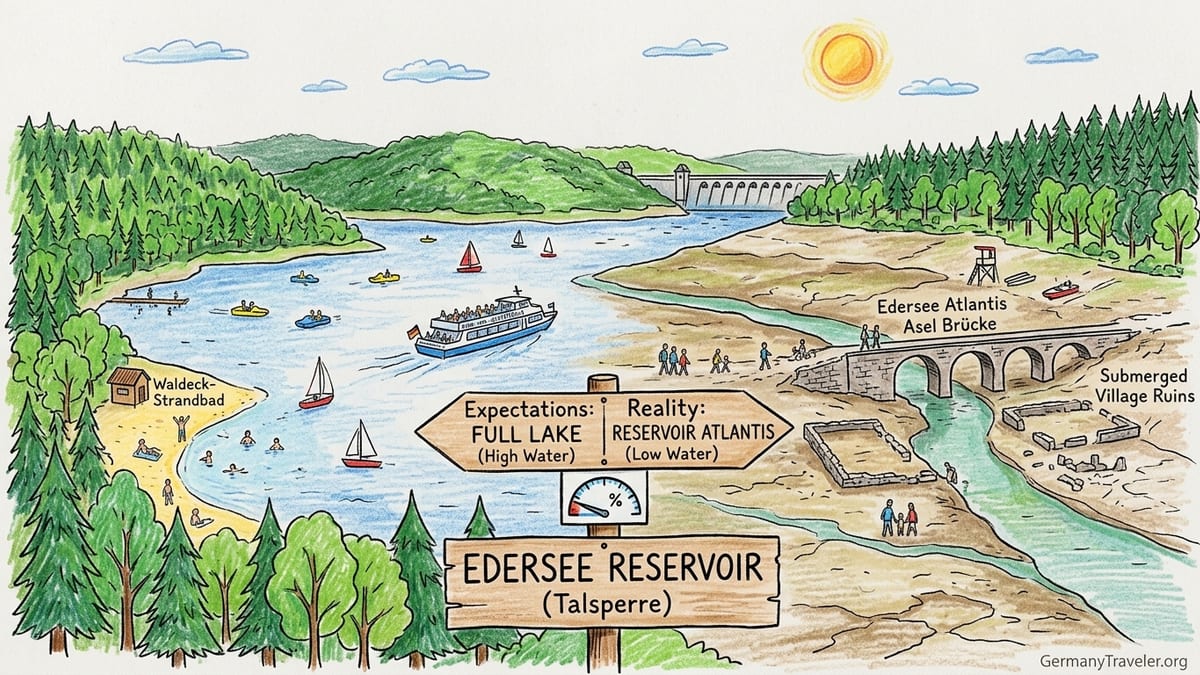
Expectations of a Lake, Reality of a Reservoir
When you approach Edersee for the first time, the marketing promises are seductive. Photos on accommodation sites show a classic German holiday lake, somewhere between Alpine postcard and Scandinavian fjord: dense forested hills, a wide surface of water, sun glittering off stand-up paddleboards and small yachts swinging at anchor. That was the image I carried with me when I booked three nights in a waterfront pension in Waldeck in August 2026, timing my visit for the height of the swimming season.
On arrival, the disconnect was immediate. The hotel still looked toward the water, but “lake view” meant long brown slopes leading down to a distant strip of greenish blue. The shore that appeared in booking pictures as a tidy arc of sand was in reality a steep descent over dusty paths and temporary stairways. Rental pedal boats sat idle on trailers far from the receding waterline, waiting for staff to tow them closer. What I had not appreciated was that Edersee is the third-largest reservoir in Germany, built behind the Edersee Dam to hold roughly 199 million cubic meters of water, and it is managed first and foremost as part of a regional water system, not as a scenic swimming pool.
This is a crucial difference. A natural lake often fluctuates only modestly from season to season. Edersee, by contrast, can look dramatically different within a single summer. In 2026, by mid July the reservoir was reported as being less than one third full, with the famous old Asel bridge already high and dry and the outlines of submerged settlements beginning to appear on the mudflats. By the time I arrived in August, entire coves once photographed as sheltered swimming bays had turned into broad, baked plains crisscrossed by walking tracks. I had come for a lake holiday and found myself in a landscape somewhere between a drought-stricken river and an open-air archaeological site.
The surprise was partly my own fault. Somewhere between glossy images and optimistic website language about “lake adventures from April to October,” I had missed the fine print that Edersee is a regulated reservoir feeding the Weser and the Mittelland Canal, generating electricity and absorbing floods. Water is released when shipping and river ecology downstream need it, regardless of whether a family from the Netherlands has booked a lakeside campsite expecting to moor their inflatable dinghy directly below their pitch.
How Water Management Reshapes Your Holiday
Once you grasp that Edersee is governed by hydrology rather than holiday timetables, many puzzles fall into place. The most obvious is swimming access. At high water, beaches such as Waldeck-Strandbad and Rehbach are typical German lakeside setups, with lawns, kiosks selling fries and ice cream, and ladders dropping into clear water only a few steps from the promenade. In low-water years, those same spots can sit far above the actual shoreline. At Waldeck in 2026, I watched families pick their way down temporary paths over muddy terraces to reach a shallow, sometimes weedy edge. Lifeguard platforms that had once stood just offshore now loomed over dry ground.
Passenger-boat operations also tell the story. Edersee’s main excursion company normally runs frequent round trips from March to October, connecting Edertalsperre at the dam, Waldeck-Strandbad, Rehbach and Herzhausen. In 2026, a red banner on the company’s homepage announced a “Fahrplanänderung” due to the lowered water level. From 10 August to 4 October 2026, a reduced timetable came into force, with only a handful of departures each day between the dam and Waldeck and a truncated extension toward Rehbach that operated under specific depth conditions. This was not a small tweak to departure times. It determined whether guests could realistically use the boat to reach trailheads or return to their accommodation after a hike.
The same reservoir logic affects marinas and private boating. Several harbors on Edersee are built on floating pontoons that can follow the water down, but access routes, slipways and mooring depths cannot. Talking to a sailing instructor at a lakeside school, I learned that their season is increasingly shaped by the water curve. In some years they can offer sailing and charter from May into October. In summers with strong drawdown, keelboats have to be moved to deeper sections or taken out of the water entirely because the fairway in front of the harbor becomes a narrow channel. For visitors hoping to rent a small sailboat for an afternoon, that can mean finding that online offers are “on request” or temporarily suspended.
Even viewpoints and “waterfront” accommodation are victims of the reservoir’s moods. Popular outlooks like the Waldeck castle terrace or the viewpoints along the Urwaldsteig hiking trail deliver very different scenes depending on lake level. Full or nearly full, the reservoir reads as a classic ribbon of water framed by forest, with the dam at one end and gentle bays at the other. At low levels, large pale scars of exposed shoreline encircle the water, and the asymmetry between deep and shallow arms becomes stark. Hotels, campsites and holiday apartments advertise “direct lake access,” yet in lean summers that phrase can conceal a gap of several hundred meters between the property edge and the water, sometimes across sloping, uneven ground that may not be suitable for very young children or less mobile guests.
Reading the Water Level Before You Book
Given how much the water level shapes every aspect of a stay, checking it should be as routine as checking the weather. In practice, many visitors never do. The official tourism site for the region offers a dedicated water level page with the current height of the reservoir given in meters above sea level, alongside its maximum value. At a full volume of roughly 199.55 million cubic meters, the lake surface sits at about 244.97 meters. By comparing the current reading to that full figure, you can gauge how much of the “classic lake” experience is likely to be on offer.
A rule of thumb used locally is that when the reservoir is close to full, the dam overflows visually with a broad curtain of water and most beaches are short walks from promenades. Once the level falls significantly, long tongues of former lakebed appear, and Edersee’s second personality, often branded as “Edersee Atlantis,” begins to emerge. The official site also links to webcams that show real-time scenes from around the lake. In August 2026, those webcam views made it clear that several arms of the lake looked drastically narrower than the pictures still sitting proudly on some hotel homepages.
For more granular information, German federal services maintain online gauge data for the Eder river and the reservoir. These charts show not only the current value but also trends over recent days and weeks. When planning a trip, watching those lines can give you a realistic idea of whether the lake is filling, stable or dropping. Several independent sites and local blogs also mirror the reservoir level with simple percentage graphics. I found that taking five minutes to understand these numbers did more for my expectations than hours of scrolling social media posts captured during wetter years.
The key lesson is that photographs are time slices. An inviting shot of sun loungers at Rehbach taken in a high-water summer tells you little about what the same spot looked like last August when the Asel bridge was walkable and passenger boats were curtailing service. Before you commit to a lakeside campsite or spend extra for a “direct waterfront” suite, cross-check the current water level and webcam images. If a property cannot confirm how far the waterline is at the moment, treat any promises of easy swimming access with caution.
Edersee Atlantis: History Revealed as Holidays Shrink
The flip side of a shrinking recreational lake is that Edersee becomes one of the most unusual open-air historical experiences in Germany. When water is released and the reservoir falls sufficiently, structures from the drowned Eder valley reappear. The most famous of these is the stone Asel bridge, a four-arched span that once crossed the river before the dam was built. At higher water, only the tops of its arches may be visible, or nothing at all. In low-water years like 2026, the entire bridge can stand clear and dry, allowing visitors to walk across what is normally the lake bed.
In July 2026, local media were already describing Edersee Atlantis as appearing “very early.” The marketing office confirmed that the Asel bridge could be crossed on foot and that the outlines of former village sites at Alt-Bringhausen and Berich were emerging. As the level dropped further, foundations, walls and old road lines became visible on wide tracts of cracked earth. Paths were marked out for guided walks, and information boards explained where houses, churches and farms once stood before approximately 900 residents of several villages were resettled for the creation of the reservoir in the early 20th century.
Walking there is a strange, compelling experience, especially if you arrived expecting a simple swim-and-sun holiday. Standing on the Asel bridge in the heat of an August afternoon, with the shrunken reservoir glinting in the distance and the modern village high above on the slope, you can feel the weight of both history and contemporary climate pressure. A reservoir that was intended to stabilize water supply for the Weser and the Mittelland Canal, to generate hydropower and to catch floods, now also serves as a visible barometer of prolonged dry spells. Local sailing schools describe adapting their offers every season, and tour operators talk of a balancing act between the appeal of Atlantis-style ruins and the disappointment of visitors who simply wanted full beaches.
The contradiction at the heart of Edersee holidays is that the same low water that creates Edersee Atlantis undermines much of the classic lake recreation that most people still expect. Families arrive with inflatables and SUP boards to find that the nearest usable water is a long walk over dusty ground and that official bathing jetties are temporarily fenced off. Divers who booked to explore underwater forests find visibility reduced in shallow, murky bays. Yet day-trippers with an interest in history and photography flock to the exposed relics. A practical conclusion is that travelers need to decide honestly what they want. If your priority is swimming and boating, you should aim to visit when the reservoir is high. If you are fascinated by the idea of walking through a submerged valley and across an old bridge, you may be willing to trade away easy shoreline access.
Beyond the Waterline: Kellerwald-Edersee National Park and Urwaldsteig
Fortunately, Edersee is not only about the water. The lake sits at the edge of Kellerwald-Edersee National Park, a core area of ancient beech forest that forms part of the UNESCO-listed “Ancient and Primeval Beech Forests of the Carpathians and Other Regions of Europe.” Even in low-water years, the forest delivers a consistently strong experience. Trails dive into steep ravines, run along airy ridges and drop back to bays and inlets, sometimes high above a reduced lake surface but always wrapped in green.
One of the best ways to see this landscape is the Urwaldsteig, a roughly 68 kilometer hiking trail that loops around the lake in a series of demanding day stages. In planning materials, the route is often broken into 5 to 7 sections, many between 10 and 15 kilometers per day, connecting places such as Scheid, Waldeck, Bringhausen and Herzhausen. Some stages are easier to combine with passenger boats when the timetable is at full strength. In 2026, with service reduced from August 10 onward due to low water, walkers needed to pay closer attention to boat connections or plan for bus transfers and one-way taxi rides.
On my visit, I tackled a day segment from Waldeck to Herzhausen. The trail climbed from the lakeside up through beech woods, occasionally bursting out at viewpoints where information boards politely showed a full blue reservoir and my eyes instead saw far-reaching mudflats. Yet the walk itself was deeply satisfying. Sunlight filtered through tall trunks, woodpeckers hammered somewhere out of sight, and the scent of leaf litter and moss replaced my frustration with the receding lake. In some ways, the low water pushed me into the forest, which turned out to be the highlight of the trip.
The Kellerwald visitor center near Herzhausen, reachable by car, bus or in better years by boat, offers exhibitions on forest ecology, the history of the reservoir and the broader hydrological system. Entry prices and special programs change season by season, but you can expect to pay a modest fee for the main exhibition, with family tickets available. Staff described to me how visitor interest shifts with the lake level. When the water is high, many guests start with boat tours and short walks and only later drift into the forest. In low water periods, hiking and educational visits become the main draw, often combined with guided walks to ruins on the exposed lakebed.
Costs on the Ground: Accommodation, Transport and Activities
Understanding Edersee’s water logic is only part of trip planning. The other is the cost of actually being there. Accommodation in villages along the shore spans simple campsites, family-run guesthouses and more polished hotels. In high season 2026, I saw double rooms in small pensions in Waldeck and Hemfurth-Edersee advertised from around 80 to 110 euros per night including breakfast, with lakefront hotels and apartments reaching 140 to 200 euros depending on view and facilities. Campsites with lake access typically charged in the order of 10 to 20 euros per adult per night plus a fee for a tent or camper van and electricity.
Transport costs are manageable but add up if you rely on flexibility. Regional buses connect towns like Bad Wildungen, Waldeck and Edertal with stops around the reservoir. A single ticket within the local network usually costs under 5 euros, with day passes available that can be good value if you combine hiking with sightseeing. Parking at popular lakeside spots near the dam or Waldeck-Strandbad is often regulated by machines charging a few euros per day. If you find yourself stranded at the end of a long hike because a passenger boat connection was canceled due to low water, a local taxi back to your accommodation can easily cost 20 to 40 euros depending on distance.
On the water and in the forest, prices vary by provider but a few reference points are useful. A standard round trip on a passenger boat on Edersee commonly costs around 20 euros per adult, with reductions for children and family tickets. Shorter legs between specific piers are cheaper. Guided “Edersee Atlantis” walks that include explanations of the submerged villages and the dam history are often priced in the low double digits per adult. Rental of pedal boats or small electric boats for an hour typically sits somewhere between 15 and 35 euros, while sailing courses and day charters are significantly more, reflecting instructor time and equipment.
Food and drink mirror broader rural Hesse. In 2026 I paid around 12 to 18 euros for main dishes such as schnitzel with potatoes or vegetarian pasta at lakeside restaurants, and 3 to 4 euros for a beer or soft drink. Kiosks at bathing beaches charged a few euros for snacks like fries, ice cream and simple sandwiches. The financial sting comes if you arrive expecting to spend most of your time in free or low-cost lake activities and instead shift to paid attractions and longer drives because water levels are too low for convenient swimming or boating. That is another reason to check not only room prices but also reservoir levels before locking in dates.
Choosing Your Season: Swimming, Boating or Heritage
If Edersee’s personality changes with the water level, then the best time to visit depends on what you want to do. For a classic swimming and boating holiday, your safest bet is still late spring to early summer. In many years, May and June offer a good balance of high.water levels, newly warm water temperatures and the start of frequent boat services, without the peak crowds of school holidays. Early July can also be excellent if winter and spring rains have been generous and the dam has not yet released large volumes downstream.
For heritage exploration and Edersee Atlantis, the key factor is how far the reservoir has dropped, which increasingly can happen by mid or even early summer in dry years. Traditionally, locals expected the old Asel bridge and village sites to emerge more significantly in late summer and autumn. Recent seasons, including 2026, have seen them appear much earlier. If your priority is to walk across the exposed bridge, wander through the foundations of old houses and photograph the drained lakebed, you may want to watch the gauge from late June onward and be ready to time a short-notice trip when water levels dip below certain thresholds.
Hikers focused on the Kellerwald-Edersee National Park and trails like the Urwaldsteig enjoy more flexibility. Spring and autumn are particularly attractive, with lush new foliage or intense color displays in the beech forest and cooler temperatures for climbing the steep slopes. Rainy periods do not spoil hiking in the same way they can wash out swimming days; in fact, they can temporarily raise the reservoir, softening some of the most dramatic mudflats. Winter brings limited boat service and occasional snow or ice on higher paths, but for solitude lovers, it can be an evocative time to explore the dam and forest.
In deciding your dates, accept that you cannot control the water level, only understand its patterns. If you are booking far ahead for peak summer, consider a plan that is not entirely dependent on the lake being brim-full. Build in at least one forest-heavy day and allow for the possibility that boat timetables may be shortened, as they were from August 10 to October 4 in 2026 because of low water. Conversely, if your ideal is to see Edersee Atlantis, be ready to compromise on easy swimming and perhaps bring sturdier shoes instead of flip-flops.
The Takeaway
Edersee is not broken. It is doing what it was built to do: storing and releasing water for a wider region, generating renewable energy and offering a buffer against floods and droughts. The problem is that many of us still travel there as if it were a natural lake kept at an aesthetically pleasing level for our convenience. My own 2026 trip exposed this gap between expectation and reality in a way that no brochure or sunny Instagram photo could have.
If you understand Edersee as a working reservoir first and a holiday landscape second, your planning becomes much sharper. Before you book, check the current water level and webcam images, and think carefully about where your chosen accommodation sits in relation to the fluctuating shoreline. Read any notices from passenger-boat operators about timetable changes due to low water, and imagine how you would adapt if a key connection disappeared. Ask yourself honestly whether you would be happy trading full beaches for the chance to walk across a hundred-year-old bridge that usually lies under several meters of water.
With that mindset, Edersee becomes less a destination that might disappoint and more a complex, living system that you step into for a few days. You can swim in coves when the water is high, hike ancient beech forests regardless of the level, and, in low-water phases, explore the eerie remnants of villages that sacrifice themselves to modern infrastructure. What holiday guides rarely explain is that all of these faces belong to the same place and the same curve on a water-level graph. The real choice is whether you take control of that reality before you click “book now,” or let it surprise you on arrival.
FAQ
Q1. Is Edersee a natural lake or a man-made reservoir?
Edersee is a man-made reservoir created by the Edersee Dam in the early 20th century to store water, support downstream shipping, generate hydropower and provide some flood protection.
Q2. How much can the water level at Edersee change within a year?
The level can fluctuate dramatically over a single season, from close to full volume in spring to less than a third of capacity in dry late summer periods, exposing large areas of former lakebed.
Q3. Where can I check the current water level before booking?
You can consult the official Edersee tourism water-level page and national water gauge services, many of which show current height, capacity percentage and webcam images.
Q4. When is the best time to visit Edersee for swimming?
For the most reliable swimming conditions, late spring and early summer, especially May and June, usually offer higher water levels and more accessible beaches than late summer.
Q5. What is “Edersee Atlantis” and when does it appear?
Edersee Atlantis refers to the remains of villages and structures flooded by the reservoir, including the Asel bridge and old village sites, which become visible when water levels fall significantly.
Q6. How did low water levels affect passenger boats in 2026?
Because of reduced water levels, the main passenger-boat operator introduced a revised timetable from 10 August to 4 October 2026, with fewer departures and adjusted routes.
Q7. Are lake photos on hotel websites reliable indicators of current conditions?
No. Many photos were taken in high-water years and do not reflect current levels. Always cross-check with live water-level data and webcams before relying on images.
Q8. What alternatives are there if the water is too low for swimming?
Visitors can focus on hiking in Kellerwald-Edersee National Park, walking sections of the Urwaldsteig, visiting the dam and exploring exposed historical sites on the former lakebed.
Q9. How expensive is a day on Edersee with boats and meals?
A typical day with a passenger-boat round trip, a simple lakeside meal and a small boat rental can easily reach 50 to 80 euros per adult once tickets, food and extras are included.
Q10. Which season is best if I want both lake activities and Edersee Atlantis?
Shoulder periods between early and mid summer may offer a compromise, but conditions vary year to year, so monitoring water-level trends in the weeks before your trip is essential.