


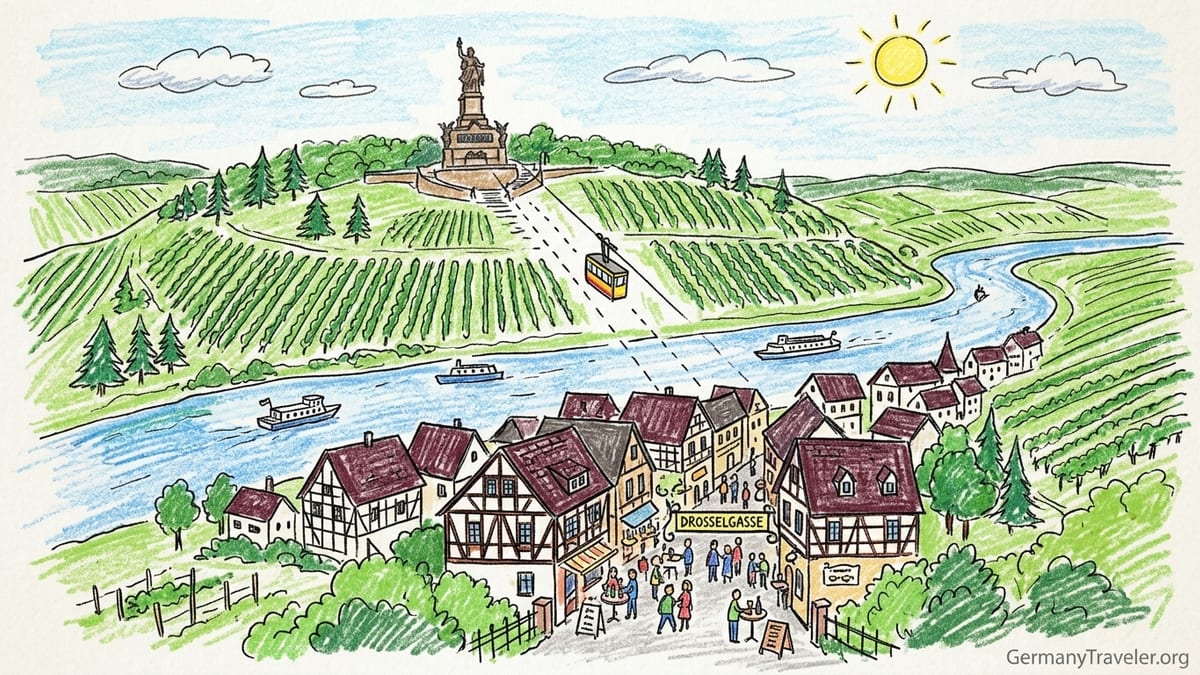
Rüdesheim am Rhein has been sold to travelers, myself included, as the quintessential Rhine wine village: crooked timbered houses, intimate taverns, Riesling poured by the winemaker’s daughter and soft river light on slate roofs. I arrived with that image firmly in mind. What I found instead, especially around the famous Drosselgasse and the classic Rhine tour products, felt much closer to a wine-themed amusement arcade than to a living Rheingau village. In 2026, with key elements such as the Assmannshausen chairlift out of action, the gap between the romantic promise and the industrial reality of Rüdesheim’s tourism has rarely been larger.
The Promise of a Quiet Rhine Wine Village
Before visiting, I had absorbed the standard brochure language about Rüdesheim: “romantic gateway to the Rhine Gorge,” “cosy wine taverns,” “authentic Rheingau atmosphere.” The emotional weight of that promise is powerful if you love wine and river landscapes. It suggests a place where daily life still revolves around vineyards and cellars, and where tourism fits into an existing village rhythm rather than overwhelming it.
The reality begins to tilt as soon as you step out of the train or ferry. The first thing you notice near the old town is not the smell of fermenting must or the quiet clink of glasses, but a concentration of group buses, tour leaders holding up numbered paddles and rivers of day‑trippers pushed along the same few streets. The infrastructure around the station, piers and Oberstraße feels designed first for volume, and only secondarily for character.
This is not unique along the Rhine, but in Rüdesheim the contrast between expectation and reality is especially sharp because so many guidebooks and older magazine pieces still describe it as if it were a sleepy wine town that just happens to receive visitors. In 2026, it is more accurate to call Rüdesheim one of the Middle Rhine’s most heavily programmed resorts, with a tourism industry that extends from the river cruises to the vineyards above the town.
None of this would be a problem if the commercial layer also helped visitors understand and experience Rheingau wine culture in some depth. The disappointment is that in many of the classic products and most famous streets, the story has been flattened into a few repetitive clichés, and the village beneath is hard to find.
Drosselgasse: 144 Meters of Noise, Not Wine Culture
Drosselgasse is the symbol of Rüdesheim’s fame, a cobbled lane barely 2 meters wide and, as the town’s own city map proudly notes, about 144 meters long of “convivial wine taverns and courtyard bars.” It is also marketed as a kind of open‑air living room of Rheingau hospitality. In practice, it feels much closer to a cruise‑ship entertainment deck dropped into an old town street grid.
On a recent mid‑season visit, you could barely see the cobbles for feet. The crowds are real, not hyperbole. Local and regional descriptions put annual visitor numbers to the lane in the millions, and that is exactly how it feels when a few riverboats and several coach tours empty at once. You do not stroll Drosselgasse so much as get carried along by a slow‑moving human current, dodging umbrellas and camera phones while a different band belts out Schlager or classic rock every twenty meters.
The taverns and restaurants lining the lane are not without charm if you step back and look at individual facades. Many courtyards have carved wooden balconies, vine‑draped walls and signs that play on centuries of wine trade history. But sit down, and the experience quickly reveals its template. Menus repeat near‑identical line‑ups of schnitzel, sausage, flammkuchen and tourist‑friendly “Rüdesheimer Kaffee,” served with live music that is amplified first for one group, then another.
Prices are not uniformly outrageous, but they are carefully calibrated to high footfall. A 0.2‑liter glass of basic Riesling on Drosselgasse in 2026 often runs around 5 to 6 euros, with some branded taverns nudging higher for “house specialties.” A simple main course such as Jägerschnitzel with fries commonly lands in the 18 to 22 euro range. These are not scandalous prices in a busy tourist destination, yet the issue is value and context: what you rarely get in return is any real connection to a specific vineyard site, producer or vintage.
Souvies, Live Bands and Tour Groups: Who Is Drosselgasse Really For?
If you pay attention to what is actually on offer along the 144 meters, it becomes clear that Drosselgasse has been optimized for short‑stay visitors and large groups. Souvenir shops spill onto the lane with shelves of mass‑produced steins, fridge magnets, T‑shirts and generic “Germany” trinkets that could be from Rothenburg or the Black Forest. A few windows do stock locally bottled wines, but they are usually presented as branded merchandise rather than as part of a coherent Rheingau selection.
Live music is a major draw, and for some visitors it is precisely why they come. Brass bands and guitar duos switch between oompah standards, Schlager evergreens and rock classics from the 1960s. If you love this atmosphere and do not mind shouting over the speakers, you may well have a fantastic evening. For anyone looking to taste and understand Rheingau Riesling, Spätburgunder or the nuances between vineyards such as Berg Rottland, Berg Schlossberg or Rüdesheimer Bischofsberg, this soundtrack and setup make it almost impossible to focus.
Group menus and set packages reinforce the feeling that Drosselgasse is oriented toward efficiency rather than exploration. Cruise passengers are typically steered into pre‑booked lunches that include a “wine tasting” of two or three simple house wines, poured quickly with minimal explanation. Guides often have very little time to add background on soil types, classifications or the region’s long history. Many groups are back on the boat within two hours of stepping into town, having technically “done” Rüdesheim without learning much about what makes Rheingau wine distinctive.
There are exceptions. A small number of establishments off the lane and on the side streets do offer better curated lists, single‑estate bottles and staff who can talk in some detail about local terroir. The problem is that nothing about the core Drosselgasse experience encourages visitors to seek them out. The lane delivers a loud, efficient, easily consumed fantasy of wine country instead of a nuanced introduction to it.
Pricing, Portions and the Myth of the “Rip‑Off Town”
It would be easy to dismiss Rüdesheim as simply overpriced, but that is not entirely fair. A closer look at menus in 2026 shows that many restaurants in and around Drosselgasse charge within a band that is comparable to other high‑tourism German destinations. A 0.2‑liter glass of house Riesling at 5.50 euros or a plate of käsespätzle for around 16 euros does not qualify as a outrageous rip‑off by current standards in a popular riverfront town.
The more subtle disappointment lies in what those prices buy you in terms of authenticity and learning. House wines are often anonymous blends or broad “Rheingau” cuvées without clear indication of the producer or vineyard. Wine lists may include better bottles, but these are rarely highlighted, and staff under time pressure from high turnover tend to push the easy options. You can spend 30 to 38 euros on a bottle of local Riesling at a busy Drosselgasse tavern and still leave with only the vaguest idea of where it came from.
Food follows a similar pattern. Portions are plentiful, which many visitors appreciate, but menus lean heavily into predictable tourist comfort dishes with only passing reference to regional specialties. When Rheingau or Rhine dishes do appear, such as Handkäs mit Musik or Federweißer with onion tart in season, they are often overshadowed by the evergreen parade of schnitzel, bratwurst and flammkuchen that can be found across half of Germany.
The result is a peculiar dynamic: Rüdesheim’s most famous street is not systematically fleecing visitors, yet it offers limited depth. The disappointment is not the bill at the end of the meal. It is the realization that you could have spent the same amount in a quieter nearby village and come away with a far richer sense of Rheingau wine and food culture.
Niederwalddenkmal, Cable Car and Rhine Cruises: Classic Views, Packaged Hard
Above the town, the experience improves visually but remains highly structured. The cable car from Rüdesheim to the Niederwalddenkmal glides over vineyards for roughly ten minutes and covers around 1.4 kilometers. The view over the Rhine, with the river splitting around islands and freight barges threading between passenger boats, is undeniably beautiful. In 2026, a single one‑way ride costs around 6.50 euros, and combination tickets with return journeys or integrated hike segments are widely marketed.
The Niederwalddenkmal itself is an imposing national monument dedicated to the founding of the German Empire, framed by terraces and viewing platforms. On a clear day it is crowded with visitors taking selfies in front of the Germania statue and scanning the UNESCO‑listed Upper Middle Rhine Valley. Again, the scenery delivers. The disappointment is that the interpretive material remains fairly generic, and the space around the monument is packed with snack stands and kiosks that make the hilltop feel like an outdoor concourse rather than a landscape that invites quiet reflection.
Rhine cruises from Rüdesheim are another key selling point. Major operators offer round trips to the Loreley rock or shorter segments to Bingen and back, with 2026 timetables showing multiple departures daily in high season. Ticket prices for standard daytime segments between Rüdesheim and the central castle stretch typically land in the 25 to 35 euro range for longer outings, with cheaper local lines for brief crossings or hops between towns. As products they deliver exactly what they promise: castle silhouettes sliding by, audio commentary in several languages, wine or beer at your table.
Yet the cruise experience connects only lightly with Rüdesheim itself. Boats fill and empty rapidly at the town’s piers, and commentary focuses on river folklore and castle owners more than on the working life of Rüdesheim or the vineyards of the Rheingau. If you arrived hoping that a classic “Rhine in a day” circuit from Rüdesheim would embed you into local culture, you may come away with great landscape memories but only thin insights into the town that sold you the package.
The 2026 Disruption: Assmannshausen Chairlift and Broken Ring Tours
One of the most significant but under‑communicated changes in 2026 is the disruption of the traditional “Ringticket” or classic circular tours that connect Rüdesheim, the Niederwald, Assmannshausen and the Rhine by a combination of cable car, chairlift, walking and boat. At the heart of this circuit is the Assmannshausen chairlift between the riverside village and Jagdschloss Niederwald.
Due to a serious control system defect, the Assmannshausen lift has been taken out of normal operation. Local tourism and hotel information notes that the chairlift “will not be able to transport guests as usual in the coming weeks” because of the repair work. By mid‑2026, regional reporting had gone further and stated that the lift team had announced the Seilbahn would not open at all for the 2026 season. Replacement products are being improvised that link the Rüdesheim cable car with walks to the Jagdschloss and ferry crossings, but they are not a like‑for‑like substitute for the classic ring experience.
This matters because older guidebooks, websites and blog posts from just a year or two ago still describe the seamless Ringticket as if nothing had changed. Many outline an effortless four‑part loop: cable car up from Rüdesheim, walk through the Niederwald, chairlift down to Assmannshausen and boat back along the Rhine. When you arrive in 2026 expecting that exact sequence only to discover that the chairlift segment is suspended or replaced with a simple ferry and hike, the sense of being misled is strong.
Local tourism bodies and hotel partners are slowly adjusting their descriptions, proposing alternatives such as cable car rides in both directions combined with extra hiking or bus transfers. However, the reality for independent travelers using older printed guides or pre‑2026 blog itineraries is confusion at ticket counters and a scramble to re‑plan the day. The disruption exposes how dependent Rüdesheim’s marketing has become on a few well‑worn packaged experiences rather than on flexible, visitor‑led exploration.
In practical terms, this means that if you booked Rüdesheim in 2026 specifically for the romantic idea of hovering over steep red‑wine terraces into Assmannshausen on a vintage‑feeling chairlift, you will be disappointed. The Rhine and vineyards are still there, but one of the most evocative links in the circuit is temporarily broken, and the communication gap makes that frustration worse.
Quieter Alternatives: Eltville, Hattenheim, Johannisberg and Lorch
The criticisms of Rüdesheim would matter less if there were no alternatives nearby. In reality, some of the most rewarding Rheingau wine experiences in 2026 are a short train, bus or bike ride away in towns that see far fewer buses yet maintain strong wine identities.
Eltville, to the east, offers a riverside promenade shaded by plane trees, a rose‑filled castle garden and an old town where wine taverns and vinotheks are integrated into everyday streets rather than concentrated into a single entertainment lane. Prices for a glass of estate Riesling in Eltville’s better vinotheks can be similar to or slightly lower than in Rüdesheim, but you are more likely to see clear vineyard names on the list and to talk directly with staff who know the producers personally.
Hattenheim and Johannisberg, a little further inland, give a stronger sense of what a working wine village looks like when coach tourism has not yet overwhelmed the core. In Hattenheim, you can move between half a dozen wine estates on foot, tasting in simple courtyard settings where bottles are labeled first by site and classification rather than by romantic branding. Johannisberg’s terrace above the river delivers a panoramic view that rivals the Niederwalddenkmal but is shared mainly with other wine enthusiasts and locals out for a walk.
To the west, Lorch sits closer to the narrow heart of the Upper Middle Rhine Gorge, with steep vineyards climbing almost directly from the river and a compact town center that feels far less staged. Here, terrace restaurants look onto the Rhine without the constant churn of large tour groups, and conversations with winemakers about slate soils and Riesling acidity are easier to start.
These villages are not free of tourism, nor are they immune to commercialization. What distinguishes them from Rüdesheim in 2026 is the ratio of lived wine culture to packaged spectacle. Wine estates still set the tone, and visitors are invited to step into that rhythm, rather than being channeled through a narrow corridor of standardized experiences.
Five Concrete Disappointments in Rüdesheim’s 2026 Reality
Looking back at my time in Rüdesheim, five specific disappointments stand out, not as abstract complaints but as grounded observations that prospective visitors should weigh.
First, the scale and density of the crowds in Drosselgasse make it difficult to enjoy the architecture or any sense of place. Being shoulder‑to‑shoulder in a 2‑meter‑wide lane, with three million annual visitors compressed into 144 meters, turns what could be an atmospheric stroll into a slow‑motion shuffle.
Second, the famous street does very little to educate visitors about Rheingau wine. Menus and blackboards mostly sell “Riesling” or vague “house wine,” without emphasizing vineyard names, classifications or producer stories. Staff pressed for time default to generic descriptions. You can leave Drosselgasse having drunk several glasses of local wine yet unable to name a single estate or site.
Third, the dependence on amplified live music and group entertainment erodes any remaining sense of village life. Bands are fun for many, but they dominate the soundscape so completely that quieter conversations about wine, history or even personal travel stories are pushed into corners or off the lane entirely.
Fourth, the communication around the 2026 suspension of the Assmannshausen chairlift and its impact on ring tours is patchy. Older guides and many third‑party descriptions still present the classic chairlift segment as a given, and some booking pages only mention disruptions in small print. Travelers who planned their trip around that specific experience are left improvising on the ground.
Fifth, the overall balance between tourism infrastructure and everyday life feels skewed. In the core of Rüdesheim, the visual language, opening hours and shop mix are tuned so precisely to short‑visit consumption that it can be hard to find spaces where locals sit without being part of the industry that serves visitors. For an area with such a rich wine culture, that imbalance is a let‑down.
The Takeaway
So, is Rüdesheim overrated? If your expectations are shaped by glossy images of a quiet wine village where you can drift from cellar to cellar in peace, the answer is yes. The town’s most famous assets in 2026, from Drosselgasse to the tightly packaged cable car and cruise products, concentrate visitors and commerce into narrow channels that leave limited room for unhurried discovery.
Yet to dismiss Rüdesheim outright would ignore what it still does well for certain travelers. If you enjoy lively taverns with sing‑along bands, do not mind crowds and want an easy, logistically simple way to see the Rhine Gorge in a single day, Rüdesheim remains one of the most straightforward bases you can choose. You can step off a train, ride up to the Niederwalddenkmal, join a cruise, taste a few accessible wines and be back at your hotel without navigating complex timetables or trail maps.
Rüdesheim is also where some visitors feel safest touching the Rhine landscape for the first time. For older travelers, group tour participants or those with limited mobility, the density of services, frequent departures and clear signage are real advantages. Classic viewpoints are simple to reach, menus are familiar, and English is widely spoken in the central taverns and ticket offices.
The key is to align your expectations with the reality of 2026. If your heart is set on in‑depth Rheingau wine exploration, consider basing yourself in Eltville, Hattenheim, Johannisberg or Lorch and visiting Rüdesheim as a brief, curious detour rather than your main stage. Treat Drosselgasse as a 144‑meter spectacle, not as the definitive expression of Rhine wine culture, and you are more likely to leave the region with your sense of romance intact.
FAQ
Q1. Is Rüdesheim still worth visiting in 2026 despite the Assmannshausen chairlift disruption?
Yes, Rüdesheim is still worth visiting if you value easy access to Rhine cruises, the Niederwalddenkmal viewpoint and lively taverns. You should, however, adjust expectations if you were counting on the classic ring tour that includes the Assmannshausen chairlift, because that segment is currently disrupted and replaced by alternative walking and ferry options.
Q2. How crowded does Drosselgasse really get during the main season?
Drosselgasse can be extremely crowded from late morning through evening in main season, especially when multiple riverboats and coaches arrive. The lane is only about 2 meters wide and 144 meters long, so even a few large groups can create shoulder‑to‑shoulder conditions that make strolling or photography difficult.
Q3. Are food and wine prices in Rüdesheim much higher than in nearby wine villages?
Prices in central Rüdesheim and along Drosselgasse are somewhat higher than in quieter villages, but not dramatically out of line for a busy tourist town. Expect around 5 to 6 euros for a 0.2‑liter glass of simple Riesling and 16 to 22 euros for main dishes. The bigger issue is not the price itself but that many venues offer limited information about producers and vineyards compared with taverns in Eltville, Hattenheim or Johannisberg.
Q4. Can I still do a circular tour from Rüdesheim that combines cable car, hiking and a boat trip?
Yes, circular tours are still possible, but in modified form. You can ride the cable car from Rüdesheim to the Niederwalddenkmal, walk through the Niederwald forest and use ferries or local boats to return along the Rhine. Because the Assmannshausen chairlift is out of normal operation in 2026, check locally which combination tickets are available and what segments are currently included.
Q5. Where should I stay if I want a quieter Rheingau base but still visit Rüdesheim?
If you prefer a quieter atmosphere with strong wine culture, consider staying in Eltville, Hattenheim, Johannisberg or Lorch. These towns and villages have working wine estates, more balanced tourism and good connections by train, bus or boat, so you can visit Rüdesheim for a day trip without committing to its crowds every evening.
Q6. Does Drosselgasse offer any serious wine bars or is it all tourist entertainment?
Most of Drosselgasse is geared toward quick‑turnover taverns, group menus and live music, with only a handful of places edging toward more serious wine lists. The best options for focused tasting are usually found on nearby side streets or in other parts of the Rheingau, where vinotheks highlight specific estates and vineyard sites rather than just house wines.
Q7. How does the view from the Niederwalddenkmal compare with other Rheingau viewpoints?
The view from the Niederwalddenkmal is impressive, taking in a long bend of the Rhine and several castle silhouettes. However, it is also busy and commercialized. Terraces near Schloss Johannisberg or hilltop paths above Lorch and Assmannshausen offer equally beautiful perspectives on the river and vineyards, often with far fewer people around.
Q8. Are there authentic local dishes I should look for in Rüdesheim and the Rheingau?
Yes, dishes such as Handkäs mit Musik, onion tart with new wine in autumn and hearty stews in colder months are part of regional tradition. In Rüdesheim’s busiest streets these can be overshadowed by generic tourist staples, so you may have better luck seeking them out in less crowded taverns or in nearby villages where menus lean more on local regulars than on passing tour groups.
Q9. How many days should I spend in Rüdesheim if I am mainly interested in wine?
If wine is your primary focus, one full day in Rüdesheim is usually enough to explore the old town, ride the cable car and sample a few wines. To dive deeper into Rheingau vineyards and producers, plan additional days based in or visiting Eltville, Hattenheim, Johannisberg or Lorch, where you can visit multiple estates without the same tourist pressure.
Q10. Who is Rüdesheim best suited for in its current form?
Rüdesheim suits travelers who enjoy lively, music‑filled evenings, appreciate the convenience of packaged Rhine experiences and do not mind crowds. It is particularly practical for first‑time visitors to the region, cruise passengers and those who want to see classic Rhine scenery and monuments with minimal planning, even if that comes at the cost of some authenticity and depth.