


I arrived in Würzburg on a soft Friday evening, the kind where the light lingers just a little longer over the red roofs and vineyards. I had two full days to see whether this university city on the Main River was really as people had described it to me: part baroque stage set, part student town, part open-air wine bar. What I found over a weekend was a compact city where monumental architecture, riverside life and a distinct Franconian wine culture all fold easily into the rhythm of a short stay.
First Impressions of a Compact River City
Würzburg is small enough that I walked from the main station to my hotel in about fifteen minutes, my bag rolling over the cobbles of Kaiserstraße. On the way I passed tram stops full of students clutching reusable coffee cups, the green strip of the Ringpark peeking between buildings, and the twin towers of the cathedral anchoring the skyline. It felt immediately like a place where the monumental and the everyday sit close together.
I based myself near the old town for this weekend, in a mid-range hotel close to the Dom for about 110 euros per night including breakfast. That put almost everything I wanted to see within walking distance: the Würzburg Residence one way, the Main river and the Alte Mainbrücke the other. For the whole weekend I never needed public transport, though a day ticket for trams and buses in Würzburg usually costs around 6 to 7 euros if you prefer to ride rather than walk.
What struck me first was the student energy. With Julius-Maximilians-Universität spread through the city, the pavements on a Friday evening were full of groups switching effortlessly between German and English, gathering outside bakeries and kebab shops or heading down to the river steps with bottles of Franconian wine. It is not a polished, museum-like town; it breathes and moves like a lived-in university city whose baroque facades just happen to be spectacular.
I ended that first night with a very local dinner: a plate of bratwurst with sauerkraut and a glass of Silvaner at a simple wine tavern just off Domstraße, paying a bit under 20 euros including a small tip. The sausages were the coarse, Franconian style, the wine served in the classic bulbous Bocksbeutel bottle that you see everywhere in Würzburg. It felt like a good introduction to a weekend that would be framed by food and wine as much as by churches and palaces.
Day One Morning: Old Town Streets and Sacred Stone
My first full day began at the heart of Würzburg’s old town. From the station I walked down Domstraße toward the towers of St Kilian Cathedral, the street already busy by 9:30 with people on bikes and delivery vans weaving through. The cathedral is free to enter, and stepping inside I went from noisy student city to cool silence in a heartbeat. The thick, pale walls and high nave carry the weight of centuries, including wartime destruction and painstaking reconstruction, and I found myself lingering longer than planned just to let my eyes adjust.
From there it is a short walk across the square to the Marienkapelle on the market square, a striking late Gothic church in vivid red and white. Outside, fruit and vegetable stalls were setting up for the day, and the smell of fresh bread floated over from nearby bakeries. I slipped inside briefly; the interior is simpler than the dramatic exterior suggests, but the contrast of sacred building and everyday commerce right outside the door sums up Würzburg’s character very well.
Next I crossed over to the rococo facade of the Falkenhaus, home to the tourist information office. Even if you do not need maps, it is worth standing back on the square to admire its elaborate yellow and white stucco work. I picked up a printed city map and confirmed some practicalities for the next day, including that the Würzburg Residence admission in 2026 is 10 euros for adults, with the Court Garden and Court Church free to enter, and that the public guided tours are included in that price.
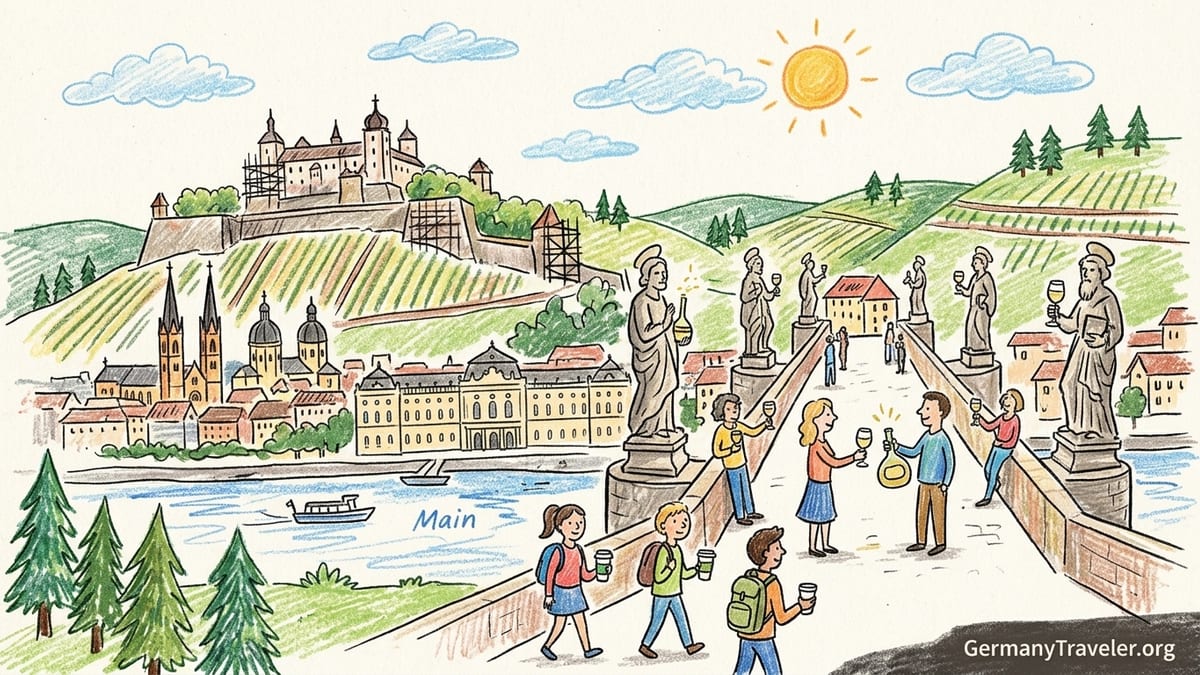
By late morning I was ready to aim for the river. I walked down toward the Main, passing cafés with outdoor tables already filling, and followed the slight downhill of Domstraße until the city suddenly opened up and the statues of the Alte Mainbrücke appeared in front of me. The first glimpse of the bridge, with its row of saints, the Main flowing below and vineyards and fortress rising ahead, felt like stepping into a postcard.
Bridge Wine on the Alte Mainbrücke: Local Ritual or Tourist Show?
The Brückenschoppen, the custom of drinking a glass of Franconian wine on the Alte Mainbrücke, was one of the things I most wanted to experience. On a sunny Saturday around midday the bridge was already busy. Two main outlets, including the Mainwein wine bistro and the restaurant Alte Mainmühle, were serving wine “to go” in stemmed glasses against a deposit of a few euros. The going rate in 2026 for a 0.25 liter glass of Silvaner or Müller-Thurgau seemed to be around 5 to 6 euros, plus 5 euros glass deposit that you get back when you return it.
Space-wise, the bridge can feel crowded. There is a constant flow of pedestrians crossing from old town to the left bank, and along both parapets clusters of people stand with glasses, angling themselves between the stone statues for the best view. At peak times it can be a gentle squeeze to find a clear spot at the railings, and I noticed some locals clearly trying to thread their way to work or errands through groups focused on selfies rather than the flow of traffic.
I took my glass of dry Silvaner and edged toward the side facing upriver. From there the view is magnificent: the Main curving gently, vines striped across the slopes of the Würzburger Stein and other vineyards, and the bulky shape of Festung Marienberg exactly where you want a fortress to be, high on the hill above. Church spires punctuate the skyline behind you, and boats move lazily under your feet. In terms of atmosphere, little snatches of Franconian dialect floated past, intertwined with American English, Italian and occasional Spanish.
Did it feel like a meaningful local custom or a tourist ritual by 2026? Honestly, a bit of both. The Brückenschoppen is genuinely rooted in the city’s wine culture, and I did hear plenty of German being spoken around me. At the same time, the density of cameras and the queue snaking from the wine counters made it clear that visitors have embraced it enthusiastically. For me it still felt worthwhile, not as a quiet contemplative moment but as a snapshot of Würzburg’s social life: students meeting up, older couples pausing on a Saturday walk, visitors leaning into the view, all held together by a shared glass of Franconian wine.
Afternoon Walks and Student-City Energy Along the Main
After returning my glass and getting my deposit back, I walked across the bridge to the left bank for a different angle on the city. From here the old town looks like a layered stage set, with the cathedral, Neumünster, and the domes of other churches rising behind the bridge statues. Cafés and small restaurants spill out onto the riverbank, and I noticed cyclists using the riverside path as a commuting route, weaving between strolling families and small groups with picnic blankets.
I followed the path downstream for a while before looping back into the city through residential streets filled with student housing and small bars. Würzburg’s university presence shows up not only in the crowd but in the details: posters for theater groups and language exchanges taped to lampposts, budget-friendly doner and pizza places on almost every corner, and bookstores that give more shelf space to exam preparation than glossy coffee-table volumes. It gives the city a lived-in texture that many purely tourist towns lack.
For a late lunch I stopped at a simple Franconian restaurant near the market square and ordered “Fränkische Schäufele,” roasted pork shoulder with crackling, dumplings and cabbage. It was a heavy meal for about 17 euros, but after a morning on my feet it felt justifiable. With a small beer and tap water, my bill came to around 22 euros including tip. If you stick to bakeries and street food, it would be easy to spend less, but hearty regional dishes like this are part of the experience.
The rest of the afternoon I kept light. I ducked into a couple of churches I had missed earlier, browsed in a small independent bookstore, and people-watched from a café terrace over a cappuccino that cost just under 4 euros. As the sun dropped, groups began drifting back toward the river and the bridge. I skipped a second bridge wine in favor of a quieter walk along the riverbank, but the sound of laughter and clinking glasses carried easily across the water.
Day Two: Inside the Würzburg Residence and Its Gardens
Sunday was my day for the Würzburg Residence, Würzburg’s UNESCO-listed baroque palace and one of the major reasons many people stop in the city. I arrived just after opening, shortly after 9:00, to be sure of a relaxed start and to catch the 11:00 English guided tour of the state rooms. In 2026, admission is 10 euros for adults, with reduced 9 euro tickets available for some categories. Children and teenagers under 18 enter free, and importantly, the Court Garden and the Court Church remain free for everyone, even if you skip the palace interior.
Tickets are sold inside the main entrance, and from there you walk into the monumental staircase hall that makes the first deep impression. The stone staircase sweeps up in a broad curve under a vaulted ceiling, and above it the famous fresco by Giovanni Battista Tiepolo covers the entire ceiling. The painting is a dizzying celebration of the four known continents at the time, and standing on the landing beneath it I found myself craning my neck in the same way everyone else did, rotating slowly in place to take it all in.
The guided tour in English at 11:00 was included in the ticket price, as it is in 2026, with another English tour scheduled at 15:00 later in the day. Our group gathered at a marked meeting point near the top of the stairs. Numbers were reasonable for a high-season Sunday: around twenty people, which meant we could all fit into the staterooms without feeling packed tight. The guide led us through a series of rooms that gradually escalated in decoration, from stuccoed antechambers to gilded mirrors and richly painted ceilings.
In practical terms, I spent about two hours inside including the tour, wandering a little on my own afterward. Personally, I found the 10 euro admission excellent value when you think of it as paying not just for a sequence of rooms, but for the chance to stand quietly beneath that Tiepolo ceiling and on that staircase. By contrast, the Court Garden outside, which you can enter for free, offers a very different kind of value: formally laid-out flower beds, clipped hedges, fountains and long shaded paths that are as much public park as palace appendage. If I were on an ultra-tight budget, I would at least visit the gardens and gaze at the palace from outside, but if you have any interest in baroque art and architecture, the paid interior is what truly justifies coming here.
Climbing to Festung Marienberg: Views and Renovation Reality
After a restorative coffee and a simple sandwich for about 8 euros in total at a café near the Residence, I headed back to the river for the afternoon’s activity: the walk up to Festung Marienberg. From the Alte Mainbrücke I turned toward the hill on the left bank and followed signs that eventually picked up the Tellsteige path, a short but steep route through terraced vineyards and leafy slopes. The climb from the bridge to the fortress gate took me around 25 minutes at an unhurried pace, with several pauses to look back over the city spreading out below.
The weather that day was cooperative: broken cloud, temperatures in the low twenties Celsius, and a light breeze that made the uphill sections comfortable. On a hot summer afternoon, the same path would feel considerably more demanding, and I would recommend bringing water and perhaps choosing the slightly gentler route via the paved road if climbing is not your favorite activity. Along the way I passed a handful of joggers and other walkers, some locals in sports gear, others identifiable as visitors by their cameras and occasional puzzled map checks.
Reaching the fortress plateau, I was met by the sight of scaffolding and construction fencing as well as stone walls and towers. Festung Marienberg is in the middle of a multi-year general renovation project in 2026, and while the exterior ramparts, viewpoints and some courtyards are accessible, parts of the core castle remain restricted. The Museum für Franken, housed within the complex, is open with its own admission fee, but certain interiors, towers and sections of the inner fortifications are either closed entirely or visible only from a distance.
Despite the renovation, the views justify the climb. The Fürstengarten, or Prince’s Garden, offers one of the classic panoramas over Würzburg: rows of vines in the foreground, the Main looping through the city, the domes and towers of the old town clustered to one side, and beyond them the long, pale facade of the Residence. I spent about half an hour just walking the exterior wall paths, taking photographs and watching boats move slowly along the river far below. The mix of cranes, scaffolding and ancient stone is not picture-perfect, but it is honest, and it is still very much worth the effort to come up here.
Cafés, Wine and Real Weekend Costs
My descent from the fortress back to the city was gentler, following a longer path that zigzags down through trees and emerges close to the river. By mid-afternoon I rewarded myself with another coffee break, this time at a café along the Main where I found an outdoor table with a view of the bridge and fortress. A cappuccino and a slice of cake cost just over 8 euros, which felt like a fair price for both the taste and the scenery.
Over the two days I kept a rough tally of my expenses to get a sense of what a weekend in Würzburg actually costs in 2026. Leaving aside accommodation, I spent approximately 10 euros on the Residence ticket, around 12 euros on bridge wine and a second glass later in the evening, roughly 40 to 45 euros on two sit-down restaurant meals, and about 25 euros on coffees, snacks and bakery items. Add a couple of takeaway drinks and small souvenirs, and I landed somewhere in the 90 to 100 euro range for food, drink and sights for the weekend.
Wine culture here is not limited to the bridge. I visited one of the traditional wineries in the city center for a short tasting flight, sampling a dry Riesling, a Silvaner and a Scheurebe for about 12 euros, standing at a wooden counter among a mix of locals filling bottles and visitors asking questions in English. This grounded the bridge wine experience, reminding me that those glasses on the Alte Mainbrücke are part of a much larger story of vineyards and cellars that stretch back centuries in and around Würzburg.
In the evenings the student-city energy shows up most clearly. On both nights the streets around the market square and in the lanes leading down to the river were lively until late, with groups sitting on low walls, spilling out of small bars, or walking with open bottles of wine or beer in hand. It felt sociable rather than raucous, and I never felt unsafe, but anyone expecting a sleepy provincial town will find a more animated atmosphere, especially during the university semester.
Würzburg Versus Bamberg: Two Franconian Weekends
Having visited Bamberg on a separate trip, I inevitably found myself comparing the two over the course of the weekend. Bamberg is a UNESCO World Heritage old town almost in its entirety, a labyrinth of medieval and baroque streets centered on the famous town hall on the river island. It feels like walking onto a film set, with little lanes, half-timbered houses and breweries around each corner. Würzburg, by contrast, feels more open and less preserved-in-amber, its wartime destruction and rebuilding visible in wide streets and postwar buildings threaded between surviving monuments.
In terms of atmosphere, Bamberg leans more toward traditional Franconian town, defined strongly by its beer culture, particularly the distinctive smoked Rauchbier. Evenings there feel anchored in brewery taprooms and beer gardens. Würzburg’s personality revolves more around wine, students and baroque architecture. The Würzburg Residence and Festung Marienberg give it a monumental frame that Bamberg lacks, while Bamberg’s hilltop cathedral and old town blend create a denser, more cohesive historic core.
As a traveler, the choice between them for a short visit depends on what you want. If you are more drawn to narrow medieval streets and beer, Bamberg is the obvious pick. If you are excited by baroque palaces, vineyard vistas and the idea of a glass of wine on a bridge above a broad river, Würzburg will speak more to you. Having experienced both, I would say that Würzburg’s combination of big, dramatic set pieces like the Residence and fortress with the everyday energy of a student town makes it feel slightly more contemporary, whereas Bamberg feels more like stepping back in time.
In an ideal itinerary I would not choose; I would link the two for a longer Franconian journey, spending one to two days in each. But if your time allows for only one, ask yourself whether you would rather raise a glass of Rauchbier in a centuries-old brewery in Bamberg, or a glass of Silvaner on a bridge under the gaze of a hilltop fortress in Würzburg. Having done both, I can say they each justify their own weekend.
The Takeaway: What Justified Two Days and What to Skip
Looking back on my weekend in Würzburg, a few things clearly justified stretching the visit to two full days. The first is the Würzburg Residence interior, especially the monumental staircase and Tiepolo ceiling, together with the included guided tour. This is not something to rush through on a quick stop; it rewards time, whether you are listening to the guide’s explanations or simply standing quietly beneath the fresco. Coupled with a lingering walk in the free Court Garden, it easily fills a half day in a satisfying way.
The second is the combination of riverfront and fortress. The Alte Mainbrücke, whatever you feel about the balance between local custom and tourist ritual, is a central piece of Würzburg’s identity, and taking the time to experience the bridge wine, cross the river, and then climb up to Festung Marienberg for views back over the city provides a narrative arc that a brief pass-through cannot match. Even with renovation fencing and restricted interiors at the fortress in 2026, the viewpoints and the feeling of being slightly above it all made the climb more than worthwhile.
Third, the city’s student energy, markets and casual food and drink scene reward slow wandering. Having time to sit in a café and watch trams and students pass, to try a proper Franconian meal rather than grabbing a quick snack, or to drop into a winery tasting room made the city feel like a place to inhabit rather than just a checklist of monuments.
If I had to compress Würzburg into a single day, I would keep the Residence interior with its staircase and Tiepolo ceiling, the Court Garden, a walk across the Alte Mainbrücke with at least one glass of Franconian wine, and a partial climb up toward Festung Marienberg to at least reach one of the lower viewpoints over the city. With limited time, I would skip going inside multiple smaller churches beyond the cathedral and Marienkapelle, trimming long restaurant meals in favor of quicker bites. But given two full days, the slower rhythm of coffee stops, riverside walks and a wine tasting or two was exactly what turned my visit from a quick architectural detour into a satisfying, wine-tinged weekend in Franconia.
FAQ
Q1. How much does it cost to visit the Würzburg Residence in 2026?
The Würzburg Residence charges 10 euros for a standard adult ticket in 2026, with 9 euro reduced tickets for eligible visitors. Children and teenagers under 18 enter free, and admission to the Court Garden and Court Church is also free for everyone.
Q2. Are guided tours of the Würzburg Residence included in the ticket price?
Yes. Public guided tours are included in the admission ticket. In 2026 there are English-language tours scheduled at 11:00 and 15:00, with additional German tours throughout the day, so you do not pay extra to join them.
Q3. Is the Court Garden at the Würzburg Residence worth visiting if I skip the paid interior?
Absolutely. The Court Garden is free to enter and offers formal flower beds, fountains, shaded alleys and excellent views of the palace facade. It gives a strong sense of the baroque setting even if you decide not to pay for the interior rooms.
Q4. What is the climb to Festung Marienberg like, and how long does it take?
The walk from the Alte Mainbrücke up to Festung Marienberg via the steeper vineyard path takes around 20 to 30 minutes, depending on pace. It is short but fairly steep in places, so comfortable shoes and water are recommended, especially in warm weather.
Q5. Are parts of Festung Marienberg closed due to renovation in 2026?
Yes. In 2026 Festung Marienberg is undergoing a multi-year general renovation, so some interiors and areas of the core castle are restricted or closed. The outer walls, viewpoints and gardens remain accessible, and the Museum für Franken operates within the complex.
Q6. How much should I budget for food and drink for a weekend in Würzburg?
For a mid-range traveler, a realistic food and drink budget in 2026 is around 45 to 60 euros per day. That covers a sit-down meal, several coffees or snacks, and a couple of glasses of wine or beer, assuming you mix restaurants with bakeries and casual options.
Q7. Is the Brückenschoppen on the Alte Mainbrücke mainly for tourists now?
By 2026 the bridge wine scene is a mix of locals and visitors. It has become quite popular with tourists and can be crowded, but you will still hear plenty of German spoken, and it remains rooted in Würzburg’s broader Franconian wine culture.
Q8. Do I need public transport to get around Würzburg for a weekend?
If you stay near the old town, most key sights such as the Würzburg Residence, cathedral, Alte Mainbrücke and the start of the Festung Marienberg climb are walkable. A day ticket for trams and buses is useful if your accommodation is further out, but not essential for a central stay.
Q9. How does Würzburg compare to Bamberg for a short trip?
Würzburg feels more centered on baroque architecture, student life and wine, with highlights like the Residence, Alte Mainbrücke and fortress. Bamberg offers a denser medieval old town and a strong beer culture. Both are rewarding, but they offer different versions of Franconian character.
Q10. Is one full day in Würzburg enough, or should I plan two?
One full day is enough to see the Würzburg Residence, walk the Court Garden, cross the Alte Mainbrücke and start the climb toward Festung Marienberg. Two days allow you to experience the city’s cafés, wine culture, markets and university atmosphere at a more relaxed pace, which I found more satisfying.