


Between the forested hills of northern Bavaria and the loops of the River Main, the Franconian wine region offers one of Germany’s most distinctive wine landscapes. This is Silvaner country, a place of steep stone terraces, compact riverside towns and the unmistakable squat Bocksbeutel bottle on restaurant shelves. Rather than a single signposted wine road, Franconia is a patchwork of vineyard districts, historic villages and cycling paths that reward slow, curiosity-led travel.
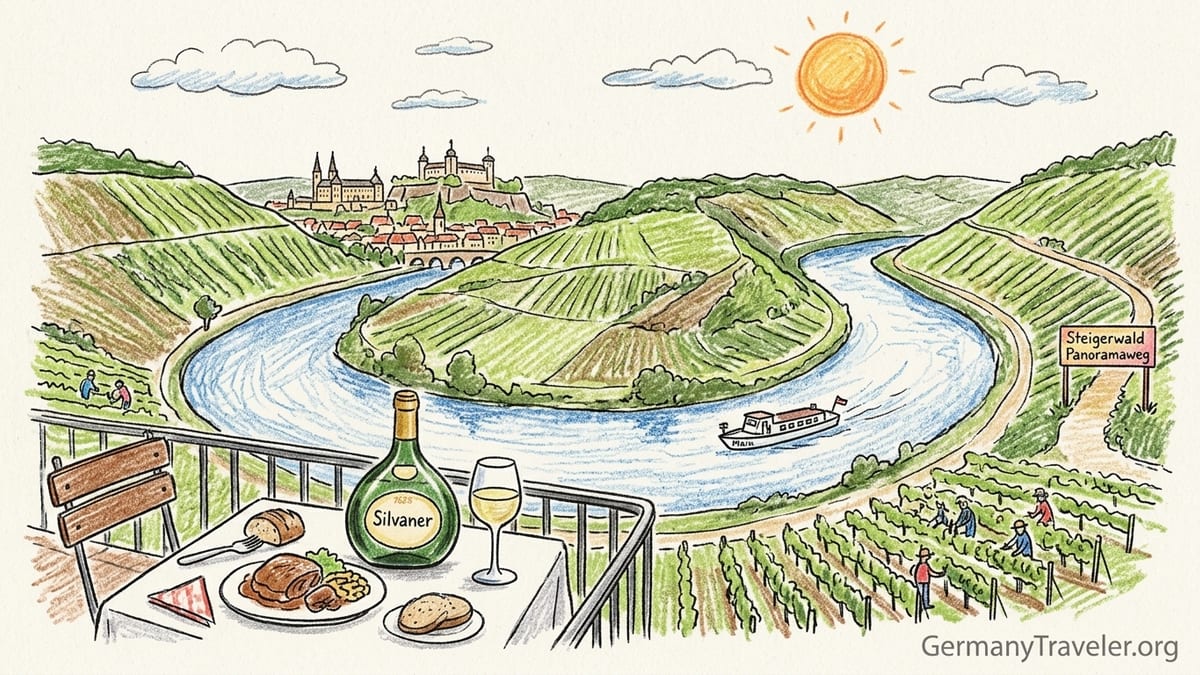
Franconia at a Glance: Silvaner, Bocksbeutel and the Main
Franconia, or Franken in German, is one of Germany’s 13 official wine regions. According to the German Wine Institute, in 2025 it had around 6,040 hectares of vines, with approximately 83 percent planted to white varieties and Silvaner as the flagship grape. White grapes dominate the hillsides, yet red wines from Pinot Noir and the local Domina also play an important role, especially in the western reaches near the Spessart forest.
The region’s visual emblem is the Bocksbeutel, a broad, flattened bottle with a short neck and rounded shoulders. Protected under European law, it is most closely associated with high quality Franconian wines. You will see Bocksbeutel bottles lined up in Würzburg’s vinotheques, stacked in half-timbered Heckenwirtschaften in villages like Sommerach, and on tasting-room shelves in estates along the Main. Not every wine is bottled this way, but when you order a Silvaner in a traditional restaurant, it is likely to arrive at the table in Bocksbeutel form.
Geographically, viticultural Franconia follows the Main River and its tributaries. Hills rise on both banks, often with vineyards cut into steep slopes above towns such as Klingenberg, Randersacker and Iphofen. The river both moderates temperatures and shapes the scenery, most dramatically at the Mainschleife near Volkach, where it forms a near-complete loop. For travelers, this makes it easy to combine tastings with waterfront walks, boat trips and cycling.
Silvaner is central to Franconia’s identity because it has been grown here for more than 350 years and responds sensitively to soil and site. Plantings in the region account for roughly a quarter of the vineyard area, with especially strong showings on shell limestone and Keuper (marl) soils. In tasting rooms you will often be able to compare Silvaner from different slopes and soil types, which helps make sense of the region’s three main wine landscapes.
The Three Franconian Wine Landscapes
Unlike some German regions that are described mainly by river valleys, Franconian winegrowers talk about three Bereiche, or districts, each with different geology and styles. From west to east these are Mainviereck, Maindreieck and Steigerwald. The names refer loosely to the way the Main River bends through the countryside and to the forested ridges behind the vineyards.
Mainviereck, around towns such as Klingenberg and Bürgstadt, lies on the western edge toward the Spessart forest. Here, colored sandstone dominates, absorbing and reflecting warmth. This landscape favors red varieties, especially Pinot Noir and the regional Domina. Terraced vineyards like Klingenberger Schlossberg cling to steep slopes above the river, and walking paths thread between dry stone walls and old staircases. The atmosphere feels intimate, with compact old towns squeezed between river and hillside.
Maindreieck forms the central heart of the region, stretching around Würzburg, Randersacker, Thüngersheim and up to Volkach. Shell limestone and loess are the characteristic soils. Many of the most famous Silvaner vineyards lie here, including Würzburger Stein above the city and Randersackerer Sonnenstuhl a short distance downstream. In tastings, Maindreieck Silvaner is often described as firmer and more structured, with pronounced mineral notes and a dry style that pairs well with local dishes such as Schäufele (roasted pork shoulder) or carp from the Main.
East of the Maindreieck, the vineyards of Steigerwald gather around villages such as Iphofen and Castell, backed by the forested Steigerwald hills. Keuper soils, a type of marl that often contains gypsum, are the signature here. Producers in Iphofen, for example, bottle Silvaner from sites like Julius-Echter-Berg, which are widely cited in German wine literature for their ability to produce long-lived, layered wines. Visitors will notice gentler, rounded hills compared to some of the steeper Main slopes, making this a particularly pleasant area for vineyard walks.
Soils, Styles and the Limits of Terroir
The Franconian wine trade is fond of explaining wines through geology. At tastings, hosts will speak of Buntsandstein (colored sandstone) in the Mainviereck, Muschelkalk (shell limestone) in the Maindreieck, and Keuper in the Steigerwald. In broad terms, this framework works. Reds such as Pinot Noir from sandstone slopes around Bürgstadt are often described as fragrant and supple. Silvaner from shell limestone near Würzburg may show firm, stony freshness, while Keuper-grown wines from Iphofen can feel broader and spicy.
It is important, however, not to read soil types as a guarantee of quality. Many of the region’s top vineyard names are indeed tied to particular geologies, yet what ends up in the glass also depends on vine age, yield levels, cellar technique and vintage weather conditions. A carefully farmed Silvaner from a lesser-known slope can be more compelling than a famous vineyard bottling from a highly commercial producer. Travelers will taste this diversity when visiting different estates across the same village.
For visitors, a practical way to approach the geology story is to use it as a tasting theme rather than a hierarchy. In Würzburg or Volkach, for instance, many vinotheques offer flight-style tastings where you can sample three or four Silvaners side by side: one from shell limestone, one from Keuper and one from sandstone. Staff often have maps at hand and can point out exactly where each site lies on the surrounding hills. This concrete comparison brings the theory to life without implying that one soil is inherently “better.”
Another nuance is that climate change is subtly reshaping which sites excel. Warmer, drier summers have made some previously marginal slopes more viable for high-quality reds, especially in the Mainviereck. At the same time, winemakers are adjusting harvest dates and canopy management to preserve freshness in whites. Even when you read traditional descriptions in guidebooks, be aware that the wines you taste in a given year might show slightly riper fruit or different balances than those from a decade ago.
Choosing a Base: Würzburg, Volkach, Sommerach and Iphofen
Würzburg, at the center of the Maindreieck, is the most practical urban base for a Franconian wine trip. It has a major railway station with frequent trains from Nuremberg, Frankfurt and Munich, plus city trams and buses that reach nearby wine villages. Within the city, you can visit historic estates such as Staatlicher Hofkeller beneath the Residenz palace or private wineries that maintain vaulted cellars and tasting rooms. A glass of Silvaner on the Old Main Bridge at sunset, watching the light fall on the fortress and vineyards, is almost a rite of passage for wine travelers.
For scenery, Volkach and the Mainschleife area are the standout choice. Volkach is a small town on a terrace above the Main, ringed by vineyards and orchards. From here the river makes its famous loop, encircling vineyard-laden hillsides above villages such as Nordheim and Escherndorf. In good weather, you can combine a cellar tasting in Volkach with a short boat ride along the loop and a walk to viewpoints like the terroir f lookout above the river bends. Accommodation runs from simple guesthouses to small design-led hotels, many of which offer packages that include one or two tastings at nearby estates.
Sommerach and Nordheim, two villages on or near river islands in the Mainschleife, are ideal for visitors who want a deeply local wine experience. Many families here still live directly above their cellars and open small seasonal taverns. In Sommerach, the local producers’ cooperative operates a sizeable vinotheque in a converted historic building where visitors can taste wines from multiple member estates at once. In Nordheim, you are never more than a short walk or bike ride from vineyards and riverbanks, and it is common to see cyclists in tasting rooms in mid-afternoon, helmets in hand.
Iphofen, further east on the Steigerwald’s Keuper slopes, offers a different atmosphere again. The walled old town is exceptionally well preserved, with stone gates, half-timbered houses and a main square framed by wine estates. Architecture and wine tourism blend seamlessly here. Several wineries are within a few minutes’ walk of each other, and signposted vineyard paths climb gently into the hills above. Panels along these routes explain soil layers, local flora and grape varieties, making them easy self-guided excursions for travelers without cars.
Heckenwirtschaften, Tasting Etiquette and Practical Costs
A distinctive feature of Franconian wine culture is the Heckenwirtschaft, also known locally as Häckerwirtschaft or simply Häcke. These are seasonal wine taverns operated directly by growers, where they are legally allowed to serve their own wines and a limited selection of simple, hearty dishes for a few weeks each year. In Franconia, signs with a bunch of twigs or the word “Häcke” on house fronts signal that a Heckenwirtschaft is currently open.
Because opening periods are restricted and often spread across spring, late summer and autumn, specific dates vary widely between villages and even from year to year. Many local tourism boards publish coordinated Heckenwirtschaft calendars for their area, but these schedules can change at short notice. Travelers interested in visiting should check locally at tourist information offices or directly with estates once in the region rather than relying on an old list from a previous season.
In terms of tasting etiquette, most winery visits in Franconia fall into two categories. Some estates, particularly larger ones in or near Würzburg and Volkach, maintain regular vinotheque hours where you can walk in without an appointment and pay a modest fee to sample several wines. Others, especially smaller family-run wineries in villages like Castell or Bürgstadt, prefer visitors to arrange appointments, which helps ensure that someone is available to pour and explain. Calling or emailing a few days ahead is advisable if you have set targets in mind.
Prices as of late 2025 remain relatively moderate by Western European standards, though there are exceptions at top estates. Simple estate Silvaner or Müller-Thurgau often starts around 7 to 9 euros per bottle at the cellar door. More ambitious single-vineyard Silvaner in Bocksbeutel bottles frequently ranges from about 12 to 20 euros, with premium or late-harvest selections above that level. Tasting fees differ: some producers waive the charge if you buy a few bottles, while others apply a fixed fee per flight, commonly in the range of roughly 8 to 15 euros for several samples. It is courteous to buy at least one bottle if you have had an extended free tasting.
Harvest Season, Festivals and Where to Stay
Harvest in Franconia typically begins in September and can stretch into October, depending on the vintage and grape variety. Early in the season, you might encounter freshly pressed Federweißer, a cloudy, lightly fermented grape juice served with onion tart in taverns and at outdoor stands. As the harvest progresses, vineyard teams move through the slopes from early morning, and some estates limit tasting hours while work in the fields is at its peak. If your main aim is relaxed cellar visits, consider planning your trip for late August or the second half of October, when activity has slowed.
Wine festivals are a major draw from late spring into early autumn. Towns like Volkach, Würzburg and Kitzingen host large multi-day Weinfest events in central squares or riverside parks, with booths from multiple wineries, live music and regional food stalls. Entry is usually free, while a reusable glass and your first pour might cost in the region of 5 to 8 euros. You can then purchase additional small pours at individual stands, commonly from 3 to 5 euros, depending on the wine. These festivals are popular with locals, and evening crowds can be dense, so early arrivals work well for travelers interested in more focused tasting.
Accommodation runs the gamut from family-run Gästehäuser and small hotels inside wine villages to four-star properties in Würzburg and spa hotels on the fringes of the Steigerwald. In smaller villages, many wineries operate their own guest rooms, which makes it easy to enjoy evening tastings without driving. Room rates in these guesthouses often start somewhere around 80 to 120 euros per night for a double room with breakfast, while upscale hotels in Würzburg may charge more, particularly during major events and weekends.
Advance booking is strongly recommended for weekends from May through early October, particularly around major festivals or public holidays. On the other hand, midweek stays in shoulder months such as April or November can feel notably quieter and may yield better rates. Travelers who rely on public transport will find the densest network in and around Würzburg, with regional trains and buses connecting to many wine villages, while the more rural corners of Steigerwald and Mainviereck demand more careful planning of timetables.
Walking and Cycling Among the Vines
The compact geography of the Franconian wine region makes it especially suitable for walking and cycling. Many vineyard slopes start directly behind village houses, and waymarked paths lead to viewpoints, chapels and picnic spots within a short climb. In Iphofen, for example, well-signed vineyard nature trails loop through the Julius-Echter-Berg and surrounding sites, with information boards explaining soil strata and grape varieties in both German and occasionally English.
For cyclists, one of the best-known circuits is the Volkacher Mainschleife tour, a roughly 35 kilometer loop that starts and ends in Volkach. Official route descriptions suggest around three hours of cycling time for reasonably fit riders, but those interested in stopping at viewpoints or tasting rooms should allow a full day. The circuit passes through villages such as Nordheim, Escherndorf and Sommerach, with multiple opportunities to detour into cellars or pause at riverfront beer gardens and wine terraces.
Most of the Volkacher Mainschleife route follows paved paths or quiet local roads with separate cycling lanes, making it accessible to casual riders and families. E-bike rental has become increasingly common at bike shops and some hotels in Volkach and other hubs, offering an accessible way to tackle the gentle climbs up to vineyard viewpoints. Helmets are not legally required for adults in Germany, but they are widely recommended, especially on busier segments near towns and during festival weekends when paths can be crowded.
Elsewhere in the region, the MainRadweg long-distance cycling route follows the river for hundreds of kilometers, and many travelers use a short section of it to link wine villages without a car. Walkers can connect smaller paths into half-day hikes between places like Randersacker and Würzburg, or from Sommerach over low ridges to neighboring settlements. Tourist information offices in Volkach, Würzburg and Iphofen stock up-to-date printed maps that show gradients and path surfaces, useful for planning realistic distances if you are combining exercise with wine tastings.
Getting Around and Why There Is No “Franconian Wine Road”
Visitors familiar with the Pfalz or Baden may arrive in Franconia expecting a single, officially signposted Franconian Wine Road. This does not exist. While marketing materials sometimes refer broadly to a “route through Franconian wine country,” there is no continuous, state-recognized wine road with standardized road signs comparable to the German Wine Route in the Palatinate. Instead, the region is served by a network of country roads, cycle paths and local trails that connect wine villages in flexible ways.
This absence of a single fixed route can be an advantage. Travelers are not funneled along one busy corridor but can plan loops and detours that fit their interests and transport mode. For instance, a short public-transport-based itinerary might link Würzburg, Randersacker and Sommerach, while a driver with several days might create a circle from Klingenberg in the Mainviereck through Würzburg and Volkach to Iphofen and back via the Steigerwald. Local tourist boards sometimes promote thematic routes, such as Silvaner-themed circuits or castle-and-wine combinations, but these are planning aids rather than rigidly signposted roads.
Public transport forms a workable backbone for travelers who prefer not to drive. Regional trains connect Würzburg with Kitzingen, Iphofen and other towns along the Main and toward the Steigerwald. Buses link many smaller villages, although frequencies can decline on weekends and in the evenings. Bringing bicycles on regional trains is often possible for a small additional fee, subject to space and local regulations, which makes one-way cycling day trips easier to arrange.
For those who do plan to drive, standard drink-driving limits in Germany are strict, and random police checks are not uncommon on festival weekends or near larger towns. Because tastings can be generous and wines in Franconia are often bottled in 0.75 liter formats, it is prudent to designate a non-tasting driver or rely on spitting and small measures. Many estates and festival stands understand visitors’ concerns and will pour smaller tasting portions on request, especially if you explain that you are driving afterward.
Suggested Plans for Different Travelers
First-time visitors to Franconian wine country often benefit from a short, concentrated introduction. A beginner-friendly two-day plan might base you in Würzburg without a car. On day one, explore the city on foot, visiting a major estate’s historic cellars and tasting a flight of Silvaner and Müller-Thurgau, then walk up to vineyards such as Würzburger Stein for a panoramic view. On day two, take a short regional train or bus ride to a nearby village like Randersacker or Thüngersheim for a contrasting small-town tasting experience, followed by a riverside walk before returning to Würzburg for dinner.
Serious wine enthusiasts with more time can design a four to five day itinerary that samples all three wine landscapes. One workable approach is to start in the Mainviereck, staying a night in or near Klingenberg to focus on Pinot Noir and Domina from sandstone terraces. Continue to Würzburg for one or two nights, using trams and buses to visit urban estates and nearby shell-limestone vineyards. Then shift to Volkach or Sommerach at the Mainschleife for two nights to focus on Silvaner comparisons and the 35 kilometer cycling loop, before ending with a night in Iphofen or Castell to explore Keuper-grown wines and vineyard walks in the Steigerwald.
Travelers who prefer not to drive at all can still experience much of the region. A no-car three-night stay might split time between Würzburg and Volkach. Local transport connections between the two towns are reasonably straightforward with regional buses or combinations of train and bus, and once on site you can explore by foot, rental bike and occasional taxi. Some accommodation providers, particularly in wine villages, can arrange transfers to and from nearby train stations or include shuttle services to events like Weinfests, which removes logistical stress after tastings.
Another option for non-drivers is to book an organized day tour from Würzburg or other larger towns. Local operators and occasionally the tourist boards coordinate small-group excursions that visit several wineries, often including cellar visits, a guided tasting flight and restaurant lunch. While offerings change from year to year, these tours can be a practical choice for travelers who want expert guidance on producer selection and do not wish to worry about transport between villages after sampling multiple wines.
The Takeaway
Franconia is not just another German wine region but a coherent wine-travel landscape shaped by Silvaner, the Bocksbeutel bottle and the bends of the Main. Its three core districts offer distinct combinations of soil, scenery and wine styles, yet they are close enough together to explore within a single trip. Geology matters, but it is only one part of the story alongside human decisions in the vineyard and cellar.
For visitors, the region works particularly well for slow travel. Compact towns like Würzburg, Volkach, Sommerach and Iphofen invite unhurried walking, spontaneous tastings and evenings in seasonal Heckenwirtschaften. Cycling circuits, vineyard paths and boat rides along the Mainschleife provide gentle structure without the rigidity of a fixed wine road. With thoughtful planning, including attention to transport and responsible tasting, Franconia rewards both first-time wine tourists and seasoned enthusiasts with a distinct sense of place in every glass of Silvaner.
FAQ
Q1. What makes Franconia different from other German wine regions?
Franconia stands out for its focus on dry Silvaner, the distinctive Bocksbeutel bottle, and vineyard landscapes that follow the Main River rather than the Rhine or Mosel. The region also has a relatively high share of white varieties, around 83 percent of plantings, and a long history of Silvaner cultivation.
Q2. When is the best time of year to visit Franconian wine country?
Late April to early October offers the widest range of open tasting rooms, Heckenwirtschaften and festivals. Harvest activity usually peaks in September and early October, which is atmospheric but can mean shorter visiting hours at some estates. For quieter cellar visits, consider late May to June or the second half of October.
Q3. Do I need a car to explore the Franconian wine region?
A car is helpful for reaching smaller villages, especially in the Steigerwald and Mainviereck, but it is not essential. Würzburg, Volkach and Iphofen are reachable by train or bus, and many vineyards sit within walking or cycling distance of town centers. Non-driving travelers can combine public transport, bike rental and occasional taxis.
Q4. How much should I budget for winery tastings and bottle purchases?
As of late 2025, basic tastings often cost in the range of 8 to 15 euros for several wines, sometimes waived with a purchase. Entry-level estate bottles may start around 7 to 9 euros, while single-vineyard Silvaner in Bocksbeutel bottles frequently falls between 12 and 20 euros. Top selections and rare wines can cost more.
Q5. What exactly is a Heckenwirtschaft, and how do I find one?
A Heckenwirtschaft is a seasonal wine tavern run directly by a winery, serving its own wines and simple regional food for limited weeks each year. Opening periods vary by estate and season. Local tourist offices, village noticeboards and winery websites or social media channels are the most reliable ways to find current dates once you are in the region.
Q6. Is there a Franconian Wine Road I can follow by car?
No, there is no single officially signposted Franconian Wine Road. Instead, travelers navigate a network of regional roads, cycle paths and walking trails connecting villages. Tourist information offices can suggest scenic loops through areas like the Mainschleife or Steigerwald tailored to your available time and preferred mode of transport.
Q7. Which towns are best for a first stay in the region?
Würzburg is the easiest urban base, with strong public transport links and major estates in town. Volkach is ideal for scenic river views and access to the Mainschleife cycling loop. Sommerach and Nordheim offer immersive small-village wine experiences, while Iphofen combines striking architecture with vineyard walks on Keuper soils.
Q8. What wines should I focus on if I only have time for a few tastings?
Prioritize Silvaner from different soil types and locations to understand Franconia’s core identity. If possible, include one tasting in the Mainviereck to sample red wines such as Pinot Noir or Domina from sandstone terraces, and another in the Maindreieck or Steigerwald for shell limestone or Keuper-grown Silvaner.
Q9. Can I cycle safely between wineries?
Yes, many routes use dedicated paths or quiet local roads, especially around the Mainschleife and along the MainRadweg. The approximately 35 kilometer Volkacher Mainschleife loop is a popular option that connects several wine villages. Always factor in tasting quantities, wear a helmet if possible, and consider an e-bike if you are not used to cycling hills.
Q10. How do I handle tastings if I am concerned about drink-driving laws?
Germany’s drink-driving limits are strict, so it is wise to appoint a non-tasting driver or rely on spitting and small pours if you must drive. Many wineries and festival stands will provide reduced tasting measures on request. Alternatively, base yourself in wine villages or towns with accommodation within walking distance of tasting rooms, and use public transport or taxis for longer transfers.