


The first time I saw a photograph of Rothenburg ob der Tauber’s Plönlein, I assumed it was a film set. The sloping yellow half-timbered house, the two watchtowers, the cobbled fork in the road: it looked too perfectly medieval to be real. When I finally arrived in person, rolling my suitcase through tour buses and souvenir stands, I felt the jolt between that iconic image and the reality of a town that has built its modern livelihood on packaging a particular version of the Middle Ages. Rothenburg is beautiful. It is also one of the most heavily touristed small towns in Germany. Walking its streets with a notebook in hand, I set out to ask a blunt question: is Rothenburg ob der Tauber overrated?
The Shock of Arrival in a Fairytale Town
My train from Steinach clattered into Rothenburg ob der Tauber’s small station just before late-morning peak time. A loose crowd shuffled off the regional train: a Japanese tour group following a raised umbrella, a cluster of day-trippers from Munich consulting a Romantic Road brochure, several families already wearing paper bags from a Nuremberg Christmas market. The walk from the station to the old town walls is barely ten minutes, but even before I reached the medieval gate, the town’s dependence on tourism became impossible to miss. The route funnels you almost automatically past hotels with names like “Romantik” and “Altfränkische,” and storefronts already pushing cuckoo clocks and beer steins into the pedestrian flow.
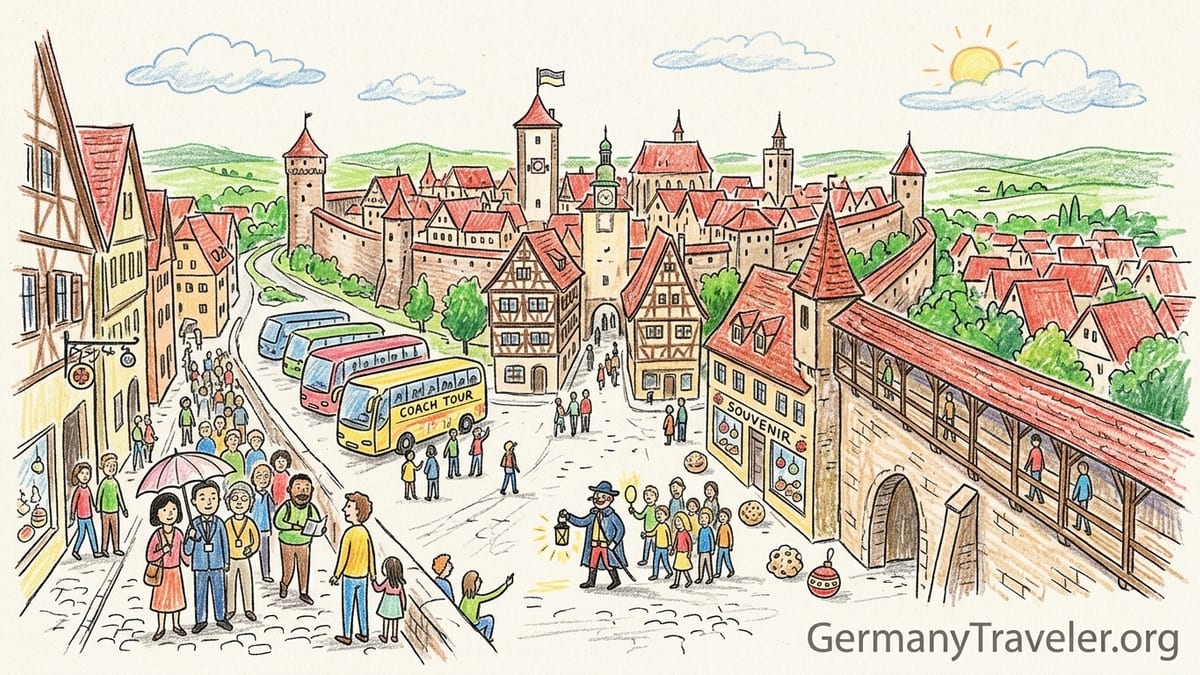
Stepping through the old town gate into Rothenburg’s Altstadt should feel like passing through a time portal. Instead, my first impression was of modern crowd management. Directional signs in German, English, Chinese and Japanese point toward the Marktplatz, the Plönlein and the Christmas Museum, as if the town itself had been turned into a three-stop theme park. Coaches deposit day-trip groups from Frankfurt, Nuremberg and Munich in steady waves, and many follow the same loop with little time for detours. The architecture remains enchanting, but it is wrapped in a choreography of group schedules and standardized photo stops.
For a visitor who has internalized the dreamy images from guidebooks and social media, this can be an unsettling start. Rothenburg is not a quiet, undiscovered medieval town. It is a mature tourism product, built over decades and fine-tuned to handle enormous visitor numbers relative to its size. Walking those first streets, I felt something like jet lag between the romanticized Rothenburg in my head and the commercial machine humming around me.
Souvenir City: Christmas Shops, Trinkets and Themed Retail
Nowhere is Rothenburg’s tourist economy more visible than in its retail. Within minutes of entering the old town, I passed shops crammed with magnets, shot glasses and “medieval” tankards engraved with the town’s name. Whole windows were devoted to mass-produced figurines of knights and beer-drinking gnomes. The goods are not unique to Rothenburg; you could find versions of them in any busy European destination. What felt different here was the concentration. Entire streets near the Marktplatz are lined with souvenir outlets, some barely distinguishable from one another, each competing to turn the same handful of romantic motifs into merchandise.
The Christmas economy is another story altogether. Rothenburg is home to several year-round Christmas stores, with Käthe Wohlfahrt’s vast flagship the most famous. Step inside and you are transported not into history, but into a carefully staged winter fantasy: artificial snow, nutcrackers stacked to the rafters, wooden pyramids, glass baubles, carols looping softly. It is impressive as retail theatre, and plenty of visitors clearly love it. Yet I could not shake the feeling that I was in an upscale theme shop that happened to stand inside a medieval shell, rather than in a living town that happens to sell Christmas ornaments. Prices, too, are a reminder that you are on a tourist trail. Hand-carved decorations, beautiful as they are, can easily run into dozens of euros each.
This commercialization would disappoint me less if it were balanced by more everyday life on the main streets. Instead, the core of the old town often feels geared almost entirely toward visitors. Bakeries sell “Rothenburger Schneeballen,” fist-sized pastry balls that photograph well and taste mostly of dry shortcrust. Cafés advertise “typical Franconian” menus in half a dozen languages. Supermarkets and unglamorous services, where locals quietly shop, hide in side streets away from the tourism arteries. The result is a center that can feel more like an open-air shopping mall with heritage façades than a mixed-use town.
Rebuilt Beauty: War Damage, Reconstruction and What Is “Authentic”
To dismiss Rothenburg as fake, however, would be too simple and, historically speaking, unfair. In March 1945, a late war air raid destroyed around 40 percent of the old town’s building stock, particularly in the eastern part of the Altstadt. Contemporary German sources describe nearly the entire eastern half as badly damaged or leveled. The walls and street grid largely survived, but many individual houses did not. After the war, Rothenburg became a showcase for a particular style of reconstruction that aimed to preserve the medieval townscape, even when much of what rose from the rubble dated from the late 1940s and 1950s.
Walking the streets with that knowledge changes how you see the place. Some structures, like large portions of the defensive walls and several towers, are genuinely medieval or early modern, repaired but not fundamentally replaced. Many of the timber-framed houses in the western part of town retain substantial historic fabric. Others, especially toward the east, are careful reconstructions, following historic footprints and silhouettes but built with postwar materials. Architectural historians sometimes describe this approach as the “Rothenburger Weg,” a model where the overall historical image of a town is prioritized over a strict differentiation of old and new.
As a visitor, you experience this visually more than intellectually. Stand on the Marktplatz and gaze at the stepped gables and the bulk of the town hall and you see a convincing late medieval merchant city. Unless someone tells you, you are unlikely to guess which sections burned in 1945 and which did not. That raises questions about authenticity, but not in a simple binary of real versus fake. Is a 500-year-old street pattern populated by 70-year-old reconstructed houses less worthy than a street that never burned at all? In nearby Dinkelsbühl, which survived wartime bombing essentially intact, much of the fabric is older. Yet Rothenburg’s reconstruction was not cynical theme-building; it was a conscious decision by locals, preservationists and planners to restore an urban ensemble that they considered historically and culturally important.
From a critical traveler’s perspective, the more relevant distinction is between reconstruction that respects the town’s proportions and materials and modern interventions that exist purely for tourist spectacle. Some rebuilt façades, like the often-photographed Gerlachschmiede near the walls, deliberately exaggerate the half-timbered charm in ways that feel closer to stage scenery than to ordinary historic housing. Others blend almost invisibly into the medieval texture. Learning a little of this history before you arrive helps shift frustration away from “it is all fake” toward a more nuanced appreciation of what Rothenburg is and is not.
Crowds, Cameras and the Plönlein Problem
Nowhere did Rothenburg feel more like a victim of its own image than at the Plönlein. The spot appears on brochures, calendars and social media so often that it has become the town’s visual brand. When I turned the final corner, I found not a quaint side street but a knot of thirty or forty people vying for the same angle. Tripods sprouted between parked cars. Influencers in floaty dresses took turns stepping into the roadway while a friend barked directions from the sidewalk. A delivery van trying to exit the lower gate waited, engine idling, as visitors shuffled reluctantly out of the way.
In that moment, the Plönlein was less a place than a backdrop. People arrived, captured their proof, then moved on to the next stop on their mental checklist. I counted at least three separate organized tour groups in the ten minutes I lingered, each guide holding up a sign as they explained that yes, this is where that famous Christmas movie was filmed, and no, the town did not actually look like this in the Middle Ages. It is hard to savor architectural details when you are constantly trying not to stray into someone else’s frame.
The Marktplatz suffers a milder version of the same problem at midday. The square is Rothenburg’s heart, lined with photogenic gabled houses and fronted by the town hall. It fills with school groups, pensioner excursions and independent travelers following guidebook walking tours. On busy days, queues for the town hall tower can snake across the cobbles. Street musicians add atmosphere, but they also contribute to a sense that the square has become a stage set for visitor entertainment.
This is the first of several disappointments that stuck with me: how image consumption can crowd out simple presence. I did eventually return to the Plönlein just after sunrise the next morning. There were only two other photographers, both quietly keeping to opposite sides of the street. In that pale early light, with shutters still closed and the clatter of luggage absent, the scene regained some of its magic. That contrast between packed late morning and soft, empty dawn became a recurring theme during my stay.
Eating in a Theme Park: Menus, Prices and Missed Opportunities
Another disappointment lay in Rothenburg’s food scene on the main tourist arteries. Many restaurants around the Marktplatz and along Herrngasse and Schmiedgasse appear to follow a similar playbook: heavy on “rustic” decor, multilingual menus plastic-laminated for easy wiping, and a short list of crowd-pleasing dishes that could be served in almost any German tourist town. Schnitzel with fries, sausages with sauerkraut, “Frankish plate,” maybe a token vegetarian pasta. Prices for mains in these central spots often hover in the mid-to-high teens in euros, edging above what you might pay for comparable food in less touristed Franconian towns.
None of this is shocking. High demand plus limited old-town space equals elevated prices. Yet in a region with rich culinary traditions, from Franconian carp and hearty stews to excellent local wines from the Tauber valley, it felt like a missed opportunity. I had a plate of Rothenburger Schneeballen in a café off the Marktplatz that perfectly captured the problem: a local specialty that has been optimized for transport and display instead of taste. The dry, crumbly pastry was coated in a generous layer of powdered sugar that photographed well and dulled what little flavor there was.
Walk two or three streets away from the main axis, and things improve. I found a small Weinstube near the walls serving simple, solid Franconian dishes at gentler prices and pouring local Silvaner by the glass. The atmosphere was quieter, the clientele more mixed, including actual residents. The contrast reinforced my frustration that so many visitors might leave with the impression that Rothenburg’s cuisine begins and ends with tourist platters and mass-market pastries.
This gap between the tourist-facing dining offer and the region’s real food culture forms my second meaningful disappointment. It matters because eating is one of the most accessible ways for travelers to connect with place, and in Rothenburg’s busiest streets, that connection often feels flattened into generic “German” options that could be replicated far from the Tauber valley.
On the Walls and with the Night Watchman: When Rothenburg Works
Paradoxically, the experiences that convinced me Rothenburg is not a write-off were the ones where the tourism formula is simplest. Walking the town walls is free, requires no reservation and offers some of the most evocative moments in town. Much of the defensive circuit can be explored via covered walkways that run along the inside of the ramparts, punctuated by towers and views over the sea of red roofs and the Tauber valley beyond. Even during a busy afternoon, sections of the wall were almost empty. The slight creak of old timbers, the uneven stone underfoot and the smell of sun-warmed wood made the medieval fabric feel immediate in a way no souvenir shop could match.
The Night Watchman tour is the other highlight that, despite its theatricality, earns its popularity. Every evening, a costumed guide meets visitors on the Marktplatz and leads them through the streets by lantern light, mixing historical facts with dry humor. As of mid 2026, the public tour costs around 8 euros per adult in German and 9 euros in English, with reduced prices for students and free participation for young children, payable in cash on the spot. You do not need to book ahead. You simply show up at the appointed time and join the crowd.
On the night I joined, at least a hundred people gathered, clustered in loose semicircles around the guide. It began to drizzle lightly, but hardly anyone left. The Night Watchman explained his historic duties, pointed out where wealthy merchants once lived and sketched Rothenburg’s role in regional trade. Walking through the dimly lit streets in a large group did not feel intimate, and there were moments when the performance slipped toward routine. Yet it achieved something many heritage attractions struggle with: it made the town’s past feel inhabited and specific rather than abstract.
This is where Rothenburg’s much-touted romantic atmosphere still works, especially in the evening after most day trippers have left. Streets that felt like corridors between photo spots at noon gained depth once the shops closed and the tour buses rolled away. The Night Watchman tour, at under ten euros for a full hour of guided storytelling, struck me as fair value, especially compared with far pricier experiences in larger cities that deliver less insight.
Five Disappointments That Stuck With Me
Looking back over my notes, five specific disappointments stand out, beyond general grumbling about crowds. The first is the Plönlein’s transformation from lived space into open-air photo studio, which erodes any sense of discovery. The second is the dominance of generic souvenir shops near the center, which crowd out small independent businesses and make the town’s retail feel homogenous and externally focused.
The third disappointment is the food on the main tourist routes: not catastrophic, but too often unimaginative and overpriced compared with both local potential and what you find just a few streets away. A visitor arriving with limited time and no research might reasonably assume that Rothenburg’s culinary scene consists primarily of safe-but-dull staples designed for international palates.
The fourth is the way organized day trips compress the town into a half-day checklist. Many group itineraries from Munich, Frankfurt or Nuremberg allow only a few hours in town, enough for a quick wall walk, the Plönlein, the Marktplatz and perhaps a rushed lunch. Guides keep one eye on the clock because the coach has to reach the next Romantic Road stop. This rhythm keeps Rothenburg’s central streets perpetually busy during late morning and early afternoon, while doing little to encourage deeper engagement beyond the obvious highlights.
My fifth disappointment is subtler: the relative invisibility of local life in the most photographed areas. Tourist areas inevitably tilt toward visitors, but in Rothenburg, the balance sometimes feels extreme. Children playing, neighbors chatting in doorways, someone wheeling a bicycle home from work: these are surprisingly rare sights on the core streets in high season. Without small glimpses of everyday life, a town risks becoming a consumable object rather than a place where people live. For a destination celebrated worldwide as a perfect medieval town, that distinction matters.
Rothenburg vs. Dinkelsbühl: Two Medieval Towns, Two Atmospheres
To understand whether Rothenburg is overrated, it helps to compare it with another Franconian town often mentioned in the same breath: Dinkelsbühl. Like Rothenburg, Dinkelsbühl sits along the Romantic Road and boasts an intact ring of walls, towers and handsome timber-framed houses. Unlike Rothenburg, Dinkelsbühl escaped wartime bombing almost entirely. Regional tourism authorities describe it as one of Germany’s best preserved late medieval towns, and it wears that status lightly.
Walking through Dinkelsbühl’s old town, the first thing I noticed was the relative lack of tour groups. There are visitors, of course, and even a few coaches parked outside the walls, but the scale felt more balanced. Market activity, schoolchildren on bicycles and residents running errands were all immediately visible. Instead of a single iconic photo spot drawing everyone into the same alley, interest is more evenly spread across winding market streets and crosswise squares like the Weinmarkt.
There are souvenir shops here too, and guesthouses clearly catering to travelers, but the overall atmosphere feels less choreographed. The town’s big annual Kinderzeche festival, a historical pageant held in July, draws crowds and injects theater into the streets, yet for much of the year Dinkelsbühl retains an everyday rhythm that Rothenburg often lacks in its core. In terms of raw architectural drama, Rothenburg’s hilltop setting and more dramatic vistas may have the edge. In terms of authenticity of day-to-day life within medieval walls, Dinkelsbühl makes a compelling case.
For a traveler deciding between the two, expectations matter. If you want the full medieval fantasy, complete with night watchman, Christmas shops and polished visitor infrastructure, Rothenburg delivers, especially if you can stay overnight and time your walks for quieter hours. If you are more interested in a working small town that happens to have extraordinary historic fabric and fewer crowds, Dinkelsbühl may feel more satisfying. In that sense, Rothenburg’s extraordinary reputation does set it up for disappointment, especially among travelers who equate “authentic” with “not obviously catering to tourists.”
When Rothenburg Still Shines: Timing Your Visit
For all my criticisms, there were moments in Rothenburg when I understood exactly why people fall in love with the place. Every one of those moments shared two conditions: it was either early morning or late evening, and I was at least one block away from the most obvious attractions. At seven on a summer morning, the light hit the upper town walls in a soft, golden angle. A lone local walked a dog along the ramparts. The only sounds were birds, distant church bells and my own footsteps on the stone. On a side lane off Herrngasse, half-timbered houses framed potted geraniums in front of doors that clearly belonged to permanent residents, not guesthouses.
After dark, once the Night Watchman tour had ended and the market square emptied, I retraced part of the route alone. Streetlights cast warm pools of light on uneven plaster and half-timber framing. A single late-opening bar spilled a strip of neon onto the cobbles, but most shutters were closed, and the town felt closer to a place its former inhabitants might recognize. Even the Plönlein, revisited close to midnight, gave off a different mood: still, slightly eerie, its prettiness no longer undercut by constant performance.
These experiences convinced me that Rothenburg is at its best as an overnight stay rather than a rushed day trip. Arrive in the late afternoon, let the day buses depart, walk the walls and side streets in the evening, join the Night Watchman if it appeals, then wake early for a slow wander before the first excursion buses arrive. This rhythm costs you the price of a hotel night, but it also buys you the sense of occupying the town rather than simply consuming it.
Is Rothenburg overrated? If you visit for three crowded hours at midday, armed with Instagram expectations and a checklist of photo spots, quite possibly yes. If you treat it instead as a complex place with layers of reconstruction, commercialization and beauty, and give it the breathing room of a full day and night, its reputation begins to make more sense.
The Takeaway
Rothenburg ob der Tauber is not a lost medieval village frozen in time, nor is it a hollow stage set devoid of substance. It is a small Franconian town that suffered serious wartime destruction, rebuilt itself with remarkable visual coherence and then leaned heavily into tourism as its economic engine. Those choices have produced a destination of considerable charm and considerable compromise.
My own experience oscillated between enchantment and irritation. I resented the crowds jostling for the same Plönlein shot and the souvenir monoculture around the Marktplatz. I felt let down by bland, tourist-oriented menus that ignored local culinary depth. I wished group itineraries allowed people to see more than the headline sights. At the same time, I was moved by quiet minutes on the walls, impressed by the clarity of the Night Watchman’s storytelling and repeatedly struck by the town’s cohesive skyline dropping toward the Tauber valley.
In the end, whether Rothenburg feels overrated depends less on the town than on how and when you meet it. Go in with realistic expectations, stay overnight, seek out side streets and local-run spots, and Rothenburg still has the power to justify its fame. Treat it as a quick-stop backdrop for photographs and souvenir shopping, and you may leave wondering what all the fuss was about.
FAQ
Q1. Is Rothenburg ob der Tauber worth visiting if I dislike crowds?
It can be, but only with careful timing. Midday in high season is very busy, especially around the Marktplatz and Plönlein. Visiting on a weekday, staying overnight and exploring early in the morning or late in the evening dramatically reduces crowd pressure and lets you experience quieter streets and the town walls in relative peace.
Q2. How badly was Rothenburg damaged in World War II?
Rothenburg suffered a significant air raid in late March 1945 that destroyed roughly 40 percent of the old-town building stock, particularly in the eastern Altstadt. Many houses you see today are careful postwar reconstructions on historic foundations, while the overall street pattern, walls and several major structures retain substantial medieval and early modern fabric.
Q3. Is Rothenburg “fake” because of the reconstruction?
No, but it is curated. The postwar rebuilding aimed to restore the townscape as a coherent medieval ensemble, sometimes idealizing earlier forms. Some façades are more picturesque than strictly historical, yet the street layout, fortifications and many buildings are genuinely old. It is more accurate to see Rothenburg as a reconstructed historic town than as an invented fantasy.
Q4. How much does the Night Watchman tour cost and is it worth it?
As of 2026, the public Night Watchman tour costs around 8 euros per adult for the German tour and 9 euros for the English tour, with reductions for students and free participation for young children. The walk lasts about an hour, covers key streets and squares and combines history with humor, making it one of the better-value experiences in town.
Q5. Can Rothenburg be done as a day trip, or should I stay overnight?
You can see the main sights in a day trip, and many organized tours from Munich, Frankfurt or Nuremberg do exactly that. However, staying at least one night lets you experience Rothenburg before and after the busiest hours, walk the walls in quiet and join the Night Watchman tour without racing back to a coach or late train.
Q6. How does Rothenburg compare to Dinkelsbühl?
Both are walled medieval towns in Franconia, but their atmospheres differ. Rothenburg is more famous, more dramatic in its hilltop setting and more heavily geared toward tourism, with big crowds and extensive souvenir and Christmas retail. Dinkelsbühl is less crowded, largely untouched by wartime bombing and feels more like a lived-in small town, which some travelers find more authentic.
Q7. Are the souvenir and Christmas shops in Rothenburg worth visiting?
They can be enjoyable if you like Christmas décor and traditional ornaments, and some items are high quality. However, many shops sell similar mass-produced souvenirs, and prices in flagship Christmas stores are relatively high. If you value unique or locally made products, you may prefer to seek out smaller specialist shops away from the main squares.
Q8. What are the best things to do in Rothenburg that are not overly commercialized?
Walking the town walls, exploring quieter residential lanes away from the main axes, visiting smaller churches and taking in views over the Tauber valley are all low-cost, low-commercial experiences. Simply sitting on a bench on the walls or in a side square in the early morning or evening can be more rewarding than queuing for the classic photo spots.
Q9. When is the best time of day to photograph the Plönlein without big crowds?
The Plönlein is busiest from late morning through mid-afternoon, especially when multiple tour buses are in town. For a calmer experience and cleaner photographs, aim for shortly after sunrise or late in the evening, when day-trippers have left and the street is used mostly by residents and overnight guests.
Q10. Is Rothenburg ob der Tauber overrated overall?
It can feel overrated if you expect an untouched medieval village and visit only during peak hours, when crowds and commercialization are most intense. If you arrive with realistic expectations, stay overnight and focus on quieter times and less obvious corners, Rothenburg offers enough beauty and atmosphere to justify a place on a thoughtful German itinerary.