

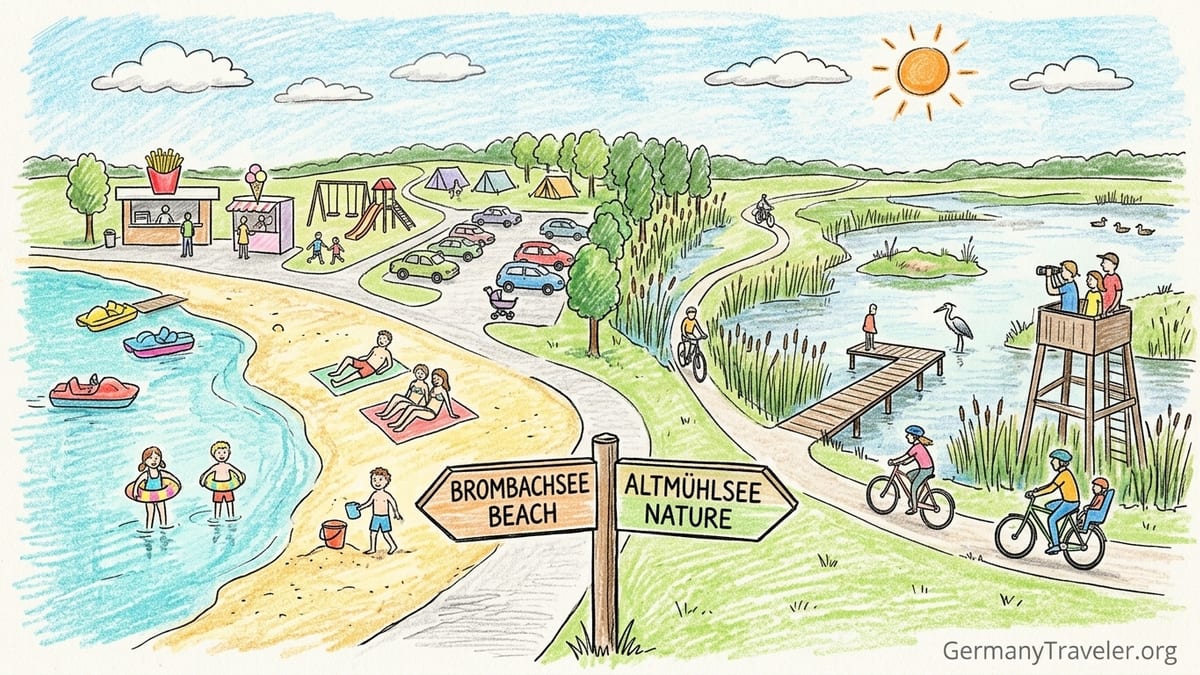
By the time we packed the last sand toy into the car, our two children were already arguing about who would be first in the water. We had promised them a late-summer weekend away at the Franconian lakes, and like many families from Nuremberg and beyond, we chose a classic combination: a fun, beach-heavy Saturday at Brombachsee, followed by a quieter, nature-focused Sunday at Altmühlsee near Muhr am See. What we found was less about idyllic Alpine scenery and more about clever Bavarian engineering, family logistics and deciding what kind of lake day really suits your kids.
Why These Lakes Are Not Alpine, And Why That Matters For Families
The Franconian Lake District is often advertised with palm-fringed photos and turquoise water that look almost Mediterranean. In reality, Großer Brombachsee, Kleiner Brombachsee and Altmühlsee are reservoirs created through one of Germany’s largest water management projects, completed around the year 2000 to move water from the wetter Danube basin toward the drier north of Bavaria and to help with flood protection. Recreation came on top of that technical purpose, not the other way around. For families, that means well-planned infrastructure and wide, shallow shorelines rather than wild mountain scenery.
You really notice this at Großer Brombachsee. It is held back by a long earth dam and ringed by an almost continuous path, with seezentren, car parks and campgrounds placed at regular intervals. There are no steep alpine cliffs plunging into deep water; instead, gentle banks allow for broad beaches and grassy meadows. At Kleiner Brombachsee, the Badehalbinsel Absberg forms a tongue of land with bay after bay of sand and lawn, purpose-built for swimming, picnics and boats.
Altmühlsee, a little further west, has the same artificial origin but a different character. A 12.5 kilometre circular path surrounds the lake, and north of Muhr am See lies the Vogelinsel, a designated nature reserve and low-water bird sanctuary with observation towers and screens. While there are also bathing areas, a large part of the shore is protected and feels more like a wetland landscape than a beach resort. On paper these lakes are siblings in the same project; on the ground, a day at Brombachsee and a day at Altmühlsee feel very different, especially with children in tow.
Understanding that these are engineered lakes with layered roles is helpful for parents planning a weekend. Infrastructure is generally excellent, but water levels can fluctuate. In September 2026, low levels on Altmühlsee were serious enough that passenger cruises were suspended temporarily, and local operators warned of continuing constraints. When a lake doubles as a working reservoir, schedules depend on more than just the school holidays and sunshine.
Day One: A Beach-Filled Saturday At Brombachsee
We started our Saturday on the Badehalbinsel Absberg at Kleiner Brombachsee, about an hour’s drive south of Nuremberg. By 10:00 a.m., signs were already guiding cars to overflow parking. From the main lot we had a five to ten minute walk with stroller, cool box, inflatable animals and a bag full of spare clothes. For families, that last stretch is where the romantic idea of “just going to the lake” meets reality: somebody ends up with a child on one hip and a bucket of sand toys in the other hand.
Absberg rewards the effort. The peninsula offers around 1,300 metres of sandy beach with shallow entry, backed by lawns and trees. The sand is coarse enough for castles but heavy enough not to blow into your face at every breeze. Our three-year-old could wade far before the water reached her waist, and lifeguard-marked zones gave us some extra confidence. Behind the beach are changing cubicles, outdoor showers, basic toilets and several kiosks and snack stands where families line up for fries and ice cream. Expect to pay somewhere around 3 to 4 euros for a cone and 4 to 6 euros for a portion of fries with sausage, which adds up quickly when children decide they are suddenly starving.
For older kids, the Badehalbinsel packs in plenty of distractions beyond swimming. There is a lakeside playground with climbing frames and swings, beach volleyball courts, a wakeboard cable park and rental stations for pedal boats and stand-up paddleboards. On a warm September weekend many blue and yellow pedal boats were out on the water, parents pedalling hard while children leaned over the bow to trail their fingers through the lake. Renting a pedal boat for half an hour typically costs around 12 to 18 euros depending on size and operator, so we opted for one 30 minute ride rather than several shorter trips to keep the budget in check.
What impressed us at Brombachsee was how much of this had been clearly designed with volume in mind. Paths from the car parks are paved or compacted, suitable for strollers, and the main beach zones are wide enough that even on a busy day you can usually find a spot if you arrive before midday. The downside is that it feels developed. At peak times there is music from beach bars, queues at the toilets, and a constant flow of people hauling SUP boards, cool boxes and inflatable flamingos past your towel.
Exploring Pleinfeld, Ramsberg And The Big Lake Feel
After lunch we packed our decidedly heavier beach bag back to the car and drove the short distance around to the southern shore of Großer Brombachsee, aiming for Pleinfeld and Ramsberg. Here the big reservoir character becomes obvious. Großer Brombachsee is larger and deeper than its little sibling, with about 17.5 kilometres of shoreline and a central basin that feels almost like an inland sea. At the shore, however, the facilities again lean hard into family use: long strips of beach, extensive lawns and a broad, mostly level path for cycling and walking.
Pleinfeld’s lakeside area combines sand sections and grass, which is great if you dislike sand sticking to everything. We parked in a large paid lot set slightly back from the water and followed another stroller-friendly path down to the beach. On this side, the lake shelves more quickly in some places, so we appreciated clearly marked non-swimmer zones for children. There were more shady areas under trees, which made the afternoon heat manageable without renting a sunshade.
In Ramsberg, a little further along, the atmosphere feels more maritime. There is a marina with sailing boats and the pier for the trimaran passenger ship that usually operates on Großer Brombachsee, stopping at several seezentren such as Ramsberg, Absberg, Enderndorf, Allmannsdorf and Pleinfeld. The boat is popular with families because it allows you to turn a day at the lake into a mini cruise, ride with a stroller and hop off near another playground or kiosk. A family round trip for two adults and two children can easily come to 30 euros or slightly more depending on the ticket option and season, so it is worth checking the price list in advance and deciding whether you want a full loop or just a short hop.
The path that links these shore areas is one of the quiet strengths of Brombachsee for families. Cyclists share it with walkers, scooters and balance bikes. With older kids you can realistically ride sections of the loop, stopping for swims and ice cream. For our mix of toddler and schoolchild, we chose a compromise: one parent cycled a short loop with our seven-year-old while the other stayed near the beach playground. The surface is mostly smooth and the gradients gentle, but helmets are a must because of the mixed traffic.
Hidden Costs And Practical Challenges Around Brombachsee
By the end of Saturday, the most obvious lesson was how much a “cheap lake day” can cost when you multiply everything by four. Parking near the main seezentren around Brombachsee is usually paid. Day tickets of around 4 to 6 euros are common at large lots like Badehalbinsel Absberg or Ramsberg. If you arrive late and end up in a more distant overflow area, you may still pay similar rates and walk farther. For our family, two days of parking at different spots over the weekend added up to around 12 to 15 euros.
Food is another major factor. Many families bring picnics, but children often lobby hard for a lakeside treat. Around Brombachsee, snack stands sell typical German lake classics: bratwurst in a roll, fries, soft drinks, ice cream, coffee and simple cakes. A family of four can easily spend 30 to 40 euros on lunch and treats if everyone orders at the kiosks. We tried to balance by bringing sandwiches and fruit in a cool box, then allowed the children one purchased snack each in the afternoon.
Facilities are generally good, but they also shape your day. Public toilets near the main beaches are usually free or cost around 50 cents per visit, which adds another few euros over the course of a long stay. Changing cabins and beach showers are useful but create pinch points with queues, especially when a rain shower passes and everyone suddenly decides to go home. For parents, timing can feel like a juggling act between nap schedules, restroom runs and avoiding the longest ice cream lines.
Crowding is perhaps the least controllable variable. On a sunny Saturday in late summer, even September can feel like high season. By mid-afternoon, the sand at Absberg and the lawns at Pleinfeld were busy enough that we watched our toddler more closely than we would on a quieter day. If your children are easily overwhelmed by noise, consider arriving early in the morning or later in the afternoon, or opting for a smaller, less central access point rather than the main seezentrums.
Day Two: A Quieter, Nature-Focused Sunday At Altmühlsee
On Sunday we traded sand for reeds. Altmühlsee lies only a short drive from Brombachsee, near Gunzenhausen, but the mood is noticeably different. Instead of one continuous belt of beach infrastructure, much of the shore is designated as a bird reserve and wetland habitat. Our goal for the day was the area near Muhr am See and the famous Vogelinsel, combined with at least a section of the 12.5 kilometre circular path that loops around the lake.
We parked near the Seezentrum Muhr am See, which offers a mix of lawns for swimming, a small beach section, a playground and access to the path toward Vogelinsel. Here the ground is more grassy and less sandy, which immediately changed the packing list. We left the large sand toy bag in the car and focused on binoculars, rain jackets and a backpack with snacks. The children were less excited at first by “going for a walk” than they had been about the beach, but the promise of spotting herons and maybe even a stork helped.
The path toward Vogelinsel is flat and suitable for strollers and bikes, although in places it is unpaved gravel. After a short walk we reached the entrance to the Vogelinsel reserve. This is a protected area of shallow water, islands and reed beds with a roughly 1.5 kilometre walking loop and several bird hides and observation towers. Children pay no entry fee, and adults typically pay only a modest conservation contribution, which felt well justified given the well-maintained boardwalks and information panels.
Inside the reserve, the tone shifted. Voices dropped automatically as people tried not to scare the birds. Our children were fascinated by the long-lens photographers and the silhouettes of cormorants drying their wings. From one of the viewing platforms we watched grebes diving and a marsh harrier gliding low over the reeds. It felt far removed from the inflatable flamingos and bluetooth speakers of Brombachsee the day before, even though in reality the two lakes are part of the same system.
Walking, Cycling And Low Water: The Realities Of Altmühlsee
After our circuit on the Vogelinsel we rejoined the main circular path around Altmühlsee. At 12.5 kilometres, the loop is manageable in one go for adults or older children who are used to walking or cycling, but it is too long for most toddlers on foot. Many families tackle just one section, using Muhr am See or another seezentrum as a base for out-and-back excursions. The path stays close to the water for much of its length and offers frequent benches and small access points to the shore, where children can throw stones or watch ducks.
We chose to cycle a short stretch from Muhr toward Gunzenhausen with our seven-year-old on her own bike and the toddler in a child seat. Surfaces ranged from compact gravel to smooth asphalt, and gradients were so gentle that we could maintain a relaxed pace. For families who like to ride together, Altmühlsee’s circuit offers a satisfying sense of going around a whole lake without serious hills or traffic stress.
Water levels, however, played a visible role during our visit. By early September 2026, low levels at Altmühlsee had already forced local operators to reduce and then suspend passenger cruises by the small excursion boat that usually serves the lake. Official notices explained that draught limitations made safe navigation impossible in some sections, and regional news reported financial losses for the MS Altmühlsee operator due to the interruption. When we visited later in the month, there were no regular passenger sailings, and ticket booths stood closed.
For families, this has a few implications. First, if part of your plan is to ride the boat as a reward for small legs after a walk or bike ride, you need a backup. Second, low water makes some shoreline areas muddier and less inviting for paddling. In several spots we saw exposed shallows and wider strips of dried lakebed than in photos from previous years. None of this made the walk less pleasant, but it underlined that Altmühlsee is an actively managed reservoir, not a natural alpine lake with consistently full banks.
Beach Day Versus Bird Day: What Children Really Notice
From a child’s perspective, the contrast between Brombachsee and Altmühlsee is stark. At Brombachsee, especially on the Badehalbinsel Absberg, the day revolves around immediate, sensory fun. There is sand between toes, the shock of cold water, playground slides, pedal boats and the smell of fries in the air. Every few minutes, something happens: a wakeboarder splashes down, the trimaran cruise ship blows its horn, or an ice cream bell rings. For many children, particularly between three and ten years old, this high-energy environment is the definition of a holiday.
Altmühlsee near Muhr am See feels almost slow-motion by comparison. On the Vogelinsel loop our toddler’s main amusements were counting ducklings, peering through viewing slits and stomping on the wooden boardwalk. Our older child engaged more with the information panels about migration routes and wetland plants, and proudly spotted an egret by herself. The rewards here are quieter and require more patience. Parents will likely find themselves narrating what is happening in the reed beds to keep younger children interested.
This difference also shows up in what you carry. For Brombachsee, we hauled a beach cart loaded with towels, toys, sunshade and an inflatable ring, plus a full cool box. The weight was noticeable on the walk from the parking lot, but essential for a long stay on the sand. At Altmühlsee, a single hiking backpack with water bottles, snacks, a thin picnic blanket and rain gear was enough. Swap shovels for binoculars and you also reduce the amount of rinsing and washing-up required back home.
Toilets, too, change how the day feels. At Brombachsee’s main seezentren, sanitary blocks are rarely more than a few minutes’ walk away, which is a blessing with recently potty-trained children. On the Vogelinsel and some quieter stretches of Altmühlsee, facilities are more spaced out. We made sure both children used the restroom at Seezentrum Muhr before walking to the island, and we built our loop around the locations of the next available toilets to avoid emergencies.
Counting The Costs: What Our Weekend Really Added Up To
For many families, the key question is what such a weekend actually costs, beyond fuel or train tickets. Our spending is only one example, but it provides a realistic ballpark. On Saturday at Brombachsee, we paid around 5 euros for day parking at the Badehalbinsel Absberg and a similar amount later at a car park near Pleinfeld and Ramsberg. That brought the day’s parking total to roughly 10 euros.
Food and drinks formed the largest single expense. Despite bringing a picnic lunch, we still bought fries, drinks and ice cream for four people at different points, which came to about 35 euros over the day. Our half-hour pedal boat rental at Kleiner Brombachsee cost just under 15 euros. With a few small extras such as a beach ball and an extra round of coffee, our Saturday outlay at Brombachsee landed in the range of 60 to 70 euros.
Sunday at Altmühlsee was cheaper but not free. Parking near Seezentrum Muhr am See cost around 4 euros for the day. Entry to the Vogelinsel reserve involved a small fee for the adults while the children were free, adding approximately 6 euros to the bill. We again bought coffee and cake at the seezentrum and an ice cream for each child, totalling roughly 20 euros. Our bikes were our own, so there was no rental cost. All in, our Altmühlsee day came to about 30 to 35 euros.
Across the weekend, excluding accommodation and travel to the region, we spent in the range of 90 to 100 euros on parking, small attractions and food for a family of four. A more frugal family could reduce this by bringing all their food and skipping paid activities like pedal boats, while a more indulgent approach with restaurant meals and additional boat rides would easily push the total higher.
The Takeaway
Looking back on the weekend, Brombachsee and Altmühlsee felt less like two versions of the same lake and more like complementary answers to different family needs. Brombachsee, especially around the Badehalbinsel Absberg, Pleinfeld and Ramsberg, delivered the classic family beach day with reliable infrastructure: long sandy and grassy shores, shallow entry for young children, playgrounds a short walk from the water, and plenty of options for boat rental or a cruise on the big lake. The trade-offs are crowds on sunny weekends, paid parking close to the action and constant small expenses for food and treats.
Altmühlsee, especially around Muhr am See and the Vogelinsel, provided a calmer, more nature-based alternative. The 12.5 kilometre circular path and the protected bird reserve turned the day into a slow exploration rather than a series of adrenaline hits. Our children came away talking as much about the birds and the long walk as about the brief paddles in the shallows. The lack of passenger cruises in September 2026 due to low water levels was a reminder that this is an engineered body of water subject to management decisions, not just a leisure park.
For toddlers, Brombachsee’s shallow beaches and playgrounds are ideal, as long as parents are ready for short walking distances from car parks and the challenge of keeping track of small children in busy areas. Altmühlsee works better for very young children if you combine short stretches of the circular path with frequent play stops at seezentren and manage expectations about swimming.
Older children and teenagers who like to be active may prefer Brombachsee, where they can cycle sections of the shoreline, rent pedal boats or boards and enjoy the busier scene. Adults seeking relaxation, quieter walks and birdwatching will probably be happier at Altmühlsee, particularly around Muhr am See and the Vogelinsel. Cyclists of all ages benefit from both lakes, with Brombachsee offering slightly more variety in beach stops and Altmühlsee providing a well-defined 12.5 kilometre circuit with strong nature focus. The real luxury of this corner of Franconia is that you do not have to choose: in one weekend you can have both a commercial beach day and a nature excursion, then decide which one your family will be talking about for longer.
FAQ
Q1: Are Brombachsee and Altmühlsee natural lakes?
They are artificial reservoirs built as part of a large Bavarian water management project to move water from the Danube basin and support flood protection, with recreation added later.
Q2: Which lake is better for toddlers?
Brombachsee, especially the shallow sandy sections at places like Badehalbinsel Absberg, is usually better for toddlers thanks to gentle entry, nearby playgrounds and dense facilities.
Q3: How long is the circular trail around Altmühlsee?
The circular path around Altmühlsee is approximately 12.5 kilometres, suitable for adults and older children on foot or by bike, but long for toddlers to walk in one go.
Q4: What is special about the Vogelinsel near Muhr am See?
The Vogelinsel is a protected bird reserve with a short loop trail, hides and observation towers where you can watch waterbirds and learn about wetland habitats in a relatively quiet setting.
Q5: Were passenger cruises running on Altmühlsee in September 2026?
No, by September 2026 regular passenger cruises on Altmühlsee were suspended due to low water levels that affected safe navigation for the excursion boat.
Q6: Do I need to pay for parking at the lakes?
Yes, at the main access points and seezentren around both Brombachsee and Altmühlsee, parking is usually subject to a day fee, with machines near the car parks.
Q7: Can you cycle safely with children around these lakes?
Yes, both lakes offer largely level multi-use paths. Sections can be busy near seezentren, so helmets and close supervision are important, but many families cycle short loops together.
Q8: Is Brombachsee very crowded on summer weekends?
On sunny weekends and holidays, especially in late summer, the main beaches at Brombachsee can be quite crowded, so arriving early in the day helps secure a good spot and easier parking.
Q9: What should we pack differently for Brombachsee and Altmühlsee?
For Brombachsee, focus on beach gear like towels, toys and sunshade. For Altmühlsee and the Vogelinsel, prioritise comfortable shoes, binoculars, weatherproof layers and snacks for walking or cycling.
Q10: Which lake is better if adults mainly want peace and nature?
Altmühlsee, particularly the areas around Muhr am See and the Vogelinsel, is generally better for adults seeking quieter paths, birdwatching and a more natural atmosphere than the busy beaches of Brombachsee.