

Ask many travelers about Franconia and you will usually hear the same names: Nuremberg, Bamberg, maybe Rothenburg ob der Tauber. Yet this northern part of Bavaria, with related Franconian areas stretching into Thuringia, Hesse and Baden-Württemberg, is far more than a handful of medieval showpieces. Franconia is a historical and cultural region in its own right, anchored by the Bavarian administrative regions of Upper, Middle and Lower Franconia and enriched by outlying Franconian enclaves. Its 16 officially promoted vacation landscapes range from limestone gorges and cave systems to vineyard-clad river valleys and quiet low mountain ranges. For travelers willing to look beyond Bavaria’s famous Alps-and-lakes imagery, Franconia offers a compact cross-section of Germany in one region.
Understanding Franconia: More Than “Northern Bavaria”
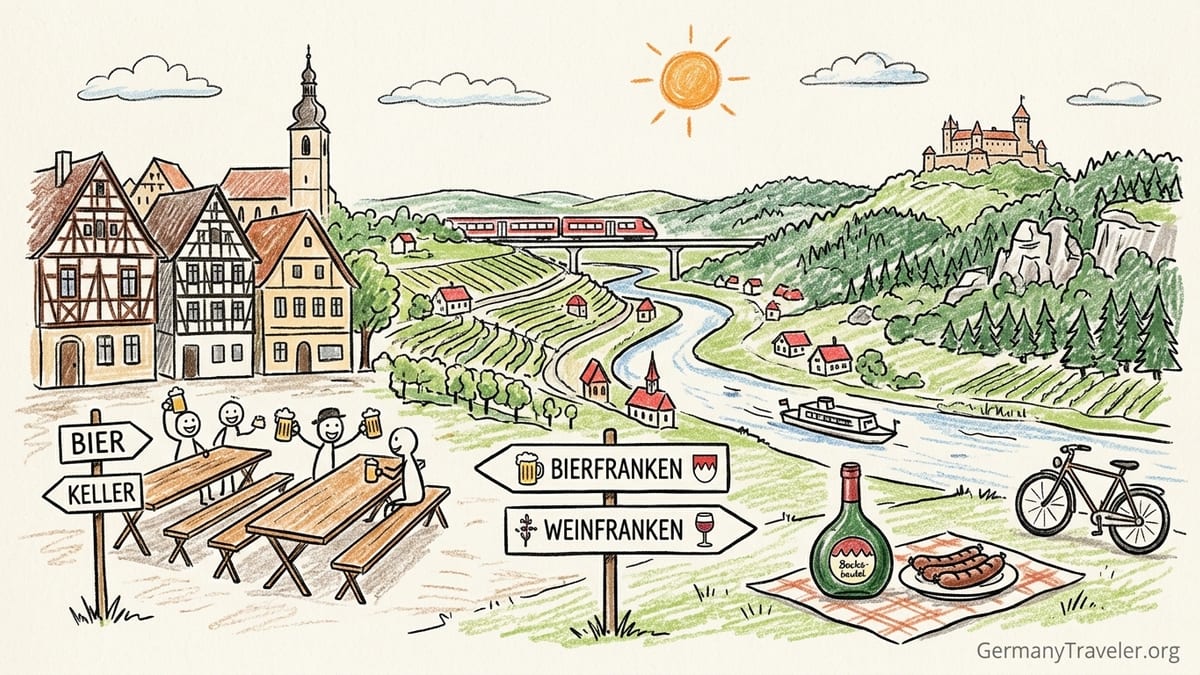
To appreciate why Franconia deserves its own trip, it helps to step back from modern state borders. Historically part of the Holy Roman Empire’s Franconian Circle, the region today covers the Bavarian districts of Upper, Middle and Lower Franconia and spills into neighboring states through areas such as South Thuringia, parts of the Rhön in Hesse and the Tauber valley in Baden-Württemberg. You notice the difference almost immediately on the street. Local dialects shift from Bavarian to East Franconian, half-timbered houses replace Alpine chalets and brewery signs and wine taverns advertise “Franken” as a regional identity distinct from “Bayern.”
The regional tourism board underlines this diversity with 16 official vacation landscapes, including Franconian Switzerland, the Franconian Lake District, Franconian Wine Country, Romantic Franconia, Steigerwald Forest, Nuremberg Metropolitan Region and Spessart-Mainland, among others. Together, they create a patchwork of river valleys, forested hills, nature parks and small cities that cannot be reduced to one postcard view. A traveler could spend a week moving only 60 to 80 kilometers at a time and still move between very different atmospheres: from red-sandstone river towns on the Main to volcanic basalt domes in the Rhön or granite ridges in the Fichtelgebirge.
Practically, Franconia is also one of Germany’s easiest regions to navigate. Nuremberg serves as the main hub, with high-speed ICE trains connecting it in roughly one hour to Munich and in around two and a half hours to Frankfurt, including direct services from Frankfurt Airport. Regional trains fan out to Bamberg, Würzburg, Bayreuth, Coburg and Hof, while buses and local rail lines reach smaller towns and nature areas. This makes Franconia particularly attractive if you prefer to base yourself in one city and make day trips, or to design a rail-and-hike itinerary without renting a car.
At the same time, Franconia is not without drawbacks. Public transport into the more rural vacation landscapes can mean hourly or two-hourly buses, and some last-mile journeys after dinner may be impractical without a car. Winter outside Advent season can feel very quiet, with shorter opening hours and fewer English-speakers in smaller places. For all its compactness, this is a region where it pays to plan connections and seasons carefully, rather than assuming year-round Alpine-style tourism.
Nuremberg: Imperial History, Museums and Urban Base
Nuremberg is the largest city in Franconia and functions as the region’s urban anchor. The walled old town, crowned by the Imperial Castle on a sandstone ridge, gives an immediate sense of why the city mattered to Holy Roman Emperors, who kept their regalia here for centuries. Visitors can tour the castle complex, including sections of the imperial palace and the deep well, and then walk down through streets that still follow medieval lines despite heavy wartime damage. The rebuilt Hauptmarkt hosts one of Germany’s most atmospheric Christmas markets, and at any time of year the surrounding streets offer traditional sausage kitchens and beer taverns where you can try Nuremberg Rostbratwurst with sauerkraut at informal communal tables.
What sets Nuremberg apart from many other romantic German towns is the density of serious museums. The Documentation Center at the former Nazi Party Rally Grounds, currently in the midst of a long-term refurbishment program with a redesigned permanent exhibition, tackles the city’s role in National Socialism with sober, detailed interpretation. The Memorium Nuremberg Trials in the Palace of Justice focuses on the postwar trials in Courtroom 600, using multimedia exhibits to show how this provincial city became a global symbol of accountability. Add to this the Germanisches Nationalmuseum, one of the largest cultural history museums in the German-speaking world, the Toy Museum with exhibits dating back to early tin toys, and the Albrecht Dürer House, and you have several days of rain-proof, content-rich sightseeing.
Nuremberg works well as a two to three night city break, or as a base for side trips to Bamberg, Franconian Switzerland or the Franconian Lake District. The city’s public transport network, run under the VGN umbrella, integrates U-Bahn, trams, buses and S-Bahn on a single ticket, so moving between the old town, the rally grounds and outlying districts is straightforward. From Munich, high-speed ICE trains usually take around one hour, while regional trains take closer to two hours, with construction work on the line occasionally affecting timings. A saver fare on an ICE, booked ahead, can often be competitive with renting a car when you factor in fuel and parking.
The main drawbacks are crowds and occasionally heavy subject matter. During Advent, weekend day-trippers from Munich and beyond can pack the old town so tightly that finding a quiet corner becomes difficult, and hotel prices near the market rise accordingly. Many of the top sights deal with war, dictatorship and trials, which can be intense if you are traveling with younger children. While there are green escapes along the Pegnitz river and a compact zoo, families who want playgrounds and outdoor time may find Nuremberg best combined with a lake or countryside destination.
Bamberg: UNESCO Old Town and Brewing Heartland
North of Nuremberg, Bamberg distills many of Franconia’s strengths into a small, walkable package. The entire old town is listed as a UNESCO World Heritage Site, spanning three historical cores: the episcopal hill with its cathedral and former prince-bishop’s residence, the island town with merchants’ houses along the Regnitz, and the gardeners’ district with traditional urban agriculture. Iconic images include the Old Town Hall straddling the river on a bridge and the Bamberg Rider statue in the Romanesque-Gothic cathedral. Despite this, the city still functions as a living university and administrative center, which keeps it from feeling like a pure museum set.
Bamberg is equally famous among beer enthusiasts. Within the city you can visit several historic breweries and taverns, some with centuries of history, and try local specialties such as Rauchbier, a smoked beer served in atmospheric beer halls. In summer, beer cellars on hill slopes around the town function as leafy Biergärten. Using Bamberg as a base, many visitors take regional trains or cycling routes into the surrounding countryside, which has one of the highest densities of breweries per capita in the world, although operating hours, languages and payment options in tiny village pubs can be decidedly local.
As a destination, Bamberg suits a one or two night stay, or a very full day trip from Nuremberg or Würzburg. Regular regional trains connect Bamberg to Nuremberg in roughly 40 minutes, and the station lies within walkable distance of the old town via a gentle downhill stroll. Public transport within the city is mostly by bus, but once you reach the historic core, nearly everything is best explored on foot. If you plan to tour multiple churches and museums, it is worth checking opening hours in advance, as smaller exhibitions can close on Mondays or off-season afternoons.
The main disadvantages are popularity and topography. River cruise groups and coach tours can make the most photogenic lanes crowded from late morning, especially between May and September. Some of the old town streets are steep and paved with cobblestones, which can be tiring if you have mobility issues or heavy luggage. Accommodation in the medieval core often sits in older buildings without elevators or air-conditioning. Travelers who dislike beer or who prefer minimalist modern design may find Bamberg charming but limited after a couple of days.
Würzburg, Rothenburg & Dinkelsbühl: Baroque, Vineyards and Contrasting Medieval Townscapes
On the Main river in Lower Franconia, Würzburg combines Baroque splendor with active student life and surrounding vineyards. The Würzburg Residence, rebuilt and restored after wartime destruction, is one of Germany’s outstanding Baroque palaces, with an elaborate staircase, frescoes and ornate state rooms that reward a guided tour. Above the river, the Marienberg Fortress offers views over terraced vineyards and the old bridge lined with statues, a popular evening spot where locals sip Franconian white wine sold from small bars at the bridgeheads. The compact center, with its mix of churches, university buildings and wine taverns, lends itself to a two-night stay focused on architecture and food.
Würzburg is an easy rail stop on north-south routes between Frankfurt and Nuremberg, with several daily ICE services and dense regional connections. From Frankfurt Airport, travelers can take an ICE directly to Würzburg in roughly 90 minutes without changing trains in the city center, which makes it a practical first stop in Germany. Around the city, buses reach outlying wineries and residential areas, but many visitors will happily spend most of their time walking between the Residence, cathedral, fortress and riverside promenades. Wine-focused trips in late September and early October coincide with harvest activity in the vineyards and local festivals, though they also mean fuller hotels.
Further south in Middle Franconia, Rothenburg ob der Tauber represents for many travelers the quintessential walled German town, with intact fortifications, cobbled lanes and steep-gabled houses lining the market square. It is photogenic from almost any angle, and walking the town walls at sunset can feel close to a time-travel experience. About an hour away by regional train and bus, Dinkelsbühl offers a contrasting medieval townscape, with a ring of colorful townhouses, a vast late Gothic hall church and an almost complete circuit of towers and walls reflected in the town moat. Where Rothenburg leans heavily into its international fame, with year-round Christmas shops and large tour groups, Dinkelsbühl feels more local and less staged.
Both Rothenburg and Dinkelsbühl work well as one-night stops on a self-drive route, or as day trips for travelers based in Nuremberg or Würzburg who are comfortable with regional trains and connecting buses. Reaching Rothenburg by public transport often involves a train to Steinach and a short branch-line ride or bus, and services thin out in the evening. Dinkelsbühl, lacking a mainline station, is currently better reached by stopping in nearby towns such as Ansbach or Crailsheim and continuing by bus or car. In both places, winter outside the Advent period can feel very quiet, with some hotels and restaurants closing or reducing hours, while mid-summer sees streets busy with groups during the day and relative calm after dark.
Bayreuth, Coburg, Volkach & Iphofen: Culture and Wine Towns With Character
Bayreuth, in Upper Franconia, is synonymous with composer Richard Wagner and the annual Bayreuth Festival, but the city’s appeal extends beyond opera enthusiasts. The Margravial Opera House, a lavish Baroque court theater, is a UNESCO World Heritage Site and has been meticulously restored inside, with painted wooden architecture and ornamentation that illustrate 18th-century courtly spectacle. Guided tours allow non-opera-goers to experience the auditorium without attending a performance. Elsewhere, the New Palace and the Eremitage park with its follies and water features recall the tastes of the margraves who once ruled this small court city.
Bayreuth’s practical advantage lies in its manageable size and connections. Regional trains link it with Nuremberg in about an hour, and frequent buses connect the station with the festival theater on the green hill above town. For visitors not attending the summer festival, a one or two night stay allows plenty of time to explore the opera house, palaces, gardens and a couple of local breweries. During the festival season, typically from late July to late August, hotel prices rise, and reservations at central restaurants become essential, while outside these weeks the city adopts a calmer, student-town feel.
Further west, Coburg presents a different slice of Franconian history. The Veste Coburg, one of the largest hilltop fortresses in Germany, looms over the town and contains art collections, historical arms and rooms associated with Martin Luther’s stay there in the 16th century. Down in the old town, neat squares and civic buildings reflect Coburg’s 19th-century role as a small but influential duchy whose ruling family married into various European royal houses. Visitors interested in monarchy, European history or fortifications will find plenty to occupy a full day and night, while casual travelers may prefer a shorter visit focused on the fortress and a stroll through the center.
Lower Franconia’s Volkach and Iphofen highlight the wine side of the region. Volkach sits on a loop of the Main river surrounded by vines, with riverboats, bike paths along the levees and numerous wine estates offering tastings. Seasonal wine festivals fill local squares with long tables and live bands, especially from late spring to early autumn. Iphofen, stitched into the edge of the Steigerwald Forest, charms with intact town walls, a main street lined with wineries and a mixture of historic half-timbered facades and Baroque townhouses. Because both towns are relatively small, they work best for travelers who enjoy unhurried days of walking in vineyards, visiting tasting rooms and dining in traditional Franconian restaurants.
Access to Volkach and Iphofen by public transport requires more patience than for the larger cities. Regional trains serve nearby hubs such as Würzburg and Kitzingen, from which buses run into the towns, often hourly. Services can taper off in the evening, so staying overnight in the town where you plan to drink wine is advisable if you do not have a designated driver. Outside the main wine and holiday seasons, especially in November and January, visitors may find reduced opening hours at family-run wineries and fewer scheduled tastings in English.
Franconian Switzerland, Franconian Lake District, Fichtelgebirge & Rhön: Nature-Focused Escapes
For outdoors-oriented travelers, the vacation landscapes of Franconian Switzerland, the Franconian Lake District, the Fichtelgebirge and the Rhön show why Franconia is far more than museum towns. Franconian Switzerland, northeast of Nuremberg, is a classic limestone karst region of cliffs, river valleys and caves. Hiking routes thread through valleys like the Wiesent and Trubach, past ruined castles perched on rocks and small villages with old stone churches. Show caves such as the Devil’s Cave near Pottenstein, where guided tours lead visitors through chambers of stalactites and stalagmites, provide a weather-proof highlight and a clear sense of the geology that shaped the landscape. Rock climbers find numerous bolted routes, while canoe rentals on calmer river stretches offer a different perspective for families.
The Franconian Lake District, southwest of Nuremberg, could not look more different. Here, a cluster of large artificial lakes such as the Großer Brombachsee and Altmühlsee, created in the late 20th century as part of a water management project, now function as a major recreation area. In warm months, visitors swim at sandy beaches, rent paddleboards and pedal boats, or take circular cruises on excursion ships. Lakeside paths attract cyclists, rollerbladers and walkers, and campgrounds and holiday apartments around the shore make it a relaxed base for families who want car-free play space for children. Compared with the crowded lakes near Munich, prices for lake-view accommodation and meals can be noticeably gentler, especially outside school holidays.
The Fichtelgebirge in northeastern Upper Franconia and the Rhön on Franconia’s northern edge provide more serious upland landscapes. In the Fichtelgebirge, granite peaks such as the Schneeberg and Ochsenkopf are crisscrossed by hiking and biking trails, with chairlifts and observation towers providing views deep into neighboring Saxony and the Czech Republic in clear weather. The region sees winter sports when snowfall allows, though conditions vary from year to year, and cross-country skiing often takes precedence over alpine infrastructure. The Rhön, shared between Bavaria, Hesse and Thuringia, presents a softer, open upland with basalt domes, raised bogs and wide horizons. Designated as a biosphere reserve, it appeals to hikers and those seeking dark skies, with stargazing events organized in some communities.
Reaching these nature regions without a car requires more planning. From Nuremberg, regional rail services reach gateways such as Ebermannstadt and Pegnitz for Franconian Switzerland or Gunzenhausen and Pleinfeld for the Franconian Lake District, with buses continuing into valleys or to lake shores. Services are generally timed to meet school and commuting needs, so mid-day frequencies can drop. In the Fichtelgebirge and Rhön, key towns such as Wunsiedel, Bad Alexandersbad, Bad Kissingen or Gersfeld have rail access, but trailheads and viewpoints may still require bus transfers or taxi rides. For a short break focused on varied hiking with minimal logistics, combining one of these upland regions with a base in a nearby spa town can strike a good balance.
The seasonal character of these landscapes is both a strength and a drawback. Late April to October offers the most reliable weather for hiking, cycling and lake swimming; July and August bring the warmest water but also the largest crowds at popular bathing spots. Outside weekends and German school holidays, spring and early autumn can feel pleasantly uncrowded. In winter, some accommodation closes entirely in smaller villages, and car access may be complicated by snow or ice on minor roads. If you hope to rely on public transport for winter hiking or cross-country skiing, verify current bus timetables shortly before traveling and build in time buffers in case connections are missed.
Selective Stops: Bad Windsheim, Miltenberg and Kulmbach
Among the many smaller destinations in Franconia, Bad Windsheim, Miltenberg and Kulmbach stand out for specific attractions rather than overall fame. Bad Windsheim in Middle Franconia combines spa facilities with a major open-air museum. The spa center includes large indoor and outdoor saltwater pools, some with high salinity similar to the Dead Sea, which attract visitors seeking therapeutic soaks and relaxed wellness weekends. Next door, the open-air museum assembles historic farmhouses, barns and craftsmen’s houses from across Franconia, reconstructed on a large rural site where you can spend several hours moving between building clusters that illustrate different sub-regions and centuries. For travelers interested in rural architecture or vernacular culture, this museum can be worth a dedicated day trip from Nuremberg or Würzburg.
Miltenberg, on a bend of the Main river in the Spessart-Mainland vacation region, rewards those who enjoy atmospheric small towns rather than big-name sights. The old town’s main street runs between half-timbered houses, including one of the most photographed historic inns in Germany, and up towards a modest hilltop castle. River cruise ships occasionally stop here, bringing brief pulses of activity to an otherwise unhurried place. While Miltenberg rarely justifies a long detour on its own, it can add texture to a multi-day road trip following the Main between Aschaffenburg, Wertheim and Würzburg, especially for travelers who appreciate intimate, walkable streets and evenings spent in family-run wine taverns.
Kulmbach, north of Bayreuth, is primarily of interest to beer and food history enthusiasts. The town has long been associated with brewing, and the Bavarian Brewery Museum inside the Plassenburg fortress traces the technological and social history of beer production with exhibits ranging from historic equipment to advertising materials. The fortress itself, perched above the town, offers views across the surrounding hills and contains additional collections, including a noted display of tin figures depicting historical scenes. For a traveler already passing between Bamberg, Bayreuth and Hof, stopping in Kulmbach for half a day to combine the museum, a brewery visit and a walk through the compact center can be a satisfying detour.
In all three cases, the main limitation is that they are specialist rather than generalist destinations. Bad Windsheim appeals most strongly if you want either spa time or open-air history; Miltenberg fits river and wine itineraries; Kulmbach rewards beer and military-history interests. Public transport remains adequate but less frequent than along main corridors, with regional trains and buses forming the backbone of access. Drivers will find it easier to include these stops on flexible routes that already pass nearby, while first-time visitors on short trips may reasonably focus instead on the larger cities and headline landscapes.
How to Choose Your Franconian Itinerary
With 16 vacation landscapes and a mix of cities, wine towns and upland parks, Franconia can feel overwhelming on the map. A practical way to plan is to think in terms of travel appeal: city break, family base, rural escape or road trip corridor. For a culture-heavy city break, Nuremberg, Bamberg and Würzburg form a natural triangle, each with strong identities and easy rail links. A traveler flying into Frankfurt might start in Würzburg, move on to Bamberg for two nights, then finish with three nights in Nuremberg, using one day for an excursion to Franconian Switzerland or Rothenburg.
Families may prefer to anchor their trip around the Franconian Lake District or a spa town with pools, adding city day trips rather than the other way round. For instance, a family might rent an apartment near Altmühlsee for a week in August, spend most days cycling, swimming and visiting playgrounds around the lakes, and then take one-day excursions by regional train into Nuremberg or Ansbach. In shoulder seasons like late May or early September, combining a couple of days in Nuremberg with three or four days at the lakes can balance museums and outdoor time without extreme heat or crowds.
Travelers seeking rural escapes or long-distance hikes might target the Rhön, Fichtelgebirge or the more remote corners of Franconian Switzerland, perhaps linking them with stays in spa towns such as Bad Kissingen or Bad Alexandersbad, where accommodation ranges from modest guesthouses to multi-day wellness hotels. Road trippers can treat Franconia as a mesh of thematic routes, following the Castle Road between Nuremberg, Coburg and Bayreuth, then joining the Romantic Road near Rothenburg or weaving along the Main to wine towns like Volkach and Miltenberg. In all cases, allowing for slower travel between landscapes leads to richer experiences than trying to tick off every famous name in three or four days.
There are also real-world constraints to consider. If you rely entirely on trains, check current construction updates on major lines such as Nuremberg to Munich, where engineering works can alter journey times in specific periods. For rental cars, remember that many small-town hotels and guesthouses sit within traffic-calmed centers, with parking provided on the edge of the old town or in backyard courtyards that may require advance reservation. Dining late by southern European standards can be tricky in villages and small towns, where kitchens often close by 9 p.m., so planning meal times and shopping for snacks before arriving in quieter areas helps avoid frustration. Franconia rewards curiosity and a slightly slower pace, and most frustrations arise when travelers try to force it into a whirlwind Alpine-style itinerary.
FAQ
Q1. How is Franconia different from the rest of Bavaria for travelers?
Franconia feels culturally distinct from southern Bavaria. Dialects, traditional food, and even drinks differ, with a stronger focus on beer and Franconian wine rather than Alpine imagery. Architecturally you see more half-timbered houses, town walls and river valleys than onion-domed churches against mountain backdrops. Many visitors use Munich as a gateway but then find that cities like Nuremberg, Bamberg and Würzburg offer a different rhythm and urban scale.
Q2. When is the best time of year to visit Franconia?
Late April to October is generally the most rewarding period, with long days for hiking, cycling and outdoor dining. July and August bring the warmest weather for swimming in the Franconian Lake District but also more crowds and higher accommodation prices around school holidays. Advent is atmospheric in cities like Nuremberg and Bamberg thanks to Christmas markets, though weekends can be very busy. From January to early March many smaller rural accommodations reduce operations, so a winter visit works best if you focus on larger cities and spa towns.
Q3. Can I explore Franconia without renting a car?
Yes, if you plan carefully. High-speed and regional trains link major cities such as Nuremberg, Bamberg, Würzburg, Bayreuth and Coburg, and buses connect many smaller towns and nature areas. You can comfortably visit Nuremberg, Bamberg, Rothenburg and parts of Franconian Switzerland or the Franconian Lake District by public transport. However, for deeper exploration of upland regions like the Rhön or Fichtelgebirge, or for flexible winery-hopping around places like Volkach and Iphofen, having a car or booking local taxis can make the trip smoother.
Q4. How many days should I plan for a first trip to Franconia?
For a focused introduction, five to seven days works well. One common pattern is two nights in Würzburg for Baroque architecture and vineyards, two nights in Bamberg for the UNESCO old town and brewing culture, and two or three nights in Nuremberg as an urban base with imperial sights and day trips. If you want meaningful time in nature regions or wine villages, extending the trip to 10 days allows you to slow down and add a stay in the Franconian Lake District, Franconian Switzerland or the Rhön.
Q5. Is Franconia a good destination for families with children?
Franconia suits families who enjoy a mix of culture and outdoor activities. Children often like the castles of Nuremberg, Coburg and Bayreuth, open-air museums such as the one at Bad Windsheim, and swimming and boating in the Franconian Lake District. Cities offer playgrounds and child-friendly museums, but some heavy historical sites in Nuremberg may be better for older children or teens. In rural areas, check in advance for family rooms, playgrounds and rainy-day options, since smaller villages may have limited indoor attractions.
Q6. What are typical costs for eating out in Franconia?
Compared with Munich or major international capitals, restaurant prices in Franconia are relatively moderate. In a traditional Wirtshaus in a medium-sized town, a main dish such as Schäufele (roast pork shoulder) or Franconian carp usually costs less than in big-city Bavarian beer halls, and a glass of local beer or house wine is often very reasonably priced. In wine towns and popular old towns, menus at central squares can be higher, so walking a couple of streets away from the main market often brings both quieter atmospheres and slightly lower prices.
Q7. Are English speakers widely understood in Franconia?
In larger cities such as Nuremberg, Bamberg and Würzburg, many people working in hotels, main museums, and central restaurants speak some English, and information in major attractions is often available in multiple languages. In small villages, rural guesthouses or family-run wineries, you may encounter more limited English. A few basic German phrases, plus translation apps, go a long way, and most hosts appreciate simple efforts to communicate even if they switch to English where they can.
Q8. How does Franconia compare to the Bavarian Alps for scenery?
Franconia does not have high Alpine peaks, but it offers a varied mix of river valleys, low mountain ranges and rock formations. Franconian Switzerland provides dramatic limestone cliffs and caves; the Rhön has open uplands and broad horizons; the Fichtelgebirge features granite peaks and dense forests. The Franconian Lake District adds broad water views without mountain backdrops. For travelers who prefer rolling hills, hiking through mixed forests and cycling along rivers over steep mountain ascents, Franconia can be more appealing than the classic Alpine postcard.
Q9. Is it worth visiting both Rothenburg ob der Tauber and Dinkelsbühl?
If you enjoy historic townscapes and have enough time, visiting both can be worthwhile because their atmospheres differ. Rothenburg is more famous, with a strongly international visitor presence, elaborate Christmas shops and dramatic views from its walls. Dinkelsbühl feels more lived-in and less overtly stage-managed, with colorful townhouses, a large parish church and quieter streets in the evening. Travelers on a tight schedule can choose one, while those on a road trip might stay overnight in one town and stop in the other for a few hours.
Q10. How should I prioritize if I only have a long weekend?
For a three or four day visit, basing yourself in Nuremberg works well. You can dedicate one full day to the castle, old town and museums, another to historical sites like the rally grounds or the Toy Museum, and then use a third day for a side trip to Bamberg or Franconian Switzerland. If you are more interested in wine and Baroque architecture than in imperial or twentieth-century history, an alternative is to spend your time in Würzburg with a half-day excursion to nearby vineyards and perhaps a quick hop to Volkach or Iphofen.