


I arrived in Bamberg just after nine on a cool early autumn morning, stepping out of the station with the slightly sweet smell of malt already in the air. I had planned a classic old town walk past the Altes Rathaus, the cathedral and the rose garden. What I did not expect was how often vegetables, greenhouses and gardening families would keep appearing between the medieval facades and brewery signs, turning a day of sightseeing into a lesson in how a city can keep growing food inside its historic core.
First Impressions and the Walk into the Old Town
From Bamberg’s Hauptbahnhof I followed the signs toward the Zentrum, a straightforward 15 to 20 minute walk of about 1.5 kilometers that gently introduces you to the town. The route first passes postwar apartment blocks and small shops, then the street begins to narrow as the roofs tilt higher and timber framing appears. By the time I crossed the broad Ludwigstraße and slipped into the Inselstadt, or island city, the pavements were busier and the buildings had taken on the softly leaning quality that tells you you are walking into a medieval street plan.
My first coffee stop cost 3.20 euros for a cappuccino and 1.40 euros for a buttered pretzel at a bakery near the Grüner Markt. Prices felt similar to other medium-sized German cities, not inflated tourist rates, and the staff were serving a mix of office workers grabbing breakfast, students, and one or two visitors unfolding maps. Sitting by the window, I watched delivery vans thread their way through the tight corners and thought about how little the street widths had changed since traders brought goods by cart instead of truck.
From there, the route toward the river is simple: follow the slight downhill until you meet the Regnitz. The streets turn from commercial to almost theatrical, with pastel facades, oriel windows and stone portals. Yet even here, small hints of Bamberg’s gardening heritage already appear. A florist’s buckets spill onto the narrow sidewalk, and in several first-floor windows I noticed seed packets, potted herbs and tomato seedlings, a quiet sign that many residents still think in terms of growing as much as decorating.
Altes Rathaus and the Riverfront
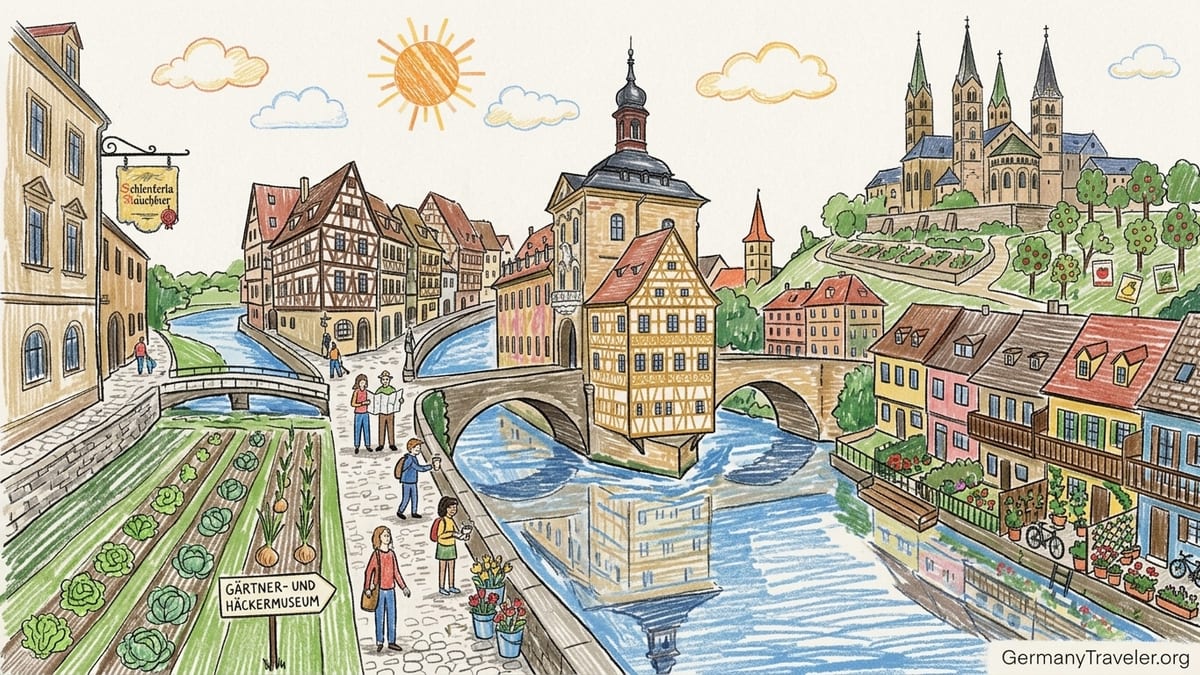
The first major landmark was the Altes Rathaus, Bamberg’s old town hall that sits improbably in the middle of the river, reached by two bridges. The often-repeated story is that the bishop refused to give the citizens land, so they built their administration building on an artificial island anchored between the banks. Whether or not every detail of that legend is accurate, the effect is undeniable: half-timbering, painted baroque facades and arches that make you feel you have walked straight into a history book.
At around 10:30 the bridges were already busy but not yet overwhelmed. I spent a good half hour here, circling the building and pausing at viewpoints over the weir. The sound of the water rushing under the arches mixes with snatches of conversation in German, English and Italian. Looking back toward the Oberbrücke, I saw my first brewery sign of the day hanging from a nearby house. In Bamberg it often feels as if every second doorway has some connection with beer, either in the present or somewhere in the town’s long brewing history.
I followed the riverfront north, staying on the right bank. This short section, only a few hundred meters, offers classic postcard views. Stone houses step down toward the water, washing lines hang from balconies, and the smell alternates between damp river air and, on this day, a drifting toastiness from a nearby brewery’s mash tun. The Regnitz has long shaped Bamberg’s economy, from transporting goods to powering mills, and today it still frames the experience of the old center.
Klein Venedig and the Climb to the Cathedral
Klein Venedig, or Little Venice, appears without much announcement. Suddenly, a row of former fishermen’s houses with low roofs and wooden balconies cascades along the riverbank. Many visitors stop at the first viewing platform and take a quick photo before turning back, but it is worth walking the full stretch. The front gardens are tiny and practical, often packed with geraniums, beans climbing improvised poles and a bicycle wedged between flowerpots. Even in this most photographed strip, gardening and utility feel more important than manicured displays.
From Klein Venedig I turned inland toward the Domberg, the hill crowned by Bamberg Cathedral. The climb is short but fairly steep, perhaps ten to fifteen minutes of steady uphill walking along cobblestones. As I rose, the sounds of the river and traffic faded, replaced by the echo of footsteps and, during my visit, the muted chime of the cathedral bells striking eleven. The streets narrow, the houses lean closer, and the skyline opens to reveal towers and spires that have dominated Bamberg for centuries.
Bamberg Cathedral itself, with its four towers and mix of Romanesque and Gothic elements, is one of the city’s defining silhouettes. The square around it feels monumental but not forbidding. I stepped inside the cool interior for a quiet circuit, then came back out into the light to appreciate how the Domplatz connects to the older residential fabric. From certain angles, you can see the edge of terraced gardens and fruit trees behind the stone walls, reminders that for much of its history, the hilltop was not only spiritual and political center but also a place where food was grown in monastic plots.
Alte Hofhaltung, New Residence and the Rose Garden
Just beside the cathedral lies the Alte Hofhaltung, the former bishop’s residence. Entering through its gate feels like stepping behind the scenes of the city. Half-timbered galleries frame a cobbled courtyard, and a couple of museum doors stand open. I arrived close to lunchtime and was struck by how quiet it was compared to the bustle at the Altes Rathaus. A few small groups lingered with guidebooks, but several corners of the courtyard were empty except for bicycles propped against the walls. This relative calm, only a few minutes from the main tourist artery, made the space feel almost like a local shortcut rather than a major sight.
Across the Domplatz stands the Neue Residenz, or New Residence, a more formal palace whose main attraction for many visitors is its rose garden. The garden is reached via an inner courtyard and a staircase, and once you emerge onto the terrace the city spreads below like a model. During my visit, the beds were still dense with late-season blooms and neatly clipped hedges. A small café kiosk sold coffee and simple cakes, with prices around 3 to 4 euros, and most people seemed to be a mix of Bamberg residents meeting friends and visitors pausing during their hill walk.
The rose garden is manicured in contrast to the productive plots of the Gärtnerstadt, but it still reflects Bamberg’s gardening culture. The composition of beds, the careful labeling of varieties and the way locals talk about “their” roses connect to a wider tradition of cultivating plants within the city’s steep and sometimes awkward topography. From the balustrade, I could look down toward the flatter land where the gardeners’ district stretches out and see the sharp contrast between dense historic core and surprisingly open agricultural strips.
Crossing into the Gärtnerstadt: Bamberg’s Market Gardeners’ District
After taking in the view, I descended toward the east, crossing back through the Inselstadt and out toward the Gärtnerstadt, the Market Gardeners’ District that forms one of the three key components of Bamberg’s UNESCO World Heritage listing. This walk from the Domberg to the heart of the gardeners’ area took a little over 20 minutes on foot, roughly 1.7 kilometers. The atmosphere shifts gradually. Tourist boutiques give way to hardware stores, small supermarkets and quiet residential blocks. Then, quite suddenly, long narrow strips of cultivated land open up between the houses.
Urban market gardening has been practiced here since the Middle Ages, and what makes Bamberg unusual is that commercial plots still lie inside the town rather than at its outskirts. Families work thin fields of lettuce, onions, cabbages and traditional Bamberg specialties such as licorice-rooted herbs and certain heirloom vegetables. Several sources describe how these plots, along with the gardeners’ distinctive houses and storage buildings, were a crucial reason for Bamberg’s inscription as a World Heritage site and are also recognized on Germany’s national list of intangible cultural heritage. The result on the ground feels like a living patchwork where city blocks and vegetable rows alternate in a way that would surprise anyone expecting a purely historic stone center.
One stop that helps interpret this world is the Gärtner- und Häckermuseum, the Gardeners’ and Vintners’ Museum, located in a former gardener’s property at the core of the district. Here, rooms display old tools, seed-saving equipment and reconstructed living quarters that show how tightly work and home life were intertwined. The museum and related urban gardening projects have received funding over the past decade to support educational programs and direct marketing for local produce, including initiatives under the label that translates roughly as “Good Food from the Gardeners’ District.” This modern marketing effort sits on top of centuries of know-how in soil preparation, crop rotation and water management that allowed families to earn a living from relatively small plots.
Walking along these garden lanes, I noticed hand-painted signs advertising seedlings and fresh vegetables in season. Prices were competitive with supermarket offerings, with a basket of mixed salad greens around 3 euros and bunches of herbs for 1 to 2 euros. Several plots had small self-service huts where customers could drop coins in a tin, a level of trust that says a lot about the relationship between gardeners and neighbors. Although the city has grown around them, these parcels continue to act as local cooling zones and green corridors, and they keep agricultural skills circulating between generations.
Lunch Between Greenhouses and Historic Streets
Rather than eating in the busiest part of the old town, I chose a small family-run eatery on the edge of the Gärtnerstadt where the daily menu highlighted local vegetables. The dish of the day was a simple vegetable stew with carrots, leeks and beans, served with a side of bread and a small mixed salad. At 11.50 euros including tap water, it felt fairly priced, and the server explained that several ingredients came directly from nearby gardeners with whom the restaurant has long-standing relationships.
This kind of link between urban farming and urban dining is central to Bamberg’s identity. The city describes itself not only as a bishop’s and brewer’s town but also as a gardeners’ town, and many residents speak with pride about the continuity of cultivation despite real estate pressure. In the restaurant, two older guests at the next table discussed the season’s weather in terms of what it meant for onions and celery, not just for weekend plans. Their conversation underlined what the UNESCO documentation emphasizes: that the value here is not only in preserved buildings but in the ongoing practice of commercial gardening woven into the urban fabric.
After lunch I walked another loop through the fields, this time noticing small innovations that show how traditional know-how adapts to current challenges. Several plots included low tunnels of plastic sheeting for season extension, and I saw one demonstration bed laid out beside an information board about soil health and water-saving techniques. Some of this work stems from a multi-year urban gardening project that invested both in landscape improvements and in teaching residents about the gardeners’ heritage. The overall impression is neither museum-like nor purely commercial but a hybrid landscape where work, education and heritage preservation meet.
Rauchbier at Schlenkerla and Comparing Local Brews
No day in Bamberg that tries to understand tradition can skip its most famous beer, Rauchbier. In the afternoon I headed back toward the cathedral district to visit Schlenkerla, the historic tavern at the foot of the Domberg widely associated with smoked beer. The walk from the Gärtnerstadt back to Schlenkerla took around 25 minutes at an unhurried pace, so by the time I reached the timber-framed house with its distinctive sign, I was ready for a sit-down.
Inside, the vaulted rooms were busy but not chaotic. It was about 3:30 in the afternoon on a weekday, and I found a spot at a shared wooden table within a few minutes, without any queue at the door. I ordered a half-liter of Aecht Schlenkerla Rauchbier Märzen, the flagship smoked lager. The price on the menu for a 0.5 liter glass was a little under 4 euros, comparable to other Franconian beers despite the global fame of the brand. The server set down a dimpled glass that smelled powerfully of smoked beechwood, almost like a ham smoking shed compressed into foam.
The first sip can be a shock if you have never tasted Rauchbier. The smoke dominates at first, with aromas of bacon, campfire and dried plums, but beneath that I found a clean malty sweetness and a surprisingly crisp finish. The texture was medium-bodied, and as the beer warmed slightly the balance shifted from pure smoke to something more integrated, where the underlying lager character appeared. It is not a beer that tries to be subtle, yet it pairs perfectly with the hearty local dishes on Schlenkerla’s menu such as smoked sausage and Bamberg onion stuffed with minced meat in Rauchbier sauce.
To understand the contrast, I later ordered a non-smoked local beer at another brewery guesthouse closer to the station, roughly a 15-minute walk from the old town core. There I tried a classic unfiltered Kellerbier, again around 4 euros for 0.5 liters. Compared to the Rauchbier, this beer presented soft notes of fresh bread, light herbal hops and a gentle bitterness. The difference highlighted how unique Bamberg’s smoked brewing tradition is even within its own region. One beer evoked a smokehouse and medieval malting floors, the other a cool cellar with wooden barrels and freshly baked loaves.
Practicalities: Brewery Access, Beer Tasting Package and Costs
During my day, I found Bamberg’s breweries and guesthouses accessible without much pre-planning. Many open around late morning or midday and continue serving through the evening, though some smaller places close one or two days a week or take winter breaks. It is worth checking opening hours in advance if you have a specific brewery in mind, but within the city center there are enough options that you are unlikely to go thirsty. I did not encounter long queues, though by early evening popular spots such as Schlenkerla and certain riverside beer gardens became noticeably busier, and solo travelers may find it easier to squeeze into a shared table than groups of four or more.
The city promotes an official beer-tasting package priced at 29.50 euros. This package typically includes several tastings at participating breweries, a beer stein or other souvenir and sometimes a small snack or entry to a beer-related museum, depending on the current offer. I chose not to purchase it, preferring to decide spontaneously where to drink. By paying individually, I spent roughly the same total by the end of the day: about 12 euros on three half-liters spread across different places, plus 20 to 25 euros on food, including lunch in the Gärtnerstadt and a light evening plate of Franconian sausages and potato salad back near the center.
In retrospect, the package would have offered a more structured route and perhaps saved me a few euros if I had focused my whole afternoon on brewery interiors. However, it might have constrained the free time I spent in the Gärtnerstadt and along the river because participating venues are spread out and tied to specific vouchers. Travelers who enjoy collecting stamps and following a set tasting trail may find it ideal. Those, like me, who want to weave beer experiences into a day that also includes lingering in gardens, churches and random courtyards might prefer to keep the schedule open and pay per glass.
Overall, the costs for a full day felt manageable. Counting three beers, two café stops and two simple meals, my out-of-pocket expenses for food and drink stayed under 45 euros. Museum fees in Bamberg tend to be modest, often well under 10 euros per site, and the main pleasures of the city walking its streets, admiring architecture and watching gardeners at work are free apart from the energy you invest in your feet.
Evening Light, Local Atmosphere and the Question of an Overnight Stay
As the day shifted into evening, I walked once more along the river near Klein Venedig. The light softened, catching the half-timbered facades and the roofs of small boats. Bars and restaurants slowly filled, but there was still a calm feeling. Bamberg, even in high season, rarely has the stressed atmosphere of a city overwhelmed by tourism. Part of that may be due to its diversified identity. It is a university town, an administrative center, a gardening hub and a brewing powerhouse all at once, which means visitors are part of the mix rather than the entire story.
On my way back toward the station, I deliberately skirted the main pedestrian axis to wander once more through the edges of the Gärtnerstadt. A few gardeners were still finishing up tasks in the lingering light, watering rows or stacking crates. The sight of active work among historic buildings at that hour tied together the themes of the day: Bamberg is not an outdoor museum frozen at a single moment. Medieval alleys, baroque palaces, active greenhouses and breweries that still malt and smoke their own grain all coexist within a walkable radius of a few kilometers.
This coexistence is what justifies its World Heritage status. The cathedral and the Altes Rathaus are visually striking, but without the commercial gardening belt and the continuing brewing traditions, Bamberg would risk becoming simply another beautiful shell. Instead, the city demonstrates how living trades can persist inside a preserved fabric. In practical terms, that makes visiting more interesting because you are never far from a place where someone is tending a crop, monitoring a mash tun or setting out seedlings as part of everyday life, not as a staged performance.
By the time I reached the station again, having walked roughly 10 to 12 kilometers over the course of the day including several loops, I felt that Bamberg deserved more than a rushed excursion from Nuremberg. Many travelers do visit as a half-day side trip, and in pure distance terms it is feasible. But compressing the city into a few hours means treating its highlights as a checklist: a quick bridge photo, a dash into the cathedral, a fast Rauchbier and then back on the train. Staying overnight, or at least giving yourself one long unhurried day from early morning to late evening as I did, allows you to see how the rhythm of gardening, brewing and ordinary errands changes with the light.
The Takeaway
Spending a full day walking Bamberg showed me a city where beer, medieval stone and vegetable plots are not separate attractions but interdependent threads. The Altes Rathaus and the rose garden satisfied the part of me that craves iconic views and careful landscaping. The Gärtnerstadt revealed how much work lies behind Bamberg’s reputation as a gardeners’ town, from producers selling salad greens on quiet streets to the museum that preserves tools and stories. Rauchbier at Schlenkerla and a contrasting glass of unsmoked Kellerbier brought the brewing heritage into sensory focus, smoke and malt layered over the memory of garden earth and river spray.
If you are deciding whether to treat Bamberg as a quick detour or as a place worth lingering, my experience argues for at least one long day and, ideally, a night. The city’s real charm emerges when you have time to let its different districts breathe. That means sitting in the rose garden and then, an hour later, standing beside a row of cabbages within sight of church towers. It means tasting smoke in your beer while remembering that just beyond the next hill, gardeners are still harvesting vegetables that may appear on your plate. Bamberg rewards travelers who are curious about how cities grow food and culture at the same time.
FAQ
Q1. Is Bamberg realistic as a day trip from Nuremberg, or should I stay overnight?
It is realistic as a day trip given the short rail distance, but staying overnight or committing to a very full day from morning to evening lets you experience both the major sights and the quieter Gärtnerstadt without rushing.
Q2. How much walking should I expect during a full day in Bamberg?
A relaxed but thorough day that includes the station, old town, cathedral hill, Gärtnerstadt and brewery visits can involve 10 to 12 kilometers of walking on mostly paved and sometimes cobbled surfaces.
Q3. Are the popular breweries in Bamberg difficult to access without reservations?
Many brewery guesthouses in the center are walk-in friendly during the day, though evenings can be busy; small groups or solo travelers usually find space at shared tables without advance booking.
Q4. How expensive is food and drink in Bamberg compared with other German cities?
Prices are broadly comparable to other mid-sized German towns, with a half-liter of beer often under 4 euros and simple meals in the 10 to 15 euro range, depending on the venue.
Q5. What makes the Gärtnerstadt special enough to be part of Bamberg’s UNESCO status?
The Gärtnerstadt contains active inner-city market gardens and characteristic gardeners’ houses, preserving a rare example of commercial food production integrated directly into a historic urban core.
Q6. Can visitors actually see gardeners at work in the Gärtnerstadt?
Yes, during the growing season it is common to see gardeners tending fields, and some offer direct sales of vegetables or seedlings from small stands along the lanes.
Q7. Do I need the official 29.50 euro beer-tasting package to enjoy Bamberg’s beer scene?
No, it is optional; you can sample local beers by paying per glass, which gives more flexibility, though the package can be useful if you want a structured tasting route and included extras.
Q8. What does Bamberg’s Rauchbier actually taste like?
Rauchbier has a pronounced smoked aroma reminiscent of bacon or campfire layered over malty sweetness, with a clean lager backbone that becomes more apparent as you keep drinking.
Q9. Is the rose garden at the New Residence worth visiting if I am more interested in the Gärtnerstadt?
Yes, the rose garden offers panoramic views over the city, and seeing its formal beds alongside the productive plots of the Gärtnerstadt gives a fuller picture of Bamberg’s gardening culture.
Q10. Are there language barriers for non-German speakers in Bamberg’s gardens and breweries?
Basic English is widely spoken in central museums, restaurants and larger breweries, though learning a few German phrases is appreciated and can be helpful when visiting smaller, more local places.