


By the time I finally stepped out of Teufelshöhle and back into daylight above Pottenstein, I was not marveling at stalactites. I was rubbing my knees, checking on shivering children in our group and wondering whether one of Franconian Switzerland’s most famous attractions really deserved its family-friendly reputation or the time and money I had just invested.
Arriving in Pottenstein: From Scenic Drive to Crowded Car Park
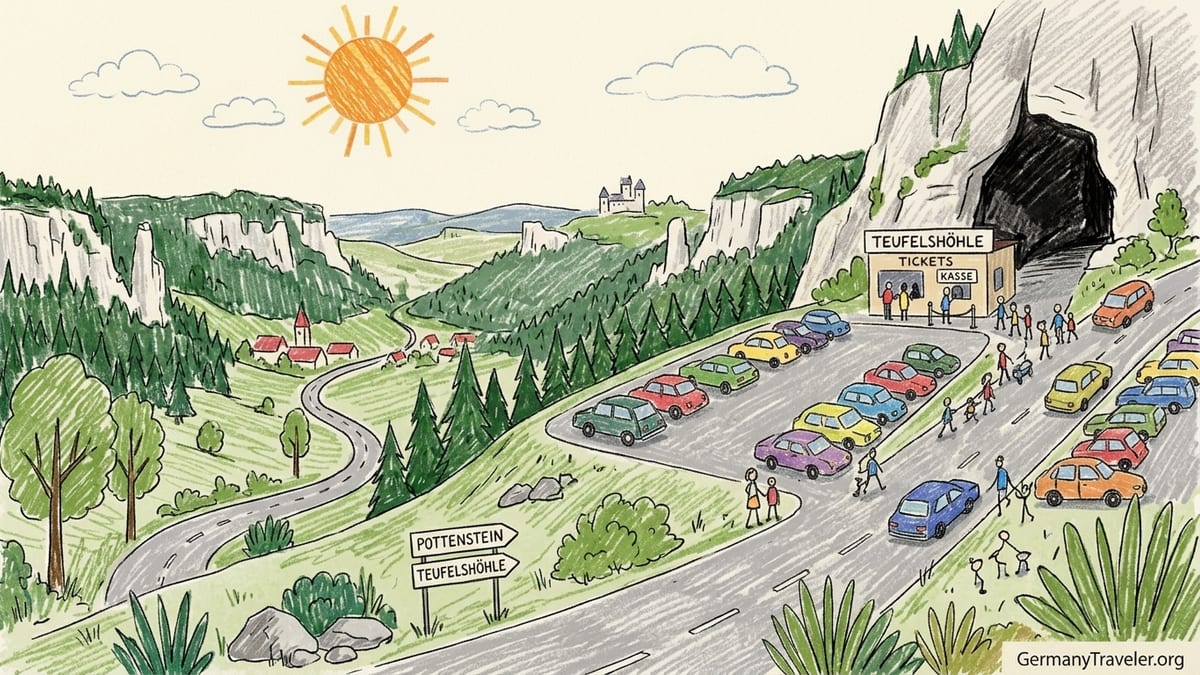
The approach to Pottenstein is undeniably beautiful. The road threads through the green valleys and limestone cliffs that have made Franconian Switzerland famous, with views that feel like a postcard come to life. That scenic build-up sets a high bar for what follows at Teufelshöhle, which is billed locally as a must-see. The reality begins in far less romantic fashion in the asphalt car park on the hillside above town.
Parking for Teufelshöhle is concentrated along the access road and at designated bays near the entrance buildings. On busy days, especially weekends and school holidays, spaces fill quickly and drivers circle for a spot while passengers spill out onto the roadside. What looked like a simple family outing turned into a minor logistics exercise before I had even seen the cave mouth. If you are traveling with small children, elderly relatives or anyone who does not move quickly, simply getting from the car to the ticket area involves negotiating parked vehicles, other groups and a noticeable slope.
The short walk towards the cave entrance passes snack stands and kiosks that clearly target day-trippers. The atmosphere is closer to a basic roadside attraction than a carefully managed nature experience. That might be fine if the infrastructure inside the cave were impeccably thought out, but my disappointment began before I even reached the first stalactite, at the point where fun marketing met the practicalities of tickets and queues.
In 2026, tickets for Teufelshöhle are purchased on site at the cash desk near the entrance. There is no widely used online booking or timed-entry system, and that alone shapes the experience. Families and bus groups converge on the same small ticket area, and you line up hoping the next guided tour will have room. On my visit, the queue had that resigned theme-park feel: people clutching jackets and backpacks, parents trying to keep children entertained and everyone looking up anxiously at the clock to see whether they would make the next departure underground.
Ticket Prices, Renovation Schedule and What You Actually Get
For 2026, the advertised ticket price for Teufelshöhle is 9 euros for adults and 5 euros for children aged roughly 4 to 15. That puts it in the same price bracket as other major caves in the region, such as Sophienhöhle near Burg Rabenstein, where adult tickets are around 8 euros and children’s tickets about 4.5 euros. The difference at Teufelshöhle is what you get for the money in terms of comfort, organization and the sense that the cave is managed around visitors rather than the other way around.
Teufelshöhle is visited exclusively by guided tour. The standard route keeps you underground for about 45 minutes. That time is often highlighted in promotional material as a positive, suggesting a substantial, immersive experience. In practice, those 45 minutes are rigidly paced, and you do not have much autonomy over how long you linger at formations that catch your eye. When you calculate the cost of a family of four, you are paying well over 25 euros for a tightly controlled walk that can feel rushed and crowded, especially if your tour is full.
Complicating matters in 2026 is a significant renovation and rebuilding project around the cave entrance and infrastructure. According to the official schedule, from 21 September 2026 Teufelshöhle operates only on Saturdays and Sundays between 9:00 and 16:00, with the last entry at 16:00. In November the cave switches to a limited winter mode, with a couple of open days at the start of the month and then Sunday-only guided tours at set times. Ordinary tickets remain available only on site and you still have to join a guided tour, which means fewer windows to visit and more pressure on each tour slot.
What this means in reality is simple but important. If you arrive on a Friday afternoon in October hoping to add Teufelshöhle to your Pottenstein day, you will find the cave closed. If you aim for a Saturday in that same period, you compress all demand into a much smaller opening window, and that translates into longer lines for tickets, more crowded tours and less flexibility for families who need to work around naps, meals and energy levels. For a site that presents itself as an easy, family-friendly must-do, the 2026 setup feels more like a fixed industrial timetable.
Forty-Five Minutes Underground: Temperature, Steps and Tight Spaces
The hard physical facts of Teufelshöhle are unambiguous: roughly 45 minutes underground, around 400 steps up and down and a constant interior temperature of about 9 degrees Celsius all year. These are not hidden details. They are mentioned in brochures and guide commentary, but in my experience many visitors in the queue had not fully absorbed what that combination actually feels like.
Stepping into the cave, the temperature drop is immediate. On a mild autumn afternoon above ground, the damp chill inside lands like walking into a lightly refrigerated warehouse. That is comfortable enough if you are wearing a fleece or a down jacket. Several people in my group, however, were in T-shirts and light tops, clearly having treated Teufelshöhle as a quick sightseeing stop rather than a prolonged stay in 9-degree air. Within minutes, you could see people rubbing their arms, zipping up hoodies and trying to huddle closer together at stops.
Then there are the steps. The advertised figure of around 400 is not an exaggeration. The route involves repeated descents and ascents on metal or concrete stairs, sometimes in long flights, sometimes in shorter, irregular sections. There are handrails, but the surfaces can feel damp and slightly slippery from constant condensation. I watched older visitors test each step carefully, and one parent spent much of the tour holding both the handrail and their child’s wrist to prevent missteps. Anyone with knee issues, poor balance or minor mobility limitations will find this a serious workout, not a gentle stroll.
Claustrophobia is a more subjective factor, but it should not be dismissed. While Teufelshöhle has a few larger chambers, significant parts of the route thread through narrower passageways where the ceiling drops and the walls close in. You are in a guided group, which means you move at the same pace as everyone else. If you begin to feel uncomfortable underground, there is no simple way to turn around or step off the route. That lack of control can quickly transform mild unease into genuine distress. For sensitive children or adults uneasy in enclosed spaces, 45 minutes can feel considerably longer.
Small Children, Mobility Limits and the Myth of “Easy” Family Adventure
Teufelshöhle is heavily promoted as a family destination. On paper, a 45-minute guided walk with colorful lighting and a “devil’s cave” name sounds like the perfect combination of mild adventure and education. What I observed inside, though, suggested that the practical realities are far less child-friendly than the brochures imply.
First, there are no strollers allowed and realistically no way they could be used on the stairs. Very young children must be carried, either in arms or in some form of carrier that you are confident managing on slippery steps. If you are used to ergonomic hiking carriers, you still need to account for the low ceilings in places and the need to duck. During my tour a parent with a toddler in a backpack carrier repeatedly had to bend forward to avoid brushing the roof, which quickly became awkward on steep stair sections.
Children aged around four to eight, who fall neatly into the cave’s child ticket category, are physically capable of the route but may struggle with the pace and the cold. I watched one child begin enthusiastically, then gradually slow down and finally burst into tears about halfway through, chilled and overwhelmed. The group could not stop for long without backing up the entire tour, so the family had to juggle comforting their child with keeping up and not obstructing others. That is a stressful dynamic to impose on parents who have already paid 5 euros per child for the privilege.
For visitors with mobility limitations, the situation is more serious. The combination of 400 steps, damp surfaces and occasional low clearances makes Teufelshöhle unsuitable for wheelchairs and genuinely taxing for anyone who relies on a cane or simply does not feel steady on stairs. There is no alternative short route and no viewing platform near the entrance. You either commit to the full loop or you miss the cave entirely. As someone who values inclusive design in tourism, I found it frustrating that a flagship attraction in such a popular region offers so little in terms of accessibility concessions while still marketing itself broadly to families and tour groups.
What You Actually See Underground: Nature Versus Infrastructure
Once you accept the physical strain, Teufelshöhle does deliver some undeniably attractive cave scenery. The route passes through chambers lined with stalactites and stalagmites, sinter formations and flowstone curtains. In a few places, the ceiling opens up into high, cathedral-like voids where the beam of the guide’s flashlight disappears into the darkness above. There are hints of an underground river system and dramatic rock breakdowns that hint at the cave’s geologic history.
Yet it is precisely in these moments that the intrusive visitor infrastructure is hardest to ignore. The concrete paths, metal stairs and heavy railings dominate your field of vision. Lighting units, sometimes stark white, sometimes colored, draw the eye away from subtle natural textures and toward obvious artificial fixtures. Loudspeakers, emergency boxes and cables punctuate the walls. Rather than feeling like you have stepped into an ancient world, you often feel like you are in a heavily engineered corridor that happens to pass through beautiful rock.
Photography is technically allowed, but the practical opportunities are limited. The group stops for short explanations at specific points, and you have a minute or two to snap pictures from behind or beside other visitors. There is rarely time to compose a thoughtful shot or experiment with different angles. In wider chambers, I repeatedly found my view filled by the backs of jackets and helmets rather than formations. If you have lugged a camera underground expecting to come away with a portfolio of atmospheric cave shots, you are likely to be disappointed.
Language can also become a limiting factor. Tours are primarily conducted in German, which is understandable given the location, and the guide on my visit delivered a rapid-fire stream of facts and anecdotes. For monolingual German speakers this is probably a highlight. For international visitors or those with only basic German, it is an ongoing background noise that does little to deepen understanding. Occasional brief summaries in English, when offered, felt like afterthoughts. Given Teufelshöhle’s status as a regional flagship, a more deliberate bilingual approach would be reasonable to expect, particularly at the current ticket prices.
Group Size, Pace and the Feeling of Being Processed
The tours in Teufelshöhle are scheduled “durchgehend,” meaning they run continuously depending on visitor numbers, rather than at strictly fixed times. That sounds flexible but in practice encourages the formation of sizable groups to make each tour efficient for the operator. On my visit, our group felt large enough that the guide routinely had to wait for the back section to catch up before beginning an explanation, which created start-stop bottlenecks at narrow points.
This dynamic shapes your experience more than any marketing copy admits. Instead of a quiet, contemplative walk through a geological wonder, the cave becomes a moving queue that halts, compresses and then surges forward in unison. Conversations echo, children’s cries bounce off the walls and camera flashes pop despite requests to use them sparingly. Anyone hoping for a serene encounter with underworld silence will not find it on a typical weekend tour.
The pace is efficient rather than relaxed. There is just enough time at each stop for the guide’s commentary and a quick visual sweep before you are ushered along. On a few occasions, I was still absorbing the details of an impressive flowstone sheet when the group had already started up the next staircase. Falling behind is not really an option unless you want to risk missing essential instructions, such as where to watch your head or how to navigate a tighter bend.
That sense of being processed is amplified by the tight tour schedule during the renovation period from late September 2026 onward. With fewer open days each week and limited winter operations, there is little incentive to reduce group size even though the physical environment of the cave would benefit greatly from smaller, more contemplative groups. The result is a tour that often feels designed around throughput rather than individual visitor experience, which sits uneasily with the premium positioning of Teufelshöhle in regional tourism campaigns.
Value for Money Compared with Sophienhöhle and Free Limestone Landscapes
Any evaluation of whether Teufelshöhle is “worth it” in 2026 has to be anchored in alternatives nearby. One obvious comparison is Sophienhöhle at Burg Rabenstein, another major dripstone cave in Franconian Switzerland. There, standard cave tours are priced around 8 euros for adults and 4.5 euros for children aged 4 to 14. Group sizes are capped at about 20 people per tour, which makes a noticeable difference in noise levels, personal space and the time you have to look around.
Sophienhöhle also offers its “Sophie at Night” experience, with a carefully designed light and music installation that lets visitors wander more freely within set rooms, often in smaller numbers and with a more atmospheric feel. While that special event costs a little more than the day tour, it delivers a clear qualitative upgrade rather than simply pushing more people through the same route. By contrast, Teufelshöhle’s pricing, especially the 9 euro adult ticket, does not seem to buy you smaller groups, more thoughtful interpretation or more flexible photography time.
Then there is the simplest and perhaps strongest argument against Teufelshöhle as an essential stop: the extraordinary free landscapes around Tüchersfeld and Gößweinstein. Tüchersfeld, a village in the Püttlach valley, is famous for its dramatic cone-shaped limestone reefs with timber-framed houses seemingly glued to the rocks. You can wander the lanes, admire the towering cliffs and explore viewpoints without paying an entrance fee or queuing for a ticket. The rocks around Gößweinstein, crowned by its hilltop basilica, offer similar rewards for the price of a walk.
When you weigh things up, the contrast is stark. For zero euros, a short hike above Tüchersfeld gives you sweeping views, fresh air and all the space your family needs to move at its own pace. For more than 25 euros for a family of four, Teufelshöhle gives you 45 minutes of controlled, crowded movement in 9-degree air with 400 steps. If you are on a budget or simply value comfort and autonomy, it is difficult to argue that the cave delivers proportionally better value than the landscapes above ground.
Who Should Skip Teufelshöhle, Who Might Still Appreciate It
Based on my experience and the current operating conditions in 2026, there are clear categories of travelers for whom Teufelshöhle is more trouble than it is worth. Families with very young children, especially those still in strollers or wary of dark spaces, will likely find the combination of cold, steps and group pressure stressful. Visitors with mobility limitations or joint issues should also think carefully before committing to 400 damp steps in each direction, with no option to sit out difficult sections or take alternative routes.
Travelers who dislike crowds or tight schedules are another group that may leave dissatisfied. If your idea of a perfect cave visit is wandering slowly, taking long-exposure photographs and absorbing silence, Teufelshöhle’s throughput-driven guided tours will feel restrictive. The limited weekend-only schedule from late September 2026 onward only increases the density of visitors on each tour and the sense of rush.
That said, there are visitors who will still appreciate Teufelshöhle. If you are reasonably fit, dressed warmly and comfortable with stairs, and if you understand in advance that this is a guided, time-bound experience rather than a meditative one, the cave can be an engaging glimpse into the underground geology of Franconian Switzerland. The scale of some chambers is impressive, and children who enjoy a slightly spooky setting may relish the dramatic lighting and “devil’s cave” stories, provided they are old enough to manage the route safely.
Cave enthusiasts who like comparing different systems may also find value in seeing how Teufelshöhle has been developed compared with Sophienhöhle or other show caves in Germany. In that niche context, even the intrusive infrastructure and large groups can be interesting as examples of a certain era of tourist cave design. But that is a narrow audience, far removed from the general family market that Teufelshöhle’s brochures so enthusiastically target.
Building a Better Pottenstein Day Without Depending on the Cave
The good news is that Pottenstein and its surroundings offer more than enough to fill a rewarding day without relying on Teufelshöhle as the anchor attraction. In fact, once you remove the cave from the center of your planning, the area starts to look far more relaxed and flexible, especially for families and mixed-ability groups.
One practical approach is to treat Teufelshöhle, at most, as an optional extra rather than a fixed appointment. Start your day exploring Pottenstein itself, with its small-town charm, riverside paths and accessible viewpoints. Then head to iconic landscapes such as Tüchersfeld, where the half-timbered houses nestle under towering limestone spires, or towards Gößweinstein, where short walks take you to lookout points with broad views over the valleys.
If you are interested in caves but wary of the specific trade-offs at Teufelshöhle, consider structuring your day around Sophienhöhle instead. Its capped group sizes, slightly lower ticket prices and night-time offerings give you more options to tailor the experience to your preferences. You can pair a Sophienhöhle visit with time at Burg Rabenstein itself, adding a castle context and above-ground architecture to your day, rather than committing entirely to one underground attraction.
By prioritizing open-air activities, free landscapes and more deliberately managed attractions, you lessen the impact of any one site turning out to be underwhelming. In my case, the most memorable moments in Franconian Switzerland came not in the crowded darkness of Teufelshöhle, but on a sunlit ridge above Tüchersfeld, watching climbers on distant rock towers and listening to church bells drift up from the valley. That experience cost nothing and asked only for sturdy shoes and a willingness to follow a trail.
The Takeaway
Teufelshöhle Pottenstein has the reputation, the marketing and the visitor numbers of a flagship attraction in Franconian Switzerland. Yet my first-person experience in 2026 left me questioning whether it truly deserves its status as a default family recommendation. The combination of 45 minutes in 9-degree air, roughly 400 steps, crowded guided tours and a renovation-driven, weekend-only schedule from late September onward creates a product that feels physically demanding, inflexible and only moderately rewarding compared with what is available above ground for free.
At 9 euros for adults and 5 euros for children, the ticket price itself is not outrageous in isolation, but value is always relative. When nearby Sophienhöhle offers smaller groups and varied formats at slightly lower prices, and when the spectacular limestone landscapes around Tüchersfeld and Gößweinstein cost nothing at all, Teufelshöhle’s proposition starts to look thinner. It is not that the cave lacks beauty; it is that the overall experience does not match the promise of the brochures or the expectations set by the region’s natural grandeur.
If you are fit, warmly dressed, comfortable underground and fully aware of the constraints, you may still find Teufelshöhle a worthwhile, if imperfect, addition to a Franconian Switzerland itinerary. For many others, particularly families with small children, people with mobility concerns and those craving a more spacious, self-paced connection with nature, the cave is likely to disappoint. In 2026, my honest recommendation is to treat Teufelshöhle as optional and build your Pottenstein day around the valleys, cliffs and villages that make this corner of northern Bavaria special long before you ever reach the ticket booth of a show cave.
FAQ
Q1. Is Teufelshöhle suitable for very young children?
Teufelshöhle involves around 400 steps, cool 9 degree temperatures and no stroller access, so it is challenging for toddlers and many children under about five.
Q2. Can visitors with limited mobility manage the Teufelshöhle tour?
Because of the numerous damp steps, uneven surfaces and lack of alternative routes, Teufelshöhle is generally unsuitable for visitors with significant mobility limitations.
Q3. How long does the Teufelshöhle tour take and how cold is it inside?
The standard guided tour lasts about 45 minutes, during which you are continuously in air of roughly 9 degrees Celsius, regardless of the season outside.
Q4. Do I need to book tickets for Teufelshöhle in advance?
For 2026, ordinary tickets are sold on site at the entrance, with tours organized according to demand, so you cannot rely on online pre-booking for standard visits.
Q5. What are the 2026 opening times during the renovation period?
From 21 September to 31 October 2026 Teufelshöhle is open only on Saturdays and Sundays from 9:00 to 16:00, followed by limited winter Sunday operation.
Q6. How do Teufelshöhle ticket prices compare with Sophienhöhle?
In 2026 Teufelshöhle charges about 9 euros for adults and 5 euros for children 4 to 15, while Sophienhöhle is slightly cheaper at roughly 8 and 4.5 euros.
Q7. Is photography allowed inside Teufelshöhle?
Photography is generally permitted, but the fast group pace, crowded viewpoints and limited stopping time mean it is difficult to take thoughtful, well-composed shots.
Q8. Are there better alternatives nearby for families?
Yes, landscapes around Tüchersfeld and Gößweinstein, as well as Sophienhöhle at Burg Rabenstein, offer more flexible, often better value experiences for many families.
Q9. What should I wear for a visit to Teufelshöhle?
Sturdy, non-slip shoes and warm layers such as a fleece or light jacket are essential, as the cave is damp, has many steps and remains around 9 degrees year-round.
Q10. Is Teufelshöhle worth it if I am short on time in Franconian Switzerland?
If time is limited, prioritizing outdoor highlights like the rock formations of Tüchersfeld or a visit to Sophienhöhle may provide more memorable and comfortable experiences.