


Franconia is one of Germany’s richest regions for half-timbered towns, Baroque palaces and vineyard-draped river bends, yet it is often reduced to a short Romantic Road detour. In reality it deserves its own focused road trip, with time to explore wine villages, quiet valleys and cities shaped by both medieval prosperity and twentieth-century trauma. This seven-day self-drive itinerary runs in a logical west-to-east and southbound arc, using three or four hotel bases and realistic daily schedules that you can genuinely follow on the ground.
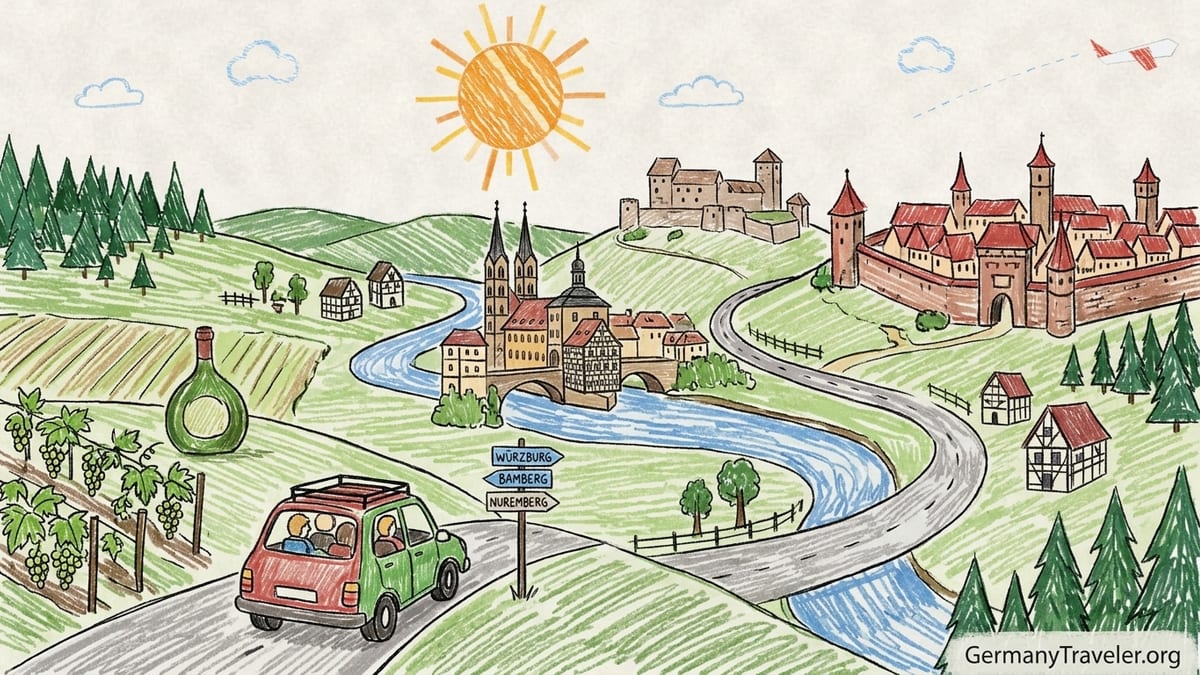
How to Use This Franconia Road Trip Itinerary
This itinerary is built around a clear geographic flow: starting in Würzburg on the Main River, looping north and east through the Mainschleife and Bamberg, cutting across to Bayreuth and Franconian Switzerland, then finishing south in Nuremberg and Rothenburg ob der Tauber. It avoids backtracking and minimizes one-night hotel stays, which are tiring and time-consuming if you pack and unpack every morning.
Driving times and distances are based on current estimates from major route planners checked in late 2026. For example, Würzburg to Volkach is about 30 to 40 minutes for roughly 30 kilometers, while Bamberg to Bayreuth is around 50 minutes for about 60 kilometers in normal traffic. These times do not include city-center congestion or time spent finding parking, so you should add a small buffer when planning each day.
Most visitors will pick up a rental car in Frankfurt or Nuremberg. A compact automatic from a major agency typically starts from around 45 to 70 euros per day with basic insurance if booked in advance for a week, plus fuel and occasional parking fees. A regional rail pass can work very well between major cities such as Würzburg, Bamberg and Nuremberg, but it does not reliably reach smaller countryside stops like Sommerach, Tüchersfeld or Eremitage without slow buses and long connections. That is why this itinerary assumes you are driving.
The daily outlines below balance two key priorities: enough time to see core sights such as the Würzburg Residence or Nuremberg Imperial Castle, and hours left over to stroll, linger in a beer garden or sit in a vineyard restaurant. Museum closure days are noted where relevant, especially common Monday closures. You should still confirm opening times right before travel, as schedules and renovation periods can change.
Day 1: Würzburg – Baroque Splendour and Wine on the Main
Würzburg is an excellent starting base because it sits on the rail line from Frankfurt and offers easy access to rental cars. Once you arrive, plan to park the car either at your hotel or in a central garage and explore mostly on foot. The city center is compact, and walking between the Würzburg Residence, the old bridge and the market streets usually takes less than 20 minutes.
The highlight is the UNESCO-listed Würzburg Residence, one of the most important Baroque palaces in Europe. The palace complex includes sumptuously decorated state rooms and a garden that makes a pleasant late-afternoon stroll. The main palace is usually open daily, although some sections can close temporarily for restoration, so it is wise to check for any ongoing renovation work if certain frescoed halls are a priority for you. Visiting the interior and gardens at a comfortable pace usually takes two to three hours, including time for the ticket line and security checks.
From the Residence, walk toward the Alte Mainbrücke, the stone bridge lined with statues that spans the Main River. In recent years, it has become a social hub where locals pick up a glass of Franconian wine from nearby bars and enjoy it while looking at the Marienberg Fortress on the hill. If you want a classic experience, aim for late afternoon or early evening when the light softens on the vineyards. Parking garages near the old town, such as those around the market square and the Residence, give straightforward pedestrian access to this area, though hourly fees usually apply during the day.
Würzburg also introduces you to Franconian wine culture. The region is known for its Silvaner, Riesling and Müller-Thurgau, often bottled in the distinctive rounded Bocksbeutel. Many wineries have tasting rooms within the city or shortly outside it in surrounding villages. If you are driving, focus on tastings where you can share small pours and buy bottles to enjoy later in the evening. Staying overnight in Würzburg avoids any need to drive after sampling wine and lets you ease into the trip without an evening transfer.
Day 2: Volkach and the Mainschleife – Vineyards and River Bends
On Day 2, leave Würzburg and follow the Main River north to the Mainschleife, a large loop of the river that curls around vineyard-covered hillsides. The drive from Würzburg to Volkach is about 30 kilometers and roughly 35 minutes depending on traffic. Many travelers choose to keep Würzburg as their base for a second night and treat the Mainschleife as a day trip, which allows them to return to a familiar hotel and reduces packing time.
Volkach is the main small town hub of the Mainschleife area, with wine shops, bakeries, and cafés clustered around a compact old center. From here, short drives bring you to wine villages such as Sommerach, which sits directly between vineyards and the river. Reaching Sommerach from Volkach usually takes less than 10 minutes by car. In Sommerach, look for family-run wineries where you can taste local Silvaner or try a glass of wine with a light snack in a courtyard setting. Opening days and hours can vary seasonally, and some estates may close on Sundays or Mondays, so checking ahead is practical if there is a particular producer you hope to visit.
The Mainschleife area invites a slower pace. You might spend the late morning wandering Volkach, then drive to Sommerach in early afternoon and take a short walk through the vineyards. River cruises also operate seasonally from Volkach, offering a different perspective on the river loop. If you prefer to keep the car parked, look for local bike rental shops that provide e-bikes, which make gentle rides along the river levees and minor roads more manageable even for casual cyclists.
Parking is generally straightforward in these towns, with signposted lots on the edge of the historic centers. Fees are often modest and sometimes limited to daytime hours. Because streets within the villages can be narrow, it is often easier to leave the car in a marked lot and continue on foot. In the late afternoon, you can either return to your Würzburg base or, if you prefer to cut the next day’s drive slightly, continue on to Bamberg in the evening and spend the night there instead.
Day 3: Bamberg – UNESCO Old Town and Brewery Culture
From Würzburg, the drive to Bamberg is about 110 to 120 kilometers and typically takes around 1 hour 30 minutes on the motorway in normal conditions. If you spent the previous night already closer to the Mainschleife, your driving time may be slightly shorter. Bamberg’s UNESCO-listed old town is spread over several hills and river islands, so once again you will want to park the car and walk or use local buses within the center.
Bamberg’s hallmark sight is the cathedral hill, with Bamberg Cathedral and the old court buildings, and the picturesque Altes Rathaus, which seems to float on its bridge above the Regnitz. Exploring these core sights and simply walking the lanes between them comfortably takes three to four hours. If you time your visit, remember that some churches and small museums may restrict visiting hours on Sundays or have limited opening on Mondays, especially outside of peak summer.
The city is also famous for its beer culture, especially the distinctive smoked beer known as Rauchbier. Traditional breweries and taverns in the old town and surrounding neighborhoods serve this alongside more familiar lager styles. A typical half-liter in a local brewpub might cost somewhere between 3 and 5 euros, depending on the establishment. If you plan brewery visits, consider leaving the car parked at your hotel and exploring entirely on foot. Many visitors choose to stay at least one night in Bamberg to enjoy the atmosphere after day trippers leave and to sample beer without worrying about driving.
Parking garages are located on the fringe of the historical core, such as near the concert hall and at various multi-story car parks. Expect to pay hourly rates during business hours. Signage in Germany uses a white “P” on a blue background to mark official parking, and electronic signs may indicate the number of free spaces. Once parked, you can reach the old town sights within a 10 to 20 minute walk, and city buses provide additional links if your hotel is in a modern district.
Day 4: Bayreuth and the Eremitage – Music Heritage and Garden Escapes
On Day 4 you move east to Bayreuth, long associated with Richard Wagner and the Margravial court. The drive from Bamberg to Bayreuth is about 60 kilometers and usually takes around 50 minutes along modern roads. Bayreuth is small enough that you can either stay one night or treat it as a long day trip from Bamberg if you prefer to minimize hotel changes, although staying over can give you a quieter evening once day visitors have departed.
The Margravial Opera House in Bayreuth is a UNESCO World Heritage site and one of Europe’s most impressive preserved Baroque theaters. In recent years it has undergone major restoration, with guided visits offering a look at its ornate, wood-carved auditorium. Visitor access often works with timed entry, and opening days can be reduced in winter or on performance days, so you should check schedules and reserve in advance where possible. A standard visit might take one to two hours including waiting time and the tour itself.
In the afternoon, head to the Eremitage, a historic garden and palace complex a short drive northeast of the city center. The drive from central Bayreuth to the Eremitage is typically about 15 minutes. There you can wander through formal gardens, water features and pavilions. Portions of the complex may be free to enter, while specific palaces or interior rooms may require an admission ticket. The parkland is extensive enough that you could spend two or three hours strolling, with opportunities to find quieter corners away from the main paths.
Parking in Bayreuth follows a similar pattern to other Franconian towns, with garages and surface lots on the edge of the historic area. Closer to the Opera House, spaces can fill when events occur, so allow extra time if you have a timed ticket. At the Eremitage, lots are usually clearly marked near the main entrances. Because the site is spread out, wearing comfortable walking shoes and bringing water is advisable, particularly in warmer months.
Day 5: Franconian Switzerland – Pottenstein, Gößweinstein and Tüchersfeld
Day 5 is dedicated to the rural landscapes and limestone hills of Franconian Switzerland, a region of steep valleys, rock formations and traditional villages. From Bayreuth, it is about 35 to 45 minutes’ drive to Pottenstein, depending on your exact route, with distances of roughly 35 kilometers. From Bamberg, it is slightly longer but still a practical day trip by car. Public transport into this countryside is limited, often involving regional buses that run infrequently, which is one of the strongest arguments for having a rental car on this particular day.
Pottenstein is known for its dramatic setting in a narrow valley, overlooked by a castle on a rocky spur. There are several attractions around the town, including caves and small leisure facilities, but even a simple walk through the valley and up to viewpoints can be rewarding. From Pottenstein, the winding road to Gößweinstein passes through forested hills and takes roughly 10 to 15 minutes. Gößweinstein’s basilica and castle sit above the village, and the surrounding area offers short hiking paths with views across the plateau.
Continue to Tüchersfeld, another 10 to 15 minute drive from Gößweinstein, which is instantly recognizable for its cluster of half-timbered houses perched below towering rock pinnacles. It is one of the most photographed scenes in Franconian Switzerland. The Franconian Switzerland Museum is housed in a historic building here and illustrates local culture and geology. Opening days are often reduced outside of high season and the museum is commonly closed at least one weekday, often Monday, so checking exact hours for your dates is essential if a visit is a priority.
Roads in Franconian Switzerland are generally narrow and winding but paved and well signposted. Average speeds are lower than on motorways, so allow time for short distances. Parking is handled through small lots on the edge of each village, usually with ticket machines for daytime use. In peak summer and on sunny weekends, these lots can fill by late morning, so an early start from Bayreuth or Bamberg helps. This is also a good day to carry a picnic or simple snacks, as restaurant choice in smaller villages can be limited to a handful of guesthouses and may close mid-afternoon between lunch and dinner service.
Day 6: Nuremberg – Imperial Castle and Difficult History
From Bayreuth, the drive to Nuremberg is about 85 kilometers and usually around 1 hour by motorway. From Bamberg, it is slightly shorter, with typical driving times of roughly 45 to 60 minutes. Nuremberg is the largest city on this itinerary and makes an excellent base for at least two nights if you want access to both historical sites and modern services like a wider range of restaurants and shops.
The medieval core centers on the Nuremberg Imperial Castle, which dominates the northern end of the old town walls. Visiting the castle interiors and climbing to the viewpoints can take two to three hours, especially if you include the museum sections. The old town streets between the castle and the Pegnitz River are lined with half-timbered buildings, market squares and churches, which reward unstructured wandering. Because the historic zone is mostly pedestrianized or limited to local traffic, you should plan to park in one of the large garages on the edge of the center and continue on foot.
Nuremberg’s twentieth-century history is equally important. The Documentation Center and the former Nazi Party Rally Grounds on the city’s edge interpret the period through exhibitions and preserved structures. As of recent years, portions of this museum complex have undergone renovation, with some exhibits relocated or temporarily closed at times, and closure on certain weekdays, often Mondays, can apply. Before your visit, it is sensible to verify which areas are open and whether you need to reserve a timed ticket. Reaching the rally grounds from the city center by car takes about 15 to 20 minutes depending on traffic, and there are usually signposted parking areas nearby.
Restaurant choice in Nuremberg is broad, from traditional Franconian spots serving Nuremberg sausages and Schäufele (roast pork shoulder) to international options. However, in the old town many kitchens stop serving full hot menus by 10 pm, particularly on Sunday and early in the week, and some smaller kitchens may close one fixed weekday, typically Monday or Tuesday. Booking ahead for popular evenings is helpful, especially during trade fairs and the famous Christmas market season, when the city is particularly busy and hotel rates rise.
Day 7: Rothenburg ob der Tauber, With Dinkelsbühl as an Extension
The final day focuses on Rothenburg ob der Tauber, perhaps Germany’s most iconic preserved medieval town. From Nuremberg, driving to Rothenburg takes around 1 hour 15 minutes for a distance of roughly 80 kilometers, mostly on regional roads. The old town is encircled by intact walls and towers and largely car-free, so you should plan to leave your vehicle in one of the designated parking areas just outside the gates, often labeled with numbered lots and daily maximum fees.
Once you step through the gates, you enter a tightly knit world of cobbled lanes, timber-framed houses and small squares. Walking the town walls, visiting the St. Jakobskirche with its famous altarpiece, and exploring the town hall tower and market square can easily take a full day at a relaxed pace. Rothenburg’s museums, such as the local history museum or the well-known criminal museum, often close one weekday, traditionally either Monday or Tuesday depending on the institution, and off-season hours can be shorter. Check ahead if there is a particular collection you want to see.
Dinkelsbühl, another exceptionally preserved walled town, lies roughly an hour’s drive south of Rothenburg. Instead of trying to squeeze both Rothenburg and Dinkelsbühl fully into a single day, use Dinkelsbühl either as an optional overnight extension or as a stop on a longer 10-day Franconia and Romantic Road circuit. Many travelers find that racing between both towns in one day reduces the atmosphere and leisure that make these places special.
If you plan to return a rental car in Nuremberg or Frankfurt, factor in driving time after leaving Rothenburg. Rothenburg to Nuremberg is about 1 hour 15 minutes, while Rothenburg to Frankfurt Airport is closer to 2 hours 30 minutes, depending on traffic. It is often wiser to spend the final night near your departure airport or in Nuremberg rather than risk an early-morning rush from Rothenburg, especially if you need to fuel the car and complete return formalities.
Smart Bases, Parking Realities and Car vs Train
Changing hotels every night might look efficient on a map, but in practice it eats away at your sightseeing time with check-outs, check-ins and luggage handling. For this 7-day itinerary, using three or four hotel bases usually works best. One sensible pattern is to stay two nights in Würzburg (covering the city and the Mainschleife), two nights in Bamberg or Bayreuth (covering Bamberg, Bayreuth and Franconian Switzerland), and two or three nights in Nuremberg (for Nuremberg itself plus Rothenburg as a day trip). This approach keeps your driving on most days to about 1 to 1.5 hours while giving you a stable base for evening meals and laundry.
Parking in medieval centers is often restricted to residents and deliveries. You will generally use multi-story garages or edge-of-town lots. For example, Rothenburg ob der Tauber operates several numbered lots outside the walls, with clear signage from the main approaches. Nuremberg and Bamberg have large underground garages near the old town perimeters. Daytime parking costs vary, but you should budget a modest daily amount in addition to your accommodation if your hotel does not include on-site parking. Some hotels in historic buildings may have very limited interior courtyards or no parking at all, so checking this detail before booking can save frustration.
When comparing car rental with trains, costs depend heavily on how many people are traveling. A compact rental at 50 to 70 euros per day, shared between two or three travelers, often compares favorably with individual train tickets plus taxis and occasional buses to reach rural areas. Trains excel between major cities on this route such as Würzburg, Bamberg and Nuremberg, with relatively frequent regional services, but they do not run to Pottenstein, Gößweinstein, Tüchersfeld or the smaller wine villages. Reaching these places by public transport can mean sparse local buses or long walking connections, which significantly limit how much you can see in a single day.
This is also where expectations about the Romantic Road need adjusting. Rothenburg ob der Tauber and Dinkelsbühl sit along or near that classic tourist route, but Franconia as a cultural region is much broader. It includes the vineyards around Würzburg and Volkach and the limestone hills of Franconian Switzerland, which are not captured by a simple Romantic Road bus tour. A proper Franconian road trip is about combining city heritage, rural landscapes and wine culture rather than only ticking off a series of postcard towns.
Five-Day and Ten-Day Variations on the Route
If you only have five days, it is better to trim the itinerary thoughtfully rather than deleting random towns. One practical five-day version starts with two nights in Würzburg, where you visit the Residence and the Mainschleife, followed by two nights in Bamberg with a day trip to Bayreuth, and finishes with one night in Nuremberg. In this version, you would skip the deeper dive into Franconian Switzerland and treat Rothenburg as a future trip, focusing instead on strong rail-linked cities and one compact wine region.
Another five-day option is to fly into Nuremberg, stay there for two nights, then spend two nights in Bamberg and finish with one night in Würzburg. This maintains the west-to-east and southbound logic in reverse, minimizes long drives, and lets you use trains between the three main cities if you do not wish to rent a car. You would still be able to make a short excursion into the Mainschleife by local bus or taxi from Würzburg, although your reach into the countryside would be more limited than with a car.
For a ten-day trip, instead of simply adding more dots on the map, deepen your experience at each base. Add an extra night in Franconian Switzerland to include a full hiking day or a visit to additional caves and viewpoints. Spend an additional night in Dinkelsbühl or nearby along the Romantic Road to enjoy an evening in a smaller town after tour groups leave. You might also include an extra day in Nuremberg for museums such as the Germanic National Museum or for a relaxed bike ride along the Pegnitz.
A ten-day version might look like this: two nights in Würzburg, two nights in Bamberg, two nights based in or near Franconian Switzerland, three nights in Nuremberg with a day trip to Rothenburg, and one night in Dinkelsbühl on the way toward southern Germany. This gives you time to slow down in each region, repeat a favorite restaurant, or adjust for rainy days without losing key experiences.
The Takeaway
A well-planned Franconia road trip is about much more than ticking off famous towns on the Romantic Road. Over seven days you can experience Würzburg’s palatial Baroque and riverfront wine culture, gentle vineyard loops around Volkach and Sommerach, Bamberg’s hilltop UNESCO core and breweries, Bayreuth’s theatrical heritage, the rock-studded valleys of Franconian Switzerland, Nuremberg’s layered medieval and modern history, and Rothenburg’s storybook walls. Each day involves realistic drives that rarely exceed one and a half hours, leaving generous time to walk, taste, and linger.
Using three or four hotel bases rather than moving every night keeps the focus on the experience rather than logistics. Renting a car opens genuinely rural corners that trains and buses cannot reach easily, while still letting you tap into larger cities with rich cultural offerings. At the same time, being aware of museum closure days, seasonal restaurant schedules and the realities of medieval-center parking helps you avoid common frustrations on the road.
Most importantly, this route treats Franconia as a coherent region in its own right. By pairing vineyards with valleys, and palaces with half-timbered streets, you gain a more nuanced sense of how the Main and its tributaries shaped both trade and culture. Whether you follow the full seven-day plan, compress it into five days or stretch it to ten, the combination of historic cities and countryside gives a satisfying cross-section of northern Bavaria that stands on its own, far beyond a simple Romantic Road label.
FAQ
Q1. Do I need a car for this Franconia itinerary?
While trains connect major cities like Würzburg, Bamberg and Nuremberg, a car is highly recommended for reaching smaller places such as Sommerach, Pottenstein, Gößweinstein and Tüchersfeld, where public transport is limited and infrequent.
Q2. Is driving and parking difficult in Franconian towns?
Driving between towns is straightforward on well-maintained roads, but historic centers are often restricted, so you park in signed garages or edge-of-town lots and explore on foot.
Q3. When is the best time of year to do this road trip?
Late spring and early autumn are ideal, with milder temperatures, greener landscapes and usually fewer crowds than peak summer or Christmas market season in Nuremberg and Rothenburg.
Q4. How expensive is car rental in this part of Germany?
Recent checks suggest compact cars often start around 45 to 70 euros per day for week-long rentals, excluding fuel and parking, with prices varying by season and demand.
Q5. Can I do this trip using only trains and buses?
You can link Würzburg, Bamberg, Bayreuth and Nuremberg by train, but reaching wine villages and Franconian Switzerland by bus will require more time, planning and flexibility.
Q6. Are museums and castles open every day?
Many museums and some palaces close at least one day a week, often Monday, and may reduce hours in winter, so checking specific opening times before each stop is important.
Q7. How many hotel bases should I plan for a week?
Three or four bases, such as Würzburg, Bamberg or Bayreuth, and Nuremberg, strike a good balance between reducing packing and keeping daily driving times short.
Q8. Is the Romantic Road the same as touring Franconia?
No, the Romantic Road is a specific tourist route that overlaps with towns like Rothenburg, but Franconia also includes vineyard regions and Franconian Switzerland that lie beyond it.
Q9. Do I need to book restaurants in advance?
In smaller towns, many places offer walk-in tables, but it is wise to reserve for popular evenings, weekends and during festivals or trade fairs in larger cities.
Q10. Is this itinerary suitable for children?
Yes, provided you plan plenty of breaks; Franconian Switzerland’s short walks, castles and caves, along with city playgrounds, can be particularly engaging for families.