


I arrived at Nuremberg’s Christkindlesmarkt on Saturday, December 9, 2023, just after 4:30 p.m. A light drizzle hung in the air, the temperature hovered around 3 degrees Celsius, and dusk was already settling over the Hauptmarkt. It should have been the perfect setting for a storybook German Christmas market. Instead, within fifteen minutes I realised I had walked into something closer to a festive traffic jam than a magical winter experience.
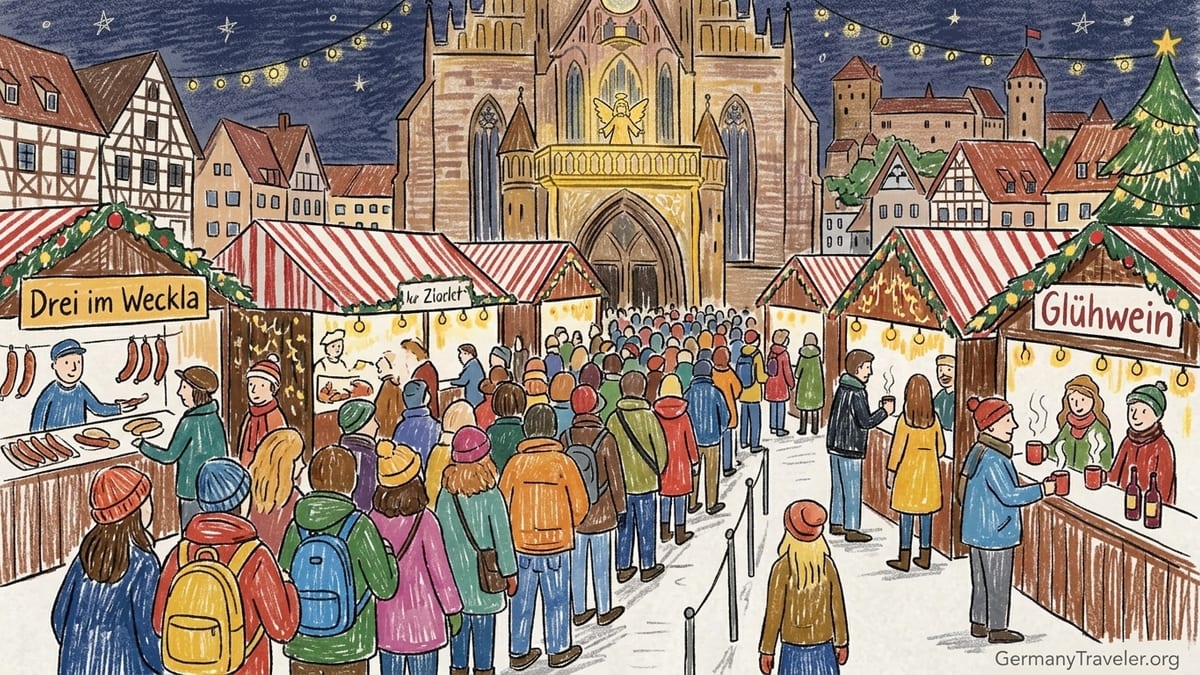
The Dream of a Medieval Market vs. the Reality of a Human Traffic Jam
Nuremberg’s Christkindlesmarkt is sold as a nostalgic, almost medieval experience: rows of red-and-white striped stalls, the golden Christkind opening the market from the balcony of the Frauenkirche, and the scent of gingerbread and mulled wine under half-timbered roofs. The official materials speak of centuries of tradition and more than two million visitors each year in the heart of the old town. In 2026, the market is once again scheduled to run from November 27 to December 24, typically from 10:00 to 22:00, with shorter hours on Christmas Eve. On paper, it sounds irresistible.
On the ground, on that December evening in 2023, what I mostly saw was the back of other people’s winter jackets. As the sky darkened and the lights switched on, the Hauptmarkt turned into a slow-moving, densely packed river of bodies. Progress from one side of the square to the other took close to twenty minutes. There were moments when movement simply stopped and the crowd locked into place, shoulder to shoulder, strangers pressed close enough to smell each other’s mulled wine. The romantic idea of wandering from stall to stall was replaced by a very real concern about how to exit if anything went wrong.
The density shaped every decision. Instead of choosing where to go, I was carried where the human current allowed. If something caught my eye to the right, reaching it meant cutting across several streams of people, which simply was not possible without a series of polite shoves and apologetic smiles. After about half an hour, the market felt less like a place to linger and more like a one-way circuit you had to endure if you wanted to reach the side streets and escape.
It is important to be clear about the timeline. My visit was in December 2023, not yet under the exact 2026 setup, but the fundamentals remain the same: the same compact historic square, the same worldwide reputation, the same seasonal convergence of tour groups, day-trippers, and families. The city’s own promotion of the market virtually guarantees that crowd pressure in 2026 will be at least as intense on peak evenings. If you are imagining a quiet medieval stroll, you are setting yourself up for disappointment.
Food Queues, Elbows and the True Cost of “Three in a Roll”
Like many visitors, I arrived hungry and set my sights on the classic Nürnberger Rostbratwürste, especially the famous Drei im Weckla, three tiny sausages in a crusty roll. In 2023, overhead boards showed prices clustered between about 4.50 and 5 euros for a portion, in line with local press reports from that season. By late afternoon, every bratwurst stall on the Hauptmarkt had a thick queue spilling directly into the already congested walkways. A simple snack suddenly required a tactical plan and a chunk of time.
At one stall along the northern edge of the square, I joined a line of roughly twenty people. It took just under fifteen minutes to shuffle to the front. The service itself was efficient: one person taking orders and cash, two working the grill, one assembling rolls. The limiting factor was the crowd, as each new customer had to force their way out of the stall frontage and back into the human tide. With my paper plate finally in hand, there was nowhere to stand without blocking someone. The result was a hurried meal, eaten half-sideways while trying not to be knocked into by passing backpacks and rolling suitcases.
By 2025 and looking ahead to 2026, prices have edged upward again. Local media and specialist guides now often quote ranges of about 4.50 to 6 euros for Drei im Weckla at market stalls, depending on location and ingredients, which matches what visitors report seeing on boards last season. That is not outrageous in isolation, but you rarely stop at one portion. Add a second snack, maybe a portion of grilled mushrooms or Kartoffelpuffer, and a drink, and you can burn through 20 euros remarkably quickly, especially if you are visiting with a partner or family.
The famous Nuremberg Lebkuchen tells a similar story. Large, attractively packaged gingerbread hearts or tins from well-known local bakeries can easily run into the 8 to 15 euro range per item at market stalls and dedicated gingerbread booths. There is real craftsmanship behind the best products, with some bakeries trading on centuries of history, but at the Hauptmarkt these treats are often displayed in such an intense crush of people that you have to decide within seconds whether to buy. Browsing, comparing, or even reading the description cards becomes a competitive sport played with gloves and shopping bags.
Glühwein Mugs, Deposits and Nowhere to Put Your Cup Down
Mulled wine is the emotional centre of many Christmas markets, and Nuremberg is no exception. When I ordered a standard Glühwein on that December evening, I paid once for the drink and again for the privilege of holding the mug. The pattern is consistent: the drink itself is priced somewhere in the area of 4 to 5 euros, while the deposit on the cup typically runs another 5 euros. Recent collectors and local reports from 2023 and 2024 confirm that the Pfand, or deposit, at the Christkindlesmarkt has climbed to about 5 euros per mug, a figure that looks suspiciously close to an invitation to keep it as a souvenir.
In theory, this system is elegant. You pay your deposit, enjoy your drink, then return the mug to reclaim your cash. In practice, in the middle of the Hauptmarkt crowd, it created two problems. First, simply getting near the counter again required a second battle through the crush. Second, there was almost nowhere to stand and drink comfortably. Without shared high tables or quiet corners, drinkers just stopped where they were, adding static clusters to already narrow walkways. I found myself clutching a scalding mug in one hand and my bag in the other, trying to sip without burning my lip as the crowd pushed from behind.
If you are traveling with children, the hot-drink situation becomes more stressful. Many stalls also serve Kinderpunsch, a non-alcoholic punch for around 3.50 to 4 euros, often in the same style of heavy ceramic mug. Every child with a cup represents another object you have to keep track of in a crowd where a small person can vanish from sight within seconds. One family near me on the eastern side of the square formed a tight defensive circle around a stroller and two older children with steaming drinks, shoulders squared as if bracing for a wave.
Over the course of one visit, it is common to tie up 10 to 20 euros in mug deposits alone if you are not careful, especially if different members of your group wander off with their own cups from different stalls. Yes, you can reclaim it all at the end of the night, but only if you have the energy to fight your way back to the right vendors, in the dark, with tired companions in tow. For many people, the path of least resistance is simply to accept the mugs as part of the souvenir budget and swallow the cost.
Families, Strollers and the Illusion of a Child-Friendly Wonderland
Nuremberg likes to present the Christkind as a figure especially beloved by children, and promotional images often show smiling families beneath twinkling lights. There is indeed a separate Kinderweihnacht, the Children’s Christmas Market, set up on Hans-Sachs-Platz with a small Ferris wheel, rides, and stalls scaled more to young visitors. In principle, this should provide a more manageable alternative to the intense crush of the Hauptmarkt. In practice, moving a family between the two spaces at peak times is far from simple.
On my December 2023 visit, I watched parents attempt to push strollers through the narrow passages between stalls near the Frauenkirche. Wheels snagged on uneven cobblestones and electrical cables. Every time the flow stopped, the stroller became a tripping hazard for people behind who could not see where the tide of bodies ended. One frustrated father finally lifted the front wheels off the ground and carried the stroller sideways through a gap, his face set in the determined grimace of someone who had planned a magical outing and now simply wanted to avoid tears.
The Kinderweihnacht itself is gentler, but hardly empty. The rides have their own queues, and the surrounding streets still absorb overflow from the main market. Children enjoy the illuminated carousel and toy stands, but adults are not automatically relaxed. Many parents hovered within arm’s reach of their children at all times, anxious about losing sight of them among winter coats and hats that all looked alike at a glance. The experience that marketing materials promise as a warm, shared family memory felt, on the ground, more like a logistical marathon with scattered moments of joy.
If your main goal for visiting Nuremberg in December 2026 is to let small children run around a charming Christmas scene, you may find more breathing room in smaller Franconian markets such as the medieval-style market in Fürth or the intimate Christmas events in Erlangen or Bamberg. These towns also get busy, but the physical scale of the markets often allows for actual wandering, not just queuing and defending your immediate rectangle of sidewalk.
Photography, Souvenirs and the Problem of Authenticity
Virtually every visitor arrives with a camera, whether a dedicated device or a smartphone. The Christkindlesmarkt looks spectacular from a distance: the lights on the stalls, the silhouette of the Frauenkirche, the massed glow of candles and strings of decorations. Up close, the act of taking a simple photo becomes an exercise in patience and luck. Every composition is interrupted by a bobbing knit hat, a raised arm holding a phone, or a vendor’s sign jutting into the frame. Trying to capture candid scenes, I repeatedly found that by the time I had framed an interesting interaction at a stall, the participants were lost behind three rows of new customers.
Night photography in such crowds also presents basic safety issues. To use a slower shutter speed or adjust settings on a camera, you need a moment of stillness and some space. On my visit, setting down a backpack to access gear felt risky; even in a largely honest environment, you are never more vulnerable than when distracted and hemmed in from all sides. In the end I snapped a few quick smartphone shots above people’s heads and gave up. The images are evidence that I attended, not photos I would ever display.
The souvenir situation is similarly at odds with the marketing story. Nuremberg is proud of its traditional handmade items such as Zwetschgenmännle, little figures made from dried plums and walnuts, and quality wooden ornaments from regional workshops. There are certainly stalls selling exactly these kinds of products, and the provenance of some can be traced directly to craftsmen in Franconia or other parts of Germany. However, it takes effort to find them among the many booths selling mass-produced ornaments and generic Christmas trinkets that show every sign of being imported in bulk.
In the busiest passages, it is difficult even to pause long enough to ask a vendor about their work. When I did manage to stop at a stall with intricate carved nativity figures, the conversation was interrupted repeatedly by people jostling past. The vendor was patient and clearly knowledgeable, but after a few minutes it felt unfair to take up space without buying something expensive. In contrast, at smaller Franconian markets I have visited, including a modest Christmas market in Erlangen’s historic centre, artisans were able to talk at length about their materials and methods while visitors browsed at a comfortable distance.
Logistics, Prices and the Hidden Cost of a Famous Name
The Christkindlesmarkt does not charge admission, but treating it as a free attraction is misleading. Costs accumulate quickly, starting with transport and accommodation. Nuremberg in December is a popular destination, and hotel prices respond accordingly. It is not unusual to see central mid-range hotels charging well over 150 euros per night for weekends during the market period, with even basic guesthouses and chain properties on the edge of the centre climbing significantly compared with November or January. Budget-minded visitors often end up staying in nearby towns or on the outskirts of the city and riding in by regional train or U-Bahn.
For those who insist on driving, parking in the old town is another significant line item. City-centre garages such as those near the Hauptmarkt and the Katharinenhof typically charge around 2 euros per hour, with daily maximums in the area of 20 euros for 24 hours and higher for longer stays. On busy December Saturdays, spaces fill quickly, and drivers can spend precious time circling one-way streets in search of a spot. The stress does not end once you park; the knowledge that your car is ticking away a double-digit parking fee adds pressure to every decision about whether to stay a little longer or queue for one more snack.
Inside the market, prices for food and drink are in line with other major German Christmas markets but feel amplified by the overall spend. A realistic evening for two adults in 2026 might look like this: two servings of Drei im Weckla at 5.50 euros each, two cups of Glühwein at 5 euros each plus 10 euros in refundable deposits, perhaps a shared portion of roasted almonds at around 5 euros, and a small pack of branded Lebkuchen for 10 to 12 euros. Without souvenirs, you are already above 40 euros for what is essentially a walk-around snack dinner. Add a Zwetschgenmännle figure for 10 to 15 euros or a commemorative mug you decide to keep, and your total climbs further.
None of these prices are individually shocking for a major European tourist event, but they sit uneasily alongside the narrative of a simple, old-fashioned market. The combination of crowd-induced stress and creeping expenses left me feeling that I was paying a premium, in both money and patience, for the right to say I had been there. When you factor in accommodation and transport, a December weekend focused on the Christkindlesmarkt can easily exceed the cost of a quieter winter city break elsewhere in Germany or even in neighbouring countries.
Why Smaller Franconian Markets Often Deliver More Actual Joy
After my Nuremberg visit, I spent time at several other Franconian Christmas markets over subsequent years, including events in Erlangen, Fürth, Bamberg and smaller towns that host only a few dozen stalls instead of well over a hundred. None of them has the Christkindlesmarkt’s global name recognition, but several offered something I found largely missing on the Hauptmarkt: room to breathe and space to connect.
In Fürth, for example, the medieval-themed Christmas market on the Fürther Freiheit square features fewer stalls, but more opportunities to talk to vendors and enjoy performances. Crowds certainly form on weekend evenings, yet I could step back from a stall, sip a drink, and actually hear the live music. The lack of international tour groups and day-trip buses created a very different atmosphere. Most people there seemed to be locals meeting friends after work, rather than ticking off a bucket-list destination between other European highlights.
Erlangen’s smaller markets, including a cosy “forest” themed event and a more traditional set of stalls in the historic centre, strike a similar balance. There were still family crowds, school groups and office outings, but the narrower audience meant I could return to a stall two or three times in one evening, chat with the same artisan about their ceramics or woodwork, and make a purchase without feeling rushed. Prices were not dramatically lower across the board, but the psychological value was higher, because each euro spent came with a sense of connection rather than frustration.
Bamberg’s Maxplatz market and surrounding Advent events also deserve mention. The old town’s architecture is at least as charming as Nuremberg’s, yet the markets feel integrated into daily life rather than staged as a global attraction. Standing at a small Glühwein stall under the shadow of Bamberg’s town hall, I could actually see the ground and my own shoes, something that was rarely possible on the Hauptmarkt during peak hours. That alone changed the quality of the experience.
How to Beat the Crowds at the Christkindlesmarkt in 2026
If, despite these criticisms, you are determined to experience Nuremberg’s Christkindlesmarkt in 2026, the only realistic strategy is to plan around the crowds as aggressively as you plan your flights. The market will run from November 27 to December 24, with daily opening hours generally from 10:00 to 22:00 and reduced hours on Christmas Eve. The key variables you can control are time of day, day of week, and how central your accommodation is.
The most effective crowd-avoidance tactic is to visit in the late morning or early afternoon on weekdays. Arriving around 10:00, when the stalls first open, allows you to move freely for at least an hour or two before tour groups and after-work visitors swell the numbers. On my own return to the city in 2024, a weekday lunchtime stroll through the market felt almost civilised compared with that 2023 Saturday evening. I was able to approach stalls directly, read price lists, and even find a spot at one of the rare standing tables to eat without constantly being bumped.
Evenings, especially Fridays and Saturdays in December, are when the market becomes the postcard scene and, simultaneously, the most stressful. If you insist on seeing the lights after dark, aim for a Monday or Tuesday and arrive shortly after sunset, then leave by 19:00 before the central bottlenecks become impassable. Consider booking accommodation within walking distance so that you can retreat easily and avoid adding overcrowded trams or full parking garages to the experience. And if you are traveling with young children or anyone with mobility issues, be honest about whether a peak-time visit is worth the strain.
From a budgeting perspective, assume that an evening at the Christkindlesmarkt in 2026 will cost, at minimum, around 25 to 35 euros per adult for food, drink and one modest souvenir. Add another 5 to 10 euros if you tend to keep the Glühwein mug. A couple sharing several snacks and buying a few gifts should plan for 60 to 80 euros on-site, not counting transport or lodging. With that in mind, you can decide which indulgences matter most rather than being caught off guard by the cumulative total.
The Takeaway
My December 2023 visit to Nuremberg’s Christkindlesmarkt left me with a lasting impression that is at odds with the glossy images used to promote it. The history is real, the setting is beautiful, and the local specialties are genuinely delicious, yet the experience as a visitor in a peak year was dominated by crowd control, queues and a constant low-level anxiety about losing companions or simply finding room to stand. The market’s international fame has become both its greatest asset and its greatest weakness.
Looking ahead to the 2026 season, when the Christkindlesmarkt will again fill the Hauptmarkt from November 27 to December 24, travelers should approach it with clear eyes. This is no longer a quaint local event but a global attraction that compresses enormous demand into a relatively small historic square. If you time your visit carefully, stick to weekday daylight hours, and accept that you may focus on one or two food stalls rather than attempting to sample everything, you can still enjoy aspects of the market. The smell of roasting sausages and spiced wine drifting through the cold air is undeniably evocative.
However, if your ideal of a Christmas market involves leisurely browsing, long conversations with artisans, and children able to explore without being boxed in by strangers on every side, then a smaller Franconian market may serve you better. Cities such as Erlangen, Fürth and Bamberg, along with numerous small towns across Franconia, offer markets where the ratio of people to space is kinder, and where the Christmas spirit feels less like a performance and more like a shared, local celebration.
In the end, the choice is not between visiting Nuremberg or skipping German Christmas markets altogether. It is about understanding what the Christkindlesmarkt has become in practice and deciding whether that reality matches your own idea of festive magic. For some, the crowds themselves are part of the experience. For others, like me, the real joy of Advent in Franconia lies just a short train ride beyond the Hauptmarkt, in places where the mulled wine is no cheaper, but the air around your shoulders is wonderfully, blessedly empty.
FAQ
Q1. When does the Nuremberg Christkindlesmarkt take place in 2026?
In 2026 the Christkindlesmarkt is scheduled to run from November 27 to December 24, typically from 10:00 to 22:00 daily, with shorter hours on Christmas Eve.
Q2. How crowded does the Christkindlesmarkt really get?
On peak December evenings, especially Fridays and Saturdays, the Hauptmarkt can feel like a human traffic jam, with shoulder-to-shoulder crowds and very slow movement through the main aisles.
Q3. What should I budget for food and drink at the market?
A realistic 2026 estimate is around 25 to 35 euros per adult for an evening, covering one or two snacks, a drink or two with mug deposit, and perhaps a small treat like roasted nuts.
Q4. How much does Glühwein cost, and what is the mug deposit?
Recent seasons suggest Glühwein at roughly 4 to 5 euros per mug, plus about 5 euros deposit on the cup, which you can reclaim when you return it if you do not keep it as a souvenir.
Q5. Is the market suitable for families with small children?
Families do visit, but at peak times the Hauptmarkt is extremely crowded for strollers and small children. The separate Children’s Christmas Market is gentler, yet still busy and requires moving through packed streets to reach it.
Q6. How can I avoid the worst of the crowds?
Visit on weekday mornings or early afternoons, ideally arriving around opening time. If you go in the evening, choose Monday or Tuesday, come early after dark and leave before the busiest late-evening period.
Q7. Are the souvenirs at the Christkindlesmarkt genuinely handmade?
Some are, especially traditional items like Zwetschgenmännle and high-quality wooden ornaments, but many stalls sell mass-produced decorations. You need time and space to ask vendors about provenance, which is easier at quieter markets.
Q8. How does Nuremberg compare to smaller Franconian Christmas markets?
Nuremberg offers scale, history and atmosphere but intense crowds. Smaller markets in places like Erlangen, Fürth and Bamberg often provide more room, easier conversations with artisans and a calmer, more local feel.
Q9. What about transport and parking for a visit in 2026?
City-centre parking garages near the old town typically charge about 2 euros per hour with daily maximums that can reach around 20 euros, so many visitors prefer to use regional trains or the U-Bahn to avoid traffic and parking stress.
Q10. When does it make sense to skip Nuremberg and choose a smaller market instead?
If you dislike dense crowds, are traveling with young children or anyone with mobility issues, or value slow browsing and conversations with artisans, you will likely have a better Advent experience at one of the smaller Franconian Christmas markets.