


By the time my train on the Gräfenbergbahn squealed into tiny Weißenohe, the carriage already smelled faintly of hiking boots and malt. Half the passengers in my compartment clutched printed maps of the Fünf-Seidla-Steig, Franconia’s now-famous “five breweries trail” that social media loves to present as an easy countryside stroll with five perfectly spaced beer stops. I had come to find out whether that promise holds up in real life. What I discovered instead was a route that is longer, steeper and more logistically fragile than its cheerful marketing suggests, where bad timing, closed kitchens and disappearing buses can turn a beer hike into a minor endurance test.
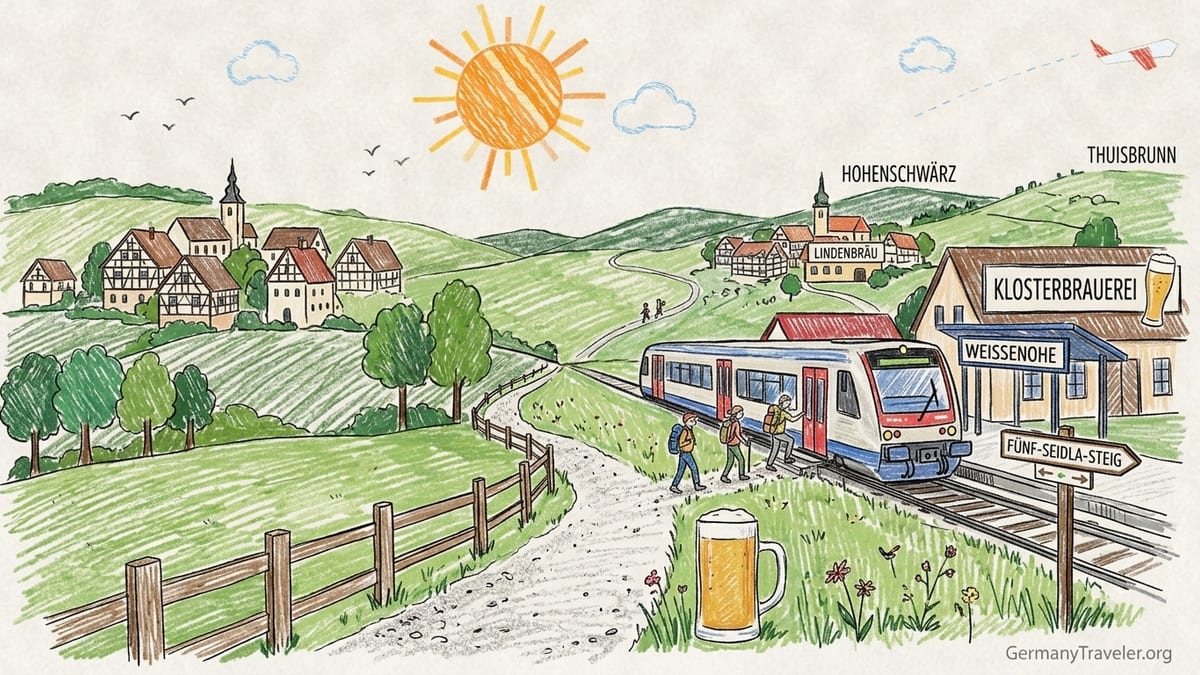
Getting to the Trail: The Illusion of Effortless Access
My day began at Nürnberg Nordost, the city tram and bus hub that feeds into the single-track Gräfenbergbahn. The regional timetable shows the RB21 trundling every hour or so between Nürnberg Nordost and Gräfenberg, with stops at small stations like Heroldsberg, Eschenau and finally Weißenohe. On paper it looks simple: hop on, step off in beer-hiking country. In reality, that hourly pattern already sets the tone for a day where missing a connection means losing 60 minutes of walking and drinking time.
The train itself is a modern diesel multiple unit with wide doors and a few bike spaces. On my weekday visit, the 8:18 departure from Nürnberg Nordost toward Gräfenberg filled quickly with walkers. Some got off at Kalchreuth for other trails, but most stayed seated until Weißenohe, the main promoted access point for the Fünf-Seidla-Steig. A few minutes after Eschenau, the Pegnitz valley suburbs fall away and the line begins to feel distinctly rural. From Nürnberg Hauptbahnhof to Nordost plus the RB21, a day ticket for the VGN transport area works out at roughly the price of two half-liters of beer, which is attractive, but it also binds you to the quirks of the regional timetable.
Stepping onto the low platform at Weißenohe, you see no grand trailhead gate or visitor center. A small station sign, a parking strip and a simple underpass mark the entry into Franconian beer-walking mythology. Waymarking for the Fünf-Seidla-Steig begins only as you approach the village street, where discreet brown and white signs point you toward the first brewery stop at the Klosterbrauerei Weißenohe. Already it is clear that this is not an industrially polished tourism product with redundant transport and signage. It is a rural line and a rural path, and visitors who assume metropolitan frequency and fail-safe navigation are in for a surprise.
This initial approach matters, because every hour spent waiting on a bare platform while the evening light fades is an hour less for hiking back out of the hills. Too many glossy articles mention “take the Gräfenbergbahn” as if that alone guarantees a smooth there-and-back. In practice you need to decide before your first Seidla how you will get home and by which train. That backward planning sets the tone for what follows.
How Long and How Steep It Really Is
The way the Fünf-Seidla-Steig is advertised creates its first big misunderstanding. Regional marketing material often talks about a route of roughly 10 kilometers between Weißenohe and Thuisbrunn in one direction, which sounds manageable even for casual walkers. Other sources round the figure up to about 15 kilometers as a pleasant “wandering distance” with stops. What most visitors do not absorb is that this one-way measurement assumes you solve the “how do I get back” problem separately, either with a return bus, a long wait, or a taxi ride that costs more than a full lunch.
Hiking blogs and the Franconian nature park information add an important missing piece: if you want to design your day as a circular route, starting and finishing at the same station or parking place, you are now looking at roughly 18 to 20 kilometers on foot, with around 437 meters of ascent. That figure appears again and again in more detailed hiking descriptions. The number is not dramatic for experienced walkers, but it clashes sharply with the carefree image of a flat amble between village beer gardens. You accumulate those vertical meters in short but persistent climbs between Weißenohe, Gräfenberg’s hilltop quarters, Hohenschwärz and finally Thuisbrunn.
On the ground, the trail surface is mixed. Leaving Weißenohe, I walked briefly on village tarmac before joining an agricultural concrete lane that soon gave way to packed gravel and earth. Between the villages, the Fünf-Seidla-Steig often piggybacks on the long-distance Frankenweg, following field edges and forest tracks that are mostly firm but not smooth. There are compacted forest roads where stroller wheels rattle, muddy ruts under beech trees after rain, and short rooty ramps that demand at least moderate ankle stability. The official website insists that the route is “mainly on paved or well-maintained paths,” but that phrase hides the reality that “well maintained” in a Franconian forest still means stones, puddles and the occasional slippery leaf carpet in autumn.
On my visit, a passing shower turned mellow loam to slick paste in under twenty minutes. Descending from a ridge toward Gräfenberg with a half-liter of unfiltered beer in my stomach felt noticeably different from strolling a waterside promenade. By mid-afternoon, the up-and-down sections around Hohenschwärz had built a quiet fatigue into my legs, the kind that makes another detour to “just one more” brewery a real decision rather than an automatic yes.
Brewery Timing: When Heritage Meets Closed Doors
The most jarring contrast between marketing and reality appears when you start treating the breweries as reliable milestones. The official information about the Fünf-Seidla-Steig repeatedly warns visitors to check opening days and holidays. That warning is not bureaucratic small print. It is the central design constraint of this hike. The five participating breweries are independent, family-run operations in small villages. Their opening hours are not harmonized, and several close at least one weekday, or operate only for lunch and early evening.
Take Klosterbrauerei Weißenohe, for example. On many weeks, its main guesthouse opens five days, staying shut on certain Tuesdays or Wednesdays outside peak season. Lindenbräu in Gräfenberg and Brauerei Friedmann, split between different outlets in the town, have their own mix of closed days. Up the line, Thuisbrunner Elch-Bräu and Brauerei Hofmann in Hohenschwärz also follow family and production rhythms rather than tourist buses. On some Mondays and Tuesdays, your “five brewery” hike can easily degrade to two or three actual open doors, especially outside school holidays or in shoulder seasons such as March or November.
Those closures have concrete consequences. Twice on my research trips I watched groups arrive in Hohenschwärz mid-afternoon, expecting at least a snack and a beer, only to find Hofmann’s gasthof shuttered. They had misread the seasonal timetable and walked past Gräfenberg’s options in the late morning, assuming more variety later. Instead, they faced a choice between pushing straight on to Thuisbrunn in increasing hunger or backtracking a steep kilometer to try their luck elsewhere. The mood on the bench outside the closed door was not festive.
Even when breweries are trading, kitchens do not always match hiker expectations. Franconian breweries typically serve hearty dishes such as Schäuferla, sausages and Käsespätzle within set kitchen hours, often stopping hot meals around 14:00 or 14:30 on weekdays and then reopening for the evening. Arrive at 15:00 expecting a plate of roast pork under a chestnut tree and you might find only cold Brotzeit platters, or in some cases just cake. This is not a fault of the breweries; it is how rural restaurants operate. The problem is that many English-language descriptions gloss over this, giving foreign visitors the impression that food will be available all day at each stop, which is not guaranteed.
The official trail advice to reserve a table on busy weekends also felt theoretical until I saw the implications up close. On a sunny Saturday in late spring, Lindenbräu’s terrace in Gräfenberg was fully booked from noon. Walkers without reservations were offered standing room or a wait of more than an hour. One couple who had counted on a hot lunch there realized that their only alternative would be to cut the route short to catch a mid-afternoon train back before evening family commitments. They had treated the Fünf-Seidla-Steig as a spontaneous outing that would adapt to them. Instead, their plans had to adapt to the invisible spreadsheet of a village kitchen.
Beer, Prices and the Physical Reality of Drinking While Hiking
Then there is the beer itself. The name Fünf-Seidla-Steig refers directly to the traditional Franconian Seidla, a half-liter mug. Today most breweries on the route still serve their standard beers in 0.5 liter measures. Prices in 2026 tend to cluster between about 3.50 and 4.20 euros per Seidla, depending on the house and the specialty. At Klosterbrauerei Weißenohe I paid just under 4 euros for an unfiltered lager. In Gräfenberg, both Lindenbräu and Friedmann charged in a similar band, with some seasonal brews a few cents higher. At Thuisbrunner Elch-Bräu the house pils and Kellerbier fell into the same general range.
Presented as numbers on a menu, those prices feel modest compared with big-city beer gardens. Across a long hike, they add up. Five Seidla at an average of 4 euros is 20 euros in beer alone. Add one or two hot meals at roughly 11 to 15 euros each for a main dish like Schäuferla, Gulasch or a generous vegetarian option, plus soft drinks, and a full day on the trail can easily reach 50 to 60 euros per person before you even address transport back to Nuremberg.
The physical impact matters more than the cash. Drinking several half-liters of 4.8 to 5.5 percent beer in the space of five or six walking hours is not a simple “tasting.” It is sustained alcohol consumption layered on top of moderate exercise. Climbing from Gräfenberg up through fields toward Hohenschwärz under direct sun after two Seidla, I felt my pace slow and my foot placement grow sloppier. The relatively gentle gradients became more demanding, and my risk of a twisted ankle on loose stones increased. Locals often pace themselves with a single beer at each stop and plenty of water, but many visitors arrive primed by the idea of a “beer crawl” and underestimate how quickly four or five half-liters compromise balance and judgment.
This has direct safety implications for the journey home. The nearest train stations are in Weißenohe and Gräfenberg, both at least several kilometers of walking away from the furthest brewery in Thuisbrunn. Anyone who drinks heavily and then expects to “just walk back down” in the evening dusk is making a decision with real consequences. It is not dramatic alpine terrain, but it is dark country lanes, forest verges and roadside walking with tired legs and a fuzzy head. The traditional culture of beer hiking can coexist with safety only if visitors pay attention to measures like alternating alcoholic and non-alcoholic drinks, stopping at three Seidla over the whole day rather than five, and making sure at least one person in any group remains sober enough to manage navigation and emergency calls.
The Return-Transport Trap at Thuisbrunn
The most serious structural weakness of the Fünf-Seidla-Steig lies at its far end, around Thuisbrunn. The promoted one-way route wants you to enjoy your last beer up here, then rely on regional buses to escape the Trubach valley and reconnect with the rail network. The problem is that these buses are both infrequent and, in the evening, heavily thinned out. Information from the regional transport association shows that in the Thuisbrunn and Egloffstein direction, regular daytime services run primarily in school and commuter windows. After roughly 20:16, connections become sparse, and some evening and weekend services operate only as on-demand “Rufbus” journeys that must be ordered by phone or online well in advance.
Standing at the modest bus stop in Thuisbrunn, the gap between theory and practice becomes uncomfortably clear. Timetable posters include cryptic footnotes and symbols explaining which trips run only on school days, which require reservation the previous day, and which do not operate on public holidays. For visitors without German, these notes might as well be code. I met one group of international hikers who had simply read the boldface line “to Gräfenberg” on a PDF map and assumed that buses ran hourly until late evening. Around 18:30, they realized that the last straightforward connection back toward Gräfenberg had already left, and that the next option was a call-ahead minibus whose order deadline had passed.
In theory, you could of course walk back. From Thuisbrunn to Gräfenberg station via Hohenschwärz is about 7 to 8 kilometers, depending on your choice of farm track or roadside walking. From Thuisbrunn all the way down to Weißenohe, the distance is in the range of 10 kilometers. Attempting those returns in darkness, after several beers and on tired legs, is not a smart backup plan. Yet that is exactly what several groups end up doing on long summer evenings, headlamps bobbing in the distance along the roadside.
The taxi alternative is real but costly. Local firms based in Gräfenberg, Egloffstein or other nearby towns can provide pickups from Thuisbrunn if you call ahead. On current price levels in rural Franconia, a 15 to 20 minute taxi journey for up to four people can easily cost 35 to 45 euros, sometimes more in the evening or on Sundays. Split among a group of four, that is an extra 10 euros per person, but for couples or solo travelers it quickly becomes a financial penalty for poor planning. Several drivers I spoke with mentioned that they frequently rescue stranded Fünf-Seidla-Steig walkers who simply misjudged the last bus times.
Complicating matters further, mobile reception along parts of the route is weak. In forested dips and sections of the Todsfeldtal between Weißenohe and Thuisbrunn, I repeatedly dropped from 4G to a flickering one-bar signal or lost data entirely. If you only realize your transport mistake at a bus stop in a coverage dead zone, placing a taxi call can take several attempts, if it works at all. Relying on ride-hailing apps is unrealistic; this is traditional taxi territory, and downloading or updating an app on the fly over a poor signal is not guaranteed. Any responsible plan for the day has to assume that you might not be able to rebook your exit at the last minute from the far end of the hike.
Weather, Fatigue and the Myth of the Easy Stroll
The cumulative effect of distance, ascent, alcohol and transport uncertainty becomes most visible when the weather turns against you. My second visit fell on a humid summer day with temperatures climbing above 27 degrees Celsius by early afternoon. The first leg from Weißenohe to Gräfenberg felt comfortable in the morning shade, but by the time I was climbing the exposed fields beyond Gräfenberg toward Hohenschwärz, the sun was hammering the track. There is little natural shade on these hillside sections; trees cluster along the creek beds, not the open arable land.
Under those conditions, one Seidla at lunch translated directly into dehydration risk. I watched two hikers from Hamburg drain half-liters at Lindenbräu without touching their water bottles, then slog uphill increasingly red-faced. By Hohenschwärz, one of them admitted a pounding headache and decided to abandon the fifth brewery entirely. They ended up walking straight down to Gräfenberg and catching an earlier train, having essentially paid for an overlong pub visit away from the actual landscape they had come to see.
On cooler days, the physical fatigue manifests differently. Autumn rain transformed the forest paths near Weißenohe into a patchwork of puddles and greasy mud. Careful footwork slowed the pace, and the nominal 10 kilometer one-way route began to feel more like 12 as we picked around obstacles. My own knees reminded me that 437 meters of up and down is not nothing when you are no longer twenty-five. By the time we reached Thuisbrunn, the idea of retracing our steps felt oppressive, and we were very aware of the narrow time window before the last reliable bus back down the valley.
This is where the myth of the Fünf-Seidla-Steig as an “easy countryside stroll” does real harm. The terrain is not extreme, and the route is achievable for moderately fit walkers. The damage comes from underestimation. Visitors set out later than they should, add an unplanned extra beer in each village, forget to factor in weather and photo breaks, then realize in the early evening that they have two hours of walking left and one realistic bus. What could have been a leisurely exploration of Franconian brewing tradition becomes a clock-watching march with a nagging sense of risk.
Planning Smarter: Shorter Routes, Responsible Drinking and Safer Returns
After two trips that were more stressful than they needed to be, I came to the conclusion that the healthiest way to experience the Fünf-Seidla-Steig is to ignore its name. Think in terms of “three Seidla” and a manageable walking loop rather than religiously ticking off all five breweries in one day. One practical strategy is to start early at Weißenohe, visit the Klosterbrauerei for a single beer and perhaps a light second breakfast, then walk to Gräfenberg for lunch at either Lindenbräu or one of the Friedmann outlets. That already gives you two distinct brewing traditions, around 6 to 7 kilometers of walking and enough ascent to feel a sense of achievement.
From Gräfenberg station you can simply catch the RB21 back toward Nuremberg, with trains typically running into the late evening. The PDF timetable for Gräfenberg station in spring 2026, for instance, shows departures around every hour until close to midnight on many days, which significantly widens your safety margin. If you still have energy, you can extend this plan with a short spur to Hohenschwärz and back, trimming the total distance to under 15 kilometers while still seeing some of the classic countryside views.
Another approach is to base yourself in one of the villages overnight, particularly Gräfenberg or Weißenohe, and break the full five brewery experience into two days. Day one could cover Weißenohe and Gräfenberg at a relaxed pace, with time for a brewery tour if offered. Day two could then focus on the higher sections around Hohenschwärz and Thuisbrunn, returning by bus or taxi without pressure to connect straight through to Nuremberg the same night. This does add accommodation cost, typically from around 45 to 80 euros per person in a simple guesthouse room in these villages, but it transforms the character of the outing from a logistical race into a slow exploration.
Responsible alcohol management is not an optional add-on; it is part of basic mountain sense, even in low hills. Planning at most three Seidla over a full day and alternating them with large glasses of water keeps blood alcohol at a more manageable level for most adults. Sharing beers within a group to taste different styles without each person downing a full half-liter is another simple tactic. Crucially, leave your final beer for the village where your confirmed return transport starts, not the furthest outpost. Having your last drink within walking distance of Gräfenberg station or your guesthouse in Weißenohe changes the risk profile dramatically.
FAQ
Q1. Is the Fünf-Seidla-Steig really suitable for casual walkers who just want a gentle stroll?
For reasonably fit walkers, the trail is achievable, but calling it a gentle stroll is misleading. A full circular variant can reach around 18 to 20 kilometers with roughly 437 meters of ascent, and surfaces vary from smooth village roads to muddy forest tracks. If you are used to flat city walks, you should train a little and plan a shorter version of the route.
Q2. How many breweries can I realistically visit in one day without feeling rushed?
Three breweries is a sensible target for most visitors. For example, start at Klosterbrauerei Weißenohe, walk to Gräfenberg for Lindenbräu and one Friedmann outlet, then decide whether you have time and energy for a short extension. Trying to collect all five in one day often leads to rushed visits and stressful transport connections.
Q3. What happens if I arrive and a brewery is closed unexpectedly?
If you have not checked opening days and kitchen times in advance, you may find shutters down or only limited cold food on offer. In that case you might need to walk on to the next village without a meal, or backtrack, which adds distance and time. This is why checking current opening hours directly with each brewery before your trip is essential.
Q4. How late do buses and trains run back from the Thuisbrunn side?
Regional buses from the Thuisbrunn and Egloffstein direction become very limited in the evening, with some last straightforward connections around early evening and later services often operating only on request. Trains on the RB21 line from Gräfenberg to Nürnberg Nordost typically run later into the night, but you still need to verify the current timetable for your specific travel date.
Q5. Are taxis a reliable backup option if I miss the last bus?
Local taxis can usually pick you up from places like Thuisbrunn, but you should not assume instant availability. In busy periods or late in the evening there can be waits, and a ride of 15 to 20 minutes can cost in the area of 35 to 45 euros. It is wise to save numbers of local taxi companies in your phone before setting out.
Q6. How bad is mobile reception along the Fünf-Seidla-Steig?
Reception fluctuates. In and around villages you usually have a usable signal, but in forested valleys and open fields between Weißenohe and Thuisbrunn coverage can drop to one bar or disappear entirely. You should download maps in advance and avoid leaving critical tasks such as booking a taxi or checking the last bus to the very end of the day.
Q7. What should I budget for a full day on the trail, including food and drink?
As a rough orientation in 2026, five half-liter beers might cost about 20 euros in total, with hot main dishes often between about 11 and 15 euros. Add snacks, soft drinks, and a regional day ticket for public transport, and many visitors spend somewhere in the range of 50 to 70 euros each for the day, excluding any taxi fares or accommodation.
Q8. Is it possible to walk the trail with children or less mobile companions?
Sections of the route follow paved or well-maintained paths, and some families do walk shorter stretches with strollers. However, certain segments include steeper climbs, narrow forest tracks and roadside walking without sidewalks. For children or less mobile companions it is usually better to choose a short, clearly defined stretch between one or two breweries and avoid committing to the full route.
Q9. What is a safer alternative to doing the entire Fünf-Seidla-Steig in one push?
A good alternative is to split the experience across two shorter days, overnighting in Gräfenberg or Weißenohe. Day one can focus on the lower breweries and a relaxed lunch, while day two covers the higher villages like Hohenschwärz and Thuisbrunn with an early start and a clear plan for the return trip.
Q10. What are the most common mistakes first-time visitors make on the trail?
Common mistakes include underestimating the total distance and ascent, assuming every brewery will be open all day for food, starting late in the morning, drinking too many half-liters without enough water, and failing to check the last bus times from the Thuisbrunn side. Avoiding those errors turns the Fünf-Seidla-Steig from a stressful logistical puzzle into an enjoyable rural beer hike.