

I thought I knew Bavaria. Before I finally gave myself two weeks to travel beyond Munich, I pictured one vague postcard of beer gardens, dirndls and a single fairy-tale castle somewhere in the Alps. What I found instead was a state officially divided into four very different holiday regions, and that felt exactly right on the ground: the lakes and Alps of Upper Bavaria, the rugged south around Füssen and Garmisch-Partenkirchen, the austere drama of Berchtesgaden, and the half-timbered, wine-scented streets of Franconia in Nuremberg and Rothenburg ob der Tauber. Moving between them, mostly by regional train and a few memorable drives, felt less like traveling within one region and more like crossing borders into four.
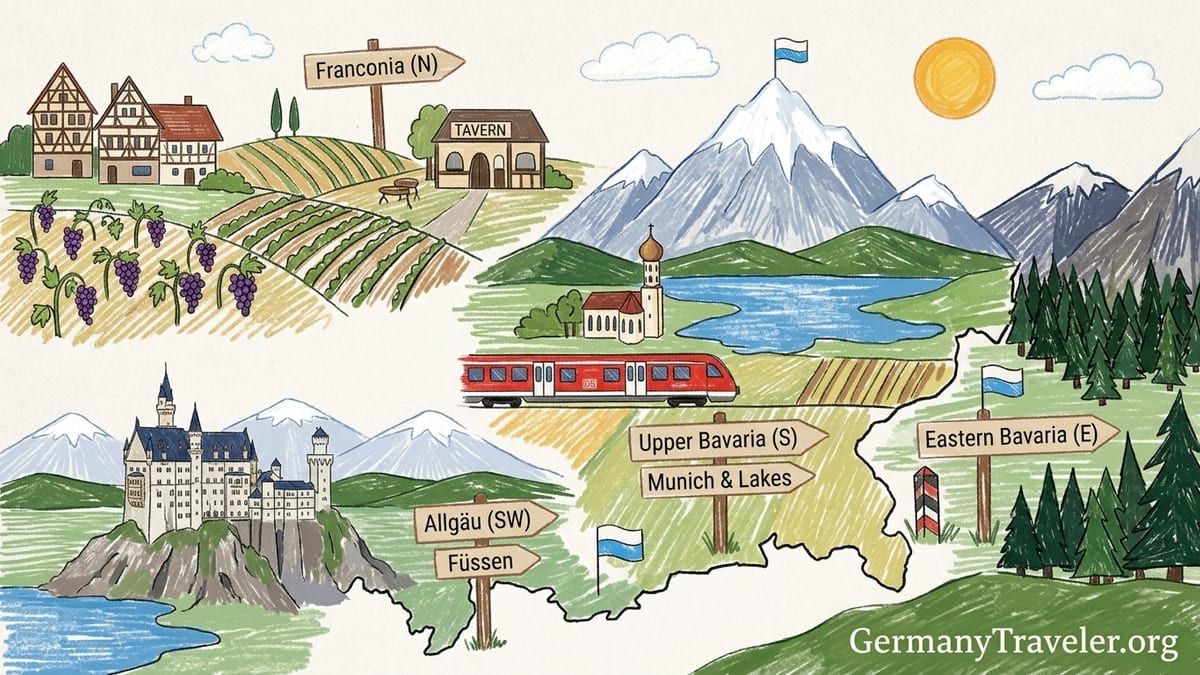
Realizing Bavaria Is Four Different Trips, Not One
The surprise began before I even boarded my first train. Browsing the official Bavaria tourism material, I kept seeing the same message repeated: the state is framed around four distinct holiday regions, not a single homogeneous destination. Those regions are Franconia in the north, Allgäu and Bavarian Swabia in the southwest, Upper Bavaria around Munich and the lakes, and Eastern Bavaria stretching to the Czech and Austrian borders. Once I was on the ground, that marketing line suddenly made sense. The timbered houses and wine taverns north around Nuremberg did not feel remotely like the glacier-fed lakes near Garmisch-Partenkirchen, even though they share the same blue-and-white flag.
I started and ended in Munich, but I made a deliberate choice: I would spend more nights outside the capital than in it, using Munich mainly as my rail hub. I sketched out a rough loop. First, south to Füssen for Neuschwanstein and the Allgäu foothills. Then across to Garmisch-Partenkirchen for the Zugspitze region. From there I would continue east to Berchtesgaden, before cutting back north by long-distance train to Nuremberg and on to Rothenburg ob der Tauber. I wanted to feel the shifts in landscape, language, and even beer styles, not just tick off famous sights.
My second decision was to mostly rely on regional trains. In Bavaria that usually means a patchwork of Deutsche Bahn and private operators, all integrated into the same timetable and ticketing system. I anchored several days around the Bayern Ticket, a regional day ticket valid on most local trains and city transport within Bavaria after 9 a.m. on weekdays and all day on weekends. When I checked in autumn 2026, the standard second-class Bayern Ticket for one person was around the mid-20 euros range, with each additional traveler added for a smaller supplement. That felt like a bargain for the distances I was covering, but it also introduced my first wrong assumption of the trip: thinking one ticket type and one mental image of Bavaria would cover everything.
South to Füssen: A Fairy-Tale Castle and a Very Real Commute
My first foray beyond Munich was the classic: a day-and-a-half around Füssen and Neuschwanstein. From München Hauptbahnhof I boarded a morning Regionalbahn service heading toward Füssen. On the day I traveled, the most practical option was a regional connection with a change at Buchloe rather than the limited direct trains. The whole ride took a little over two hours. I used a Bayern Ticket, which covered both the Munich S-Bahn I used to reach the Hauptbahnhof and the regional trains all the way to Füssen.
That first train ride out of Munich was where “Upper Bavaria” as a phrase turned into something I could see. The line slid past suburban apartment blocks into a landscape of green fields, onion-domed church towers, and occasional glimpses of lakes near the tracks. As we passed Kaufbeuren, the Alps appeared, low at first, like a distant blue brushstroke. The train itself felt very ordinary, with families and day-trippers in hiking gear, but I remember the quiet murmur of English and Spanish conversations all orbiting the same word: Neuschwanstein.
From Füssen station the onward journey to the castles is more prosaic than the famous photographs suggest. I walked out of the small terminal and crossed the parking area to board the local bus toward Hohenschwangau. The ride took about ten minutes and was included in the Bayern Ticket. At the village, the practical realities of one of Germany’s top attractions set in. Timed tickets, lines, and the constant choreography of buses, horse-drawn carriages, and hikers switchbacking up the hill to Neuschwanstein. I had booked my castle entry time in advance for late afternoon, but I still queued at the ticket center earlier in the day to collect it and confirm the exact slot.
The castle tour itself was exactly as controlled and crowded as expected, and still worth it. What surprised me more was how much I enjoyed the walk toward Marienbrücke, the bridge that gives the classic view of Neuschwanstein’s towers spilling out of the forested ridge. In early autumn the weather shifted every half-hour. At one moment low cloud scraped the tree line and hid the castle entirely. Ten minutes later the sun would burn through just enough for the white façade to glow against the dark forest. I had packed for a stable alpine day and ended up peeling layers on and off constantly as a drizzle came and went.
Wrong Assumptions in Allgäu and the Lakes
My first big mistake was timing. I had assumed one overnight in Füssen would be enough: see Neuschwanstein, sleep, and move on. What that plan ignored was the quiet pleasure of the surrounding Allgäu, which technically sits in the Allgäu / Bavarian Swabia holiday region rather than Upper Bavaria. The next morning I woke to a crisp blue sky that made the previous day’s moody clouds feel like another planet. From the lakefront in Füssen itself, the mountains looked sharper, and the pale green Lech River ran impossibly clear beneath the old town walls. I found myself wishing I had left an extra day for an unhurried lake walk or for renting a bike to cycle toward Forggensee.
Instead, I hurried that morning connection back toward Munich, boarding a regional train from Füssen with a change at Buchloe again. The service was busy with commuters for the first stretch, and I was glad I had arrived a little early to find a seat. I used another Bayern Ticket, again bought on the DB Navigator app, which meant I did not have to fight with the ticket machines at the station. The app also turned out to be my best defense against disruption. On another day later in the trip, a direct Munich to Füssen regional train was canceled and replaced with a bus on part of the route, and the app updated with the substitute service and arrival times.
Back near Munich, I made what turned out to be an unnecessary detour. I decided I wanted to fit in an afternoon at one of the lakes west of the city before heading into the Alps proper. I took a local S-Bahn to Starnberg on Lake Starnberg, thinking I would simply stroll the waterfront and get a taste of “Munich’s bathtub,” as locals sometimes call it. The weather that had been bright in the Allgäu had turned hazy and humid. The lake was still pretty, lined with villas and boat clubs, but it did not add much to what I would later experience more dramatically near Garmisch-Partenkirchen and in the Berchtesgadener Land. Looking back, I would have traded that lake detour for another Allgäu hike or a quieter second evening in Füssen.
Garmisch-Partenkirchen: Mountain Weather and a Lesson in Train Planning
From Munich to Garmisch-Partenkirchen I again chose the regional train. Services on the Munich–Garmisch-Partenkirchen line usually take around one hour and twenty minutes, running via Starnberg and Murnau. I boarded a mid-morning train from München Hauptbahnhof, again using a Bayern Ticket, and found myself surrounded by skiers and hikers. The further south we went, the more the train filled with backpacks, trekking poles, and the distinct smell of sunscreen and coffee. Somewhere after Murnau the first full wall of the Wetterstein mountains became visible. That was the moment I realized how small my mental picture of “Bavaria” had been.
In Garmisch-Partenkirchen I checked into a family-run guesthouse within walking distance of the station. The owner asked, in the most practical tone, not whether I planned to visit the Zugspitze, but on which day. That mattered, he explained, because weather trumps every plan here. The cable cars to the Zugspitze plateau and the cogwheel railway that climbs through the mountain both operate in most conditions, but wind and visibility can turn a dream day into an expensive ride into fog. He pointed to the forecast for the next two days: mixed clouds and showers followed by a clearer morning. I had originally booked my Zugspitze trip for the first day, but I swapped it on the spot, paying the small change fee at the ticket counter near the station.
The following day I woke to exactly the kind of weather I had tried to avoid. Low clouds sat on the shoulders of the mountains, and intermittent showers made the streets in town reflective and gray. Instead of forcing the cable car ride, I stayed lower, hiking part of the Partnachklamm gorge trail. The rain actually added to the experience, with waterfalls tumbling more powerfully into the narrow canyon. By the time I returned to town my shoes were damp and my rain jacket was coated in a fine mist, but I had one of my favorite meals of the trip: a plate of käsespätzle in a small stuben-style restaurant in the old Partenkirchen half of town, paired with a local Helles beer from the region.
When the clear window finally arrived the next morning, it was worth the patience. I took the short local bus to the base station of the Zugspitzbahn and rode the cogwheel train up to the Zugspitze plateau, then transferred to the final cable car up to the summit station. The air at the top was thin and bright, with patches of late-season snow clinging to shaded corners. Looking south into Austria and north across Bavaria, I could trace in my mind the routes I had taken and still meant to take. I also realized how many travelers rush this area as a day trip from Munich, fitting it into a single Bayern Ticket day. Having two full nights in Garmisch-Partenkirchen meant I could adapt to the weather, which in the mountains changed more in one hour than the urban forecast back in Munich would ever suggest.
Berchtesgaden and the Eagle’s Nest: Seasons, Roads and Reality
My longest intra-Bavaria transfer of the trip was between Garmisch-Partenkirchen and Berchtesgaden. The fastest options involved at least one change, sometimes two, often in Munich or Salzburg. I chose a route that took me back via Munich on a morning regional train, then onto another train east toward Freilassing and finally a local service into Berchtesgaden. It turned a map’s short diagonal into several hours of actual travel. This was one of those days when I wondered whether renting a car for just this segment would have made more sense, especially given the flexibility needed in the alpine south. Still, my Bayern Ticket covered the entire journey on regional trains.
Berchtesgaden felt immediately different from Garmisch-Partenkirchen, even though both sit in the alpine south. The valley is narrower, the peaks around it steeper, and the town carries a more somber historical weight. I stayed in a small hotel up a side street from the station, within walking distance but steep enough that I was grateful for a backpack rather than a suitcase. My main goal here, like many visitors, was the Kehlsteinhaus, better known to English speakers as the Eagle’s Nest.
What I had not fully appreciated before arriving is how seasonal and controlled access to the Kehlsteinhaus is. The building sits at roughly 1,834 meters above Berchtesgaden, and the road up to it is not public. Visitors generally reach it by taking a bus on the designated Kehlstein line from the Obersalzberg bus station, then transferring to a historic brass elevator for the final ascent. According to the latest schedule information I checked for 2026, the official operating season typically runs from early May to early November, with exact opening and closing dates adjusted each year based on snow conditions and rockfall risk. Outside that season the bus line does not operate, and independent drivers cannot simply take the road to the top.
I had timed my visit for the middle of the operating window, in late September, but even then the weather asserted its own rules. Morning clouds obscured the summit entirely, and bus staff were upfront that visibility at the top would be poor. I debated postponing, but with only two nights in Berchtesgaden I decided to take a calculated risk and go up later in the day. The ride from Obersalzberg on the special buses was stunning in its own right, with the narrow mountain road cut into the slope and occasional glimpses down toward the valley. At the top, the views initially were limited to shifting pockets of blue sky as clouds moved through, but when they opened the panorama over the Königssee area and toward the distant Salzach Valley was remarkable.
My miscalculation in Berchtesgaden was around time. I had assumed a half-day for Kehlsteinhaus and a half-day for the lake would be enough. That underestimated both. The boat tours on Königssee, which glide silently with electric motors between the cliffs, invite you to linger at stops like St. Bartholomä. Add in potential weather delays and queueing for both boats and buses, and it quickly becomes a full-day affair if you do not want to feel rushed. Next time I would allow at least three nights in Berchtesgaden, using one full day for lake excursions and another for the Kehlsteinhaus and surrounding Obersalzberg history, with a buffer day for weather.
North to Franconia: Nuremberg and Rothenburg Feel Like Another Country
From Berchtesgaden I finally turned north toward Franconia, the region that dominates northern Bavaria. The train journey to Nuremberg looked straightforward on paper: a local train to Freilassing, a regional or long-distance connection through to Nuremberg Hauptbahnhof, and possibly one more change depending on the schedule. In practice, it felt like stepping from one cultural climate into another. The mountains gradually gave way to rolling hills, then to the gentler landscapes around the Main and Pegnitz rivers. The half-timbered houses became denser and more urban as we neared Nuremberg.
What struck me most in Nuremberg was how little it felt like “Bavaria” as I had pictured it from Munich and the Alps. Officially I knew I was in the Franconia holiday region, and that the area has a distinct identity, but it was only walking the streets that I felt it. The local dialect sounded different, the beer menus highlighted Franconian specialties, and wine suddenly played a more prominent role in restaurant lists. I spent a good portion of my first afternoon simply walking from the Hauptmarkt up toward the Kaiserburg, winding through streets rebuilt after the Second World War but still carrying the outline of the old medieval city.
I had chosen a mid-range hotel near the station, an area that some travelers dismiss as too practical and businesslike. For this trip, it made sense. I wanted to use Nuremberg as a rail base for visiting Rothenburg ob der Tauber. From Nuremberg to Rothenburg the journey involved a change in Ansbach and again in Steinach, dropping from a mainline Intercity or regional express to smaller branch-line trains. It took roughly one hour and forty-five minutes each way on the day I traveled. I used a combination of a Bayern Ticket and local tickets, depending on the exact time of departure, because some of the faster trains outside the Bayern Ticket’s weekday morning validity window would have required a different fare.
Rothenburg itself felt almost unreal when I stepped out of the small station and walked through the city walls. Half-timbered houses leaned over cobbled lanes, and shop windows spilled handcrafted Christmas ornaments even in months far from December. The town is heavily touristed, especially in the middle of the day when buses arrive, but I still found quiet corners on back streets and small, shaded squares. My wrong assumption here was in the opposite direction from Füssen: I had given Rothenburg a full day trip, but part of me wished I had arranged an overnight. Once the day-trippers leave, the town reportedly becomes much quieter, something my daytime visit only hinted at.
Trains, Tickets, Roads and What I Would Plan Differently
By the end of my loop, I felt I had earned a small degree in Bavarian transport. The Bayern Ticket was the workhorse of my trip, offering all-day travel on most regional trains and local transit within Bavaria. When I checked in autumn 2026, the base price for one traveler in second class sat in the mid-20s in euros, with each additional person up to a group limit added for a modest supplement. It is valid from 9 a.m. on weekdays until early the following morning, and from midnight on weekends and public holidays. That 9 a.m. weekday rule is important. On my Füssen day, I had originally planned to catch an earlier train, only to realize that doing so would invalidate the Bayern Ticket for that segment and require a separate ticket. I shifted my departure slightly later to stay within the rules.
Where the Bayern Ticket shone was on routes like Munich to Garmisch-Partenkirchen, Nuremberg to Rothenburg, and Munich to Füssen, where regular regional trains run at roughly hourly intervals. It allowed me to stay flexible, hopping onto an earlier or later service depending on how long I lingered at a lake or castle. The flipside was travel time. Some diagonals within Bavaria are surprisingly slow by regional train, especially when they require routing via Munich or Nuremberg. The Garmisch-Partenkirchen to Berchtesgaden stretch, for instance, consumed much of a day. On a future trip I would consider renting a car just for that segment or booking a long-distance train with a saver fare when it significantly cuts the journey time.
Driving came into play in only one notable stretch of my actual trip: a day when I rented a small car to explore some of the secondary lakes in Upper Bavaria between Munich and the Austrian border. I picked up the rental at Munich’s central station and followed signed federal roads rather than the autobahn toward Tegernsee and Schliersee. Traffic was heavier than I expected, particularly near lake access points and on sunny weekends, and parking near popular swimming spots required patience and small coins for the meters. The reward was being able to pull off at viewpoints and lesser-known bathing places along the shore, something the train network cannot offer as freely. Yet I also felt the stress of driving narrow mountain roads when afternoon thunderstorms rolled in, and I was glad that the bulk of my Bavarian loop remained on rails.
Another planning lesson involved seasonal access. The Kehlsteinhaus in Berchtesgaden, for example, operates only from around May to early November, with exact dates published by local authorities each year based on snow and safety conditions. Boat services on alpine lakes can reduce frequency outside the summer months, and some mountain lifts close for maintenance in spring or late autumn. I arrived in late September, which turned out to be a sweet spot: most services still ran, and crowds had thinned compared with high summer, but weather was already more volatile. On one day in Garmisch-Partenkirchen the morning started in brilliant sunshine, only for thick clouds to swallow the peaks by midday. Building one or two “buffer days” into an itinerary for weather-sensitive activities is not a luxury in Bavaria; it is self-defense.
The Takeaway
Looking back on this journey beyond Munich, the biggest surprise was how right the official framing of Bavaria as four distinct holiday regions felt at traveler scale. In a single state I moved from lakeside strolls and soft foothills in the Allgäu and Upper Bavaria, through the sharp drama of the alpine south around Garmisch-Partenkirchen and Berchtesgaden, to the almost separate world of Franconia, where Nuremberg and Rothenburg ob der Tauber leaned more toward half-timber and wine than toward beer gardens and high peaks. Trains, buses, and the occasional rented car stitched those experiences together, but culturally and visually they could have been in separate countries.
If I were to repeat the trip, I would add at least one extra night in Füssen and another in Berchtesgaden, and I would consider sleeping in Rothenburg ob der Tauber rather than visiting only by day. I would still base myself in Munich at the beginning and end for its rail connections, but I would resist the temptation to squeeze in every nearby lake. Instead I would focus on a few, like the Zugspitze region’s Eibsee or Berchtesgaden’s Königssee, and give them the time they deserve. I would keep using the Bayern Ticket for its value and flexibility, but I would not hesitate to mix in an occasional long-distance ticket or a short-term car rental when terrain or time demanded it.
Most of all, I would remember that “Bavaria” is not one idea. It is a mosaic of regions that each reward slow travel and curiosity. Standing at the top of the Zugspitze with wind tugging at my jacket, walking the quiet back lanes of Nuremberg at dusk, or watching mist pull off the surface of the Lech near Füssen, I felt less like I was visiting a single place and more like I had been granted four distinct journeys that happened to share one name.
FAQ
Q1. How did you use the Bayern Ticket during this Bavaria trip?
The Bayern Ticket was my main tool for regional travel. I used it for routes like Munich to Füssen, Munich to Garmisch-Partenkirchen, and Nuremberg to Rothenburg ob der Tauber, plus local buses in places like Füssen and around Munich. I bought it in the DB Navigator app, which made it easy to adjust exact trains on the day as long as I respected the validity times.
Q2. Is one day enough for Neuschwanstein and Füssen?
You can technically visit Neuschwanstein on a long day trip from Munich, but I found one overnight in Füssen was the bare minimum, and I would now book two. That extra time lets you handle weather changes, enjoy the old town and nearby lakes, and avoid rushing in and out with the biggest crowds.
Q3. How much time would you recommend in Garmisch-Partenkirchen?
I stayed two nights and felt that was the minimum if you want a realistic chance at good weather for a Zugspitze visit and time for at least one lower-level hike such as the Partnachklamm. If you are into hiking, three or four nights would give you space for multiple routes and a true rest day.
Q4. Do you need a car to explore Bavaria beyond Munich?
You do not strictly need a car, and I managed almost everything by train and bus. A car becomes useful on some diagonals, such as between Garmisch-Partenkirchen and Berchtesgaden or for quiet lakes with limited public transport. For my style of travel, a mix of mostly rail plus a short targeted car rental day worked best.
Q5. When is the best season to visit Berchtesgaden and the Eagle’s Nest?
The Kehlsteinhaus typically operates from early May to early November, depending on snow and safety checks. I visited in late September and enjoyed thinner crowds, but I had to be flexible with cloudy weather. If clear views are a priority, late June through early September offers the most stable conditions, though it is busier.
Q6. How different did Franconia feel from Upper Bavaria?
Franconia around Nuremberg and Rothenburg felt like a different cultural region entirely. The architecture leaned more to half-timbered houses, there was more focus on wine alongside beer, and the local dialect and food felt distinct from what I had experienced in Munich, Füssen, or Garmisch-Partenkirchen.
Q7. Would you stay overnight in Rothenburg ob der Tauber next time?
Yes. I visited as a long day trip from Nuremberg, which worked logistically but meant I only knew the town in its busiest hours. Next time I would book at least one night inside the walls to experience the quieter early mornings and evenings after the day-trippers leave.
Q8. How did mountain weather affect your plans?
Weather reshaped my schedule several times. In Garmisch-Partenkirchen I swapped my planned Zugspitze day to follow a clear-weather window and used a rainy day for a lower gorge hike instead. In Berchtesgaden I delayed my Kehlsteinhaus bus until clouds lifted enough to make the views worthwhile. Building flexibility into the plan made those adjustments possible.
Q9. Did you find any detours you would skip in hindsight?
My short detour to Lake Starnberg from Munich was the one stop I might skip next time. It was pleasant but did not add much compared with the more dramatic lake and mountain landscapes I later saw near Garmisch-Partenkirchen and Berchtesgaden. I would use that time for an extra hike or an additional night in Füssen instead.
Q10. How many days would you allocate for a similar Bavaria loop?
For a loop similar to mine, I would recommend at least twelve to fourteen days: two or three in Munich, two in Füssen, two or three in Garmisch-Partenkirchen, three in Berchtesgaden, and three split between Nuremberg and Rothenburg. That length allows for rail travel days, weather flexibility, and time to feel how each of Bavaria’s four holiday regions differs from the others.