


On my last trip to Bavaria I decided to do something that still surprises many first-time visitors. I skipped the rental car counter at Munich Airport and committed to getting everywhere by regional trains and buses, anchored around one pass: the Bayern-Ticket. Over ten days and several separate Bayern-Ticket journeys, I learned exactly how far you can get on this regional day ticket, what happens when things go wrong, and which Bavarian highlights work better without a car than with one.
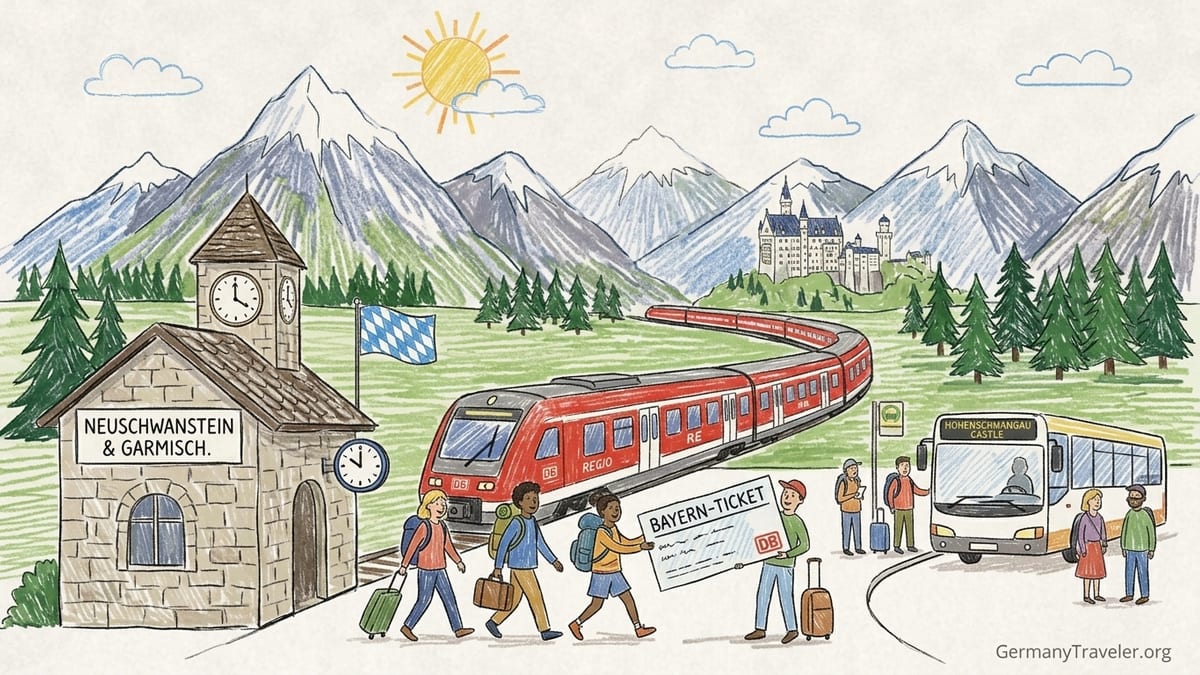
How the Bayern-Ticket Actually Works in 2026
The Bayern-Ticket is Deutsche Bahn’s regional day ticket for Bavaria. At the time of my trip Deutsche Bahn priced the second class Bayern-Ticket at 34 euros for one person, rising in steps to 74 euros for a group of five people traveling together. I verified the current price again while writing this in October 2026 through Deutsche Bahn and Bayerische Regiobahn information so you are working with up to date numbers rather than last year’s offers. The price covers unlimited travel for one day on Bavarian regional trains marked RB and RE, S-Bahn services, most U-Bahn and tram systems, and almost all local buses inside Bavaria. It does not cover long distance ICE, IC or EC trains, or Railjet style international expresses.
Two details shaped my planning more than anything else. First, on weekdays the Bayern-Ticket is only valid from 9 a.m. until 3 a.m. the following day. On Saturdays, Sundays and Bavarian public holidays it is valid from midnight, which makes early mountain starts much easier. Second, the ticket is not tied to a specific train or route. Once the clock passes 9 a.m. on a weekday, you have complete flexibility to hop on any eligible regional train, S-Bahn, U-Bahn or bus within Bavaria as often as you like until the service day ends.
The other quirk worth knowing is group composition. A Bayern-Ticket covers up to five people traveling together, and the price per person drops as the group size grows. On one alpine day I traveled with four friends from Munich to Garmisch-Partenkirchen and back on a single Bayern-Ticket for 74 euros total, which worked out to under 15 euros per person for a full day of trains and local buses. On solo days, 34 euros is less of a slam dunk, so I always compared it with individual regional fares inside the DB Navigator app. When one-way regional tickets were already above 25 euros each way, which is common on routes from Munich to Nuremberg or Berchtesgaden, the Bayern-Ticket usually won.
Buying the Bayern-Ticket: Counters, Machines and the DB Navigator App
I first bought the Bayern-Ticket the old fashioned way at a red Deutsche Bahn ticket machine inside Munich Hauptbahnhof. The process is straightforward if you take it slowly. I tapped the British flag icon for English, selected “Regional offers” and then “Bayern-Ticket.” The machine walked me through choosing second class, the number of travelers, and the date of travel. For the group ticket I had to enter one name, which must match the ID of at least one traveler, and that name was printed automatically on the ticket. The machine printed a long strip-style ticket that conductors could scan.
For subsequent days I switched to the DB Navigator app, which turned out to be easier and safer. Inside the app, I searched for my planned regional journey, then tapped the “Tickets” tab and scrolled to “Regional day ticket for Bavaria.” After paying by credit card, the Bayern-Ticket appeared in the “My tickets” section with a QR code. When tickets did not appear immediately, I learned to use the plus symbol in the app to add them manually with the booking number from the confirmation email. Conductors were very comfortable scanning the app ticket, even on non Deutsche Bahn trains like Bayerische Regiobahn.
I also tested the staffed counter once in Nuremberg while clarifying whether a planned side trip into Thuringia would still be covered. The agent confirmed that the Bayern-Ticket is limited to Bavaria with a few cross border routes, such as certain regional trains to Salzburg and Kufstein, and suggested alternative national tickets once my itinerary drifted too far. Buying at the counter costs a small service surcharge compared with the machine or app, so I would only use it if you need personal advice for a complicated route.
Typical Regional Trains and Station Changes on a No Car Trip
My no car week in Bavaria started and ended in Munich, because Munich Hauptbahnhof is the regional hub for the entire state. Almost every day began on a red DB Regio Regionalbahn or a blue and white Bayerische Regiobahn train rolling out of Munich on routes marked RE or RB. On the line toward Salzburg for example, I boarded a Bayerische Regiobahn RE 5 service that passed Rosenheim and Prien am Chiemsee on the way to the Austrian border. To reach Regensburg on another day, I used a Regionalexpress branded as alex from Munich to Regensburg, which the Bayern-Ticket covered because it was categorized as a regional service rather than long distance.
Station changes were easiest when I treated every journey as having two parts. First I used the Munich S-Bahn or U-Bahn to reach Munich Hauptbahnhof on the same Bayern-Ticket, usually on the S1 or S8 from the western suburbs. Then I transferred to a regional platform on the surface level. Travelers unfamiliar with the station can be intimidated by the construction work that has been ongoing around the station, but clear signage marks “Fernverkehr” for long distance and “Regionalzüge” for regional. The key was always looking for train numbers beginning with RE, RB or S, not ICE or IC.
Once in the smaller Bavarian cities, local transfers were usually in the same building or immediately outside. In Garmisch-Partenkirchen, buses for the Eibsee and other valley destinations leave from the square in front of the station. In Füssen, the bus to Hohenschwangau for Neuschwanstein Castle leaves from a dedicated bus area a short walk from the platforms. Because the Bayern-Ticket covers most of these buses, I simply boarded, found a free seat and showed my QR code or paper ticket when the driver asked. Only a few tourist oriented buses, such as special shuttle services up to cable cars, were not included.
Managing Luggage and Crowded Trains
Traveling Bavaria without a car made me think carefully about luggage. I opted for a 40 liter backpack and a small carry on suitcase, both of which I could lift easily into the overhead racks of a regional train. Many Bavarian regional trains have large open spaces at the doors for strollers and bikes, and I used those for my suitcase only when the carriage was not crowded. Conductors on my journeys between Munich and Nuremberg did politely ask cyclists to move hanging bikes to make room, but they never challenged my rolling suitcase when it was kept tidy.
Crowding varied dramatically by time of day. The 9 a.m. weekday validity start meant that the first useful Bayern-Ticket departures toward the Alps were often the 9:30 or 9:40 trains from Munich, exactly when day trippers and hikers swarmed the platforms. On a sunny Saturday in June my group boarded an almost full RE from Munich to Garmisch-Partenkirchen, where nearly every seat was taken and luggage space filled quickly. Standing with a backpack for the first half hour was not a big problem, but it is worth avoiding these peak departures if you are traveling with children or heavy bags.
On quieter routes and off peak departures, like an early afternoon Regionalbahn from Regensburg to Nuremberg, I had a full pair of seats to myself. I spread my map, kept my luggage on the overhead rack and worked on my laptop without feeling cramped. The key lesson was to pack light enough that I could always handle my own bags on stairs and short sprints between platforms. Bavarian stations are slowly adding more lifts, but you cannot rely on elevators being close or working, especially at smaller rural stops.
Delays, Missed Connections and How the Bayern-Ticket Softens the Blow
Anyone who spends several days on German regional trains will experience delays at some point, and I was no exception. On the day I traveled from Munich to Berchtesgaden, my morning regional express to Freilassing was delayed by fifteen minutes due to track works near Traunstein. Under a normal point to point ticket this would have threatened my planned tight connection to the waiting S-Bahn toward Berchtesgaden. With the Bayern-Ticket, the delay became a mild inconvenience instead of a crisis, because the ticket is not tied to any particular departure.
When we pulled into Freilassing too late to catch the planned S-Bahn, I simply checked the DB Navigator app, filtered for regional trains only, and boarded the next S4 departure about twenty minutes later. The Bayern-Ticket still covered it automatically. There was no need to rebook or discuss “train binding” with conductors, which is a stress factor many travelers encounter on sparpreis long distance tickets. The same flexibility helped when a planned RE from Nuremberg to Bamberg was canceled outright one afternoon. I walked to a bakery in the station, bought a coffee and boarded the following local train forty minutes later without thinking about ticket changes.
Compensation is more complicated. Regional tickets like the Bayern-Ticket are technically eligible for partial refunds under Germany’s passenger rights rules if you arrive very late at your final destination, but the process requires a paper form and is easier when you have a regular long distance ticket. In practice, I treated Bayern-Ticket days as flexible and avoided any itinerary where arriving thirty or sixty minutes late would ruin the entire goal of the day. I also found that allowing at least one full hour between regional connections on cross Bavaria trips, such as Berchtesgaden to Nuremberg, lowered my stress dramatically.
Routes and Destinations That Worked Surprisingly Well Without a Car
Before this trip I assumed that famous Bavarian sights like Neuschwanstein Castle and alpine resorts would be awkward to visit by public transport. Using the Bayern-Ticket convinced me otherwise. From Munich Hauptbahnhof I reached Füssen on a direct regional train operated by Bayerische Regiobahn, included in the Bayern-Ticket. At Füssen station, I walked a short distance to the bus bays and boarded the local bus to Hohenschwangau, also covered by the ticket. The total door to castle time was around two and a half hours, and I never had to park or navigate narrow village streets.
Garmisch-Partenkirchen was similar. A regional express from Munich reached Garmisch in about ninety minutes, and from the station square buses fanned out toward the Eibsee cable car for the Zugspitze, to the Partnachklamm gorge, and to nearby villages like Grainau. The Bayern-Ticket covered the train and the regular buses up the valley. It did not cover the Zugspitzbahn cog railway or the cable cars to the summit, which required separate mountain tickets, but those would not be included with a rental car either. What I did gain was the ability to read, nap or simply watch the countryside as we passed Murnau and other lakeside towns.
City to city hops also worked better than expected. From Munich to Nuremberg I took a slowly meandering Regionalexpress instead of the high speed ICE. The trip took just over two hours instead of roughly an hour, but with the Bayern-Ticket I paid the same flat price that also covered my afternoon tram rides out to the Nuremberg Documentation Center and back. On another day, I used the Bayern-Ticket from Nuremberg to Bamberg and back, then continued on to Regensburg the following morning with a new ticket. None of these days required a car, and the historic centers of all three Franconian cities are far easier to explore on foot and by tram.
The furthest I stretched the pass was to Salzburg and Berchtesgaden. Some regional routes from Bavaria cross into neighboring Austria, and many of them still honor the Bayern-Ticket on the regional portion of the trip. I boarded a Bayerische Regiobahn train from Munich to Salzburg and was able to ride it all the way to Salzburg Hauptbahnhof without an extra ticket, then connected to a local bus into the historic center. For Berchtesgaden, I used a combination of regional train and S-Bahn that remained within the Bayern-Ticket’s scope. Separate local tickets were only needed on a couple of cross border bus segments deeper into Austria for lake and mountain excursions.
When the 9 a.m. Weekday Start Time Really Matters
The Bayern-Ticket’s biggest constraint for many travelers is the 9 a.m. start time on weekdays. That rule is strict. Conductors checked my ticket on an 8:55 regional departure from Munich toward the Alps and politely explained that I would have been traveling without a valid ticket if the inspection had happened before nine o’clock. To avoid that problem, I trained myself to set search filters inside DB Navigator to exclude departures before 9 a.m. whenever I planned Bayern-Ticket days, unless it was a weekend or Bavarian holiday when the ticket is valid from midnight.
Practically, this meant rethinking my Alpine starts. On days when I wanted to hike long routes above Garmisch-Partenkirchen or Berchtesgaden, I favored Saturdays so that I could ride a 7 a.m. train out of Munich on the same Bayern-Ticket. That got me into the mountains by mid morning rather than closer to lunchtime. On weekdays I shifted to lower elevation hikes or city sightseeing, where a 10:30 arrival in Nuremberg, Regensburg or Augsburg was perfectly acceptable. In Bavarian cities and towns, museum opening times rarely made the 9 a.m. restriction a real issue.
The 9 a.m. rule also affects airport transfers. Arriving at Munich Airport on a weekday morning, I could not use a Bayern-Ticket to cover the S-Bahn into the city if I wanted to travel before 9 a.m. Instead, I bought a simple local transport ticket from the Munich transport association and saved the Bayern-Ticket for a later day trip. On my departure day, which fell on a Sunday, I did the opposite, using a Bayern-Ticket from Regensburg through Munich to the airport, including S-Bahn, because the weekend validity starts at midnight.
Comparing Bayern-Ticket Days With Renting a Car
Using only public transport for a week in Bavaria invited constant comparison with renting a car. A compact rental from a well known brand at Munich Airport would have cost me roughly 50 to 70 euros per day before fuel, tolls and parking. In contrast, a five person Bayern-Ticket day of castle hopping cost 74 euros total for all of us, including urban trams and buses, which came out clearly cheaper. Even solo days to distant corners like Berchtesgaden or Füssen approached break even territory once regional fares climbed.
The main trade off was time. Regional trains, especially those that weave through smaller towns, are slower than the Autobahn. A Munich to Nuremberg run that might take under two hours by car can stretch past two hours on a Regionalexpress if there are intermediate stops, although the difference is not huge. More remote mountain valleys without railheads at the end, like certain corners of the Allgäu, still require buses that add another 30 to 60 minutes. Where a car wins clearly is in extremely rural areas without dense bus networks or for travelers carrying bulky sports equipment.
On balance, my experience convinced me that first timers who plan to focus on Munich, Nuremberg, Regensburg, Bamberg, Füssen for Neuschwanstein and the classic Bavarian Alps around Garmisch-Partenkirchen do not need a car at all. The Bayern-Ticket, combined with local bus networks, handled all of these comfortably. I did occasionally wish for a car when I saw remote trailheads between bus stops, but I also appreciated arriving at beer gardens and alpine huts without worrying about driving or parking afterward.
The Takeaway
My week of using only the Bayern-Ticket and regional trains in Bavaria changed how I think about “needing” a rental car in Germany. With a single day ticket that covers almost every local and regional mode of transport inside Bavaria, I reached castles, baroque cities and genuine Alpine scenery. I dealt with crowded trains, the odd delay and an inconvenient 9 a.m. weekday start, but I also enjoyed the freedom to change plans on a whim, hop off in a village that caught my eye, and leave the driving to the professionals.
If you are comfortable reading basic departure boards and willing to carry your own luggage up and down station stairs, Bavaria opens up beautifully by train and bus. The Bayern-Ticket is not magic, and it will not make a remote farmhouse in the foothills accessible without some extra effort, yet for the majority of travelers it replaces the rental car far more often than expected. With thoughtful planning around timing and routes, you may find, as I did, that Bavaria without a car feels less like a compromise and more like the right way to see the region.
FAQ
Q1. What exactly does the Bayern-Ticket cover in Bavaria?
The Bayern-Ticket covers almost all regional trains marked RB and RE, S-Bahn services, U-Bahn and trams in Bavarian cities, and most scheduled local buses within Bavaria for one calendar day, but it does not include long distance ICE, IC or EC trains.
Q2. How much does the Bayern-Ticket cost for solo travelers and groups?
At the time of writing, a second class Bayern-Ticket costs 34 euros for one person and rises in steps up to 74 euros for a group of five people traveling together on the same ticket.
Q3. Can I use the Bayern-Ticket before 9 a.m. on weekdays?
On weekdays the Bayern-Ticket is only valid from 9 a.m. until 3 a.m. the following day, so you cannot legally ride regional trains or buses with it before 9 a.m. Monday to Friday. On Saturdays, Sundays and Bavarian public holidays, it is valid from midnight.
Q4. Is the Bayern-Ticket valid on ICE or IC high speed trains?
No, the Bayern-Ticket is limited to local and regional services. It is not valid on ICE, IC or other long distance trains, and you would need a separate ticket if you want to use those faster services.
Q5. Do I need seat reservations when using the Bayern-Ticket?
Regional trains covered by the Bayern-Ticket do not use seat reservations, so seats are first come, first served. At busy times you may have to stand for part of the journey, especially on popular routes from Munich to the Alps on sunny weekends.
Q6. Can I reach Neuschwanstein Castle and Garmisch-Partenkirchen with the Bayern-Ticket?
Yes, both Füssen for Neuschwanstein and Garmisch-Partenkirchen are on regional lines covered by the Bayern-Ticket, and the connecting local buses from the stations into the castle area and valleys are generally included as part of the Bavarian public transport network.
Q7. Is the Bayern-Ticket worth it for a single short trip?
The Bayern-Ticket offers the best value when you cover longer distances or travel as a group. For a single short regional hop, an individual point to point ticket may be cheaper, so it is worth comparing prices in the DB Navigator app before buying.
Q8. How do inspectors check Bayern-Tickets on trains?
Conductors typically walk through the train and scan either the printed Bayern-Ticket or the QR code in the DB Navigator app. For group tickets they may ask how many people are traveling together and check that at least one name and ID roughly match the ticket.
Q9. Can I interrupt my journey or change routes with the Bayern-Ticket?
Yes, within its validity period the Bayern-Ticket is not tied to a specific route or train. You can get off in intermediate towns, change plans and take different regional or local services as long as you stay within Bavaria and on eligible trains and buses.
Q10. Is traveling in Bavaria without a rental car realistic for first time visitors?
For itineraries focused on Munich, Franconian cities like Nuremberg or Bamberg, Regensburg, Füssen for Neuschwanstein and the Garmisch-Partenkirchen Alps, traveling with the Bayern-Ticket and regional transport is entirely realistic and often easier than renting a car, especially if you are comfortable reading basic train information.