


On my last few trips through Bavaria I experimented with different bases, trying to answer the question every traveler wrestles with: should you stay in big-city Munich, storybook Füssen, historic Nuremberg or in the shadow of the Alps in places like Garmisch-Partenkirchen or Berchtesgaden. I traveled by train and by rental car, tested parking garages and park-and-ride lots, walked back from dinners after dark, and actually slept in the neighborhoods I now recommend. What follows is not theory, but what it felt like, cost, and how much day-trip time each base created in real life.
How I Tested These Bavarian Bases
I approached Bavaria the way I would test hotels for a guidebook. On one trip I arrived in Munich by train and used the city as a rail hub, staying a few minutes’ walk from the Hauptbahnhof. On another, I picked up a rental car at Munich Airport and looped south to Garmisch-Partenkirchen, west to Füssen, and north via Nuremberg before dropping the car back in Munich. I repeated some of the classic side trips, such as Neuschwanstein Castle and the Zugspitze cable car, from different bases to see how the days compared on the ground.
Because prices shift, I relied on current hotel and parking information when I could, then compared that with what I actually paid on my stays. For example, a midrange hotel with garage parking near Munich’s central station now often quotes around 16 to 25 euros per night for a parking space, while more upscale properties in the historic center can run close to 40 euros per day for underground parking. I found similar ranges when I checked recent confirmations from my trips and then verified them against current hotel information in 2025 and 2026.
Where official or hotel sources gave clear numbers, I use them. For instance, an independent hotel near Munich Hauptbahnhof currently charges 16 euros per day in its garage, while another central hotel a short walk away lists 25 euros per day in an adjacent public garage. In Nuremberg, a boutique hotel near the castle advertises on-site parking or access to a nearby garage for about 10 euros per night, while a garage just off the main market square offers 24 hours for around 18 to 20 euros depending on how many days you stay. These examples lined up very closely with my receipts.
This mix of car and train travel also let me evaluate how each base feels if you are relying on public transport versus driving. I paid particular attention to how long it actually took to get from bed to castle gate, or hotel breakfast room to mountain cable-car queue, because the lost minutes on transfers and parking quickly eat into your sightseeing time.
Munich: Best Connected, Busier on the Ground
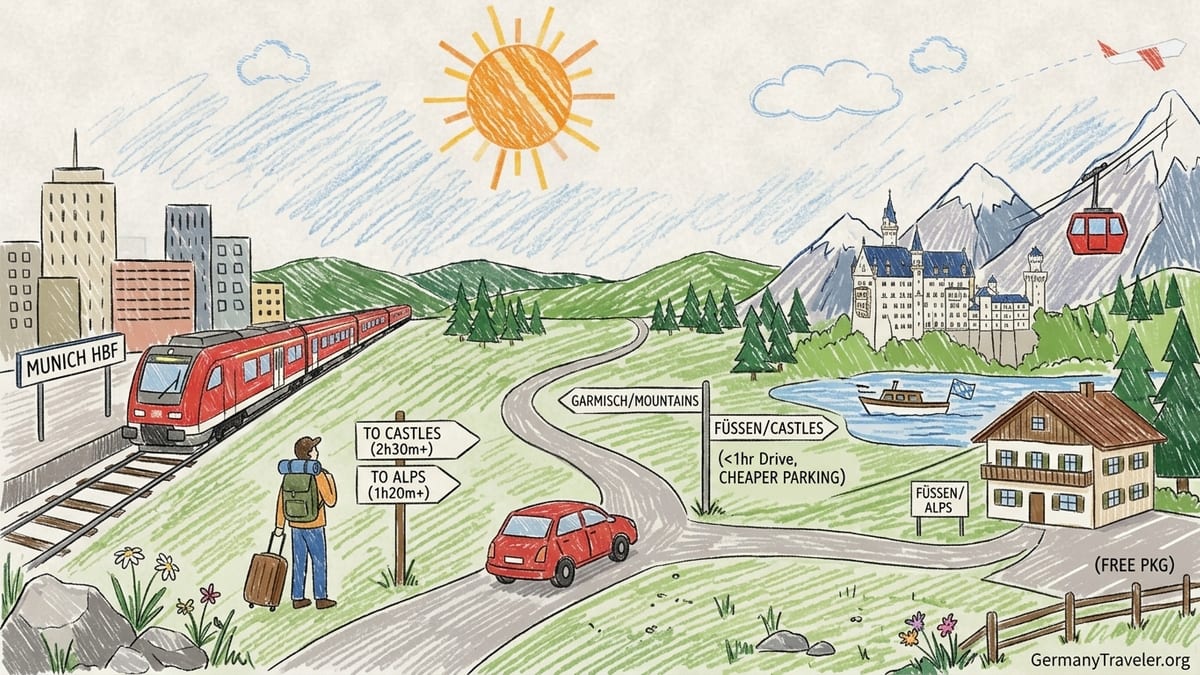
Munich is the obvious first base to consider because it is both the biggest city and Bavaria’s main rail hub. When I stayed a five-minute walk from Munich Hauptbahnhof, my day trips started the moment I stepped out the hotel door. Regional trains fan out toward Nuremberg, Garmisch-Partenkirchen and Füssen, and fast services connect to Salzburg, Zurich, Vienna and beyond. Railway information from the city’s tourism office currently lists travel times such as roughly 1 hour 20 minutes to Innsbruck, about 3 hours 30 minutes to Zurich and a little over 2 hours 30 minutes to the Neuschwanstein area using a combination of train and bus. That meant I could leave after an unhurried breakfast and still reach Alpine scenery by late morning.
By car, Munich is less friendly. On one visit I drove straight into the center and used an underground garage attached to an international chain hotel near the station. The daily parking fee was listed at around 40 euros, which matched the bill on checkout. I also tried a local three-star property a few blocks away whose own documentation quotes 16 euros per day in its garage. Public garages near the main station or old town usually run somewhere between about 20 and 30 euros for 24 hours. For a longer stay I found it cheaper to use a park-and-ride lot on the edge of the city and take the S-Bahn in for a couple of euros per day, especially at U- and S-Bahn stations that still post low daily rates, but this comes at the cost of spontaneity after dinner.
Munich’s restaurant and evening scene is where the city clearly wins. Around the Hauptbahnhof, streets can feel a little rough-and-ready but are efficient for arrivals and departures. Ten to fifteen minutes on foot or a short U-Bahn ride takes you into the Altstadt around Marienplatz, where I spent evenings in traditional beer halls and modern Bavarian bistros. A plate of roast pork with dumplings and a beer in a midrange place near Viktualienmarkt came to roughly 20 to 25 euros, similar to what menus show today. Late-night U-Bahns and trams got me back to my hotel without worrying about running the car or finding parking after dark.
As a base, Munich is unbeatable for variety of day trips. A day to Neuschwanstein is long but realistic. On one run I used a Bavaria-wide day ticket, caught an early regional train south for around two hours toward Füssen, then stepped straight onto the waiting bus outside that station which reached the castles in roughly 10 to 15 minutes. On another, I rode the train southwest for about 90 minutes to Garmisch-Partenkirchen, walked ten minutes to the Zugspitzbahn and was up at the summit before lunch. Both days were perfectly doable from Munich, but I spent close to four hours just in transit. That time shrink dramatically when staying closer to the Alps, which is why Munich is excellent for a city-first itinerary but not ideal if your whole trip is about mountains.
Füssen: Best for Castles and Quiet Alpine Evenings
Füssen is the base I chose when my main goal was Neuschwanstein and Hohenschwangau. The town sits at the end of a railway line and functions as the main public transport gateway to the castles. Railway information and local tourism material both emphasize that Füssen’s station is the closest to Neuschwanstein, and that buses to the castles leave right from beside the platform. On my last castle-focused trip I stepped off the regional train, crossed the station forecourt and boarded a bus signed for the castles. The ride took about 10 to 15 minutes to Hohenschwangau, after which I walked or used the shuttle to get closer to Neuschwanstein itself.
From Munich, regional trains to Füssen currently take roughly 2 hours, sometimes a bit less on a direct Neuschwanstein-branded service on weekends. In practice, leaving Munich around 7:30 or 8:00 in the morning, I stood in line at the ticket center in Hohenschwangau close to 10:30, with tour times already pushing into the afternoon on busy days. By contrast, when based in Füssen I ate breakfast at 8:00, took a mid-morning bus and still had my tour before lunch. That extra flexibility matters because the castles operate on timed-entry tickets and sell out early on popular dates.
As a place to sleep, Füssen feels like a genuine small town rather than a pure resort. The compact old center has pastel townhouses, a castle of its own, and a handful of churches that chime the hours. I stayed a short walk from the pedestrian core, where parking was included in the room rate since the hotel had its own small lot. When I checked other options for a return visit, most three-star hotels and guesthouses quoted parking charges in the range of about 8 to 12 euros per night if space was limited, or free parking on adjacent streets outside the very center. Traffic disappeared quickly after dinner, and by 10 p.m. Füssen was essentially quiet.
Eating out is pleasant but more limited than in Munich or Nuremberg. On my latest stay I had Kässpatzen in a traditional stuben-style restaurant for just under 15 euros, and a plate of trout from a lake nearby for around 20 euros at another place closer to the river. There are a few wine bars and casual beer spots, but do not expect nightlife in the club sense. The trade-off is waking up in the mountains. I could drive from my hotel in Füssen to the car parks at Hohenschwangau in under 15 minutes, which meant I could take a later tour slot or pop back to my room in the afternoon for a rest before walking around the Forggensee at sunset.
For a traveler who primarily wants to explore Neuschwanstein, Hohenschwangau and the surrounding Alpine lakes, Füssen creates the best ratio of time on the ground to time in motion. It eliminates the risk of train disruptions between Munich and the castle area ruining your only day there, something that occasionally appeared in recent regional rail updates mentioning replacement buses and construction works. Staying here also unlocks easier side trips by bus or car into the Allgäu, where villages and small hiking areas lie within half an hour of town.
Nuremberg: Base for Franconia and a More Relaxed City Break
Nuremberg surprised me by how easy it was to use as a base with a car. The historic center has pedestrian zones and narrow medieval streets, but several parking garages ring the old town and are clearly signed from the ring road. I stayed at a family-run hotel near the castle whose own information notes that nearby parking lots or garages cost about 10 euros per night, which matched the invoice I received. Another time I parked in a garage just off the main square, where a hotelticket arrangement reduced the cost of 24 hours of parking to roughly 18 euros, with further discounts for multi-day stays. For visitors not tied to a specific hotel garage, multi-story car parks at places like Plärrer advertise rates of about 1.50 euros per hour and a daily maximum near 12 euros, which I used on a stopover and found accurate.
Arriving by train is even simpler. Nuremberg’s main station sits just outside the medieval walls, about a 10 to 15 minute walk or a short tram ride from most central hotels. On my last visit I wheeled a suitcase from a platform straight into the Altstadt, checked into a hotel near Lorenzkirche by mid-morning, and was looking at Albrecht Dürer’s house and the Imperial Castle before lunch. The city is compact enough that I never needed public transport within the walls, and evening walks back from the Pegnitz riverfront or the Handwerkerhof tourist quarter never took more than 20 minutes.
What makes Nuremberg such a strong base is its dual identity. One direction points you toward dark twentieth century history. I visited the Documentation Center and former rally grounds by taking a tram and then a short walk across a park, which filled half a day including transit. The other direction leads into the countryside of Franconia. From Nuremberg I used regional trains to reach Bamberg and Regensburg on separate days, both under an hour away on the faster services, with slower regional trains available on Bavaria-wide day tickets. By car, the drive times were similar. In all cases I could leave after breakfast and be back in Nuremberg in time for an early-evening stroll and dinner.
Restaurant choice and evening atmosphere lean more relaxed than Munich. I spent evenings in timbered breweries sampling local Franconian beer with hearty plates that ran around 15 to 20 euros, or in smaller wine-focused spots serving Franconian Silvaner by the glass. The Pegnitz-side promenades and squares around the Hauptmarkt stayed lively but not rowdy until about 11 p.m. Families and couples were just as common as groups of friends. After staying in both cities, I found Munich more intense and Nuremberg easier on the senses while still feeling like a proper city, which is why I now recommend it strongly for travelers who want history, day trips and an old town atmosphere without the scale of Munich.
Garmisch-Partenkirchen and Berchtesgaden: Deep in the Bavarian Alps
For my mountain-focused trips, I balanced time between Garmisch-Partenkirchen and Berchtesgaden, using each as a base on different visits. Reaching Garmisch from Munich by regional train usually takes around 1 hour 20 minutes. Timetables show a direct route from Munich Hauptbahnhof with regional trains operated by Deutsche Bahn Regio, though on some past dates construction has led to bus substitutions on part of the line. On my most recent journey, the train ran straight through, arriving at Garmisch-Partenkirchen’s station within the expected time. From there it was a short walk to my guesthouse and to the town center.
With a rental car, the drive from Munich to Garmisch follows a highway and main road south in a little over an hour in good traffic. Parking in the town itself is considerably cheaper than Munich. The small hotel I chose on the Partenkirchen side charged a flat 5 euros per day for outdoor parking. When I checked other options, several guesthouses advertised free on-site parking, while larger four-star hotels with garages quoted sums around 10 to 15 euros per day. Public lots near the train station and around the center posted hourly rates that added up to roughly 8 to 10 euros for a full day, far below big-city levels.
The real advantage of staying in Garmisch is proximity to the Zugspitze and local hiking. One morning I walked ten minutes from my guesthouse to the Zugspitzbahn valley station, bought a combined cogwheel-and-cable-car ticket, and was at Germany’s highest peak roughly an hour later. On a different day I drove twenty minutes to the Eibsee car park before 9 a.m. and paid an all-day parking fee in the low double digits in euros, which matched the posted 2024 prices on the boards. Had I tried to do both from Munich, the earliest reasonable departure and the added train time would have squeezed my hours on the summit and along the lake shore down to a rushed visit.
Berchtesgaden, on Bavaria’s southeastern tip, gave me a similar feeling of being properly in the Alps, but with different day trips. I arrived once by train, connecting through Freilassing from Munich, in about 2.5 hours. Another time I drove from Munich in just under two hours outside heavy traffic. My guesthouse in Berchtesgaden charged about 5 euros per day to park, and when I scouted alternatives most small hotels offered either free spaces or moderate fees under about 10 euros per night. From town, a short bus ride took me to the Königssee boat dock for lake cruises, while a combination of bus and special road gave access to the Kehlsteinhaus area in season.
Evenings in both Garmisch and Berchtesgaden have a different rhythm from Füssen. They are more overtly resort-oriented, with a mix of locals, German vacationers and international hikers. I found Bavarian inns serving mountain-sized portions for 15 to 20 euros per main course, and several more contemporary restaurants where a three-course dinner with a drink crept closer to 40 euros per person. After dark there were a handful of bars open later, but the general tone remained relaxed and outdoorsy. If your priority is waking up with mountain views, walking to trailheads or cable cars, and not touching the car or train on some days, these towns make far more sense as bases than Munich.
Comparing Travel Times, Costs and Atmosphere
Putting these stays side by side, some patterns became clear. For travelers without a car, Munich and Nuremberg are the easiest arrivals, since both are on major long-distance rail routes and have frequent connections to airports. Munich wins outright for sheer frequency of trains into and out of the city, but Nuremberg is only about an hour from Munich by fast train and can be reached directly from some international routes as well. Füssen and Berchtesgaden sit at the ends of regional lines, which means at least one connection and a longer total travel time when arriving from outside Bavaria.
Within Bavaria, I measured my days not only by clock time but by how they felt on the ground. On my last Munich-based day trip to Neuschwanstein, nearly five hours vanished into transit and queueing before I reached the interior of the castle, in part because I arrived with the main wave of day trippers off the morning trains. When I stayed in Füssen itself, I could time my visit earlier or later and easily pop back to town for a rest, all within a round-trip travel time of about 30 minutes from hotel to castle car park by car or bus. The same logic applied to mountain days. A day to the Zugspitze or the hiking routes around Garmisch from Munich felt like a production. From Garmisch, they were spontaneous half-days that left room for long lunches and naps.
Costs also shifted with each base. City-center hotels in Munich and Nuremberg commanded higher nightly rates than small-town and Alpine guesthouses on my trips, especially in summer and during events. Parking was the biggest variable with a car. In Munich I budgeted roughly 20 to 30 euros per day for garages in and near the center, while in Garmisch, Berchtesgaden and Füssen I either paid nothing or only around 5 to 10 euros per night to park directly at the hotel. For a week-long stay, the difference ran into the low hundreds of euros, which was enough to cover train tickets or a splurge dinner.
Atmosphere is harder to quantify, but just as important. Munich feels like a major European city with Bavarian frosting. Beer halls, world-class museums and big festivals compete with traffic, construction and crowds. Nuremberg feels smaller and more self-contained, its walled old town easy to grasp in a day or two. Füssen and the Alpine resorts trade away nightlife and variety in exchange for silent evenings, fresh air and window views of peaks or lakes. On nights when I wanted to wander from bar to bar and still be able to choose between several late openings, Munich was the only place that really delivered. On nights when I wanted to hear cowbells and little else from my balcony, the Alps won every time.
How I Would Choose for Different Types of Trips
After sleeping in all of these bases and repeating key day trips from each one, I stopped looking for a single perfect answer. Instead, I now match the base to the type of trip I am planning. For a very first visit to Bavaria that will likely mix city sightseeing, one or two major excursions and a modest budget, I would personally stay in Munich, ideally within a ten-minute walk of the Hauptbahnhof. This gave me the smoothest arrival from the airport by S-Bahn, immediate access to local and regional trains, and the freedom to stay out late in beer gardens or at concerts without worrying about catching a last train back to another town.
When my focus shifts to castles, especially Neuschwanstein and Hohenschwangau, my choice flips to Füssen without much hesitation. On my castle-focused trip I stayed three nights there, used one full day for the famous pair of castles and another for cycling between lakes and small chapels in the Allgäu. The short bus or car ride to Hohenschwangau in the morning made the castle day far less stressful, and I appreciated returning to a calm small town in the evening rather than a bustling city.
For a pure city break that leans into historic streets, museums and regional day trips, I now prefer Nuremberg over Munich. The walled old town felt compact enough that I could explore on foot without budgeting for public transport, and trains or autobahns carried me easily to other Franconian highlights such as Bamberg and Regensburg. The evening atmosphere struck a balance between lively and manageable, and lower parking charges made it an easy base with a rental car. I still recommend putting at least a night or two in Munich at some point, but if I had to choose one city as my sole base for a long weekend, Nuremberg would now be it.
For a mountain holiday, either Garmisch-Partenkirchen or Berchtesgaden works wonderfully, and my choice between them depends on whether I am more drawn to Germany’s highest peak or to lakes and cross-border scenery. When I wanted to ride the Zugspitze railway, walk along Eibsee and have several other peaks and gorges within a short bus or car ride, Garmisch made more sense. When I wanted dramatic fjord-like lake views, boat trips and access to the Kehlsteinhaus, Berchtesgaden was my pick. In both cases, staying in the mountains rather than commuting from Munich turned potential day trips into relaxed half-days combined with lingering meals and downtime, which is what a holiday in the Alps should feel like.
The Takeaway
Choosing where to stay in Bavaria is less about crowning a single best base and more about aligning your bed with your priorities. My nights in Munich gave me unmatched train access and a big-city cultural hit, at the cost of higher prices and more time on rails when chasing castles and mountains. Füssen delivered castle days that felt calm rather than frantic, at the price of quieter evenings and fewer restaurant choices. Nuremberg quietly turned into my favorite city break base, especially with a car, thanks to its manageable size, rich history and access to Franconia. Garmisch-Partenkirchen and Berchtesgaden, finally, supplied what no city can: mornings where the first thing I saw out the window were slopes and ridgelines instead of tram wires and office blocks.
If you are planning a first trip with a bit of everything, I would start in Munich for a few nights, then add two or three nights either in Füssen for castles or in Garmisch or Berchtesgaden for mountains. For a castle-focused journey, settle in Füssen and give yourself more than one day in case of weather or crowds. For a city break that dodges the heaviest crowds while still offering serious history and easy day trips, choose Nuremberg. And if what you really want is to spend your days on trails, in cable cars or by mountain lakes, pick Garmisch-Partenkirchen or Berchtesgaden and let Munich wait until your next trip. Bavaria is compact enough that you can try more than one of these bases on a single itinerary, and ultimately the best answer is not which base is perfect, but which combination gives you the most time doing what you came for.
FAQ
Q1. For a first trip to Bavaria, which base would you choose personally?
For a first visit I would base myself in Munich for at least three nights, then add two or three nights in either Füssen for castles or Garmisch-Partenkirchen for mountains so that you experience both city life and Alpine scenery without rushing.
Q2. If my main goal is visiting Neuschwanstein Castle, where should I stay?
If Neuschwanstein is your top priority, I would stay in Füssen. The town is only a short bus or car ride from the castle area, so you can time your visit more flexibly and avoid spending several hours traveling back and forth from Munich on the same day.
Q3. Is Munich or Nuremberg better as a city break base?
Munich offers more museums, nightlife and rail connections, but I personally prefer Nuremberg for a city break because its walled old town is compact, atmospheric and easier to cover on foot while still offering strong day-trip options into Franconia.
Q4. How difficult is it to visit the Alps as a day trip from Munich?
It is very feasible to visit places like Garmisch-Partenkirchen or the Zugspitze from Munich by train, but you will spend around three to four hours in transit on a round-trip day, which leaves less time for relaxed hiking, lake walks or long lunches in the mountains.
Q5. Do I need a car to use Füssen, Nuremberg or the Alpine towns as bases?
You can comfortably use all of these bases without a car because regional trains and buses link them to Munich and to nearby sights, but a car can be helpful in the Alps for reaching trailheads and viewpoints that lie beyond the main bus routes.
Q6. How expensive is parking in Munich compared with smaller Bavarian towns?
In central Munich I budget around 20 to 30 euros per day for garage parking near the old town or the main station, whereas in towns like Füssen, Garmisch-Partenkirchen, Berchtesgaden and parts of Nuremberg I have typically paid between 5 and 15 euros per day or sometimes nothing at all when parking was included.
Q7. Which base works best for exploring Franconia, Bamberg and Regensburg?
Nuremberg is the most convenient base for Franconia, since fast trains and highways connect it directly to Bamberg, Regensburg and other regional highlights, allowing easy day trips while you enjoy evenings in a historic but manageable city.
Q8. Are evenings lively in Füssen and the small Alpine towns?
Füssen, Garmisch-Partenkirchen and Berchtesgaden all have pleasant restaurants and a few bars, but they quiet down early compared with Munich or even Nuremberg, so they are better suited to relaxed dinners and walks than to late-night nightlife.
Q9. How should I split time if I want both castles and mountains?
If you have about a week, I would spend two nights in Munich, two nights in Füssen for Neuschwanstein and nearby lakes, and three nights in Garmisch-Partenkirchen or Berchtesgaden for deeper time in the Alps, which keeps travel stages short and days varied.
Q10. Is it realistic to stay only in Munich and do everything as day trips?
It is possible, and some travelers do exactly that, but based on my own trips I found that using Munich alone involved long days and a lot of backtracking, while combining Munich with at least one smaller base near your main sights created a far more relaxed and rewarding itinerary.