


Bavaria officially counts more than 200 lakes, from city-edge swimming spots to high alpine basins that stay icy well into summer. After several trips based in Munich and beyond, lingering for full days and sometimes long weekends, a handful of lakes stand out not just as beautiful in photos but as places I would genuinely return to. The difference, I have learned, only appears once you have parked the car or stepped off the train, found a patch of shore, and watched how a lake feels over four or five unhurried hours.
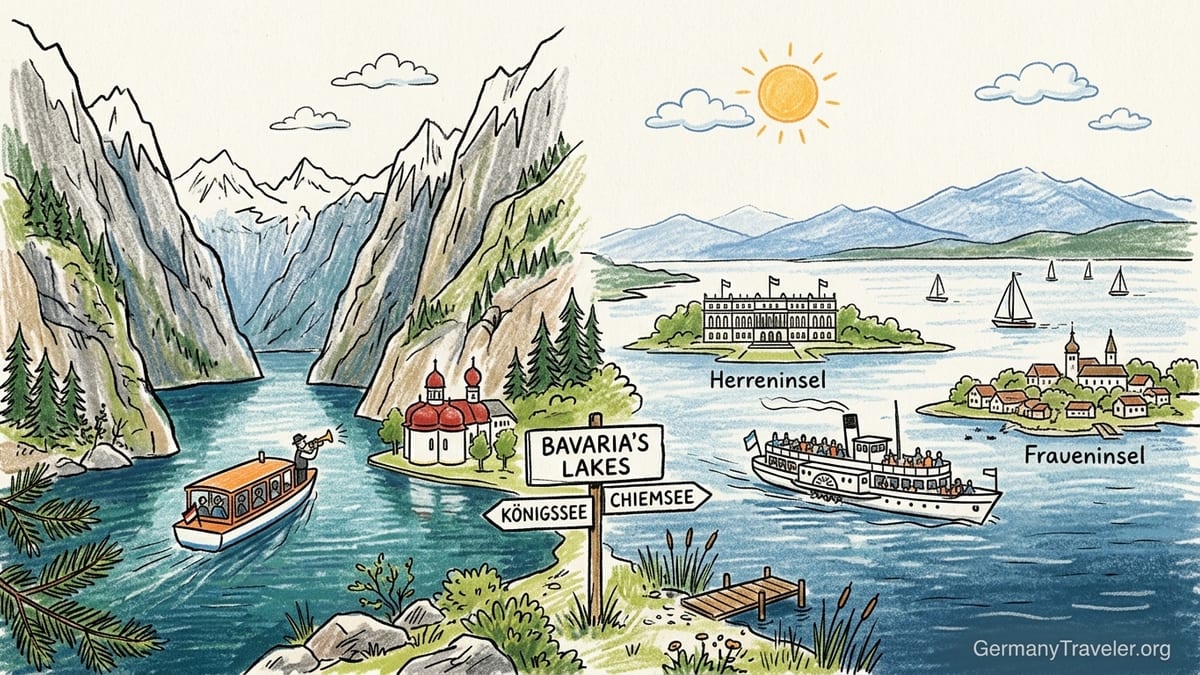
Königssee: A Fjord-Like Lake That Demands Time, Not Just Photos
My first glimpse of Königssee was the classic one: stepping off the bus at Schönau am Königssee and seeing the green water framed by souvenir stalls. It is easy to be cynical at that point. Parking lots sprawl behind the village and in high season they fill early. On one July visit I arrived by bus from Berchtesgaden Hauptbahnhof and watched latecomers circle the lots with visible frustration. Yet once you walk past the stands and board one of the silent electric boats run by Bayerische Seenschifffahrt, Königssee quickly justifies the hype. Within minutes, the village falls away and the lake narrows into a steep-sided corridor of rock that feels more like a flooded canyon than a typical alpine lake.
What makes Königssee a place I would return to is not only that iconic moment when the boatman stops mid-lake to play a trumpet echo against the cliffs, but how the day stretches after you disembark at St. Bartholomä or Salet. On one cool September afternoon I stayed off the first boat and caught a mid-morning departure instead, which meant the baroque pilgrimage church at St. Bartholomä felt calmer. I walked the short lakeside path, then simply sat at the beer garden with a plate of smoked fish from the local fishery and watched clouds drift around the Watzmann east face. The backdrop is theatrical, but the mood, once you sit down with time, can be surprisingly gentle.
Access is straightforward without a car. Trains from Munich connect to Berchtesgaden, and from there local buses run to Königssee in around 15 minutes, covered by regional tickets or the Deutschland-Ticket on most services. Boat tickets are not cheap and have risen in recent years; a full trip to Salet and back for adults now sits in the several tens of euros range, with combination offers like the See-Gipfel-Ticket tying in the Jennerbahn cable car for those who want a lake-and-mountain day. I have used the standard lake ticket and then bought a separate Jennerbahn ticket later, preferring to keep the day flexible, but for visitors set on doing both, the combination tickets can simplify the budgeting.
Swimming at Königssee is technically possible in some sections but it has never felt like a swimming lake to me. The water is cold even in high summer, there are strict rules in the national park, and most people stay on the trails or terraces. After a few visits, my pattern is fixed: arrive via bus in the morning, take a boat to St. Bartholomä, walk and linger, then either continue to Salet and the short trail to Obersee or ride back and use the remaining hours on a hike near the Jenner cable car. Königssee is crowded at the landing stages and on early boats, especially in August, but once I let go of the idea of solitude and accepted it as Bavaria’s grande-dame lake excursion, the experience became easier to enjoy. It remains the one lake in Bavaria where I still feel small every time, in a good way.
Chiemsee: Island-Hopping On Bavaria’s “Inland Sea”
Chiemsee, east of Munich, is the lake I return to when I want a full day that mixes water, history and the slightly faded charm of big excursion steamers. The practical hub is Prien am Chiemsee. Here, regional trains from Munich drop you close enough to walk or connect to the narrow-gauge Chiemsee-Bahn, a little steam railway that shuttles down to the harbor at Prien/Stock in summer. I have done both; on a hot June day when the train was late, I appreciated the Chiemsee-Bahn simply for saving my energy for the lake.
Boat services crisscross the lake to the Herreninsel, with its Herrenchiemsee palace built by King Ludwig II, and the Fraueninsel, a smaller island with a working Benedictine convent and low houses clustered around tiny lanes. Current price lists from Chiemsee Schifffahrt show adult fares in the high single to low double digits for island touring, depending on the exact route and whether you combine it with the Chiemsee-Bahn. There are also combination tickets that package train and boat, which can be cost-effective if you intend to visit both major islands in one day.
Chiemsee does not have the turquoise shock of Eibsee or the intimacy of Tegernsee. What it offers after several hours is a feeling of old-fashioned travel. On one visit I took a mid-morning boat to Herreninsel, walked through the woods to the palace, then in late afternoon rode over to Fraueninsel for an early dinner at a simple fish restaurant near the landing stage. The mountain backdrop, with the Chiemgau Alps hazy in the distance, felt less dramatic than the Berchtesgaden Alps but more expansive. You see sailboats scattered far out, long views of reed beds and the low shoreline, and if you stay late enough for a return boat at sunset, the lake can glint copper under the sky.
Swimming is possible from some mainland beaches and lakeside lawns around Prien and other shore villages; families spread out with windbreaks and inflatable toys. Parking by the harbor fills quickly on summer weekends and carries paid daily rates, while cyclists with touring bikes often lock up near the docks and treat the islands as a car-free interlude. After a few repeat visits, I have come to see Chiemsee as a lake that rewards a slower day: one island in the morning, a long lunch, a second island or a lakeside swim in the afternoon, and no attempt to “do” the whole lake. It feels broad and open, like Bavaria’s inland sea, and I keep finding excuses to ride those white boats again.
Starnberger See: Munich’s Deep-Water Escape On The S‑Bahn
Of all the lakes I have visited around Munich, Starnberger See is the one I have returned to the most, simply because it is so easy to reach by train. S‑Bahn line S6 and regional trains from Munich Hauptbahnhof run south to Starnberg and Tutzing along the Munich–Garmisch-Partenkirchen railway in around 25 to 40 minutes, depending on the service. I have taken everything from early-morning commuter trains with half the carriage in hiking boots to late-evening S‑Bahns full of people with damp towels slung over their shoulders. From Starnberg station, the lakefront promenade is only a short walk away, with lawns where people spread out swimsuits, kiosks selling ice cream and coffee, and the landing stages for lake cruises.
Starnberger See is deep and relatively cold, which means the water stays refreshingly bracing even on the hottest July days. Over several summers I have swum from different spots: the open lawns near Starnberg, the popular recreation areas around Feldafing and Possenhofen, and quiet patches near Tutzing. The beaches closest to train stations can get crowded on hot weekends, but walks of 15 to 20 minutes along the shore usually lead to less busy stretches where locals slip into the water from small gravel coves. Local information from Munich’s tourism board and regional rail guides often highlight the Feldafing–Possenhofen “Paradies” area as a classic choice, and it lives up to the name when the evening light turns golden and the lake surface settles.
Passenger boats operated by Seenschifffahrt am Starnberger See run cruises until mid-October in current seasons, with round trips departing from Starnberg and Tutzing. I have taken both a full-lake cruise and shorter segments, using the boat almost like a floating bus to reach other shores. Ticket prices depend on the route but are generally in the teens for standard adult round trips. The experience is less about sightseeing commentary and more about gentle progression along villas, boathouses and wooded coves, with the Alps faintly visible to the south on clear days.
After several multi-hour days here, the feeling I associate with Starnberger See is “urban escape with depth.” It is busy and developed, with grand houses lining much of the shore, but if you arrive early on a weekday, swim before lunch and then linger on the promenade with a coffee, the lake takes on a relaxed, almost Riviera-like air. In shoulder seasons, especially in September and early October, the crowds thin and the train ride back to Munich in the evening, with still-damp hair and tired arms from long swims, has become one of my favorite Bavarian routines.
Tegernsee: Easy Trains, Village Promenades And Mountain Backdrops
Tegernsee is often suggested to Munich visitors as the “easy mountain lake,” and in my experience that is accurate. Trains run hourly from Munich to Tegernsee station in roughly one hour, usually covered by regional day tickets and the Deutschland-Ticket on appropriate services. When you step off the train, the lake is a short walk downhill. On my first visit, I arrived around 10:30 in the morning, walked past the former monastery complex, and then let the day unfold along the waterfront promenade.
The lake itself is set in a classic amphitheater of peaks from the Mangfall mountains, with villages like Tegernsee, Rottach-Egern, Bad Wiessee and Gmund spaced around the shore. A fleet of excursion boats links these towns. Timetables show several lines operating between spring and autumn, and updated price lists indicate that adult tickets for simple crossings stay in the single digits, while broader round trips climb into the teens, with special combined lake-and-mountain tickets when partnered with nearby cable cars such as the Wallbergbahn. On one June afternoon I used the boat like a hop-on, hop-off service: boarding in Tegernsee, disembarking in Rottach-Egern for cake at a lakeside café, then crossing to Bad Wiessee for a walk along the quieter western shore.
Swimming at Tegernsee can be very pleasant in high summer, though much of the immediate shoreline is either built up or reserved for lidos and lakeside facilities. Public baths around the lake offer changing rooms, lawns, and often small snack bars. I have spent a full afternoon at one of these Strandbäder, alternating dips in the surprisingly clear water with long stretches on the grass watching stand-up paddleboarders cross the bay. The lake warms more than Starnberger See but remains cooler than many lowland lakes, which suits those who enjoy a brisk swim.
What makes Tegernsee a place I would happily return to is the combination of infrastructure and calm. Even on busy Sundays the atmosphere along the promenades feels village-like rather than overrun, and it is easy to pair a half-day hike in the surrounding hills with time at the lake. Restaurants run from traditional Bavarian inns near the former monastery, where I have lingered over roast pork under chestnut trees, to modern cafés with good espresso and generous Kuchen slices. After several visits in different seasons, Tegernsee has become my default recommendation when friends ask for a one-day taste of “proper mountains and a good lake” without renting a car.
Walchensee: Wild Water And Narrow Roads
Walchensee is the lake that changed most in my mind between looking at photographs and actually spending a full day there. In pictures, it appears as a Caribbean-colored basin fringed by forest. In reality, it is that and more, but the logistics and the road along the southern shore matter. I have always reached Walchensee by car from Munich, driving past Kochelsee and then up a winding road that climbs through forest before dropping toward the lake. On my last summer visit in late June, traffic slowed near the toll section where the scenic road continues toward Jachenau, and signage made it clear that both access and parking along parts of the shore are regulated and controlled.
The lake’s color is indeed striking. From the gravel beaches near Walchensee village you look out on water in shifting bands of pale turquoise and deep blue, with the Herzogstand and Jochberg peaks rising steeply above. Windsurfers and kiters line up offshore when the thermal winds pick up; on calmer days, stand-up paddleboards drift along the coves. Swimming here is for people who enjoy cold water. Even after warm spells, plunging in can be a shock, but once I stayed in for a few strong strokes, it became exhilarating. On that late June day, families picnicked along the shore while more experienced swimmers cut longer lines parallel to the beach.
Parking around Walchensee is paid and, based on my experience and on recent local reports, increasingly enforced. Ticket machines along popular stretches require you to register your stay, and some access roads toward the quieter eastern and southern banks have additional charges or restrictions. I have learned to arrive early, preferably before 9:30 in the morning on summer weekends, to secure a spot without circling. There is no train directly to Walchensee; public transport involves regional trains to Kochel and then a bus up to the lake, which can work well outside peak traffic but requires attention to the timetable.
After several hours, the feeling at Walchensee is quite different from Starnberger See or Tegernsee. It is wilder and more elemental, with fewer promenades and more raw shore. You watch clouds move fast over the mountains, hear the wind in the trees behind you, and see the water shift color as the light changes. Cafés and simple restaurants in Walchensee village and along the northern road offer fish dishes, cakes and coffee, but the lake still feels more like a nature destination than a resort. Each time I leave, tired from swimming and a little sunburned, I find myself planning how to return on a quieter weekday to let that intense turquoise sink in again.
Eibsee: Early Starts Beneath The Zugspitze
Eibsee, at the foot of the Zugspitze near Grainau and Garmisch-Partenkirchen, is the Bavarian lake that has challenged my patience the most. It is almost unbelievably beautiful, with small islands scattered across clear, green water and the north face of Germany’s highest mountain towering above. It is also accessed by a single, narrow road that feeds both the Eibsee car park and the base station of the Cable Car Zugspitze. On my first visit, I underestimated what this meant on a sunny August weekend. By mid-morning, cars were backed up well down the approach road, and parking staff were turning vehicles away at the entrance once lots were full.
Since then, I only visit Eibsee early or by public transport. Trains run from Munich to Garmisch-Partenkirchen in roughly 1.5 hours, and from there the cogwheel train toward the Zugspitze stops at Eibsee station, a short walk from the lake. There are combination tickets for the Zugspitze summit that include the cogwheel train and cable car, with current prices sitting in the many tens of euros per adult, but for lake-focused days I have simply used regular regional tickets and walked down from the stop. Parking fees at the Eibsee and Zugspitzbahn lots are charged around the clock for cars inside the barrier system, with restrictions on oversized vehicles and overnight stays. Local information boards highlight the risk of traffic jams in summer and recommend arriving early in the day.
The classic Eibsee experience is the lake circuit. A well-marked path loops roughly eight kilometers around the shore, sometimes at water level, sometimes slightly above it, with constant views of bays and islands. I have walked this loop in both directions, always starting clockwise from the lakeside hotel. In several places along the route, small gravel beaches and rocky outcrops invite swimming. The water is cold but crystal-clear; on a still morning you can see submerged tree trunks and the drop-off into deeper blue. Boat rental huts near the main access area rent pedal boats and rowing boats in the low double digits per hour, and on one hot afternoon I joined the small flotilla of people slowly circling an island by pedal boat, stopping to simply float under the cliffs.
Food and drink options cluster around the main access point near the hotel and cable car station: a lakeside restaurant with outdoor terrace, kiosks selling snacks and ice cream, and, higher up, the facilities attached to the Zugspitze base station. Once you are on the far side of the lake, there are no services, which is part of the appeal. After several hours at Eibsee, what stays with me is the contrast between that busy hub and the moments of real quiet halfway around the loop, looking back at the Zugspitze mirrored in still coves. It is one of the few Bavarian lakes where I feel that famous photographs actually underplay the experience, provided you are willing to beat the crowds by starting early or visiting outside peak months.
The Takeaway
Exploring Bavarian lakes only through postcards or drone shots flattens the experience. After returning multiple times to Königssee, Chiemsee, Starnberger See, Tegernsee, Walchensee and Eibsee, I have learned that the question is less “Which lake is most beautiful?” and more “Which lake suits the kind of day you actually want?” If you want a grand scenic journey with a sense of awe, Königssee and Eibsee both deliver, though each requires tolerance for crowds and higher prices. If you prefer a blend of history and relaxed cruising, Chiemsee’s islands offer exactly that. For quick escapes from Munich by train with good swimming, Starnberger See and Tegernsee are hard to beat, while Walchensee scratches the itch for wilder water and mountain views without as much built infrastructure.
Across all of them, the pattern is the same. Arrive early, ideally by rail where possible, give yourself more time than you think you need, and pick one or two key experiences rather than trying to tick every box. A single long swim, an unhurried walk along a lakeside path, or an afternoon on a slowly looping boat can tell you more about a Bavarian lake than any ranking ever will. These six are the ones I would happily return to, not for one more photo, but for one more full day lived by their shores.
FAQ
Q1. Which of these Bavarian lakes is easiest to reach from Munich without a car?
Starnberger See and Tegernsee are the simplest. Both have direct hourly trains from Munich, and from the stations it is only a short walk to the water and to boat piers or lakeside promenades.
Q2. If I only have one day, should I choose Königssee or Eibsee?
Choose Königssee if you want a classic boat journey in a national park setting with the option to extend the day on nearby mountain lifts. Pick Eibsee if you prefer a lake circuit hike and the possibility of combining it with a Zugspitze summit trip, accepting that both are busier and more expensive.
Q3. Where is swimming most enjoyable for casual swimmers?
For relaxed swimming with easy access and facilities, Starnberger See and Tegernsee are best. They offer lakeside lawns, designated bathing areas, and reasonably warm water in summer compared with deeper, colder lakes like Königssee and Eibsee.
Q4. Which lake is least crowded in summer?
No popular Bavarian lake is truly quiet in peak season, but Walchensee and some parts of Chiemsee feel less congested than Eibsee or Königssee, especially if you avoid obvious hotspots and arrive on weekday mornings rather than weekends.
Q5. Can I visit these lakes with the Deutschland-Ticket?
Yes, in many cases. The Deutschland-Ticket covers regional and local trains and many buses. It works well for reaching Starnberger See, Tegernsee, Berchtesgaden for Königssee, and Garmisch-Partenkirchen for Eibsee. However, boat trips, cable cars and some private buses require separate tickets.
Q6. Are boat tours worth the cost on every lake?
Boat tours are central to the experience on Königssee and Chiemsee, where they open up islands and shorelines you cannot otherwise reach. On Starnberger See and Tegernsee they are pleasant but optional if you are mainly interested in swimming and lakeside walks.
Q7. How cold is the water in these lakes during summer?
In high summer, surface temperatures at Starnberger See, Tegernsee and parts of Chiemsee often reach levels most casual swimmers find comfortable. Walchensee, Eibsee and Königssee stay noticeably colder, so even short swims can feel invigorating rather than leisurely.
Q8. Do I need to reserve anything in advance?
You usually do not need to reserve lake boats, but it can be wise to buy advance tickets for popular cable cars such as the Zugspitze lift or Jennerbahn on weekends and holidays. Lakeside hotels and guesthouses book up quickly around Tegernsee, Eibsee and Königssee in summer and during school holidays.
Q9. Is it realistic to combine two lakes in one day?
It is possible to combine, for example, Starnberger See and Ammersee or Tegernsee and Schliersee in one day, but with the six lakes described here, you gain more by giving each its own day. Distances, transfers and crowds make rushed itineraries feel more stressful than rewarding.
Q10. Which lake would you recommend first for a family with children?
For families, Tegernsee and Chiemsee work particularly well. Both offer easy walks, playgrounds or open lawns near the shore, boat trips that are not overly long, and a mix of cafés and restaurants where it is simple to take breaks during the day.