


I spent an entire day at Therme Erding, the huge thermal spa complex just outside Munich, to find out what it actually feels like to visit in 2026. Rather than a quick dip between flights, I treated it as a full mini-holiday: I booked in advance, arrived for opening, tried the water slides, lingered in the thermal pools and spent several hours in the textile-free sauna area. What follows is a practical, first-hand account of what my day was really like, what I paid, where the experience shined and what I would book differently next time.
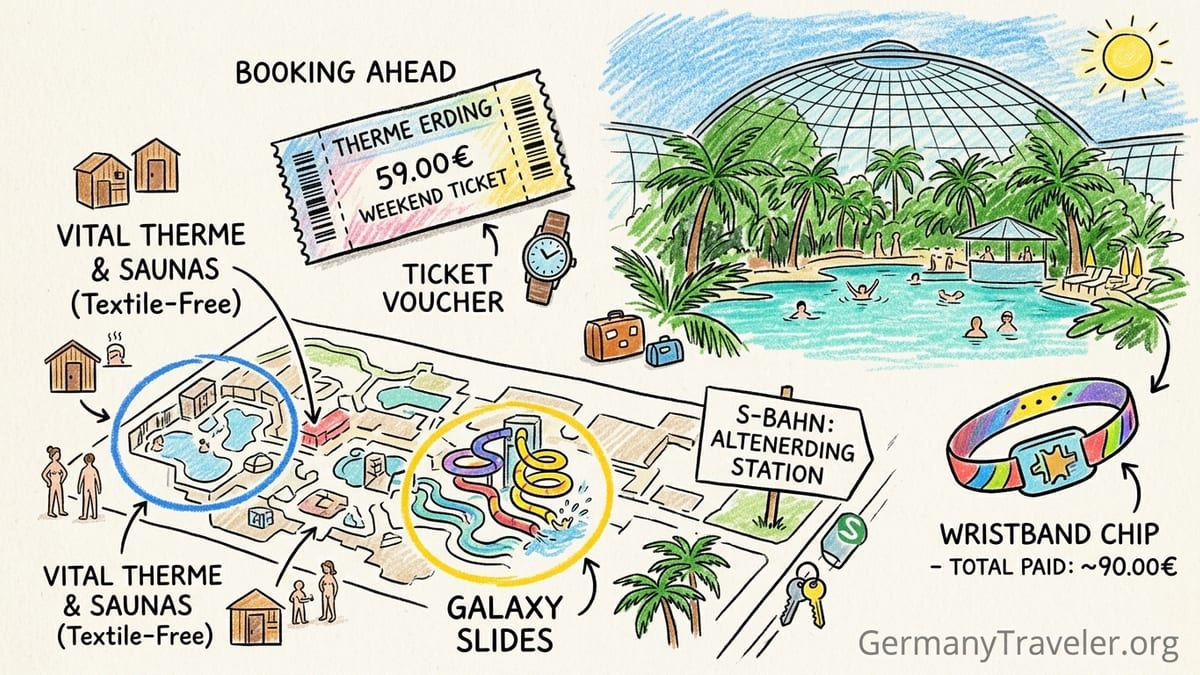
Booking Ahead and What I Actually Paid
I visited Therme Erding on a Saturday in late August 2026, right in the middle of Bavarian school holidays. That is exactly the type of day when the spa recommends advance reservations, and after seeing the crowds at midday I was glad I followed that advice. A few days before my visit, I used the official online shop to buy a voucher for a full day in the main Therme area, which cost 52 euros on a weekday and 59 euros with the weekend surcharge. For a busy Saturday, I saw the 59 euro rate and chose that option so I would not have to watch the clock. Admission vouchers for shorter stays started around the mid‑20 euro range for two hours, but in practice most day-trippers around me seemed to opt for at least a six-hour or full-day ticket.
On top of the basic ticket, I paid the optional 3.90 euro guaranteed-entry reservation fee that Therme Erding offers on busy days and school holidays. This small add-on does not lengthen your stay, but it secures a time slot and means you are not turned away at the door if capacity is reached. On my visit the walk-up line at 10:00 had a sign warning that entry could be paused later in the day. The reservation meant I could skip the uncertainty and head straight to the turnstiles. If you are planning a weekend or holiday visit, especially in winter or high summer, I would consider the 3.90 euros money well spent for peace of mind.
Once inside, costs add up gradually rather than all at once. I hired a bathrobe and towel set for a deposit, bought a light lunch and a late-afternoon snack, and finished with a drink in the pool bar. Most purchases are charged to a chip on your wristband and settled at the end of the day, so it is easy to lose track. My total for roughly ten hours, including food and rentals, came in at a little over 90 euros. It felt closer to the cost of a full-day city excursion than a simple swimming-pool outing, but that matched my expectation that this would be my main activity for the day.
Knowing the current ticket structure helped me decide how long to stay. Six-hour vouchers for the Therme alone were listed around the high 40 euro range, with a weekend version a bit more. In the end, the difference between six hours and a full day was only a few euros, so I chose not to limit myself. Having done it once, I would say a first-time visitor who enjoys both water slides and quiet spa time will find six hours extremely tight. A full day felt long but not excessive, and I still did not see every corner.
Arrival, Changing Rooms and Lockers
I arrived by S-Bahn from Munich, stepping off at Altenerding station and walking about ten minutes to the complex. From the outside it looks more like a modern shopping mall than a traditional spa, but the moment I stepped through the revolving doors I was in a different climate. The air was warm and humid, with the faint mineral scent of thermal water. Despite the size of the building, the entry sequence was straightforward: a short queue to scan my reservation, collect the wristband and pass through the turnstiles into the changing area.
The changing rooms are co-ed, which can feel surprising if you are used to gendered locker rooms. Cubicles line the central corridor, with family-sized cabins mixed in, and long banks of lockers spread out to each side. I found an empty changing cubicle easily at opening time, though by midday people were occasionally hovering to grab one as soon as someone stepped out. After changing into my swimwear, I stepped out with my bag and searched for a free locker; each one opens with your wristband, so there is no need to keep track of keys or coins.
The locker system turned out to be one of the most practical features of the day. I used a large locker near the main Therme dome as my base camp, then returned several times to swap between swimwear, my robe and a small day bag. When I decided to explore the textile-free sauna section later, I moved my things to a second locker closer to that entrance, still linked to the same wristband. The only minor frustration was that signage inside the changing hall can feel confusing, especially when it is crowded and you are carrying a bag and trying to remember which aisle you used. I took photos on my phone at the end of the row the second time, which helped me find my locker again.
Showers are plentiful around the periphery, and guests are expected to rinse before entering the pools. Water pressure and temperature were both good, though at peak times there was a brief wait. I appreciated the German approach to spa etiquette here: signs remind you to shower, dry off before sitting on loungers and keep glass away from pools, but staff rely largely on guests to self-police. The result felt orderly without being overregulated.
Exploring the Thermal Pools and Palm-Fringed Dome
I started my day in the main Therme dome, the tropical-style hall that features in most photos of Therme Erding. The giant glass roof, tall palm trees and turquoise water create a resort-like feel that is quite different from traditional tiled spas. The central pool is relatively shallow and kept around body temperature, warm enough to linger but not so hot that you overheat quickly. Around its edges are several mineral-rich thermal pools, each with slightly different compositions and temperatures, which regulars move between in a gentle circuit.
These side pools were one of my highlights. Each is marked with its mineral content and recommended bathing time, usually in the 10 to 15 minute range. I spent a relaxed hour rotating between them: first a calcium-rich pool with strong bubble jets, then a slightly saltier basin tucked into a grotto-like alcove, then an outdoor thermal pool that opened onto loungers and palm trees. Even with families present in the main dome, these smaller pools remained mostly quiet. It was easy to find a corner jet and simply float while watching clouds drift over the glass roof.
Loungers claim a big share of real estate under the palm dome, and this is where the crowds became obvious. By late morning almost every lounger had a towel on it, even if the person was elsewhere. Towel reservation is officially discouraged, but in practice it happens across most of the resort. I eventually found space in a quieter side gallery one level up, where I could leave my book and robe without feeling that I was squeezed between strangers. If having a guaranteed private resting spot is important to you, this is where the paid Royal Day Spa or reserved loungers might make sense, but I chose not to upgrade on this first visit and made do with regular chairs.
Despite the number of people, the main pools rarely felt dangerously crowded. Instead there was a constant background motion of floats, noodles and conversations in several languages. I heard German, English, Italian and Czech within the first hour. Lifeguards kept steady patrols, and I occasionally saw them remind guests about rules near the pool bar or slides. Overall, the dome felt lively rather than tranquil, which is worth knowing if your idea of a spa is meditative silence. For that, you will want the quieter sauna and relaxation wings.
Slides, Galaxy Area and Crowd Levels
Around midday I headed to the Galaxy water slide area, which occupies its own hall connected to the main Therme. The transition is obvious: the lighting shifts, music becomes more prominent and the vibe turns from spa to waterpark. This is where families with children spend much of their time, and on a school holiday Saturday I expected crowds. The reality matched those expectations. Shorter slides had lines of around ten minutes, while the most popular high-thrill tubes, such as the long indoor-outdoor runs with light effects, sometimes stretched to twenty minutes or more.
Therme Erding invests heavily in slides, and it shows. There are multi-person raft rides, body slides with sharp drops and wide open chutes where you can race friends. I rode four or five of them in my first hour, concentrating on those with medium-length queues and interesting layouts. Queue management was efficient, with staff directing riders and enforcing height and weight rules. Nonetheless, if you imagine doing every slide multiple times you will either need to stay from open to close or visit on a quieter weekday. I was content to sample a handful, then retreat once the lines grew longer and the hall became noisy.
The Adventure Pool attached to Galaxy offers a compromise between slides and spa. Here I floated under artificial palm trees, watched groups plunge into the wave pool and drifted through mild current channels. Seating was at a premium around the edges, and parents clustered around the shallow play zones. I was struck by how many guests treated Therme Erding as a full family day out, with coolers, inflatable toys and elaborate snack breaks. If your main aim is relaxation, this part of the resort will probably feel overwhelming after an hour or two, and I would recommend timing your visit here for early morning or later in the evening when energy levels dip.
In terms of crowd levels overall, the day followed a predictable pattern. From opening until around 11:00 it felt pleasantly busy but not oppressive. Between around noon and 16:00, the resort was clearly at peak capacity, with queues at food counters, loungers fully taken and some pools as busy as a public lido. After about 17:00, especially in the sauna area, the atmosphere softened noticeably. People who had arrived early were starting to leave, and the evening lighting under the dome made the water feel more tranquil again. If I were to repeat the visit, I would either focus on early morning plus late evening, or choose a midweek date outside school holidays for a calmer experience.
Textile-Free Vital Therme & Saunas
By early afternoon I was ready for quiet, so I paid the supplement for the Vital Therme & Saunas, the large textile-free wellness area that sits behind a separate access control. Entry is limited to guests aged 16 and over, and swimwear is not allowed in the saunas and most pools. This can be confronting if you are not used to European spa culture, but once inside the atmosphere is surprisingly unselfconscious. Most people wrap themselves in towels or robes while walking, disrobe only in the sauna cabins or steam rooms and shower frequently between sessions.
The Vital area felt like a different world from the Galaxy slides. Pathways wound past themed saunas with names inspired by Alpine cabins, citrus groves and gemstone caves. Each cabin had a printed temperature range and suggested duration, often between 8 and 15 minutes. I started gently in a lower-temperature herbal sauna, sitting on my folded towel as required, then worked up to a hotter Finnish room with a panoramic window onto the outdoor pools. Outside, thermal basins bubbled quietly in the fresh air, with steam rising against the backdrop of tropical planting.
One of the most distinctive features here is the programme of aufguss rituals, where a staff member performs a structured heat and fragrance ceremony in the sauna. On my visit the schedule ran throughout the day, with themes such as citrus refresh, alpine herbs and deep relaxation. I joined one mid-afternoon. The cabin filled quickly, and the door was closed once it reached capacity. Over three rounds of steam and scented water, the attendant used a towel to circulate heat, then opened the door for short breaks. The experience felt intense but refreshing, and at the end guests filed out to a nearby cold plunge pool and relaxation zone. These rituals are included in the sauna ticket, but space is limited, so arriving early to secure a bench is important.
Crowd levels in the Vital Therme were noticeably lower than in the family areas, even on a holiday weekend. I rarely had to search for an empty lounger, and I could usually find a quiet corner to read or simply lie down. The trade-off is that this area has stricter etiquette: phones and cameras are heavily discouraged, and conversations tend to be hushed. If you are the sort of traveler who enjoys cultural experiences, spending a few hours here offers a revealing look at German sauna norms, from the relaxed nudity to the unhurried pace of rest, heat, cool-down and repeat.
Eating and Drinking Inside the Spa
Therme Erding allows no outside food in the main pool halls, so unless you leave the complex mid-visit you will be relying on its internal restaurants, snack bars and pool bars. Prices reflect the captive-audience setting but were not wildly different from a casual restaurant in Munich. Around midday I had a plate of pasta with tomato sauce in the self-service restaurant off the main dome, plus a soft drink. The total came to just under 15 euros. The food was filling rather than memorable, more like a canteen than a gourmet restaurant, but portion sizes were generous and turnover was fast enough that I did not struggle to find a table.
Later in the afternoon I tried one of the pool bars, swimming up to a half-submerged counter for a non-alcoholic cocktail. Drinks here tend to be priced in the high single-digit euro range, and it is easy to add a second without quite noticing, since everything goes onto the wristband. Sipping a drink while sitting in warm water under the glass dome felt indulgent, and I could see why many guests make this a ritual. Just be aware that too many sugary drinks between sauna sessions can leave you feeling sluggish, so alternating with water is sensible.
Snack options ranged from pretzels and fries to small salads and desserts. I grabbed a pretzel and coffee mid-afternoon for around 6 euros, then skipped dinner in favour of a larger meal back in Munich later. Families near me ordered shared pizzas and platters, which seemed like a better-value route if you are feeding several people. Vegetarian options existed but often revolved around pasta or salad, so guests with dietary restrictions may want to check menus carefully on arrival or plan for an early or late main meal outside the spa.
Overall, I found the food and drink offer adequate for a full day but not a highlight of the visit. The main strength was the convenience of being able to eat in a robe with wet hair and return straight to the pools. For a return trip, I would schedule a substantial breakfast before arriving, rely on a light lunch and a snack on site, then plan dinner elsewhere to enjoy Bavarian food in a less humid setting.
How Long I Stayed and Whether It Was Worth It
I arrived shortly after opening, around 9:30, and left just after 19:30, so in total I spent almost exactly ten hours inside Therme Erding. Looking back, the day fell naturally into three phases: an exploratory late morning in the main Therme and slides, a quieter early afternoon of saunas and thermal pools, and a more contemplative late afternoon and early evening watching the light change under the dome.
In terms of value, the full-day ticket made sense for this first visit. Had I chosen a four or six-hour option, I would have felt rushed, especially once I added the Vital Therme & Saunas. Each area of the complex could easily swallow several hours: the Galaxy slides alone could take half a day for enthusiasts. Because the price jump from shorter tickets to a full-day voucher was modest compared with travel costs and the effort of getting there, the extra hours effectively felt free.
That said, ten hours of warm water, saunas and indoor air is tiring. By the last hour I noticed a sort of spa fatigue, a pleasant but heavy sensation that made it harder to appreciate the details. On a future visit, I would probably aim for seven to eight hours, arriving early to enjoy the calm, booking a guaranteed entry slot, then leaving before the evening crowd of after-work visitors arrives. Alternatively, pairing a full day in the spa with a hotel night on site or nearby would turn the experience into a short wellness break rather than a demanding day trip.
On cost-benefit terms, I considered the day worthwhile. The scale of the place, the variety of experiences and the insight into contemporary German spa culture made it feel closer to visiting a theme park than a simple pool, and the price reflected that. Travelers on a tighter budget might prefer a smaller regional spa, but if you are curious about Therme Erding specifically, I would suggest planning at least one full day to see whether the superlatives feel justified for you.
What I Would Book Differently Next Time
With one visit behind me, several changes are clear for a return trip. First, I would shift my timing to a weekday outside major school holidays to reduce crowd levels significantly. Even within my Saturday, the early and late hours were far more pleasant than the midday peak. Booking that same 3.90 euro guaranteed entry slot, but for a Tuesday or Wednesday, would probably deliver a much calmer feel without any extra cost. If weekends are your only option, consider aiming for a late-afternoon arrival and staying until closing, when families with young children have largely departed.
Second, I would budget in advance for a reserved relaxation space. The abundance of towels on loungers and the general competition for spots under the dome meant I spent more time than I liked hunting for somewhere to rest. Therme Erding sells access to Royal Day Spa lounges and reserved day beds in various categories, and while these do add a noticeable supplement, having a guaranteed private base would change the rhythm of the day. For a couple or close friends planning to stay eight hours or more, splitting the cost of a small lounge could make sense.
Third, I would plan my movements around the complex more deliberately. On my first visit I drifted between areas, following whatever looked interesting, and lost time simply orienting myself. Next time I would start with an hour of slides while queues are shorter, then move to the main thermal pools before lunch, book an aufguss ritual or two in the early afternoon and keep the last hours for quiet floating and reading. That kind of loose schedule would not cost anything extra but would likely increase my sense of having made the most of each area.
Finally, I would pack differently. A second swimsuit would have been useful to change into halfway through the day, and bringing a lightweight, quick-dry robe instead of renting one would have saved both money and the minor worry of losing it and risking the deposit. Flip-flops with good grip felt essential on wet tiles, and a simple waterproof pouch for my phone and locker number photo would have streamlined those moments of reorientation. None of these changes would fundamentally alter the experience, but together they would smooth out small frictions.
The Takeaway
Spending a full day at Therme Erding in 2026 confirmed its reputation as one of Europe’s most expansive thermal complexes. It combines the energy of a waterpark, the indulgence of a tropical resort and the rituals of a classic German sauna culture under one roof. That mixture is not going to appeal to everyone. If your idea of wellness is hushed stillness and minimalist design, the sheer scale, family focus and commercial touches here may feel excessive. On the other hand, if you are curious about large-scale thermal resorts and enjoy both fun and quiet in the same day, it is a compelling and memorable destination.
From a practical standpoint, I would strongly recommend advance booking for weekends and holidays, paying the relatively small fee for guaranteed entry and planning at least six to eight hours on site. Accept that certain moments, especially around midday, will feel crowded. Use those hours for slides, people-watching and short sessions in the main pools, then save the quieter Vital Therme & Saunas and outdoor thermal areas for late afternoon and evening. Treat on-site food as fuel rather than a gastronomic event and plan your main culinary experiences in nearby Erding or back in Munich.
Most importantly, go in with realistic expectations and a flexible mindset. You are unlikely to see every slide, sauna and pool on a single day. Instead, choose a few priorities, notice how the light shifts through the glass dome as the hours pass and let the rhythm of heat, cold and rest do its work. For me, that meant leaving tired but satisfied, with pruned fingers and the sense that I had glimpsed a distinctive slice of Bavarian leisure culture. I would not necessarily return every year, but I was glad to have dedicated a full day to discovering what life inside Therme Erding really feels like.
FAQ
Q1. Do I really need to book Therme Erding in advance on weekends?
On busy weekends and during school holidays, advance booking with the optional 3.90 euro guaranteed-entry reservation is highly advisable to avoid capacity-related entry pauses or being turned away.
Q2. How long should I plan to stay for a first visit?
For a first visit that includes both the main Therme and time in the textile-free Vital Therme & Saunas, plan at least six to eight hours; a full day lets you explore at a relaxed pace.
Q3. Is the Vital Therme & Saunas area worth the extra cost?
If you enjoy quiet spa time, sauna rituals and are comfortable with textile-free zones, the Vital area adds several hours of relaxing experiences and was a highlight of my visit.
Q4. What should I wear and bring with me?
Bring at least one swimsuit for the main pools, a robe or large towel, flip-flops with good grip and a second swimsuit if you plan to stay all day; in the sauna area you will be nude inside cabins.
Q5. Are the water slides suitable for adults traveling without children?
Yes, many slides are designed with adults in mind, including high-thrill tubes and raft rides, though queues can be long on holidays and the atmosphere is energetic and loud.
Q6. Can I find quiet spaces even when it is crowded?
Quieter spots are usually in the Vital Therme & Saunas, certain side thermal pools and upper-level relaxation galleries, especially in the late afternoon and evening when day guests start to leave.
Q7. How expensive is food and drink inside Therme Erding?
Expect prices broadly similar to a casual restaurant near Munich, with main dishes around the low to mid-teens in euros and drinks and snacks in the high single-digit range.
Q8. Is Therme Erding suitable for solo travelers?
Yes, solo visitors are common; the locker and wristband system makes logistics simple, and the sauna and relaxation areas offer comfortable spaces to read, nap or people-watch alone.
Q9. What is the best time of day to visit the Galaxy slide area?
Queues are usually shortest during the first hour after opening and again later in the evening; midday during weekends and holidays is typically the most crowded and noisy period.
Q10. Would I visit again after spending a full day there?
I would return, but on a quieter weekday and with a pre-booked relaxation lounge, treating it less as a once-in-a-lifetime blowout and more as an occasional full wellness day.