


I have lost count of how many times I have been to Bavaria, but I can still tell you exactly which experiences I would repeat tomorrow and which I would quietly skip next time. Bavaria sells itself on five pillars: cities, castles and museums, mountain landscapes, lakes and rural life. On my most recent trips, I tried to touch each of those pillars in a realistic way, with train schedules, ticket queues and weather surprises included. What follows is not a theoretical list of highlights, but the specific trips I actually did, how they went in real time and whether they genuinely felt worth the effort.
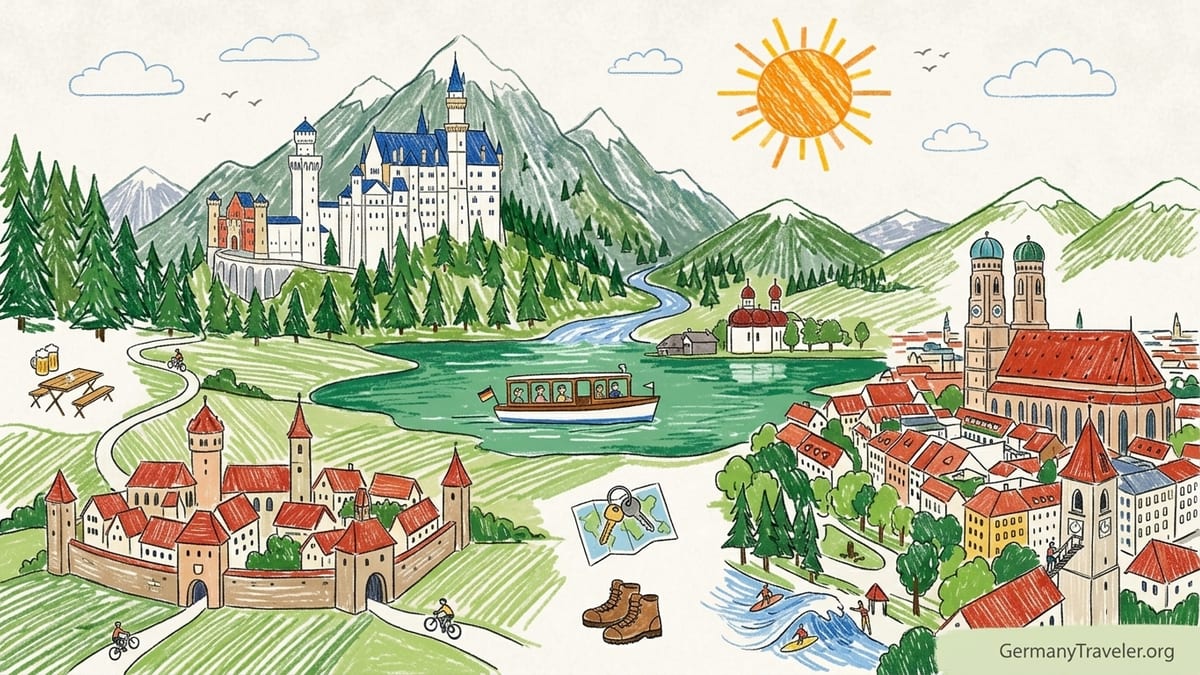
Exploring Munich Beyond Marienplatz
On my last Bavaria loop, I started in Munich and gave the city two full days instead of rushing through on the way to the Alps. I based myself near the Hauptbahnhof so I could walk or take the U-Bahn everywhere, and most of what I loved about Munich fit neatly into a 48-hour window. I spent one morning walking from Karlsplatz through the pedestrian zone to Marienplatz, timing it so I reached the square just before the Glockenspiel show at 11 a.m. In high season, the crowd filled most of the square but I still had space to stand, and what struck me most was how quickly the area emptied once the bells stopped. From there, I climbed the tower of St. Peter’s Church for the skyline view of the Frauenkirche and the Alps faintly visible on the horizon. The climb took about 15 minutes and was mildly crowded, but the view over red roofs and beer garden courtyards was exactly the mental picture I wanted of the city.
Costs in Munich always add up faster than I expect, but they stayed manageable when I focused on a few core experiences instead of trying to tick off every museum. A day ticket for the inner Munich public transport zone cost roughly the same as two single rides, so I bought the day pass and used it heavily, jumping to the Englischer Garten in the afternoon. I spent about three hours there, starting at the surfers on the Eisbach wave and then walking north until the beer garden at the Chinesischer Turm felt like a justified stop. The surprise was how easy it was to find quiet corners even in August. Within five minutes’ walk of the main lawn, I was sitting under trees with just the sound of bikes on gravel paths and the occasional dog splashing in the creek. I would repeat that exact combination of Marienplatz, tower climb and park time without hesitation.
Where Munich really rewarded a little extra effort was its museums and darker history. One afternoon, I took the S-Bahn from the city center to the Dachau Memorial Site, allowing about five hours door to door, including the on-site documentary film and walking through the grounds. The visit was emotionally heavy and the weather, a gray and cool autumn day, only sharpened that atmosphere. Entry itself was free, with only a modest charge for the audio guide. I would absolutely go again, though I would not combine it with evening beer hall plans; it deserved a quieter, reflective finish to the day. Back in the city, I saved my museum energy for the Alte Pinakothek and the Lenbachhaus, where I could focus on old masters and the Blue Rider group rather than trying to conquer Munich’s full count of more than a thousand museums in the region. That selective approach kept the city from becoming overwhelming and made each stop feel deliberate.
Crowds in Munich are simply part of the experience, but they are navigable. Marienplatz felt packed every time the Glockenspiel chimed but was perfectly manageable an hour later. The English Garden felt busy near the main entrances and almost rural deeper inside. Beer halls were full but not impossible on weeknights, especially if I arrived early in the evening. What surprised me most was that the city still felt livable and local even in peak tourist months. In quieter side streets you still see cyclists commuting, parents with strollers and office workers on lunch break, not just visitors. That everyday backdrop is one of the reasons I always end up back in Munich at the start or end of a Bavarian trip.
Touring Neuschwanstein Without Losing a Day to Queues
Neuschwanstein Castle is so firmly planted in Bavaria’s image that I felt almost obligated to visit again with fresh eyes. I based myself in Füssen for one night and reserved an early slot for Neuschwanstein using the official online ticket system. Standard adult admission in 2026 is published in the mid-teens in euros, plus a small online booking fee, which felt like cheap insurance against standing in line at the ticket center in Hohenschwangau. Door to door from Füssen station, the visit took almost five hours: a local bus to the village, the walk up to the castle, security and the timed tour, then the walk to the Marienbrücke viewpoint and back down. I started on a cloudy summer morning that turned hot by midday, and I was grateful I had done the uphill walk before the full heat kicked in.
The crowds here are real. By 10 a.m., the square in front of the ticket center buzzed with tour groups, school trips and independent travelers wrestling with bus timetables. Up by the castle entrance, visitors layered in waves based on their tour times, and every group felt full. Inside, the rooms themselves are smaller and more theatrical than most people expect, heavy with decoration from floor to ceiling. What surprised me on this visit was how efficiently the Bavarian palace administration moved people through the building. Our tour started on time and the guide kept a steady but not rushed pace. Including security checks and the interior loop, I spent about 45 minutes inside the castle itself.
My favorite moment, and the one I would repeat without question, happened outside the castle walls. After my timed tour, I walked to the Marienbrücke for the classic side-on view of Neuschwanstein sitting above the forested gorge. Even with renovation works that sometimes limit access or add scaffolding, the combination of sheer rock, waterfall noise and the pale castle walls still feels improbably cinematic. The bridge area was crowded and measured for safety, with staff controlling how many people stepped onto it, but by walking a little further up the trail I quickly found quieter viewpoints framed by trees. I spent almost an hour up there, taking photos and just watching the weather move over the Allgäu foothills, and this unstructured time ended up being more memorable than the guided tour itself.
Would I go back to Neuschwanstein yet again? Yes, but only with the same strategy. I would stay in Füssen or another local town instead of attempting a cramped day trip from Munich, book ahead on the official site and schedule the castle first thing in the morning or late in the afternoon. I would leave at least an extra hour for walking the forest trails and perhaps combine it with nearby Hohenschwangau Castle rather than adding more long-distance travel the same day. If you go into Neuschwanstein expecting crowds and a well-managed but brisk interior visit, the surrounding landscape and the sense of standing inside a piece of Bavarian myth more than justify the effort.
Gliding Across Königssee by Electric Boat
My day on Königssee in the Berchtesgaden Alps turned out to be one of the most quietly beautiful experiences I have had in Bavaria. I took a morning bus from Berchtesgaden to the lake and walked the few minutes from the stop to the boat docks run by Bayerische Seenschifffahrt. For 2026, published return fares for adults to the main stop at St. Bartholomä are set in the low to mid twenties in euros, with additional cost if you continue farther to Salet. I bought my ticket at the counter around 9 a.m., waited about twenty minutes in a growing queue and boarded one of the classic wooden electric boats that have operated here for decades. The full loop to St. Bartholomä and back, including time ashore, took almost five hours.
Once the boat left the dock, the noise of the village disappeared almost immediately. The electric motor hummed quietly, and the steep, forested cliffs on either side of the narrow lake rose almost vertically out of the water. Partway along the route, the captain stopped the boat, stepped outside and played a few notes on a trumpet so passengers could hear the famous echo bouncing off the rock walls. Even with other boats on the lake, the sound felt surprisingly pure. The weather helped: a clear, cool morning in early autumn with sunlight just touching the upper slopes and low cloud hugging the peaks near the Watzmann. I had read about this experience for years, but actually sitting on the deck in a light jacket, watching the wake dissolve almost silently behind us, felt far more serene than I expected.
Crowds were inevitable on a good-weather weekend, but they spread out once we reached St. Bartholomä. Most passengers walked straight to the onion-domed pilgrimage church and lined up at the restaurant for lake fish. I took a short trail along the shoreline instead, finding benches with views back toward the emerald water and the bare rock faces. There were always other visitors in sight, yet the atmosphere was closer to a contemplative mountain lake than a mass-tourism hotspot. I budgeted just over an hour there before taking a later boat onward to Salet, where a flat walk leads to another smaller lake framed by meadows and cattle. This extension added almost two hours to my day and was worth every minute.
If I had the chance, I would repeat this Königssee trip almost exactly as I did it, with three small adjustments. First, I would pre-check the official timetable for shoulder-season departures, which thin out compared with summer. Second, I would arrive at the dock even earlier to catch one of the very first boats and enjoy a slightly quieter lake surface. Third, I would build in a backup plan for rain, since low clouds and poor visibility can close trails and blunt the views that define this place. Bavaria’s mountain landscapes are one of its official tourism pillars, and for me, Königssee captured that pillar better than anywhere else I visited in the same week.
Tracing History in Nuremberg’s Old Town
Nuremberg is where Bavaria’s city pillar feels most layered. On my last visit I arrived by direct train from Munich, dropped my bag at a guesthouse near the city walls and spent a full day working my way from medieval alleyways up to some of the most sobering twentieth-century sites in Germany. The compact old town inside the walls is easy to explore on foot; I started at the Hauptmarkt with its busy produce stalls and moved uphill toward the castle complex that has watched over the city for centuries. The climb took less than twenty minutes, and the reward was a wide view over Nuremberg’s red rooftops, church towers and the distant modern districts.
What surprised me in Nuremberg was how quickly the mood shifts from postcard-pretty squares to difficult history. In the afternoon I took a tram to the Documentation Center on the Nazi Party Rally Grounds, which present the city’s role in the regime through exhibitions and preserved architecture around the former parade fields. I spent nearly three hours there, including walking outside to see the scale of the structures. The sky that day was heavy and overcast, and a light drizzle blew across the open grounds, making the photographs and audio testimonies feel even more immediate. The entrance fee for the museum ran in the single-digit euro range, and it was some of the best-contextualized historical interpretation I encountered anywhere in Bavaria.
Crowds in Nuremberg were noticeably thinner than in Munich or at Neuschwanstein, particularly in the evening. After the museum, I headed back into the old town for a simple dinner of Nuremberg bratwurst and potato salad at a traditional tavern. The streets around the Pegnitz River felt lively but not overwhelmed, with a mix of locals on their way home and small groups of visitors taking photos on the bridges. I remember being struck by how the same city that hosted major war crimes trials and earlier rallies also now promoted craft markets, independent shops and a thriving local food scene. That contrast made Nuremberg feel more like a lived-in city than a preserved monument.
If I had another Bavarian week, I would almost certainly include Nuremberg again, especially in cooler months when crowds are low and the city’s museums feel like a natural fit with the weather. I would allow at least one full day, perhaps two if I wanted to add the Germanisches Nationalmuseum or a day trip to nearby Franconian towns. Nuremberg rounded out my view of Bavaria beyond the Alpine stereotype and showed how the region’s castle and museum pillar connects directly to some of Europe’s most important cultural and political stories.
Sampling the Romantic Road and Rural Bavaria by Car
On one trip I decided to test Bavaria’s rural and small-town pillar by driving a section of the Romantic Road, the classic tourist route that threads from northern Franconia down toward the Alps. I did not attempt the full route in one push. Instead, I rented a compact car from Munich and spent two days linking together a handful of towns that always seemed to appear in brochures: Augsburg, Donauwörth and Rothenburg ob der Tauber just over the border in Franconia. The driving itself was straightforward, mostly on well-marked secondary roads with frequent fuel stations and rest stops. I covered only a few hundred kilometers over two days, but allowed time to stop in villages along the way whenever a church tower or hilltop wall caught my eye.
The highlight of my drive came in the late afternoon light as I approached Rothenburg. The weather that day was clear and slightly hazy, and the town walls rose out of a patchwork of fields like a storybook illustration. I parked outside the walls, paid for a few hours in a public lot and walked in under a gate tower that looked almost too picturesque to be real. Inside, narrow cobbled lanes, half-timbered houses and small craft shops lined up almost exactly as the photos suggest, yet the crowds were pleasantly moderate in the shoulder season I had chosen. I walked the walls, climbed one of the towers for a view over the Tauber valley and ended up sipping coffee in a small square while a local brass group rehearsed in a nearby church. It felt staged in the best possible way.
Driving came with additional costs compared with my train-focused trips, including fuel, toll-free but still paid parking in most towns and the rental itself. But it also opened up a side of rural Bavaria that is hard to access on public transport alone. On one stretch between Augsburg and Donauwörth, I pulled off at an unsigned field path simply because a line of trees framed the sunset over a barley field. There were no other tourists, only a tractor cutting a wide arc in the distance and the sound of evening birds. These small, unscripted stops are almost impossible on a rigid bus schedule. What surprised me was how quickly the image of Bavaria shifted, from the mountains and lakes of Upper Bavaria to the softer river landscapes and vineyards of Franconia.
Would I repeat the Romantic Road by car? Yes, though I would again resist the temptation to race from one famous stop to the next. Two or three days for only a section felt right: one night in a mid-sized city like Augsburg, one in a smaller walled town and plenty of time to wander rural detours. This slice of the Romantic Road delivered exactly what the region’s tourism board promises under its rural pillar: traditional villages, local festivals advertised on hand-painted signs and landscapes that feel deeply cultivated yet still open.
Hiking in the Bavarian Alps and Cooling Down at the Lakes
On this last trip, I made a point of pairing any city or driving days with time on foot in the Alps. One of my favorite hikes started from Garmisch-Partenkirchen, where I took a morning bus to the entrance of the Partnachklamm, a narrow gorge cut by a milky-blue mountain stream. Entry required a small fee, payable at the gate, and helmets were recommended for occasional rockfall. I walked the gorge in just over an hour, including stops to lean out over the railings and watch the water crash through the narrows. Water dripped constantly from the overhanging rock, so even on a warm summer day I needed a light waterproof layer. Emerging from the gorge into bright sun and the wider valley felt like stepping between two worlds.
Another day I took the cable car up from Garmisch to a nearer summit in the Wetterstein range instead of heading straight to the highest peak at Zugspitze. The return ticket cost more than a typical museum visit but less than some of the more complex multi-stage gondola systems in the Alps. At the top station, a well-marked network of panoramic paths offered everything from gentle one-hour loops to more serious alpine routes. I chose a mid-level trail that took about three hours with photo stops, leading across flower meadows and past small mountain huts serving simple food. The weather held cool and clear, with clouds forming only in the late afternoon. What surprised me was how quickly the crowds thinned once I walked more than fifteen minutes away from the main viewing platforms. Even on a prime summer weekend, I walked long stretches with only a handful of other hikers in sight.
To balance elevation days with something gentler, I also made time for Bavarian lakes at lower altitude. From Munich, I took a local train to Tegernsee, one of the classic pre-alpine lakes within Upper Bavaria’s belt of water. The ride took under an hour, and the cost with a regional day ticket felt entirely reasonable for a full day out. In Tegernsee town, I strolled along the promenade, rented a paddleboard for an hour and sat on a grassy shore watching families swim in clear, surprisingly cold water. Later I boarded a small passenger boat operated by the regional shipping company, paying a moderate fare for a loop that touched several lakeside villages. The atmosphere on board was relaxed, with a mix of day-trippers and locals treating it simply as public transport. I ended the day eating fish caught from local waters at a lakeside restaurant as the sun dropped behind the hills.
These mountain and lake days are the ones I would repeat almost word for word. They captured Bavaria’s landscape pillar in a direct, physical way, but remained accessible without specialist gear or technical skills. The only changes I would make next time would be logistical: starting hikes even earlier on hot days, carrying a spare set of dry layers for gorge walks and building in a buffer day in case mountain weather turned bad. Bavaria’s high trails and lower lakes felt like two faces of the same region, and alternating between them kept my trip balanced.
Steaming Away the Train Miles at Therme Erding
After a week of trains, hikes and castle staircases, I spent a recovery day at Therme Erding, one of Bavaria’s best known thermal spa complexes northeast of Munich. I took the S-Bahn and a short bus ride from the city, arriving just after opening time. The published price for a six-hour visit to the main thermal and water areas in 2026 sits around the high forties in euros for adults, with supplements if you add the large sauna complex. I chose a six-hour ticket including sauna access, reasoning that if I was going to do this, I might as well commit. Lockers, showers and rental towels were easy to arrange at the entrance desk, and within twenty minutes of arriving I was floating in mineral-rich warm water under a glass dome dotted with palm trees.
The scale of the place surprised me. Therme Erding is divided into zones: quieter thermal pools, a more active wave pool area with slides and a separate, more tranquil sauna world restricted to adults. I spent the first couple of hours cycling between different temperature pools, sitting at underwater massage jets and dozing in a lounger with a book. Midday brought more visitors, including families drawn to the slides, but the adults-only sections remained calm. After a simple lunch from the on-site restaurant, I moved into sauna territory, sampling several wood-lined rooms with different heat and humidity levels, each with names referencing Alpine herbs or regional themes.
The whole experience felt distinctly Bavarian in a modern way: efficient, clean and unapologetically focused on wellness. Crowds grew noticeably in the late afternoon and on a rainy day the complex felt almost like a small indoor city, with people wandering in robes between zones. Six hours passed faster than I expected. By the time I left, having showered and changed back into travel clothes, my legs felt vaguely rubbery in the best sense, and the accumulated fatigue from climbing castle towers and mountain trails had largely drained away. The total cost, including food and towel rental, landed somewhere around what I might have spent on an upscale dinner in the city.
Would I spend another precious Bavarian day at a spa instead of out in the mountains or museums? Surprisingly, yes, especially on a day of poor weather when mountain cable cars might close or views would be limited. Therme Erding fits snugly into Bavaria’s lake and wellness pillar, translating the idea of restorative water into a highly contemporary setting. Next time, I would book a late afternoon slot and stay into the evening, when colored lights and calmer crowds reportedly make the pools feel more atmospheric.
The Takeaway
Looking back over these trips, the experiences I would eagerly repeat cluster neatly around the same themes Bavaria promotes officially: cities with depth, castles and museums that anchor history, mountain landscapes, lakes and a surprisingly modern wellness culture. Exploring Munich at a measured pace, pairing Neuschwanstein’s interiors with extra time on the forest trails, gliding silently across Königssee, tracing Nuremberg’s layered past, drifting along sections of the Romantic Road, hiking above Garmisch and unwinding at Therme Erding all felt like time well spent, even when trains ran late or rain blew in over the Alps.
What all of these days had in common was a willingness to slow down. Rather than racing from one “must-see” to the next, I allowed enough hours in each place to absorb the weather, the crowds and the unscripted moments: a quiet bench by a lake, an unexpected rehearsal in a Franconian church, a nearly empty mountain path fifteen minutes from a busy cable car station. Bavaria rewards that approach. You can arrive for the famous postcard views, but if you leave room for detours and rest days, the region’s deeper character emerges in conversations at small bakeries, evening walks along riverfronts and the simple act of taking off your hiking boots in a thermal pool.
If you have a week or two to play with, you cannot do everything. But if you build your own itinerary around a few of the experiences above, you will touch each of Bavaria’s pillars in a way that feels grounded and personal rather than formulaic. It is exactly the trip I would plan again for myself, just with a little more time in the Alps and one extra lake day.
FAQ
Q1. How many days should I spend in Bavaria for a first visit?
For a balanced first trip, I found that 7 to 10 days worked well, allowing two days in Munich, two to three in the Alps and lakes, one around Neuschwanstein, one in Nuremberg and a flexible day for the Romantic Road or a spa visit.
Q2. Is it better to explore Bavaria by train or by rental car?
I comfortably did most of my recent trips by train and bus, especially between Munich, Nuremberg, Füssen, Berchtesgaden and Garmisch-Partenkirchen. I only rented a car for a short section of the Romantic Road to reach smaller villages. For most travelers, a mix of public transport and a brief rental car period offers the best balance.
Q3. How far in advance should I book Neuschwanstein Castle tickets?
On my visit, the official booking system showed popular times filling several days ahead in busy months. I would now book at least a week in advance for peak summer or holiday periods and a few days ahead in shoulder season, always using the official ticket provider to avoid extra markups.
Q4. When is the best time of year to visit Bavaria’s Alps and lakes?
My favorite trips were in late spring and early autumn, when trails were open, temperatures were comfortable and crowds slightly thinner than mid-summer. Winter can be wonderful for skiing and snow scenes, but some hiking routes and smaller boat services reduce or pause operations.
Q5. Are Bavarian thermal spas like Therme Erding worth the cost?
For me, a six-hour visit to Therme Erding felt worth the higher entry fee, especially after several days of hiking and city walking. If you enjoy saunas, warm pools and a slower pace, dedicating half a day to a spa can help you recover and enjoy the rest of your trip more.
Q6. How crowded did I find Königssee and other major nature spots?
On clear-weather weekends, Königssee, popular gorges and cable car stations were busy from late morning onward. By starting early, checking timetables and walking a little beyond the most photographed viewpoints, I consistently found quieter stretches even in high season.
Q7. Can I visit Nuremberg as a day trip from Munich?
I did it as an overnight, but the direct train connection makes a long day trip possible. However, I was glad I stayed one night, because it allowed me to visit the Documentation Center, explore the old town and have a relaxed evening without racing for a late train.
Q8. How expensive did everyday costs feel compared with other European regions?
Bavaria felt moderately expensive. City hotels and restaurant meals in Munich and the Alps were on the higher side, while smaller towns and self-catered options were more affordable. Public transport and most museum entries felt fair for the quality of the experience.
Q9. Do I need hiking experience to enjoy the Bavarian Alps?
For the hikes I chose near Garmisch-Partenkirchen and around lake areas, basic fitness and good shoes were enough. I stuck to marked, non-technical paths and used cable cars to gain elevation. More serious alpine routes require proper experience and sometimes a guide, but there are plenty of accessible options.
Q10. Is it realistic to combine cities, castles, mountains and spas in one itinerary?
Yes. On my last trip, I started with Munich and Dachau, visited Neuschwanstein and the Alps, added a day at Königssee, spent time in Nuremberg, drove a section of the Romantic Road and finished with Therme Erding. It felt full but achievable in about ten days with careful planning.