


I did not fully understand how different Bavarian bases feel until I spent separate trips based in Munich, Füssen and Nuremberg. I first used Munich as a hub for classic day trips, then later chose Füssen to wake up practically under the Alps, and finally Nuremberg for a Christmas market focused visit. What follows is grounded in my own time on the ground in all three places, with researched price ranges noted clearly where I needed to verify current figures. Rather than naming a single winner, I want to show how each base shaped the rhythm of my days so you can pick the one that fits your version of Bavaria.
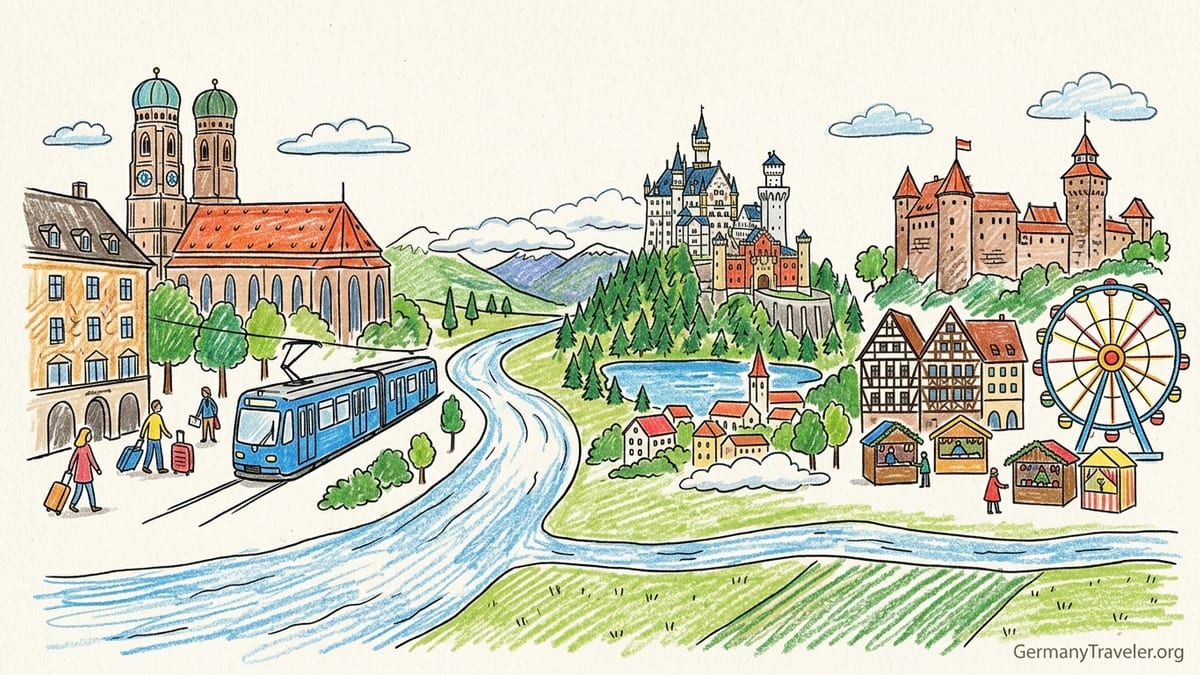
How Each City Felt As A Base
Munich felt like a proper big city base for my first Bavaria trip. I stayed near München Hauptbahnhof and most evenings ended with me walking back along Bayerstraße with a döner in hand after a late regional train. I remember returning from a long day trip to Neuschwanstein, stepping out of the S-Bahn into the bright station concourse at about 9.30 p.m., and being relieved that I still had open supermarkets, casual restaurants and a reliable U-Bahn network to get me back to bed. The city never felt overwhelming, but it did feel busy, international and full of options at almost any hour.
Füssen, by contrast, felt intimate and almost sleepy. I based myself here on a later trip when I wanted mountains more than museums. My guesthouse was a ten minute walk from the station, and I still remember opening the curtains one October morning to see low clouds caught on the foothills of the Alps. The first sounds outside were not trams but church bells and the scrape of someone sweeping leaves. Evenings meant strolling through the compact old town, grabbing a simple plate of Käsespätzle and turning in early. It was the right choice for a castle and Alpine focused stay, but it would have been limiting on my first visit to Bavaria.
Nuremberg was somewhere in between. I stayed just inside the old town walls near Königstor, so I could walk from the station to my hotel in under ten minutes and still feel surrounded by medieval towers and half-timbered houses. One evening, after a day of exploring the castle and Nazi Documentation Center, I found myself at a high table in a Bratwurst kitchen near the Hauptmarkt, shoulder to shoulder with locals in business clothes. There were enough bars and Franconian wine taverns to feel lively, yet the core of the city remained walkable and human-scale. It made a comfortable base for a culture-heavy and Christmas-season stay.
Emotionally, Munich felt like a safe first landing: forgiving if trains were late, full of backup plans if the weather turned bad. Füssen felt like a retreat that forced me to slow down. Nuremberg felt like a compact regional capital, with its own strong identity and a clear focus on history. Those personalities matter just as much as price or transport when you choose a base.
Hotel Costs And Where I Slept
On the money side, Munich was plainly the most expensive base in my own bookings. On my last stay, a simple but modern business hotel within walking distance of the Hauptbahnhof ran just over 160 euros per night for a double in shoulder season. Industry reports put recent average hotel rates in Munich around the equivalent of roughly 190 to 210 US dollars per night, which matched what I saw while hunting for anything central that did not feel budget hostel level. Prices spiked even higher when I checked dates overlapping with Oktoberfest and big trade fairs, where many central hotels went well beyond 250 euros per night for standard rooms.
Füssen has become pricier than many people expect for a small town, because it sits at the gateway to Neuschwanstein and Hohenschwangau. When I booked a midrange guesthouse a short walk from the old town, I paid around 130 euros per night for a clean ensuite room with breakfast. When I checked recent listings out of curiosity, I saw that typical three to four star hotels in Füssen often start somewhere in the 120 to 180 euro range per night for two people, with September and October on the higher side due to fall foliage and stable weather. Data from travel cost trackers suggests an average hotel spend in Füssen for two people of just under 220 euros per night in recent seasons, which lined up with what friends paid at slightly fancier spa hotels on the lake.
Nuremberg was the relative bargain in my bookings. For a centrally located hotel just inside the walls and five minutes from the Hauptbahnhof, I paid about 110 euros per night including breakfast in early December. When I rechecked prices, midrange hotels in or near the old town often fell in the 90 to 150 euro band outside major trade fairs. During my Christmas market stay, demand was high but not at Munich levels, and I could still find places under 140 euros with a bit of flexibility on exact location. Several business style hotels near the station were even cheaper on weekdays than on the busy December Saturdays.
If you want to optimize for cost alone, my own bookings and current price data both pointed to Nuremberg as the best value, Füssen as moderate but climbing, and Munich as the clear splurge. For a first trip where you will be on trains a lot, I found it easier to absorb Munich’s higher prices in exchange for its excellent connections. When my focus narrowed to castles and hiking, Füssen’s smaller scale and slightly lower rates felt worth it. For a Christmas-oriented visit with day trips to Bamberg and other Franconian towns, Nuremberg struck the best balance of comfort and price.
Food, Nightlife And Evening Atmosphere
Munich offered the broadest spectrum of food and nightlife in my experience. I spent several evenings in beer halls like Augustiner am Platzl and in smaller neighborhood bars in the Glockenbachviertel. A typical liter of beer in central beer halls set me back around 12 euros by 2024, and a hearty plate of Schweinshaxe or roast pork was usually somewhere between 18 and 25 euros. I also relied on kebab shops and Asian noodle places near the Hauptbahnhof on nights when I wanted something fast and under 10 euros. The key advantage for me was late options; when I came back from Neuschwanstein or Salzburg after 9 p.m., I could still find hot food and a drink within a few minutes’ walk.
In Füssen, evenings felt gentler and wrapped up earlier. Near my guesthouse, there were a handful of Bavarian restaurants, pizzerias and cafés, many closing their kitchens around 9 or 9.30 p.m. On my first night I lingered too long taking sunset photos above the Lech River and ended up racing the clock to order a Schnitzel before the kitchen shut. Main courses generally sat in the 16 to 22 euro range, and a half-liter of local beer was usually 4 to 6 euros. There were a few bars that stayed open later in summer, but this is not a nightlife town. I ended up buying snacks at a supermarket before dinner because I knew there would be nothing open at 11 p.m. if I got hungry again.
Nuremberg’s old town struck a satisfying middle ground. I spent one memorable evening in a vaulted cellar restaurant eating Nürnberger Rostbratwürste with sauerkraut at a shared wooden table, where a plate of sausages and sides ran around 15 euros and house beer was 4 to 5 euros for a half liter. Afterward I wandered to a wine bar under the city walls that poured Franconian Silvaner by the glass. Prices felt slightly lower than central Munich but not dramatically different. During the Christmas market, the entire Hauptmarkt area turned into one prolonged evening event, with stalls selling Glühwein for around 4 to 5 euros plus deposit and small bratwurst-in-a-roll for a few euros more. The vibe was festive rather than wild.
For travelers who want clubbing and a big city bar scene, my time out confirmed that Munich is the obvious choice. For couples or families who prefer quiet dinners and early starts, Füssen’s calmer evenings can be a plus. For a balance of relaxed evenings with plenty of cozy taverns and wine bars, especially in winter, Nuremberg worked beautifully for me.
Transport, Walkability And Car Free Logistics
As a car free traveler on all three trips, transport shaped my choice of base just as much as scenery. Munich is simply the most practical hub. From München Hauptbahnhof I could reach Füssen, Nuremberg, Regensburg, Salzburg, Garmisch-Partenkirchen and many smaller towns by direct or one change regional trains. The regional train from Munich to Füssen, usually designated RB 68 and often operated by Bayerische Regiobahn, takes roughly 2 to 2.5 hours and covers about 90 kilometers, with advance fares from around 18 euros if you use saver tickets and various regional passes. S-Bahn and U-Bahn lines made it trivial to get from my hotel to the station, and I never worried about needing a taxi late at night.
Within Munich, I walked a lot but also relied heavily on trams and the U-Bahn. Neighborhoods like the Altstadt, Maxvorstadt and parts of Glockenbachviertel are easy to navigate on foot. On a typical day I would walk from Marienplatz through the Viktualienmarkt, then out toward the English Garden, and still hop on the U-Bahn back in the evening if my legs were done. For a first time visitor who wants to see several regions of Bavaria on day trips without a car, using Munich as a hub felt logical and low stress.
Füssen’s advantage is its size. From my guesthouse near the center, I could walk to the train station in about ten minutes, to the river in five and to supermarkets in under ten. To reach Neuschwanstein and Hohenschwangau, I used the regular buses that leave from the station area and reach the castles in roughly fifteen minutes. A regional pass covered both train and bus for the day, and I appreciated not having to drive up the access roads or find parking. The downside appeared when I wanted to reach places that were not on the Füssen rail line; connections to somewhere like Garmisch or the Zugspitze area typically involved several changes and long travel days.
Nuremberg felt very walkable inside its walls. From my hotel near Frauentorgraben I could walk up to the Imperial Castle in fifteen to twenty minutes through pedestrian streets, passing the Lorenzkirche and Hauptmarkt on the way. For longer stretches or cold nights, the U-Bahn and trams filled the gaps. As a rail hub, Nuremberg gave me straightforward direct trains to Bamberg, Würzburg and Regensburg, and reasonably fast services to Munich as well. It was not as omnidirectional as Munich’s main station, but for a Franconia focused itinerary it served me well without a car.
In practical terms, if you plan to rely entirely on trains and buses and want maximum flexibility, I personally found Munich the most forgiving base. Füssen worked best when I narrowed my focus to the castles and local hiking, and I accepted that every big outing started and ended with that two hour ride to or from Munich. Nuremberg slotted neatly into itineraries centered on northern Bavaria and Franconian towns.
Castles, Mountains, Museums And Day Trips
Each base shines for different types of sightseeing. Füssen is the obvious choice if your mental picture of Bavaria is dominated by castles on forested hillsides. On my Füssen-based trip, I woke up, had breakfast at my guesthouse, walked to the station and caught the short bus to Hohenschwangau, where Neuschwanstein and Hohenschwangau castles rise over the Alpsee. Staying nearby meant I could book earlier tour slots, avoid the biggest midday crowds and still be back in town for a mid-afternoon stroll along the Lech. On another day I took the cable car up Tegelberg for Alpine views and short hikes, something that would have been very hard as a day trip from Munich in poor weather.
Munich, by contrast, excels for museums and varied day trips. I spent one full gray day moving between the Alte Pinakothek, Neue Pinakothek replacement spaces and the Lenbachhaus, all within a reasonable walking radius of each other, ducking into cafés between collections. On another day I walked the grounds of Nymphenburg Palace in the morning and visited the BMW Museum and Olympic Park in the afternoon, entirely within the city. For excursions, I used Munich as a springboard to Salzburg, Regensburg, Garmisch-Partenkirchen and the Dachau Memorial Site. Having all of those options one train ride away meant I could pivot easily if the weather turned or I changed my mind.
Nuremberg sits at the crossroads of history focused trips. The Imperial Castle and city walls offered plenty to fill a first day, with panoramic views from the ramparts over the half timbered houses and church spires. A second day let me visit the Documentation Center at the former Nazi Party Rally Grounds and the Memorium Nuremberg Trials in the Palace of Justice, which added weight and context to the seemingly pretty old town. As a base, Nuremberg let me ride direct trains to Bamberg, with its little Venice canal district and smoked beer, and to Rothenburg ob der Tauber with only one easy change. Those days felt full but not punishing from a travel standpoint.
My own conclusion after trying all three was that Füssen is best if castles and Alpine scenery are your main purpose, Munich if you want a mix of major museums and various regions, and Nuremberg if you are combining history, Christmas markets and smaller Franconian towns. None of them is wrong for any of these themes, but each one nudged my trip in a different direction.
Christmas Markets And Seasonal Atmosphere
I experienced Christmas time in both Munich and Nuremberg, and briefly in Füssen, and the difference in atmosphere was striking. In Munich, the main Christkindlmarkt around Marienplatz felt busy and broad, spreading into adjacent streets with stalls selling everything from carved Nativity figures to modern ornaments. One December evening I stood under the towering tree in front of the Rathaus nursing a mug of Glühwein, the crowd mixing tourists, families from the suburbs and office workers on their way home. Side markets like the medieval market near Odeonsplatz added variety, and the citywide decorations kept things lively even if I stepped away from the stalls.
In Nuremberg, the Christkindlesmarkt felt more concentrated and traditional. The Hauptmarkt filled with rows of red and white striped stalls, and I remember my first glimpse of it from street level as I came under the Frauenkirche in early dusk. The focus is squarely on classic items such as Zwetschgenmännle figurines and Lebkuchen, and the famous Nuremberg bratwurst grilled over open flames. I grabbed a cone of three little Nürnberger sausages in a crusty roll more times than I should admit. The surrounding old town lanes glowed with lanterns and decorations, and because my hotel was a short walk away, I could dip in and out of the crowds throughout the evening.
Füssen’s Advent atmosphere was on a smaller scale. When I passed through in late November on one trip, a modest market had set up in the old town, with a handful of food and craft stalls and lights in the narrow streets. It felt more local than spectacular. The cold air coming off the nearby lakes and mountains made evenings crisp, and I remember walking back to my guesthouse with my breath fogging in front of me, the castle on the hill lit up against the dark sky. It was charming, but if I were flying to Bavaria specifically for Christmas markets, I would not use Füssen as my sole base.
If Christmas markets are central to your plan, my personal preference runs strongly to Nuremberg as a base. The scale, tradition and density of its Christkindlesmarkt, combined with the walkability of the old town and reasonable hotel prices, made it ideal. Munich comes a close second, especially if you want a range of different styles of market and big city shopping to go with them. Füssen works best as a one or two night seasonal detour to combine a castle visit with a quieter Advent mood.
Which Base I Preferred For Different Types Of Trips
For a first ever Bavaria trip, I personally preferred Munich as a base. Being able to return to a large station with frequent late trains, a dense public transport network and endless backup options for food reduced the stress of learning a new region. On my first visit I misread a timetable in Salzburg and ended up on a later return train than planned. Stepping off that train at München Hauptbahnhof close to 11 p.m., surrounded by clear signage, open kiosks and steady S-Bahn departures, I was grateful not to be worrying about the last bus to a smaller town. From Munich I could sample Füssen, Nuremberg and Salzburg as day trips before deciding where to spend more time next time.
For a castle centered trip, Füssen won out. Planning my days around Neuschwanstein and Hohenschwangau, I loved waking up already in the foothills of the Alps, with mist on the fields outside town and the mountains visible from the station platform. After my Neuschwanstein tour, instead of racing a two hour train ride back to Munich, I simply took the fifteen minute bus back to Füssen, had an early dinner and walked along the river as the light faded. The lower daily transport time gave me space for a second castle day at Hohenschwangau and a hike up to the Marienbrücke viewpoint without clock watching.
For a Christmas market focused trip, Nuremberg was my personal favorite base. I could walk from my hotel to the Christkindlesmarkt in under ten minutes, warm up with a mug of hot wine, then retreat up side streets to quieter taverns when the crowds swelled. One evening I climbed the path to the castle just after sunset, looked down over the lights of the stalls and church towers, then wandered back into the market for roasted chestnuts and Lebkuchen. The combination of festive atmosphere, compact layout and manageable hotel costs made it feel tailor made for a December long weekend.
For car free travel in general, Munich still edged out the others for me. Being able to sit on a single train or S-Bahn line to reach the airport, use long distance trains and connect to a web of regional services without complicated changes is hard to beat. When I stayed in Füssen without a car, I sometimes felt boxed in if I did not want to commit to the long journey back through Munich for every bigger excursion. In Nuremberg, the network is solid for northern Bavaria but less universal. If you want to see as much of the region as possible in a short time and do not plan to rent a car, I found that basing in Munich first and then perhaps adding a shorter stay in Füssen or Nuremberg worked best.
There is no universal winner, and that is the real lesson I took away. Munich, Füssen and Nuremberg are three very different answers to the same question: what do you want your Bavarian days to feel like when you step out of your hotel in the morning or walk back to it at night.
The Takeaway
Looking back across my stays in Munich, Füssen and Nuremberg, I see three complementary bases rather than rivals. Munich gave me the confident sprawl and connectivity I needed on my first visit, Füssen gave me closeness to castles and mountains, and Nuremberg wrapped me in history and Advent warmth. Costs, transport and specific sights certainly matter, but the small daily moments stuck with me more: the feel of returning late to a still buzzing Munich station, the quiet of early morning streets in Füssen with the Alps hovering at the edge of town, the glow of Nuremberg’s old town on a winter evening.
If I were advising a friend planning their first Bavaria trip, I would suggest starting in Munich for at least a few nights, then adding Füssen if castles and mild hiking are a priority, and Nuremberg if Christmas markets, medieval streets and Franconian towns call to them. With a week or more, you can realistically sample two of these bases without feeling rushed. With less time, choosing the one that best matches your main interest will shape your memories more than squeezing in every sight.
What worked best for me might not be right for you, but using these three cities as different lenses on Bavaria helped me understand the region more fully. Your ideal base is not simply the cheapest or closest to a famous sight. It is the place whose streets you will enjoy walking at the end of a long day, whose trains you trust to bring you home and whose evening atmosphere feels like the right ending to your Bavarian stories.
FAQ
Q1. Is Munich, Füssen or Nuremberg better as a first base in Bavaria?
For a first trip I preferred Munich as a base because of its dense museum scene, easy airport access and excellent rail links for day trips across Bavaria and into Austria.
Q2. Which city is usually cheapest for hotels among the three?
In my bookings and recent price checks, Nuremberg tended to offer the best value, followed by Füssen, with central Munich typically the most expensive.
Q3. Where should I stay if Neuschwanstein Castle is my top priority?
If Neuschwanstein and Hohenschwangau are central to your plans, I recommend basing in or near Füssen so you can reach the castles quickly and avoid very long day trip returns.
Q4. Which base works best for Christmas markets?
I personally favored Nuremberg for Christmas markets because its Christkindlesmarkt is large, traditional and walkable from most central hotels, with Munich a strong second choice.
Q5. Can I visit Füssen and Neuschwanstein as a day trip from Munich without a car?
Yes, I have done this using regional trains and the bus from Füssen to the castles, but expect around two to two and a half hours of travel each way, making for a long day.
Q6. Is Füssen too quiet for a longer stay without nightlife?
Füssen is calm in the evenings, with restaurants and a few bars but little late night life; I enjoyed three to four nights there when I wanted early mornings and mountain air.
Q7. How walkable are Munich, Füssen and Nuremberg?
All three are walkable in their cores, but Füssen and Nuremberg feel compact, while Munich combines walkable central districts with a wider U-Bahn, S-Bahn and tram network.
Q8. Which base suits a car free traveler who wants to see several different regions?
For varied, car free exploring I found Munich best, since its main station connects easily to Salzburg, Regensburg, Füssen, Nuremberg and many Alpine and lake destinations.
Q9. Is Nuremberg a good alternative to Munich for history focused trips?
Yes, Nuremberg worked very well for me when I wanted medieval architecture, World War II sites and day trips to places like Bamberg without the size and prices of Munich.
Q10. How many nights should I plan in each city on a one week trip?
On a seven night trip, I would consider four nights in Munich to cover major sights and day trips, and three nights split between Füssen or Nuremberg depending on your interests.