


My relationship with Bavaria was forged in crowded Munich beer tents, on fogged-in Alpine trails, and on winter days when Neuschwanstein’s postcard views were simply gone behind snow clouds. Over several trips in different seasons, I learned that the best time to visit Bavaria has far less to do with dates on a calendar than with how crowds, weather and prices collide on the ground. This article blends those personal experiences with up-to-date practical details, so you can choose the season that matches your tolerance for heat, snow, rain, queues and Oktoberfest prices.
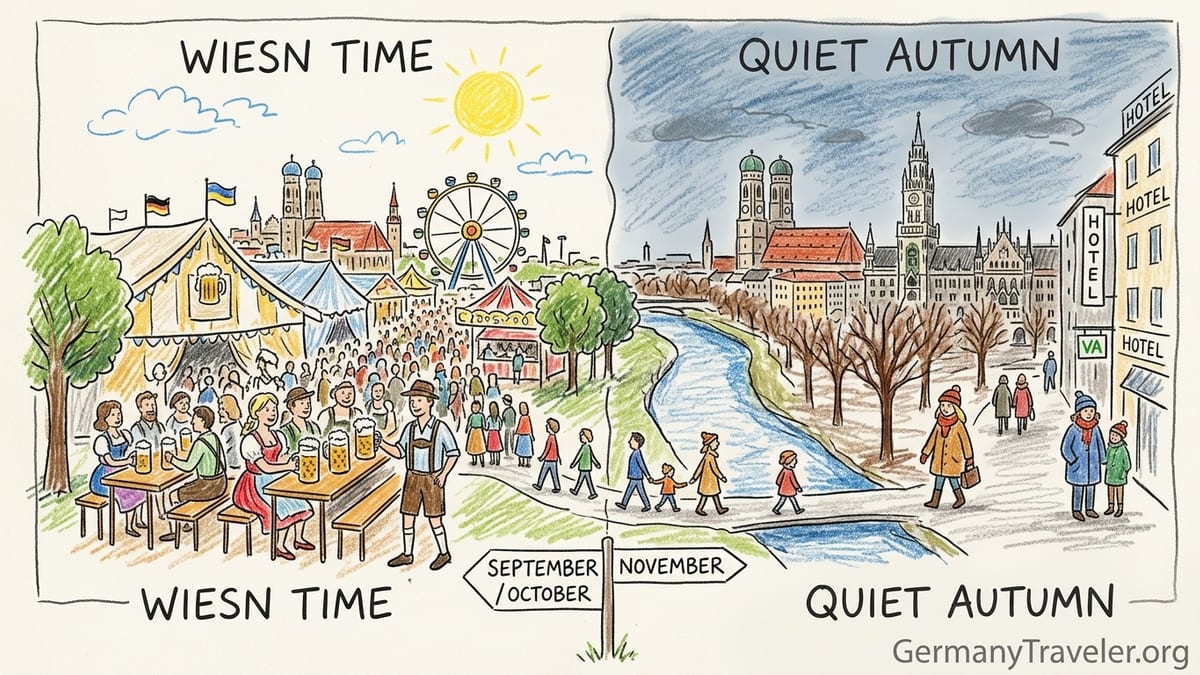
How Oktoberfest Changed My Munich Autumns
I first arrived in Munich in late September for what I naively thought would be a quiet shoulder-season city break. Only when I tried to book a hotel did I understand what “Wiesn time” really means. During the 2024 festival, data from a major hotel platform showed average room rates in Munich during Oktoberfest rising to roughly 416 euros per night, compared with about 261 euros for other autumn dates and about 175 euros for the wider year. In practical terms, the same central mid-range hotel I had priced at around 140 euros in November was listing for well over 300 euros for late September dates once the festival period opened.
On the ground, the city feels significantly different. Theresienwiese, the fairground south of the city center, becomes a dense world of beer tents, food stalls and funfair rides. In 2024, around 6.7 million visitors attended the festival over 16 days according to figures released afterward. Walking from the Hauptbahnhof down toward Theresienwiese on a sunny Saturday, I found the pavements thick with tour groups in dirndls and lederhosen, and the U-Bahn platforms so packed that station staff were actively directing passenger flow. In ordinary weeks, the same walk is a straightforward, almost quiet urban stroll apart from rush hour.
Inside the tents, the experience is more intense than any brochure suggests. On my 2024 visit, by mid-afternoon the Augustiner and Hofbräu tents were shoulder-to-shoulder, the wooden benches shaking with people stamping along to brass bands. Official beer price announcements put one liter of festival beer that year between about 13.60 and 15.30 euros, and table reservations layered on extra minimum-spend requirements. By contrast, a liter of Helles in a standard Munich beer hall outside the festival period still hovered closer to 9 to 10 euros, and a half-liter in a neighborhood Wirtshaus was often around 4.50 euros. The gap feels very real once you start ordering round after round.
Outside Theresienwiese, though, Munich is not unlivable during Oktoberfest. Early mornings in the Englischer Garten still felt calm, and museums such as the Alte Pinakothek were busy but not overwhelmed. The main change I noticed was at night, particularly around the central station and popular nightlife streets, where groups poured back from the festival in varying states of inebriation. If you want classic city sightseeing in September or early October without the party atmosphere, I would either avoid the official Oktoberfest window altogether or base yourself in a neighborhood one or two U-Bahn stops away from the center and focus your city time on mornings and weekdays.
Munich Outside the Festival: My Spring and Late Autumn Stays
Visiting Munich again in late November felt almost like a different city. The air was several degrees colder, often hovering around 5 to 8 degrees Celsius in the daytime with a damp edge, and darkness fell just after 4:30 pm. Hotel rates dropped sharply. The same mid-range hotel less than ten minutes’ walk from Marienplatz that had demanded well over 250 euros during Oktoberfest was advertising midweek double rooms for roughly 130 to 160 euros booked a few weeks in advance. Walk-in availability was suddenly realistic again.
Crowd levels followed the prices. On a Tuesday morning, I crossed Marienplatz without any need to weave through tour groups, and security checks at Frauenkirche or the Residenz were quick. The biggest pinch point was actually the Christmas market stalls that were being set up, which brought localized crowds and a more leisurely, local feel. Restaurants in central streets such as Kaufingerstrasse and Tal had spare tables without reservations, and beer halls like Augustiner am Platzl felt lively but not frenetic.
In April, Munich presented yet another side. On one trip that month, afternoon highs shifted between 10 and 18 degrees, with sudden showers that had me alternating between sunglasses and rain jacket several times a day. Beer gardens like the one at the Chinesischer Turm in the Englischer Garten were open, but on cooler days many tables sat empty until the sun broke through. Hotel prices were in an in-between zone, higher than deep winter but much lower than high summer or the festival window. For comfortable urban sightseeing with manageable costs and no weather extremes, my personal sweet spots for Munich have been April into early May, and again from early November until the start of the Christmas market season.
Transport inside the city also felt more relaxed outside festival dates. During Oktoberfest, U-Bahn lines U4 and U5 can feel saturated around Theresienwiese, and station announcements in multiple languages underline crowd control. In April and November, I rode those same lines at similar times of day and rarely had to stand for more than a few stops. If your main goal is to understand Munich’s history, museums and neighborhoods rather than its beer festival, choosing a non-Wiesn window will almost always give you a more comfortable balance of cost, weather and access.
Alpine Summers I Actually Sweated Through
My first summer trip into the Bavarian Alps came after a few days in Munich. I took the train to Garmisch-Partenkirchen, where the mountains begin to rise from the valley in steep green walls. In late July, the heat surprised me. Afternoon temperatures in town sat around 28 to 30 degrees Celsius, and the sun felt stronger than I had expected for an Alpine area. On a hike above Partnachklamm, the trail alternated between shaded forest and exposed pastures, and each time I emerged from the trees I could feel the sweat start to run again. Local tourism information boards now frankly describe summer in the area as warm enough that lakes such as Eibsee or Riessersee commonly reach about 18 to 22 degrees.
That warmth transforms the lakes into natural swimming pools. One August afternoon at Eibsee, the clear, green-tinted water was full of stand-up paddleboards and small rental boats. I waded in hesitantly at first, braced for glacier-chill, but found the shallows almost comfortable after a minute. By the time I pushed out far enough to float with the Zugspitze towering above, the water felt like a refreshing escape rather than a shock. Shore kiosks were busy selling ice cream and cold drinks, and there was a distinct beach atmosphere even though the shoreline was gravel and forest instead of sand.
Summer also brings its own visibility challenges. On one hot July afternoon, I took the Zugspitzbahn up toward Zugspitze. Heat haze blurred the far ridges, and afternoon thunderstorms built quickly. By the time I reached the top, clouds had moved in, limiting views to short openings. The pattern repeated several days that week: clear mornings, clouds building by early afternoon, short but intense storms around 3 or 4 pm, then clearing again toward evening. For mountain days in July and August, I learned to start hikes as early as possible and to treat any blue-sky afternoon as a temporary gift, not a guarantee.
Accommodation in Alpine towns tracked the demand. In Garmisch-Partenkirchen, a central guesthouse that had cost me around 90 euros for a double room in November jumped to about 150 euros in late July. Booking platforms showed many lakeside properties near Eibsee and Grainau either fully booked or quoting rates over 200 euros per night for peak August weekends. Mountain lifts and cable cars such as the Tiroler Zugspitzbahn or local chairlifts operated at full capacity, queues snaking out on sunny days. Summer in the Alps offers wonderful hiking and swimming, but it is not a quiet, low-cost escape.
My Winter Bavaria: Snow, Short Days and Closed Viewpoints
Winter in Bavaria felt sharp and compact compared with the stretched days of summer. On a January trip that looped from Munich to Füssen and Garmisch-Partenkirchen, daytime highs were often just below freezing. In Füssen, I woke to snow falling in thick, steady flakes that slowly buried parked cars and softened street noise. Walking up the hill toward Hohes Schloss, the stone walls took on a storybook quality, but the practical side of the weather revealed itself quickly in the form of icy pavements and the cold working its way through my gloves.
Those conditions had a direct effect on castle access. To visit Neuschwanstein, I took the train to Füssen and the bus to Hohenschwangau, then walked through slush from the ticket center toward the shuttle bus that normally runs up to a viewpoint near Marienbrücke. Local information boards stated clearly that the shuttle operates year-round, but not when snow or ice make the steep road unsafe. On that particular day, recent snowfalls meant the shuttle service was curtailed for several hours. Some visitors decided to hike the 30 to 40 minute uphill route; others turned back to Hohenschwangau Castle instead.
Marienbrücke itself turned into the key seasonal variable. Official messaging for the area notes that the bridge, which offers the classic side-on postcard view of Neuschwanstein, can be closed in winter for safety reasons when ice or snow accumulate on the narrow walkway or make the approach path dangerous. On my January visit, access to the bridge was indeed blocked by a barrier and clear signage. The disappointment among the crowd was palpable, especially for those on tight timetables who had come specifically for that angle. Inside the castle, tours still operated on schedule, but the famous external panoramas were reduced to misty, partially obscured outlines.
Hotel prices around Füssen and Hohenschwangau in winter dropped relative to summer, but not to the bargain levels some travelers imagine. A small hotel within walking distance of the bus stop quoted about 110 to 130 euros per night for January weekends, compared with roughly 160 to 190 euros for high-season July dates. In Garmisch-Partenkirchen, the picture reversed slightly because winter is prime ski season. There, mid-range hotels near the base stations of the classic ski areas filled up, and rates were on par with, or slightly higher than, my summer stays. Ski lifts ran on winter schedules, but wind and heavy snowfall occasionally forced temporary closures at higher elevations.
The main trade-offs in winter were time and flexibility. With sunset around 4:30 pm in January, I needed to plan castle visits and mountain outings tightly to avoid descending icy paths in the dark. Some high trails were completely off-limits due to avalanche risk, and even low elevation walks required proper footwear and sometimes microspikes. On the positive side, crowds at non-ski attractions were much thinner, and stepping into a warm Stube for Kaiserschmarrn and a hot drink after a cold day in the snow gave me a sense of Bavaria that felt very different from the beer garden stereotype.
Neuschwanstein Across the Seasons: What Actually Changes
Across several visits to Neuschwanstein in different months, the same castle felt like different destinations. In late May, a trip from Munich to Füssen brought me into Hohenschwangau under bright skies and around 20 degrees Celsius. The meadows below the castles were green, and tour buses filled the parking lots but did not overwhelm them. The shuttle bus that runs between the village and the lookout point near Marienbrücke operated continuously, with only short queues. I rode up, walked a few minutes to the bridge, and found it crowded but open, with a steady stream of visitors capturing the classic photograph from the metal span.
In peak summer, the same infrastructure strained under demand. Ticket allocations for the inside tour sold out earlier in the day, and I saw visitors turned away to afternoon slots or the next day. The walk from the ticket center up the paved road was hot and dusty, with carriages and shuttle buses kicking up fine grit. When a short but heavy thunderstorm hit, operations paused temporarily and the path became slick. Even when Marienbrücke stayed open, movement on the bridge slowed to a shuffle as hundreds of people tried to capture the same shot at once.
Winter shifted the problems from demand to safety. As official guidance explains, the shuttle buses do not operate when snow or ice make the road hazardous, since the route is steep and shaded. On my January visit, this meant that in the morning there was no bus service at all; only later in the day, after snowplows and grit trucks had passed, did a limited shuttle begin. The horse-drawn carriages continued with chains on their wheels, but passengers still needed to walk an uphill section. When I reached the viewpoint above the castle, staff had roped off the path leading out to Marienbrücke entirely, with signs citing winter danger.
If your heart is set on standing on Marienbrücke, these experiences have shaped how I would plan. Spring and early autumn, outside school holidays and major public holidays, have given me the best combination of open infrastructure, decent weather and manageable crowds. Summer maximizes the chance of snow-free trails but can still bring thunderstorms that shut things down temporarily. Winter brings a real possibility of both shuttle and bridge closures. The castle interior is reliably accessible throughout the year, but the famous panoramic perspectives are among the most season-dependent sights I have encountered anywhere in Europe.
Spring and Autumn in the Alps: My Shoulder-Season Sweet Spots
After sweating through July hikes and shivering through January castle visits, I began deliberately targeting Bavaria’s shoulder seasons. One April trip to Garmisch-Partenkirchen stands out as the most balanced. Snow still covered the higher ridges, but valley floors were green, and daytime temperatures hovered around 12 to 16 degrees. Hiking paths such as the walk through Partnachklamm were open but not crowded; in some stretches I walked ten or fifteen minutes without seeing other hikers. Occasional rain showers swept through, but the kind of all-day gloom I feared never materialized.
Lakes behaved differently in spring than in high summer. At Riessersee, the water was far too cold for a proper swim, but a few hardy locals were practicing stand-up paddling in wetsuits. Lakeside cafés were open with limited terrace seating, and it was possible to claim a bench with a direct mountain view at lunchtime without advance planning. Prices at nearby guesthouses were moderate, sitting between my winter and summer experiences: a simple double room with breakfast cost around 110 to 130 euros per night, with good last-minute availability.
Autumn shoulder-season trips felt similar but with the colors reversed. In late October around Berchtesgaden, larch and beech forests glowed yellow and orange, and morning mists filled low valleys. Daytime temperatures were often in the 10 to 14 degree range. On a boat trip across Königsee, the cliffs rose through thin clouds, and crowds were light enough that I could stand at the railings almost anywhere I liked. Some higher trails around the Jennerbahn mountain station had already closed for the season due to early snow patches, but lower-level walks through the valley remained open and almost empty.
Transport links in these shoulder periods worked in my favor. Train carriages from Munich to the Alps had seats available even on Friday afternoons, and bus connections out to lakes and trailheads ran on standard schedules without the extended high-season frequencies but also without the crush of passengers. Cable cars and chairlifts switched to reduced hours instead of full closure, so planning became a matter of checking timetables rather than avoiding entire months. For travelers who value space, moderate temperatures and flexible day plans, spring and late autumn are where Bavaria, in my experience, feels most forgiving.
Seasonal Trade-offs: Heat, Snow, Crowds and Cost
After multiple trips across the calendar, several clear patterns emerged in how Bavaria’s seasons affect real-world travel. Summer gave me the warmest lake water, the fullest menu of open hiking trails and the highest probability of clear mornings. It also brought the heaviest crowds to Alpine hotspots, the longest queues at lifts and parking lots, and the most expensive lakeside accommodation. Afternoon thunderstorms were common enough that I treated any full-day hike without weather disruption as a small stroke of luck.
Winter produced some of my most memorable visuals, from fresh snow on Neuschwanstein’s turrets to quiet streets in Füssen at dusk. However, it compressed daylight, introduced real risk of closures for bridges, shuttles and high trails, and required more serious gear planning. Castle interiors, urban museums and Christmas markets were pleasant refuges, but last-minute improvisation became harder because public transport frequencies were lower and conditions could change quickly with a single snowfall.
Spring and late autumn became my compromise seasons. I accepted that lake swimming might mean icy water and that some high routes would still be snowbound or already closed. In exchange, I enjoyed quieter paths, more spontaneous ticket purchases and more humane hotel bills. In Munich itself, those months brought moderate temperatures that made long city walks realistic, beer gardens open but not packed, and an everyday rhythm largely unaltered by major festivals or trade fairs.
Oktoberfest sits almost outside this spectrum as a special case. It overlays late September and early October with its own climate of prices, crowds and atmosphere. The city’s weather can still swing from warm afternoons on the Isar to cool, drizzly evenings that drive everyone inside the tents, but the dominant factor becomes human. If you want to experience Bavaria’s landscapes and castles with room to breathe, my trips have taught me that visiting Munich either before the festival starts or several weeks after it ends, then heading into the Alps in spring or late autumn, delivers a far calmer and often richer journey.
FAQ
Q1. When is the best overall time to visit Bavaria based on your trips?
For my mix of city time and Alpine hiking, late April to early June and mid-October have worked best. Those windows balanced mild temperatures, mostly open infrastructure and hotel prices that were noticeably lower than peak summer or the exact Oktoberfest period.
Q2. How different does Munich feel during Oktoberfest compared with a normal week?
During Oktoberfest, central Munich feels noticeably more crowded and focused on the festival, especially around the main station and Theresienwiese. Trains and U-Bahn lines that serve the grounds are packed, and accommodation near the center becomes both harder to find and significantly more expensive than in the same month outside the festival dates.
Q3. Is it worth visiting Munich during Oktoberfest if I am not a big beer drinker?
It can still be interesting if you enjoy large folk festivals, fairground rides and people-watching, but my own non-beer-focused friends have preferred coming at other times. Outside the festival, museums, parks and neighborhoods are easier to enjoy without dealing with inflated prices and crowds tied to a single event.
Q4. What have you personally experienced with Neuschwanstein access in winter?
On my January visit, the shuttle bus schedule was disrupted by snow, and access to Marienbrücke was fully closed for safety. The castle interior tour still ran as planned, but the famous bridge viewpoint was not available, and walking paths were icy enough that sturdy footwear felt essential.
Q5. Can you really swim in Bavarian lakes, and in which months did it feel pleasant?
Yes. On late July and August trips to lakes near Garmisch-Partenkirchen, including Eibsee and Riessersee, I found water temperatures in the high teens to low twenties Celsius. That was cool at first contact but comfortable enough for proper swims once I adjusted, especially on hot days around 28 to 30 degrees.
Q6. How far in advance did you need to book hotels for Oktoberfest?
For stays overlapping festival weekends, I found that reasonably priced central rooms under 250 to 300 euros per night were mostly gone several months in advance. Outside Oktoberfest, I was able to book good mid-range options in Munich a few weeks, and sometimes even days, before arrival without serious price penalties.
Q7. What kind of weather did you encounter in Bavaria in January?
In January around Munich, Füssen and Garmisch-Partenkirchen, I experienced daytime temperatures close to or slightly below freezing, with snow on the ground and occasional fresh snowfall. Days were short, with darkness falling in late afternoon, and any wind made conditions feel colder, especially on exposed castle approaches and mountain viewpoints.
Q8. Are shoulder seasons really less crowded in the Alps based on your visits?
Yes. In April and late October, I often walked popular trails and lakeside paths with only a few other visitors in sight, and I rarely queued long for lifts or boats. Some facilities ran reduced hours, but the trade-off for quieter landscapes and easier last-minute planning felt very favorable to me.
Q9. How much more did beer cost you at Oktoberfest than in regular Munich beer gardens?
At Oktoberfest 2024, a liter of beer inside the tents cost in the mid-teens of euros. In contrast, away from the festival in the same year, I regularly paid under 10 euros for a liter in city beer halls and around 4 to 5 euros for a half-liter in neighborhood pubs, so the premium at the festival was substantial.
Q10. If my priority is Neuschwanstein photos from Marienbrücke, which season would you pick?
Based on my experiences and the way closures tend to occur, I would aim for late spring or early autumn, avoiding peak school holidays and deep winter. Those months gave me the best blend of open bridge access, clear paths and reasonable crowd levels while still offering a good chance of the classic castle-and-mountains view.