


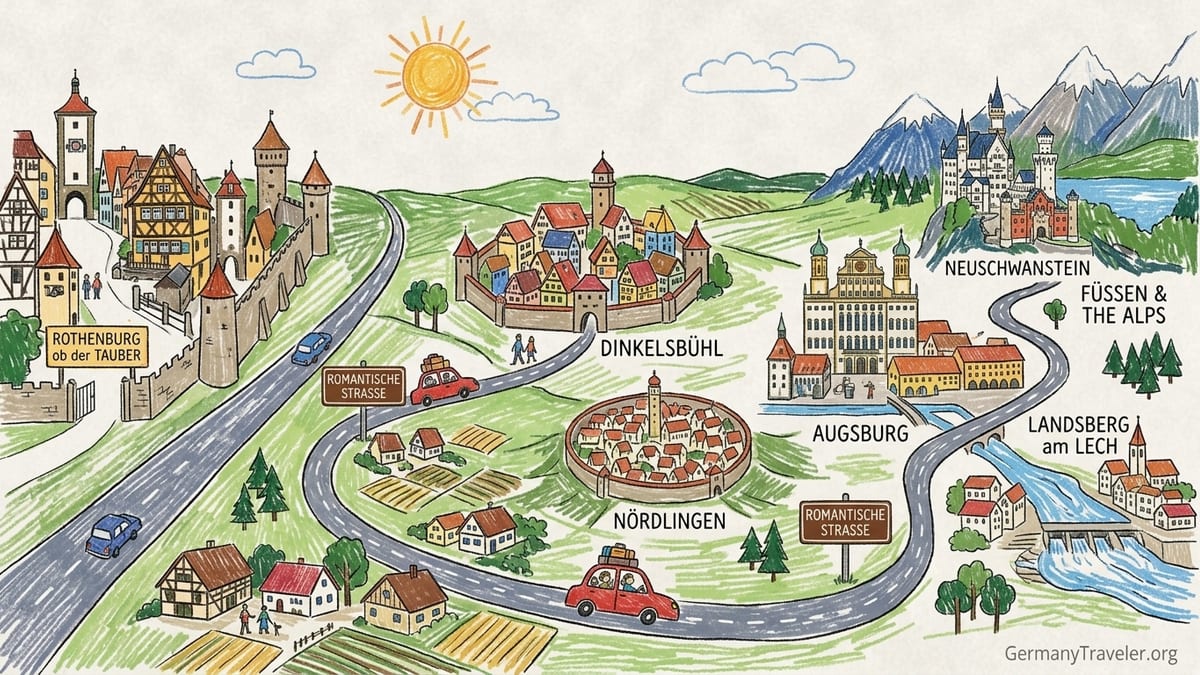
I drove Bavaria’s Romantic Road the way many people actually do it: in a rental car, with limited time, a rough plan, and a lot of curiosity. My route focused on the southern and most visited stretch, from the medieval walls of Rothenburg ob der Tauber down through Dinkelsbühl, Nördlingen, Augsburg and Landsberg am Lech, ending among the Alpine peaks near Füssen. I did not drive every one of the 29 towns on the official route, but I spent real time in these places, fought for parking by the old gates, crawled along Bundesstraßen behind tractors, and learned when the “romantic” branding feels justified and when it feels like smart marketing on a very ordinary bit of road.
Understanding the Romantic Road Once You Are Actually On It
The official Romantic Road runs for roughly 460 kilometers from the Main region in the north down to Füssen at the foot of the Alps. In brochures it looks like a continuous fairytale of half-timbered houses and flower boxes. On the ground, behind the wheel, it is a mix of lovely river valleys and fields, occasional storybook towns, and plenty of normal German countryside that could be almost anywhere in Bavaria or Baden-Württemberg. The charm lives in specific stops rather than in every kilometer of asphalt between them.
Driving it, I found that the “Romantic Road” signs are frequent enough that you can follow them without a GPS, but not so frequent that you can turn your brain off. Around major towns like Augsburg, the route merges with busy feeder roads and it becomes easy to drift off the official itinerary if you simply follow the fastest path on your navigation system. Several times, particularly between Nördlingen and Augsburg and again south of Landsberg, my GPS urged me onto faster highways while the brown Romantic Road signs led along smaller local roads.
The key realization after a day or two was that there is no penalty for occasionally ignoring the official route. In several stretches the signed Romantic Road simply parallels a quicker Bundesstraße or the A7 or B17 for long, straight segments. Cutting onto the faster road for 20 or 30 kilometers, then dropping back to the scenic route near your next town, saves time without sacrificing much in terms of views. The exceptions are when the road dips into river valleys or threads through especially pretty farming villages; at those points, I was glad I stayed with the brown signs and just accepted the slower pace.
If you go in with realistic expectations that only certain towns will truly feel medieval and magical, and that much of the pleasure comes from lingering there rather than driving every centimeter of the marked route, the Romantic Road becomes much more enjoyable. My own trip focused on Rothenburg ob der Tauber, Dinkelsbühl, Nördlingen, Augsburg, Landsberg am Lech and Füssen, and these are the places that shaped my impression of how the route works in practice.
Rothenburg ob der Tauber: Magical Old Town, Modern Parking Reality
Rothenburg ob der Tauber was my northern gateway to the Romantic Road and also the place where the gap between expectation and logistics was sharpest. The old town is astonishing, with intact walls, towers, and cobbled lanes that really do feel like a movie set. It is also one of the most popular destinations in Germany, which means buses lined up by the main gates, streams of day-trippers and overnight guests, and a lot of demand for parking just outside the walls.
Arriving by car in the late morning, I followed signs for the large Parkplatz areas that ring the old town. These are pay-and-display lots, with machines that accept coins and often card. Prices when I visited were in the range of a few euros for a couple of hours and roughly 10 to 15 euros for a full day, which is consistent with current discussions among travelers about parking costs in and around Rothenburg. The lots are well organized and within a short walk of several gates, but in high season or during the Christmas market period they can fill by late morning and cars begin circling.
Inside the walls, driving is allowed on many streets but is not pleasant if you are not used to very narrow medieval lanes and tight turns. I left the car outside and walked in, which felt much less stressful than trying to reach a hotel garage in the historic core. If you do have a hotel inside the walls, it is worth emailing them in advance to ask for exact driving directions and to learn whether they have a reserved space or arrangements in a nearby garage. Several hotel owners I spoke with said they encourage guests to park once and forget about the car until departure day.
Crowds in Rothenburg are very real, especially between late morning and mid-afternoon when buses arrive from Nuremberg, Frankfurt and Munich. Early morning and evening are when the “romantic” image comes alive: shop shutters are half closed, tour groups disappear and you share the walls and famous viewpoints with a more manageable number of people. If your Romantic Road itinerary is tight, Rothenburg is the one place where staying overnight instead of doing a rushed day trip genuinely changes the experience, because it lets you see the town outside peak visitor hours.
Dinkelsbühl: A Softer, Sleepier Medieval Stop
Leaving Rothenburg and following the Romantic Road south, the drive to Dinkelsbühl passes through fields and small villages. It is a pretty, if not spectacular, stretch of road. There are a few gentle curves and low hills, but no dramatic scenery; the reward is at the town itself. Compared with Rothenburg, Dinkelsbühl felt calmer and much less dominated by day-tripping tour groups, even though its walled old town is almost as complete.
I approached Dinkelsbühl from the north and found public parking just outside the walls. The pattern repeated from Rothenburg but at a smaller scale: signed parking areas, pay machines, and a very short walk into the center. I had no trouble finding a spot in mid-afternoon in shoulder season, and local hotel staff later said that while weekends in summer can get busy, Dinkelsbühl rarely sees the same intensity of bus tourism as Rothenburg.
The old town itself is easy to explore on foot in a few hours. The streets are lined with colorful townhouses, the church tower gives a good sense of the town’s size, and parts of the wall and towers are accessible. Walking around, I heard far more German than English, which matched what many recent travelers report: Dinkelsbühl attracts a mix of German visitors and international travelers who are specifically targeting the Romantic Road, rather than broad bus-tour traffic.
Driving out of Dinkelsbühl toward Nördlingen, traffic dropped off quickly once I left the immediate outskirts. I shared the road mostly with local cars, farm vehicles and the occasional campervan. This was one of the stretches where staying on the official Romantic Road instead of a parallel highway felt worthwhile, because the smaller road curves gently through fields and villages that seem to blend into the townscapes at each end.
Nördlingen: A Circular Town in a Crater and a Practical Overnight Stop
Nördlingen is one of the most distinctive stops I experienced along the Romantic Road, partly because of its nearly circular layout and fully walkable walls, and partly because of what lies beneath it. The town sits in the Ries impact crater, which gives the surrounding landscape a broad, shallow bowl shape as you approach. Behind the wheel, you sense this mainly as a very gradual descent into a landscape that feels more enclosed than the rolling farmland north of Dinkelsbühl.
Driving into Nördlingen, I followed signs toward the Altstadt and found several surface car parks just outside the walls. These are closer to the core than in Rothenburg, yet still outside the tight interior lanes. Charges were modest for a few hours, and I noticed that many cars displayed local parking discs in signed areas where short-term parking was free with a time limit. It is worth keeping one of these discs in your rental car; they are often available from gas stations or rental counters in Germany and make life easier in small towns along the route.
I chose to stay overnight in Nördlingen rather than just passing through. It proved a good decision, partly because it broke up the driving and partly because it let me walk the full circuit of the walls in the cool of the evening. The wall walk is free and entered through wooden stairways at intervals around the town. From above, roofs, church towers and back gardens fan out in all directions, and the circular form of the town becomes very clear. It is an experience that feels much less crowded than Rothenburg’s walls, especially once day visitors have left.
As an overnight base, Nördlingen is practical as well as atmospheric. There are several mid-range hotels and guesthouses either just inside or just outside the walls, typically with small private parking areas for guests. Restaurant prices in the old town felt comparable to other Bavarian towns of similar size, with hearty dinners and local beer at moderate prices rather than the premium you sometimes feel in the most famous Romantic Road stops. For drivers, it is a comfortable pause point before the more urban stretch toward Augsburg.
Augsburg: When the Romantic Road Becomes a City Artery
South of Nördlingen the Romantic Road heads toward Donauwörth and then Augsburg, a city that is both a historic highlight and a reminder that this route intersects modern life. The approach to Augsburg quickly shifts from open fields to multi-lane roads, traffic lights and tram lines. Here, the Romantic Road no longer feels like a country drive. Instead it becomes one route among many feeding a regional center, especially where it merges with bigger roads like Bundesstraße 2 or 17 on different segments.
Driving in Augsburg itself is manageable with a GPS, but it requires more attention than the smaller medieval towns. There is a low-emission environmental zone in the central area, which means vehicles are supposed to carry a fine-dust sticker indicating their emissions category. Rental cars picked up in Germany usually have this already, but if you arrive in your own vehicle it is important to check current rules before you drive into central streets. To simplify things, I parked in a modern underground garage on the edge of the historic center and explored on foot.
Augsburg rewards at least half a day’s stop, ideally more. The old town is larger than Rothenburg’s and blends medieval structures with Renaissance and baroque buildings, reflecting centuries as a free imperial city and the influence of merchant families like the Fuggers. The canals and water management system, now recognized for its heritage significance, thread between regular city blocks. Unlike in Rothenburg or Dinkelsbühl, driving here is purely about logistics; the romantic part is in the walking once you have put the car away.
Because Augsburg is a functioning city rather than primarily a tourist town, crowds feel different. Commuters, students and shoppers mix with visitors around the Rathausplatz and along the main pedestrian streets. That makes it less photogenic at times but also more grounded. Staying overnight here offers a contrast to the smaller Romantic Road towns and gave me a chance to enjoy a wider range of restaurants and services, including supermarkets and larger pharmacies, which can be useful on a multi-day road trip.
Landsberg am Lech and the Shift Toward the Alps
Leaving Augsburg, the Romantic Road and Bundesstraße 17 share a significant stretch south toward Landsberg am Lech. The road expands to multiple lanes in parts and feels almost like a controlled-access highway, with higher speed limits and steady traffic, especially near peak commuting times. This is not a winding scenic road but a practical north-south artery across the Lechfeld plain.
Just before Landsberg, the landscape begins to change subtly. The land starts to undulate more, and on clear days you may catch your first distant hint of Alpine peaks on the horizon. Landsberg itself is perched by the Lech River, with an old town that spills down toward the riverbank and a stepped weir that creates a cascade of white water. Driving in, I followed signs to parking areas near the old town and again found surface lots with ticket machines, as well as a compact parking garage a short walk from the central square.
Compared with Rothenburg or even Augsburg, Landsberg felt under the radar for international visitors, although Bavarian day-trippers were very present on the sunny weekend I visited. Cafes along the riverfront were busy but not overwhelmed, and the streets felt more like a local town that happens to be beautiful rather than a destination built around tourism. For drivers, this has an upside: less competition for parking and lower overall pressure on the narrowest central streets.
Landsberg also marks an emotional turning point in the drive. South from here, the Romantic Road tracks broadly with Bundesstraße 17 toward Füssen. The fields give way gradually to more pasture and forest, and the line of the Alps grows larger and more detailed. The road remains well maintained and relatively straightforward to drive, but weather becomes a more important factor, particularly in late autumn and winter when fog or snow can reduce visibility and traction. During my own drive, in stable early autumn conditions, the biggest issue was simply maintaining focus while buses and cars flowed steadily past at highway speeds.
Füssen and the Alps: Beauty, Bottlenecks and Castle Logistics
By the time I reached the Füssen area, the Alps were no longer a distant line but a wall of peaks, and the Romantic Road label suddenly felt fully justified again. The last stretch into Füssen itself passes lakes and rolling foothills, and on clear days you can see the outline of Neuschwanstein Castle on its ridge above Hohenschwangau. This is also one of the most logistically complex sections of the drive, because the roads funnel a large number of cars, tour buses and campervans to a very concentrated set of attractions.
Füssen as a town is compact and easy to navigate. I based myself in or near the center, where several hotels offer guest parking either in small courtyards or shared garages. Public parking is available in lots near the old town and along the river, again with pay-and-display machines. I left the car in town and only drove out to Hohenschwangau for my castle visit, which turned out to be the most congested piece of road on the entire trip.
The approach to Neuschwanstein and Hohenschwangau follows a local road that climbs gently into a narrow valley. Electronic boards by the roadside indicate the status of the main parking lots for cars and buses. When I arrived in mid-morning on a clear day, the closer lots were already nearing capacity and attendants were directing cars to more distant spaces. Parking rates for the official lots are clearly posted at the entrances and are significantly higher than in most small Romantic Road towns, reflecting both demand and the cost of managing large volumes of vehicles in a protected landscape.
From the parking areas it is a ten to fifteen minute walk to the ticket center and then further up to the castles, or a steeper climb on foot for those heading directly up to Neuschwanstein. Shuttle buses and horse-drawn carriages offer alternatives for the ascent, each with separate fees. Crowds here are intense in high season and on any day with good weather. If your Romantic Road itinerary is flexible, building in an early start from Füssen and booking castle tickets ahead of time reduces some of the stress of this final section.
Road Conditions, Seasonal Considerations and When to Leave the Route
Across the entire drive I experienced, road conditions were consistently good. The Romantic Road mainly follows standard German federal and regional roads, which are well maintained, clearly signed and regularly patrolled. Potholes were rare, and even smaller connecting roads between the official route and nearby gas stations or accommodations were in decent shape. Lane markings were clear, and lighting was present near towns though sections of open countryside remain unlit at night.
The main driving challenges come from three sources: slow-moving agricultural traffic, tourist congestion around the most popular towns and weather. Tractors and harvest equipment appear frequently between Rothenburg and Dinkelsbühl and again south of Landsberg. Passing them is safe where marked but requires patience. Around Rothenburg, Augsburg and Füssen, traffic can back up at key intersections at peak times, especially when tour buses are arriving or departing. In the Alps near Füssen, sudden rain showers or fog can reduce visibility quickly.
Seasonally, the Romantic Road feels very different. My own drive took place in stable weather with long daylight hours, which made side stops and evening arrivals at new towns comfortable. In late autumn and winter, shorter days and the possibility of ice or snow south of Landsberg make daytime driving more important. Drivers without winter conditions experience may want to plan fewer hops between towns and allow extra time for cautious progress, particularly in the alpine approaches to Füssen.
As for whether to stick rigidly to the official route, the answer from behind the wheel is no. The brown Romantic Road signs point you along a path that tries to balance scenic value with practicality, but it is not sacred. In several stretches I intentionally switched to nearby faster routes like the A7 or the more direct sections of B17 when my goal was simply to reach the next town in time to explore it before dark. The essence of the trip lies in lingering in places like Dinkelsbühl, Nördlingen or Landsberg, not in spending an extra hour in a car on a parallel minor road that looks almost the same as the highway a few kilometers away.
Sleeping, Eating and Parking: How the Towns Compare
Across the towns I visited, three practical themes kept repeating: where to sleep, where to put the car and how much the tourist focus affects prices and atmosphere. Rothenburg and Füssen both operate at peak-tourism intensity. Accommodation in or very near the historic centers commands higher prices and often has limited on-site parking. In both towns, I found that staying just outside the core, but within a short walk, gave me better value and more reliable parking options, often in small hotel lots or nearby public garages.
Dinkelsbühl and Nördlingen sat in the middle of the spectrum. Each has a compact old town with several family-run hotels and guesthouses, many of which offer a few private parking spaces or arrangements with nearby lots. Prices reflected their appeal but did not feel inflated purely by international tourism. In Nördlingen, my overnight stay came with a parking space in a small courtyard shared by several guest rooms, making arrival and departure very straightforward even though the building was inside the wall line.
Augsburg and Landsberg felt more like places where tourism coexists with daily life. In Augsburg I chose a modern hotel near the center with an underground garage, which simplified driving in a denser city street grid. In Landsberg, I opted for a guesthouse on the edge of the old town and parked in a public lot a few minutes’ walk away. In both cases, food and drink prices, whether for coffee on a square or dinner in a local restaurant, were more in line with regular city pricing than with a premium tourist zone.
Food along the route reflects broader Bavarian tastes: plenty of meat dishes, dumplings, local sausages and regional beer. For quick lunches between towns, bakeries in the smaller communities often proved more satisfying than service stations, offering fresh sandwiches and pastries at moderate prices. In the evenings, the most touristy menus and highest price points tended to cluster around the main squares in Rothenburg and Füssen, while lanes slightly away from postcard viewpoints or, in Augsburg’s case, in less central streets, had more local-feeling options.
The Takeaway
Driving the Romantic Road from Rothenburg to Füssen taught me that the route’s reputation is built on a handful of genuinely special towns connected by a lot of pleasant but unspectacular countryside. The strongest moments were almost always when the car was parked: early evening light on Dinkelsbühl’s walls, a quiet lap around Nördlingen’s ramparts, the sound of the Lech in Landsberg, and the sudden appearance of the Alps around Füssen. The driving between these places was generally easy, occasionally busy, and occasionally slow behind a tractor, but rarely as dramatically scenic as the brochures suggest.
In terms of logistics, the route is friendly to drivers who are comfortable with European parking systems and minor town traffic but might feel stressful to those unused to narrow medieval streets or to the dense traffic near Neuschwanstein. Planning overnight stays in a mix of major draws like Rothenburg and Füssen and quieter towns like Dinkelsbühl or Nördlingen gives the trip rhythm and helps manage crowd fatigue. Using faster parallel roads selectively, rather than treating the official Romantic Road as sacred, keeps daily driving times reasonable.
If you come expecting an endlessly romantic scenic drive, you may be disappointed by some of the more functional stretches, especially near Augsburg and along the multi-lane parts of B17. If you come expecting a string of distinctive towns and are ready to treat the drive as a connective tissue rather than the star of the show, the Romantic Road delivers a satisfying slice of southern Germany. My own trip felt less like following a packaged route and more like linking together medieval corners, riverfront squares and an Alpine finale, with the car as a practical tool rather than a central character.
Above all, the Romantic Road rewards those who slow down once they reach each town. Park just outside the walls, walk in, and give yourself time to explore beyond the busiest streets. The romance is there, but it hides behind parking signs, bus schedules and weather forecasts. The joy of driving this route comes from learning to navigate all three while still making space for cobblestones, bell towers and long views toward the Alps.
FAQ
Q1. Do I need to follow the official Romantic Road route the entire way?
It is not necessary to follow the signed Romantic Road for every kilometer. In several stretches, especially between larger towns, using a nearby autobahn or main federal road saves time without sacrificing much scenery. I often cut onto faster routes, then rejoined the Romantic Road near my next planned stop.
Q2. Is driving and parking in Rothenburg ob der Tauber difficult?
Driving inside the walls can feel stressful because streets are narrow and often crowded. I found it easier to use the large pay parking lots just outside the gates and walk into the old town. Arriving earlier in the day improves your chances of getting a convenient space.
Q3. Which towns along the route felt less crowded but still atmospheric?
Dinkelsbühl and Nördlingen both offered strong medieval character with fewer crowds than Rothenburg or Füssen. I could find parking fairly easily near the walls, and the old towns felt lively without being overwhelmed by tour groups.
Q4. Is Augsburg worth stopping at if I am more interested in small medieval towns?
Augsburg is larger and more urban, but it adds a different dimension to the trip. Its historic core shows the wealth of a former imperial city, and staying there provided access to services and restaurants that are less common in smaller stops. If your time is short, you might give it one focused afternoon rather than an overnight.
Q5. How challenging is the drive from Landsberg am Lech to Füssen?
The road surface is good and the route is mostly straightforward, often sharing alignment with Bundesstraße 17. The main challenges are higher traffic volumes and, in colder months, potential fog or snow as you approach the foothills of the Alps.
Q6. Is an overnight stay in Nördlingen worthwhile?
Yes. Staying in Nördlingen allowed me to walk the complete town walls at a relaxed pace and enjoy the circular layout without day-trip crowds. It also provided a convenient break in driving between the northern medieval towns and larger centers further south.
Q7. What should I know about visiting Neuschwanstein by car from Füssen?
The road to Hohenschwangau, where parking for Neuschwanstein is located, can be very busy. Electronic signs show lot availability, and parking fees are higher than in most smaller towns. Arriving early and having castle tickets booked in advance helped make this segment more manageable.
Q8. Are there low-emission or other driving restrictions on the route?
Certain larger cities, notably Augsburg, have environmental zones where cars need an emissions sticker. Rental cars obtained within Germany usually have one, but if you are driving your own vehicle you should check current regulations before entering central areas.
Q9. What is the best time of year to drive the Romantic Road?
Shoulder seasons with longer days and moderate temperatures, such as late spring and early autumn, balance manageable traffic with pleasant conditions. Winter brings fewer visitors in some towns but also shorter days and a higher chance of ice or snow near Füssen.
Q10. How many days should I plan for the Rothenburg to Füssen section?
Allowing at least three to five days gives time to explore Rothenburg, Dinkelsbühl, Nördlingen, Augsburg or Landsberg, and Füssen without rushing. More days let you linger, but even this shorter section benefits from unhurried overnight stops rather than a single long day behind the wheel.