


I thought I was well prepared for my first visit to Neuschwanstein Castle in 2026. I had read the official advice, booked my tickets online, and planned a relaxed day trip from Füssen. Yet by the time I finally stepped back onto the bus that evening, I realized how many small details about tickets, timing, and logistics I had underestimated. If you are planning your own visit, here is exactly how my day unfolded and what I wish I had known before I set foot in Hohenschwangau.
Booking Neuschwanstein Tickets: What I Did Right (and Wrong)
I visited Neuschwanstein in July 2026, during peak summer season, when tickets regularly sell out in advance. The official admission price for an adult is 21 euros for a guided tour, which is the only way to see the inside of the castle. On top of that, the online system charges a booking fee of 2.50 euros per person, even for the free children’s tickets. I knew dates could sell out, so I booked about six weeks ahead for a midweek visit.
I used the official Ticket Center Hohenschwangau online shop and chose a mid-afternoon English guided tour. When you book, you do not pick a “window” but a precise admission time printed on the ticket. That time is not when you should arrive in the village. It is the time your guided tour group is scheduled to enter the castle interior. This distinction is crucial and easy to miss when you are just clicking through an online calendar.
The confirmation email stressed that tickets are nonrefundable and cannot be changed. It also mentioned that remaining same day tickets are sold at the Ticket Center in Hohenschwangau only for the current date and subject to availability. On busy days, those tickets can be gone shortly after the ticket office opens. Standing in the village later and watching people queue at the ticket center screens, hoping for last minute slots, convinced me I had been right to buy in advance.
What I underestimated was how long everything around that timed ticket would take. The official advice recommends arriving in Hohenschwangau at least 1.5 to 2 hours before your Neuschwanstein admission time. At first that sounded excessive. After doing the trip, I would say that two hours is the minimum I would plan, especially if you need to pick up tickets at the counter or you want to stop at Marienbrücke.
Picking Up Tickets and First Impressions in Hohenschwangau
I based myself in Füssen and took the morning bus to “Hohenschwangau Neuschwanstein Castles” from the station, using a regional transport ticket that covered local buses. The ride took about 10 to 15 minutes. As we approached, the bus climbed gently and the view opened over the Alpsee, with Hohenschwangau Castle on one hill and Neuschwanstein perched dramatically higher behind it. Even if you have seen the castle in countless photos, that first glimpse is powerful.
All ticket business for Neuschwanstein happens down in the village of Hohenschwangau, not at the castle gate. There is no ticket counter at the castle itself. I had opted for digital tickets, so I technically did not need to stand in line at the Ticket Center, a modern low building near the main car parks with numbered counters and electronic boards showing upcoming tour times. Still, I went inside to see how things worked in case I returned with family another time.
Inside the Ticket Center, screens displayed remaining capacities for various language tours, along with the next available times. On the summer Saturday when I visited, by around 10:00 in the morning the English tours for the middle of the day were already fully booked. Later, around midday, I checked again and saw that only late afternoon slots were left and some language options had no tickets remaining at all. The people in the “today’s tickets” line looked anxious, especially those who had underestimated demand and simply turned up without reservations.
Because my ticket was on my phone, I skipped the ticket counter and instead focused on orienting myself. I noted the signs pointing to Neuschwanstein and to the shuttle bus stop, checked the time of my admission (14:50), and then looked at my watch: it was just after 12:30. On paper, that gave me more than two hours, which sounded comfortable. In practice, those hours disappeared quickly between walking, waiting for transport, and queuing at the castle entrance.
Parking, Buses, and the Uphill Journey to the Castle
Although I arrived by bus, I also paid close attention to the parking situation because many visitors around me had driven from Munich or beyond. The car parks in Hohenschwangau are large but not endless, and in summer they fill up by late morning. Drivers I chatted with at the shuttle stop told me they had paid a flat day rate to park, and several mentioned circling a bit before finding a space close to the Ticket Center.
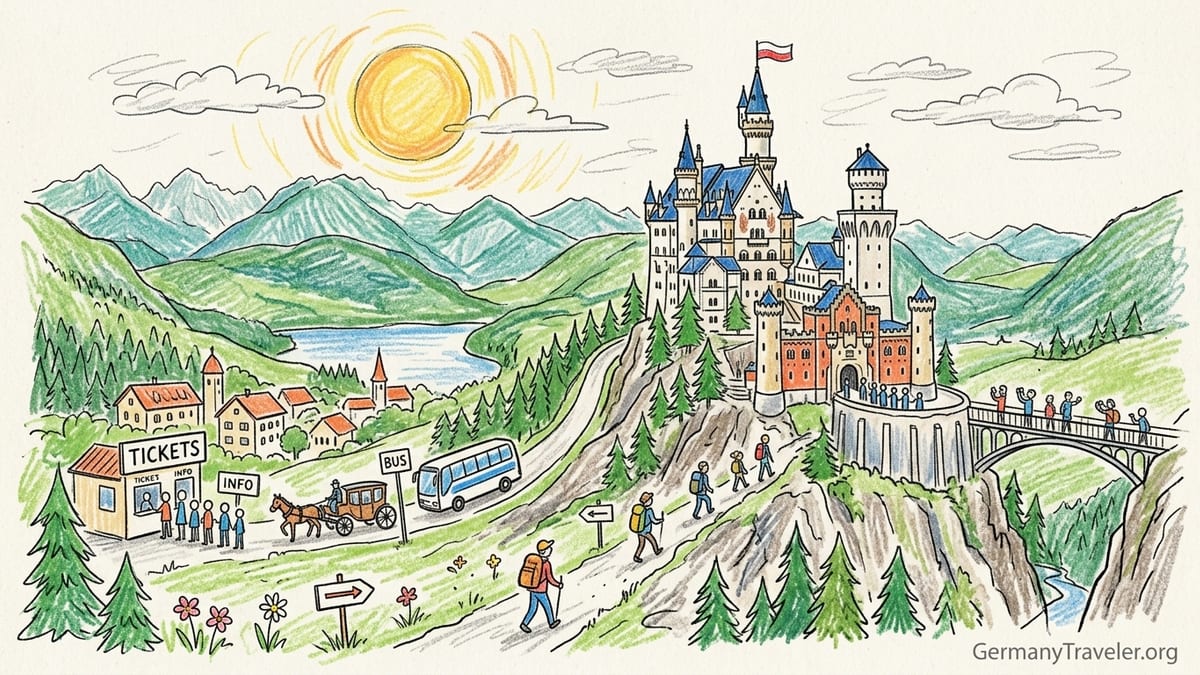
From the village you have three options to get up to Neuschwanstein: walk, take the shuttle bus, or hire a horse drawn carriage. The walk is about 1.5 kilometers on a paved but steep road and takes roughly 30 to 40 minutes at a moderate pace. The shuttle bus, operated by a private company, runs according to demand rather than a strict timetable and departs from the upper end of the village near the Schlosshotel. It drops you at a lookout point near Marienbrücke above the castle, not directly at the castle gate.
I decided to walk up and take the shuttle down, which I would recommend for many visitors with average fitness. The walk itself is pleasant but steadily uphill. I am reasonably fit and still found it more strenuous than I expected, partly because the day was warm. People with strollers, small children, or limited mobility were moving slowly and stopping frequently at the side of the road. If you have knee or heart issues, or you are traveling with anyone who cannot comfortably manage a steep 30 minute uphill walk, the shuttle or carriage is worth serious consideration.
The road is shared by pedestrians, shuttle buses, and carriages, which means that now and then you step aside to let vehicles pass. There are stretches shaded by trees and a few small viewpoints over the lake. I reached the top in around 35 minutes, slightly sweaty but with enough time to spare before my timed entry. What surprised me was that, on a busy day, even the shuttle line can be long. Later, when I went back down, I waited more than 20 minutes to board a bus and saw people turned away from already full departures.
Timed Entry and the Guided Interior Tour
Neuschwanstein can only be visited on a guided tour, and the timing is run with near military precision. Your ticket shows an admission time and a group number. The screens near the castle entrance display which group numbers should queue at the turnstiles. Arriving far too early is not necessary, but arriving even a few minutes late is a serious risk. The staff made it clear that if you miss your time, they cannot simply squeeze you into the next tour because groups are programmed down to the minute.
I reached the castle courtyard about 40 minutes before my tour. After stopping briefly at a small snack kiosk for a drink, I took some photos in the courtyard and then watched the boards. About 15 minutes before my scheduled time, my group number appeared and I joined the corresponding queue. Security checked tickets carefully, including the timing. A few people in front of me had misread their ticket, thinking the time printed there was a rough slot rather than a firm admission. They were gently but firmly told that they were too early and would need to wait until their number came up.
Once my group entered, the tour itself took just over 30 minutes, consistent with the official estimate. It is a brisk walk through a series of lavish rooms, staircases, and hallways, accompanied by a guide who delivers a well rehearsed commentary about King Ludwig II, the construction of the castle, and the symbolism in the murals and furnishings. The rooms that stood out to me were the Throne Hall with its starry ceiling, and the Singer’s Hall, which feels like a romanticized medieval fantasy. Photography inside was not allowed during my visit, and staff reminded people repeatedly to keep moving.
What I had not fully expected was how tightly tours follow one another. As soon as one group left a room, another was sweeping in behind. This can make the experience feel slightly rushed, especially if you like to linger over details. It is not a leisurely wander through a palace, but a structured, time boxed visit designed to accommodate huge visitor numbers. If you want deeper context, it can help to read up beforehand or visit the small display panels quickly when you can.
Marienbrücke and Managing the Crowds
No visit to Neuschwanstein feels complete without seeing it from Marienbrücke, the pedestrian suspension bridge that spans a gorge above the castle. The shuttle bus from the village actually drops you near this bridge, and from there you walk about 10 minutes slightly downhill to reach the castle entrance. Because I had walked up from the village instead, I saved Marienbrücke for after my interior tour, which in hindsight was one of the best decisions I made.
From the castle courtyard, reaching Marienbrücke involves following a paved path that climbs for about 10 to 15 minutes. It is not particularly long, but after the earlier uphill walk and the stress of meeting a timed entry, the extra climb is noticeable. When I arrived, the bridge was busy but still manageable, with a constant shuffle of people taking photos. Entrance to Marienbrücke itself was free, but staff were controlling the flow, allowing waves of visitors to enter and then pausing new arrivals when the bridge became too crowded.
The view from the middle of Marienbrücke is everything the postcards promise and more. You look straight across to Neuschwanstein, perched on its rocky spur, with the lakes and green countryside stretching behind. On a clear day, it is one of those scenes that justifies the entire journey. I spent about 20 minutes there, taking pictures and simply appreciating the perspective, before heading back toward the shuttle stop.
Crowd wise, the entire area around Neuschwanstein and Marienbrücke felt more congested than I had imagined. There were significant numbers of group tours with flags and headsets, families with strollers, and solo travelers all trying to navigate the same narrow paths. At several points, especially near the castle entrance and at the approach to the bridge, movement slowed to a slow shuffle. For anyone anxious in crowds, it is worth mentally preparing for that. I found that stepping aside briefly to quieter corners when possible helped a lot.
How Long the Visit Really Took
On paper, my plan was simple: arrive in Hohenschwangau around midday, visit Neuschwanstein in the afternoon, and return to Füssen by early evening. In practice, the day felt fuller and longer than it looks on a timetable. Here is roughly how my schedule broke down.
I caught a late morning bus from Füssen and arrived in Hohenschwangau shortly after 12:30. I spent about 15 to 20 minutes orienting myself, walking past the Ticket Center, checking the shuttle stop, and grabbing a quick snack. Around 13:00 I started the walk up toward the castle, which took around 35 minutes including a short break at the side of the road. That put me in the castle courtyard roughly an hour before my timed tour.
Between photos, a restroom break, and simply soaking in the view, that hour passed quickly. I joined the queue for my tour group about 15 minutes before the scheduled entry time. The interior tour itself lasted a bit more than 30 minutes. After exiting through the gift shop area, I followed the signposted path toward Marienbrücke, which took another 15 minutes or so. I then spent over 20 minutes on the bridge and the surrounding path.
Rather than walk all the way back down, I opted for the shuttle bus from the stop near Marienbrücke. There was already a line snaking along the roadside, and I waited around 20 to 25 minutes before a bus with space arrived. The ride down took less than 10 minutes. Back in the village, I took another short walk around the lakefront and then caught a bus back to Füssen. From the moment I stepped off the morning bus in Hohenschwangau to the moment I boarded the evening one, I had spent close to five hours on the ground, for a 30 minute interior tour and about an hour of viewpoints and walking. That ratio is worth keeping in mind when you plan your own day.
What I Would Do Differently Next Time
Looking back, most of what I did worked, but a few changes would have made the experience smoother and less stressful. The first change would be to book an earlier admission time, ideally late morning rather than mid afternoon. That way I could have arrived in the village around opening time, used the quieter morning hours to walk up and enjoy the exterior, and then had flexibility after the tour to either explore Hohenschwangau Castle or simply linger by the lake without watching the clock.
I would also treat the advice to arrive 1.5 to 2 hours before my timed entry as non negotiable. On my visit, I cut it fairly close. If the bus from Füssen had been delayed, if the queue for the shuttle had been longer, or if I had made an extra stop along the way, I could easily have missed my slot. Next time, I would aim to be in the village a full two hours before, and I would decide in advance whether I planned to walk or use the shuttle so I could time the uphill trip more precisely.
Another lesson was about footwear and weather planning. Because I knew there was a shuttle, I had underestimated the amount of walking involved between the Ticket Center, the castle, and Marienbrücke. Including all of it, I covered several steep kilometers on pavement and packed gravel. If I returned, I would absolutely wear more cushioned walking shoes and bring a light waterproof layer, even in summer, because the weather in the foothills can change quickly and the exposed paths offer little shelter.
Finally, I would budget more mental space for the crowds. Neuschwanstein is one of the most visited sights in Germany and has become a UNESCO World Heritage Site, and the management system reflects that level of demand. If you go expecting a quiet mountain retreat, you may feel disappointed. If you think of it instead as a large scale attraction with a spectacular setting and a tightly managed ticket system, the experience feels more logical and easier to enjoy for what it is.
The Takeaway
My day at Neuschwanstein was memorable for all the right reasons: the dramatic setting, the richly decorated interiors, and the almost surreal moment of seeing the castle from Marienbrücke for the first time. It was also a lesson in how much the success of a visit depends not just on having a ticket, but on understanding the fine print around that ticket. Regular admission is 21 euros, tours last around 30 minutes, and tickets can sell out long before you arrive in the village. Same day tickets at the Hohenschwangau Ticket Center are helpful, but they are not a guarantee.
If you are planning a visit in 2026 or beyond, my strongest advice is to secure tickets online early through the official system, pay careful attention to the exact admission time, and treat the recommendation to arrive 1.5 to 2 hours in advance as essential, not optional. Decide in advance how you will get up the hill, build in time for Marienbrücke, and prepare for significant walking and crowds. With that mindset, Neuschwanstein turns from a potentially stressful box to check into a rewarding, if busy, day in a truly remarkable corner of the Bavarian Alps.
Would I go again after seeing it once? Yes, but with a different rhythm. I would stay overnight in or near Hohenschwangau, walk up early before most tours begin, and move more slowly between castle, viewpoints, and lakeshore. Knowing what I know now about tickets, timing, and the on the ground logistics, I am convinced that Neuschwanstein can still feel special, even in peak season. The key is to respect the realities of how the site operates and plan around them, rather than fighting against them on the day.
FAQ
Q1. Do I really need to book Neuschwanstein Castle tickets in advance?
Yes. Regular admission is 21 euros and tickets for the guided interior tour are limited to specific time slots. In busy months, online allocations can sell out days or weeks ahead. Same day tickets are sold only at the Ticket Center in Hohenschwangau, only for that day, and availability is not guaranteed.
Q2. Can I buy tickets at Neuschwanstein Castle itself?
No. There is no ticket counter at the castle entrance. All sales, including remaining same day tickets, go through the Ticket Center in the village of Hohenschwangau or the official online shop. If you arrive at the castle without a valid timed ticket, you can see the exterior and courtyard but not join an interior tour.
Q3. How early should I arrive in Hohenschwangau before my timed entry?
The official recommendation is to be in the village 1.5 to 2 hours before your Neuschwanstein admission time. That buffer is necessary for collecting or checking tickets, walking or taking the shuttle up the hill, passing security, and dealing with crowds. In my experience, anything less than 1.5 hours feels rushed.
Q4. How long does the Neuschwanstein Castle tour take?
The guided interior tour lasts about 30 minutes. However, you should budget at least half a day for the entire experience, including travel from Füssen or your accommodation, time in Hohenschwangau, the uphill journey, possible queues, and a visit to Marienbrücke for the classic view of the castle.
Q5. What are my options for getting up to the castle from the village?
You can walk, take a shuttle bus, or use a horse drawn carriage. The walk is roughly 1.5 kilometers on a steep uphill road and takes around 30 to 40 minutes. The shuttle bus operates according to demand between the village and a viewpoint near Marienbrücke, from where you walk down to the castle. Carriages follow a similar route and cost more than the shuttle.
Q6. Is Marienbrücke included in the ticket and is it worth visiting?
Access to Marienbrücke was free during my 2026 visit and did not require a separate ticket, though staff controlled the flow of people for safety reasons. The short walk from the castle to the bridge adds extra uphill effort, but the view of Neuschwanstein from the middle of the span is spectacular and, in my opinion, absolutely worth the time.
Q7. What happens if I miss my timed entry for the tour?
If you arrive late and your group has already entered, staff cannot usually move you to a different tour, because visitor flows are tightly scheduled. In that case, you may lose the chance to see the interior altogether. This is why arriving in the village well ahead of time and allowing a margin for delays is so important.
Q8. Are children free and do they still need tickets?
Children and young people under 18 are generally admitted free to Neuschwanstein, but they still require their own timed tickets, especially for online bookings. When reserving, you must add a free child ticket for each child, which also incurs the same booking fee as adult tickets in the online system.
Q9. Can I see Neuschwanstein without going inside?
Yes. You can walk from the village to the castle courtyard without a ticket, and you can also visit viewpoints like Marienbrücke. Many visitors who cannot secure tour tickets still come to enjoy the exterior and the landscape. However, you will not be allowed through the turnstiles into the interior areas without a valid guided tour ticket.
Q10. Is visiting Neuschwanstein Castle doable as a day trip from Munich?
It is possible as a long day trip by combining regional trains or buses to Füssen and then a local bus to Hohenschwangau. However, the journey each way can take around two hours or more, and when you add the time needed for the castle visit itself, the day becomes quite long. Many travelers prefer to stay overnight in Füssen or Schwangau for a more relaxed pace and easier timing around their ticketed entry.