


Germany’s Baltic Sea coast stretches for hundreds of kilometres and is packed with sandy beaches, resort towns and historic spa architecture. The challenge is not whether to go, but where to base yourself. Timmendorfer Strand, Kühlungsborn, Warnemünde, Zingst, Binz and Sellin on Rügen, plus Heringsdorf and Ahlbeck on Usedom, all appear again and again when you search for accommodation. Each offers its own mix of promenade life, hotel supply, family facilities, nightlife, train access and day trip options. This guide compares them side by side so you can choose the right hub for your style of Baltic holiday.
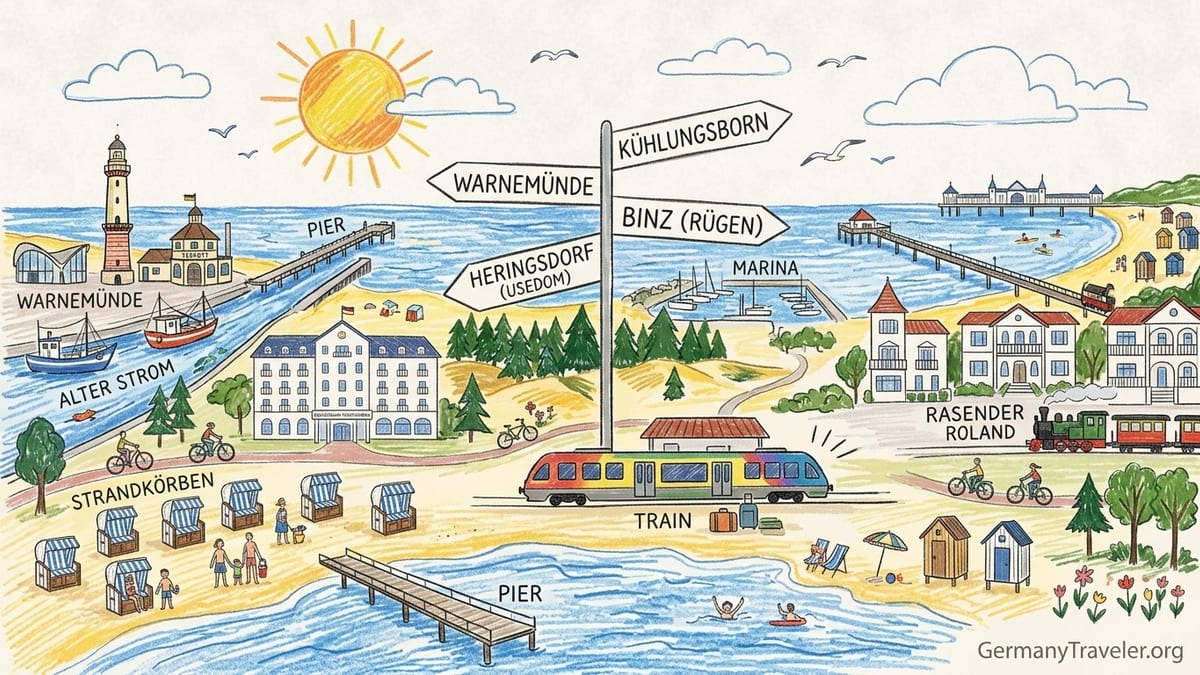
How to Choose Your Baltic Coast Base
Before zooming into each resort, it helps to be clear about what matters most to you. Along the German Baltic coast, differences are less about postcard beauty and more about atmosphere, logistics and how you want to spend your days. Almost everywhere has a long sandy beach, but some towns feel polished and upscale, others quieter and closer to nature, and some function as convenient rail hubs for day trips.
Think about how you will arrive. If you are coming by train from Hamburg or Berlin and prefer not to rent a car, places with direct or easy rail access such as Warnemünde, Binz and the Kaiserbäder on Usedom are especially attractive. If you are driving, consider parking rules and whether you are happy to leave the car at a paid lot on the edge of town and walk along the promenade.
Your priorities on the ground also matter. Families often favour flat, lifeguarded beaches with a choice of playgrounds and casual restaurants, while couples might prefer a more elegant promenade, spa hotels and quieter evening bars. Nature lovers may care more about access to national parks and cycling trails than about nightlife. The following sections walk through each major resort in detail with concrete examples of hotels, prices and day trips to help you decide.
Timmendorfer Strand: Easy Beach Break for Lübeck Bay
Timmendorfer Strand sits on Lübeck Bay, a classic choice if you are combining a city break in Lübeck or Hamburg with a few days at the sea. Expect a broad, gently shelving sandy beach, long promenade and plenty of traditional Strandkörbe beach chairs for rent by the day. In summer the waterfront can feel busy and lively rather than remote, with families, day trippers and weekenders from Hamburg filling the beach.
The town has one of the densest hotel supplies on this stretch of coast, from large four star properties like the Maritim Seehotel Timmendorfer Strand, with indoor pool and spa, to smaller family run pensions and self catering apartments. A typical mid range double room in high summer often sits in the approximate 150 to 250 euro per night range, with cheaper deals in shoulder seasons such as May or late September. You also find kid friendly amenities like the Sea Life aquarium just behind the beach, convenient if the weather turns.
Promenade life in Timmendorfer Strand is commercial and upbeat, with fashion boutiques, ice cream stands, bars and beachfront restaurants serving seafood and Flammkuchen. Evening options are better than in many small resorts, with several cocktail bars and hotel lounges staying open late, though you will not find big clubbing here. The town is broadly family friendly, but in peak season it can feel crowded, so travellers who prefer quiet dunes may want to head farther east.
Arriving without a car is straightforward. Regional trains run to Timmendorfer Strand station from Lübeck, around 25 kilometres away, and from there it is a short bus or taxi ride to the seafront. Drivers reach the resort quickly from the A1 motorway, but should factor in paid parking near the center, especially in July and August. As a base, Timmendorfer Strand works well for day trips to Lübeck’s old town, Travemünde, Scharbeutz and Niendorf, giving you a mix of urban sightseeing and coastal walks.
Kühlungsborn: Polished Promenade and Classic Seaside Style
Kühlungsborn is one of the largest and most established Baltic resorts in Mecklenburg, famous for its long, continuous seafront. The promenade stretches for more than three kilometres between Kühlungsborn West and the marina, lined with historic spa architecture, modern hotels and beach access points. The beach itself is wide and sandy, broken into sections with family zones, quieter segments and some water sports rentals.
The town offers a broad range of accommodation, from traditional spa hotels such as Upstalsboom Hotelresidenz & SPA Kühlungsborn and Hotel Vier Jahreszeiten, right on or very close to the promenade, to modern apartments set a street or two inland. In peak summer, expect mid range hotel rooms to start around 160 to 220 euros per night, with beachfront properties often higher. Many hotels have wellness areas with pools and saunas, making Kühlungsborn attractive in shoulder seasons as well.
Restaurants cluster along Strandstrasse and Ostseeallee. You can eat fresh fish at casual spots near the pier, find Italian style pizza and pasta at places like Ristorante Pizzeria La bella vita in town, or settle into a more formal multi course dinner in one of the hotel restaurants. The evening atmosphere is sociable but not rowdy, more about strolling, people watching and a glass of wine on a terrace than about loud nightlife. Families appreciate the playgrounds near the seafront and the flat, easily supervised beach.
Getting to Kühlungsborn without a car usually involves a regional train to nearby Bad Doberan and then the historic narrow gauge “Molli” steam railway that trundles directly into Kühlungsborn. Drivers will find several municipal car parks signposted near the center and at the edges of town; overnight parking is usually paid, and camper vans are directed to the dedicated camping park rather than street spaces. As a base, Kühlungsborn supports day trips along the coast to Heiligendamm, Rostock and Warnemünde, as well as inland to Rostock’s old town for a change of scene.
Warnemünde: Easiest Rail Access and City-plus-Beach Feel
Warnemünde serves as the seaside district of Rostock and is one of the most accessible Baltic beaches for train travelers. From Berlin or Hamburg you usually take an intercity or regional train to Rostock, then a short S Bahn hop to Warnemünde station, which sits just a few minutes’ walk from the beach. This makes it a popular day trip destination, especially for people using nationwide public transport tickets.
The beach in Warnemünde is long and relatively wide, with fine sand and space to spread out if you walk a little away from the station side. The waterfront is dominated by the lighthouse, Teepott building and a mix of older houses and newer hotels. Accommodation ranges from simple guesthouses in back streets to modern hotels along the promenade; prices are comparable to other major resorts, though weekends in summer can book out early due to demand from both tourists and cruise passengers.
Warnemünde’s promenade and Alter Strom canal area offer plenty of bars, fish snack stands and restaurants. You can grab a Fischbrötchen at one of the kiosks, sit down for a plate of herring or cod at a harbourfront eatery, or take coffee in one of the many cafés that line the narrow streets. Evenings can feel livelier than in smaller villages, especially when cruise ships are in port, with a noticeable bar scene and more late opening venues. At the same time, the presence of a city just behind you gives quick access to cultural sights in Rostock.
Parking can be tight and expensive close to the centre, so if you are driving it often makes sense to use edge of town car parks and walk or take local transport. As a base, Warnemünde is ideal if you want easy train-based day trips: Rostock’s brick Gothic churches and university, smaller Hanseatic towns such as Wismar, and stretches of coast toward Heiligendamm and Kühlungsborn are all reachable on regional trains or buses.
Zingst: For Nature, Space and a Quieter Promenade
Zingst lies on the Fischland Darß Zingst peninsula at the edge of the Vorpommersche Boddenlandschaft National Park, making it a prime choice for travellers who value nature and landscape. The beach is long, flat and sandy, backed by dunes and often feeling more spacious than in the big spa towns. Walk a short way along the shore outside the main access points and you can quickly find quieter stretches, especially in shoulder season.
The village has developed significantly as a resort, so you will find a solid range of hotels and holiday apartments, but the scale is generally smaller than in Binz or Kühlungsborn. Many visitors rent self catering flats for a week, especially families, although there are also mid range hotels and guesthouses near the Kurhaus and pier. Prices vary, but a modern apartment within walking distance of the sea in July can easily reach around 120 to 180 euros per night, depending on size and facilities.
Promenade life in Zingst is relaxed rather than flashy. There are cafés, ice cream stands and restaurants around the Kurhaus and along the main street into town, but less in the way of upscale shopping. The town is known for events focused on nature and photography, from crane watching in autumn to environmental festivals. Families find plenty of playgrounds, cycling paths and soft sand for children to play in, although nightlife is limited to a handful of bars and hotel lounges.
Reaching Zingst generally requires a combination of train and bus. A common route is to take a regional train to Barth or Ribnitz Damgarten West, then continue by bus onto the peninsula. This makes travel with heavy luggage a little more involved than to rail hubs like Warnemünde or Binz. If you are driving, however, access is straightforward, and there are several organised parking areas, some slightly set back from the beach. As a base, Zingst is outstanding for day trips along the peninsula to Prerow’s West Beach, to Darß’s lighthouses, and into the national park for birdwatching, cycling and boat trips on the Bodden lagoons.
Binz and Sellin: Rügen’s Resort Duo
The island of Rügen has long been one of Germany’s classic holiday destinations, and Binz is its best known seaside resort. Trains run onto the island via Stralsund, and there is a direct electrified rail line to Ostseebad Binz, so you can arrive without a car from major cities such as Berlin with just one change. The station is within walking distance of much of Binz’s accommodation and the seafront.
Binz’s beach is wide, sandy and around five kilometres long, with rows of beach chairs and plenty of access points. The resort’s famous white Bäderarchitektur villas line the seafront behind the promenade, many converted into hotels and apartments. Options range from larger four star hotels with spas and pools to smaller villa style pensions and serviced apartments. In peak season you will often see mid range rooms starting around 180 to 250 euros per night, though there are cheaper pensions a few blocks back from the water and outside school holidays.
The promenade in Binz is busy and atmospheric, especially in the evenings when visitors stroll past the pier, stop for ice cream or sit down for fish dishes and regional specialties. Restaurants vary from casual Fischbrötchen stands to smart hotel dining rooms offering set menus. Nightlife is relatively modest but livelier than in the quieter nature resorts, with several bars, hotel lounges and occasional live music. The resort is generally family friendly, with shallow water near the shore and playgrounds on or near the beach.
Sellin, a short bus or narrow gauge “Rasender Roland” train ride from Binz, is smaller but famous for its pier, which stretches out into the sea with a distinctive pavilion restaurant at the end. Its beach is slightly narrower but scenic, framed by wooded cliffs. Many travellers choose to base in either Binz or Sellin and use local buses or the island’s heritage railway to explore neighbouring Göhren, Baabe and the countryside inland. From either base you can take day trips to the chalk cliffs in Jasmund National Park near Sassnitz, the monumental seafront at Prora, or small villages such as Putbus, making Rügen one of the richest areas for varied excursions.
Heringsdorf and Ahlbeck: Usedom’s Elegant Kaiserbäder
On the island of Usedom, the resorts of Ahlbeck, Heringsdorf and Bansin form the so called Kaiserbäder, or imperial spas, a string of elegant seaside towns connected by a long promenade. Heringsdorf sits roughly in the middle and functions as a transport hub, with regional trains on the Usedomer Bäderbahn linking the island to the mainland at Züssow and Wolgast. Trains stop at Ahlbeck and other intermediate stations, so it is feasible to arrive from Berlin with just one or two changes.
The beaches here are broad, flat and sandy, stretching for many kilometres along the island’s north coast. Long, shallow shallows make them appealing for families with small children, and rows of beach chairs can be rented for the day. The promenade between Bansin, Heringsdorf and Ahlbeck runs for around 12 kilometres and continues across the Polish border to Świnoujście, creating one of Europe’s longest interconnected seafront walks and cycle paths. Along the way you pass ornate turn of the 20th century villas, piers reaching into the sea and a mix of hotels, cafés and restaurants.
Accommodation options range from grand spa hotels in Heringsdorf, some with extensive wellness facilities and indoor pools, to smaller guesthouses and apartment houses in Ahlbeck and Bansin. Prices vary by exact location, but in high summer many seafront hotels charge well above 200 euros per night for double rooms, with better value available if you book inland or outside school holidays. Self catering apartments are popular with families and often booked by the week.
The restaurant scene features both casual fish stalls near the piers and more formal dining rooms in the larger hotels, sometimes with terrace seating and sea views. Nightlife is low key; a handful of bars and hotel lounges open late, but the overall feel is relaxed and elegant rather than party driven. From a base in Heringsdorf or Ahlbeck, travellers can make easy day trips by train or bike along the island, explore the Achterwasser lagoons on the quieter south shore, or cross into Poland to visit Świnoujście’s markets and harbourfront.
Practical Comparisons: Families, Nightlife, Trains and Day Trips
For family holidays, all of these resorts offer safe, shallow beaches and the typical Baltic infrastructure of lifeguards in season, rental beach chairs and playgrounds. Timmendorfer Strand and Kühlungsborn stand out for their combination of family friendly hotels, attractions such as aquariums or mini golf, and easy dining options. Zingst, Binz and the Kaiserbäder on Usedom are ideal if you want more space, nature or longer promenades for stroller walks, while Warnemünde works especially well for families arriving by train for shorter stays.
If nightlife and evening atmosphere matter, focus on the bigger hubs. Warnemünde and Binz tend to have the liveliest bar scenes and more venues open late, followed by Timmendorfer Strand with its promenade bars and Kühlungsborn’s hotel lounges. Zingst and the Kaiserbäder lean quieter; evenings are more about dinners, sunset walks and perhaps a drink at the hotel bar. None of these resorts rival major cities for clubbing, so travellers seeking late night dance clubs may prefer to base in Rostock or Lübeck and visit the beach by day.
Train access is easiest in Warnemünde, Binz and Heringsdorf/Ahlbeck, all of which have stations close to the sea and direct or simple connections from mainland hubs. Timmendorfer Strand is also reachable by train from Lübeck, though you may transfer to a bus or taxi for the last stretch. Kühlungsborn and Zingst require a little more effort, involving transfers to narrow gauge or bus services, which is manageable with moderate luggage but may be less appealing on a short break.
As for day trips, Rügen and Usedom offer the richest menus simply because they are large islands. From Binz or Sellin you can visit chalk cliffs, forested peninsulas and historic towns without long drives, while from Heringsdorf or Ahlbeck you can cross into Poland or explore Usedom’s inland lakes. Timmendorfer Strand gives easy access to Lübeck, Scharbeutz and Travemünde, Kühlungsborn and Warnemünde are ideal for combining Rostock’s city sights and coastal stretches, and Zingst excels for nature focused outings along the peninsula and into the national park.
The Takeaway
If your priority is easy logistics and a quick beach escape from Hamburg or Lübeck, Timmendorfer Strand and Warnemünde are hard to beat. Both pair broad sandy beaches with solid hotel supply and straightforward rail connections, making them excellent choices for long weekends or first time Baltic visitors who want low stress travel.
Travellers seeking a polished spa atmosphere with a strong promenade presence gravitate toward Kühlungsborn, Binz or the Kaiserbäder on Usedom. Kühlungsborn mixes historic architecture with a long seafront and family friendly infrastructure. Binz offers perhaps the most iconic resort scenery on Rügen, plus easy train access and strong day trip potential, while Heringsdorf and Ahlbeck deliver long promenades, elegant villas and the novelty of walking into Poland along the shore.
For a more nature oriented stay with quieter evenings, Zingst and the wider Fischland Darß Zingst peninsula are especially rewarding. Here, dunes, national park trails and birdlife take centre stage, with enough cafés and restaurants for comfort but little in the way of big city bustle. Ultimately, you can hardly choose “wrong” among these bases, but matching their personalities to your priorities will make the difference between a good Baltic holiday and a great one.
FAQ
Q1. Which Baltic resort is best without a car?
Warnemünde, Binz and the Kaiserbäder on Usedom are the most convenient, with train stations close to the beach and frequent regional connections from larger cities.
Q2. Where should families with young children stay?
Families often favour Timmendorfer Strand, Kühlungsborn, Binz or the Kaiserbäder on Usedom for their shallow beaches, playgrounds and abundance of family friendly hotels and apartments.
Q3. Which base is best for nightlife?
Warnemünde and Binz usually offer the liveliest evenings, with multiple bars and late opening venues. Timmendorfer Strand and Kühlungsborn follow, while Zingst and Usedom tend to be quieter.
Q4. What is the most nature focused option?
Zingst, on the Fischland Darß Zingst peninsula near the Vorpommersche Boddenlandschaft National Park, is the standout choice if you prioritise dunes, birdlife and quieter beaches.
Q5. Which resort has the most impressive promenade?
Heringsdorf and Ahlbeck on Usedom boast one of Europe’s longest interconnected promenades, while Kühlungsborn and Binz also offer long, atmospheric seafront walks lined with historic villas.
Q6. Are these resorts suitable for a long weekend?
Yes. For a three or four night break, focus on easily reached bases like Timmendorfer Strand, Warnemünde, Binz or Heringsdorf/Ahlbeck, where you can arrive, settle in and explore without long transfers.
Q7. How far in advance should I book in summer?
For July and August, it is sensible to book popular seafront hotels or family apartments several months ahead, particularly in Binz, Kühlungsborn, Timmendorfer Strand and the Kaiserbäder.
Q8. Can I combine city sightseeing with a beach base?
Yes. Timmendorfer Strand pairs well with Lübeck and Hamburg, Warnemünde with Rostock and sometimes Wismar, and Binz or Heringsdorf with Stralsund and other Hanseatic towns on the mainland.
Q9. Is parking difficult in these resorts?
In high season, parking near the centre can be tight and mostly paid. Many drivers use municipal car parks on the edge of town and walk or take local buses to their accommodation.
Q10. Which base supports the most varied day trips?
Binz or Sellin on Rügen and Heringsdorf or Ahlbeck on Usedom support the widest range of day trips, from chalk cliffs and forests to historic towns and cross border excursions.