


The German Baltic Coast between Lübeck and Rügen is compact enough for a satisfying week-long road trip yet rich enough in Hanseatic history, seaside resorts and wild dune landscapes to feel like a much longer escape. Instead of trying to drive every kilometer from Denmark to Poland, this guide focuses on a realistic, high-impact stretch: Lübeck and Travemünde to Wismar, Kühlungsborn, Warnemünde, Fischland-Darß-Zingst, Stralsund and the island of Rügen, with Usedom as an optional extension. It is written for travelers actually planning to book rental cars, reserve parking spaces and decide where to leave the car behind in favor of trains, bikes and ferries.
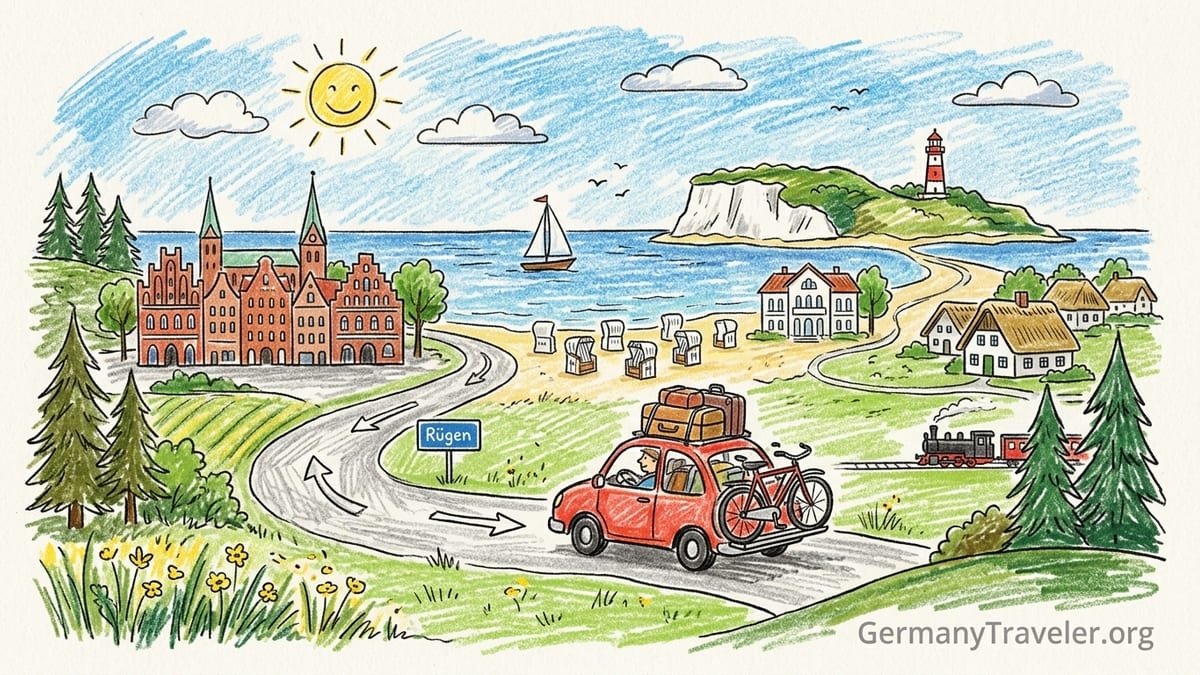
Why This Stretch of Coast Works as a Road Trip
The arc of coast between Lübeck and Rügen suits a one-week itinerary because driving distances are modest, the roads are mostly easy two-lane highways, and there are frequent rail links if you prefer to mix in car-free days. Lübeck to Wismar is about 75 kilometers, Wismar to Kühlungsborn around 45 kilometers, and Kühlungsborn to Warnemünde roughly 30 to 40 kilometers depending on the route. From Warnemünde to Stralsund via the Fischland-Darß-Zingst peninsula, the coastal route is longer and slower but rarely more than 220 to 250 kilometers total even with scenic detours. Travelers can actually visit and enjoy historic centers, beaches and nature reserves rather than simply accumulating mileage.
This section of coast is dense with classic Baltic spa towns and Hanseatic UNESCO-listed city centers. Lübeck and Wismar are known for red-brick gabled merchant houses and Gothic churches, while Kühlungsborn and Warnemünde offer long sandy beaches lined with white villas and traditional Strandkörbe wicker beach chairs for rent. Between them lie small harbors, fisher villages and stretches of open fields that make for relaxed driving. Instead of rushing, the idea is to pick two or three bases, leave the car parked much of the time, and explore by foot, bike, local trains and small ferries.
Another advantage is that the region is well set up for visitors who are not used to German driving rules. Motorways are limited; most of the route follows federal roads like the B105 and B111, with clear signage to the main resorts. International drivers arriving in a rental car from Hamburg or Berlin can ease into German roads before tackling bigger cities. Environmental zones exist in some large German cities, but the Baltic coast towns on this route are generally more focused on managing beach traffic and resort parking than on inner-city low-emission zones, which makes things simpler for visitors with a valid green sticker on the windshield.
Season matters. From late June to late August, traffic near beach resorts can be heavy on Saturday changeover days, and some hotel parking lots operate at full capacity. Shoulder seasons in May, early June and September usually combine milder weather, open beach facilities and easier parking. Winter brings quiet promenades and stormy seas for travelers who enjoy atmosphere more than swimming and do not mind that some beach kiosks and boat trips shut down.
How Many Bases You Really Need
For a seven-day Lübeck-to-Rügen itinerary, two or three overnight bases are realistic and keep packing and unpacking to a minimum. One workable pattern is Lübeck or Travemünde for two nights, a central coast resort such as Kühlungsborn or Warnemünde for three nights, and Stralsund or a town on Rügen for two nights. This allows you to see the major highlights without long daily drives. With only a week, using four or more bases usually fragments your time and turns the trip into a sequence of short hotel stays and repeated parking searches.
Lübeck and Travemünde work well as a first base because they are easily reached by train from Hamburg and have a wider range of hotels and guesthouses. Travemünde’s harborfront gives an immediate sense of the Baltic with ferries and the small local ferry across the Trave to the Priwall peninsula. Keeping the car parked for a day here is easy: several pay-and-display lots and garages serve the promenade and ferry, with clear daily maximum rates. From Travemünde, you can also make a half-day ferry crossing as a pedestrian to Priwall, then walk or bike the quieter beaches before returning to your hotel.
As a second base, many travelers choose between Kühlungsborn and Warnemünde. Kühlungsborn has a long straight promenade, family-oriented hotels and relatively concentrated parking areas, including signposted parking lots behind the seafront. A central hotel here makes it simple to walk to dinner and the beach, saving the car for day trips to Heiligendamm, Bad Doberan or Wismar. Warnemünde, in contrast, feels more urban because it forms part of the Hanseatic city of Rostock. It offers better rail connections along the coast and inland but also tighter parking, particularly near the Alter Strom harbor channel. Booking accommodation that includes a parking space, often in a courtyard or underground garage, can save stress in peak season.
For the final base, Stralsund or a location on Rügen such as Binz or Bergen makes sense. Stralsund, with its three tall brick church towers, is well connected by regional trains in multiple directions and linked to Rügen by both a road bridge and regional rail lines. Staying in Stralsund lets you explore its UNESCO-listed old town on foot and then make day trips onto Rügen. Alternatively, basing directly on Rügen, in Binz for example, puts you closer to famous chalk cliffs, beaches and narrow-gauge steam trains, but driving in and out on summer weekends can involve waiting in congestion near the Rügen Bridge as day trippers arrive and depart.
Driving, Parking and When to Leave the Car
Most of the core route follows federal and state roads rather than busy motorways. From Lübeck, travelers often head east via the A20 motorway for a short stretch before turning off toward Wismar or following smaller inland roads. The A20 usually flows well but can have construction sections, while secondary roads pass through villages with 50 kilometer per hour limits and frequent speed cameras. Planning travel legs of 60 to 120 minutes keeps driving comfortable and leaves time for stops in places like Boltenhagen or Bad Doberan.
Parking is where resort towns get complicated. In Kühlungsborn, public parking lots signposted from the main access roads charge hourly or daily fees that are moderate by German seaside standards. During peak mornings in July, spaces close to the promenade can fill by late morning, so arriving early or late in the afternoon improves your chances. Warnemünde’s narrow streets and historic houses limit on-street spaces; visitors often park in larger multistory lots on the edge of the center, then walk 10 to 15 minutes to the beach. In high season you may see temporary signs guiding cars to overflow parking fields outside the core, particularly on hot weekends.
On the Fischland-Darß-Zingst peninsula, many villages actively restrict random street parking to protect dunes and wetlands. Instead, you will find designated Besucherparkplätze on the edge of settlements such as Prerow, Zingst or Ahrenshoop. Fees collected from these lots help pay for beach cleaning and path maintenance. A typical arrangement is to pay at a machine for a half-day or full-day ticket, then walk or cycle along car-free paths through pine forests to the beach. The upside is that once you know where the big parking lots are, navigation is straightforward and you avoid circling in residential lanes.
There are also cases where you may prefer not to drive at all. Lübeck’s old town, located on an island within the Trave River, has car parks around the perimeter and a compact center best explored entirely on foot. Wismar’s historic core is similarly walkable, and many visitors leave their cars at a hotel garage while they wander the market square and harbor. In Rostock and Warnemünde, local authorities encourage using trams, suburban trains and buses to reach crowded areas in summer. Days that include wine or craft beer tastings, such as a cellar visit in Lübeck or a harbor cruise in Warnemünde, are natural candidates for going car-free.
Using Ferries, Trains and Bikes Along the Route
Short ferry rides and local trains can turn a straightforward road trip into a more varied coastal journey. In Lübeck-Travemünde, the small ferry across the Trave to Priwall is a good example. You can pay a modest fee for pedestrians or bikes, cross in a few minutes, and enjoy a quieter stretch of shoreline without fighting for a parking spot. Similar small ferries operate in different harbor towns, usually with frequent departures in high season, and are a practical way to experience maritime life without booking long-distance passenger ships.
Regional trains make strategic sense on this route. Lübeck is linked eastward toward Bad Kleinen and Wismar, while further along the coast regional lines radiate from Rostock to places like Wismar and Tessin, and from Rostock or Stralsund to Rügen and beyond. Travelers can, for instance, park for a full day in Rostock at a Park & Ride lot, then take a short S-Bahn style train to Warnemünde’s station near the beach, avoiding the congested resort streets. Another common pattern is to take a regional train one way and cycle or drive back, effectively turning a linear coastal ride into a loop without retracing your route in the car.
Bike travel is a major part of life on the Baltic coast. Long-distance cycle routes link Lübeck, Wismar, Warnemünde and Stralsund, and it is common to see German vacationers using panniers and e-bikes along the dike paths. Visitors do not need to be hardcore cyclists to join in. Renting a bike for a half-day in Kühlungsborn to ride the forest path to Heiligendamm, or in Zingst to pedal along the Bodden lagoon shore, provides a break from driving and usually avoids any search for central parking. Some local trains accept bikes outside peak commuter hours, allowing you to extend one-way rides; conductors typically expect a small surcharge or special bike ticket.
On Rügen, mixing modes becomes even more attractive. Regional trains cross the Rügen Bridge from Stralsund and stop in Bergen, Binz and other towns, where island buses and the nostalgic Rasender Roland steam railway extend onward to resorts and the Mönchgut peninsula. Travelers staying several days in Binz or Sellin often leave their car at the hotel and rely on a combination of walking, bus and steam train to reach beaches and viewpoints. This approach reduces the risk of getting caught in weekend traffic on the narrow roads and helps preserve the island’s quieter corners.
Route Highlights and Scenic Stops
Starting in Lübeck, plan at least one full day to enjoy the old town’s marzipan cafés, merchant houses and church towers. A popular real-world pattern is to arrive by train from Hamburg, spend the first night car-free in Lübeck, then pick up a rental car the next morning before driving the short distance to Travemünde. There, you can stroll the sandy beach, watch ferries bound for Sweden or Finland, and take the Priwall ferry for a walk among the old shipyard structures and dune-backed shoreline.
The drive from Lübeck to Wismar invites at least one detour to the small resort of Boltenhagen, where a long pier projects into the sea and a series of Strandkörbe line the sand. Wismar itself deserves time for its UNESCO-listed market square, St. Mary’s Church tower and small working harbor. Travelers often park in a central surface lot near the old town and walk a loop through the brick gabled streets, stopping for fish rolls at a harbor stall. Overnighting in Wismar is optional but rewarding if you enjoy quieter evenings compared with bigger resorts.
Between Wismar and Warnemünde, Kühlungsborn and Heiligendamm form a classic seaside duo. Kühlungsborn has Germany’s longest seaside promenade, lined with hotels and cafés, and a small marina. From here you can board the historic Molli steam train for the ride to Bad Doberan, passing close to the shore at Heiligendamm. Many visitors leave their car parked in Kühlungsborn, ride the train one way, then return later in the day, turning a potential parking challenge in Bad Doberan into a stress-free excursion.
Warnemünde marks a change in atmosphere, with a wide sandy beach, lighthouse and a busy harbor channel. Fishing boats sell take-away fish, and cruise ships occasionally dock nearby. A popular viewpoint is to walk out onto the western mole at sunset and watch ships entering and leaving the harbor. From Warnemünde or Rostock you can drive or cycle north to the Baltic cliffs near Stoltera, or turn east toward the Fischland-Darß-Zingst peninsula, where low-key villages like Ahrenshoop offer thatched-roof houses and dramatic sunsets over the Bodden lagoons.
Fischland-Darß-Zingst, Stralsund and Rügen
The narrow spit of land that makes up Fischland, Darß and Zingst is among the most distinctive landscapes on the German Baltic Coast. Reached by road from the west near Dierhagen or from the south via Barth and the Meiningenbrücke bridge, it offers a mix of open dune beaches on the sea side and sheltered reed-fringed Bodden lagoons on the landward side. Many visitors park in Prerow or Zingst and walk or bike into the Darß Forest, where wooden boardwalks and sandy paths lead to the famous Weststrand, a wild beach where trees often lean and topple under the force of winter storms.
Because access roads are narrow and nature protection is a priority, it is common for local authorities to restrict car access beyond certain points, especially near the most fragile dunes. Parking areas sit outside the core zones, sometimes a kilometer or more from the beach, with marked walking and cycling routes leading the rest of the way. For a practical example, travelers arriving midday in high summer may find the main lot at Prerow close to full yet still be able to secure a space in overflow fields signposted from the entrance road. Having coins or a payment card ready for ticket machines helps speed things along.
Continuing east, Stralsund appears across the Strelasund strait with its skyline of church towers and brick warehouses. The city’s old town, on a small island, is compact and easily explored on foot, with several parking garages and surface lots at the edge of the historic area. Visiting the maritime museum or simply wandering the harbor quays reveals the town’s Hanseatic past and its modern role as a gateway to Rügen. Many travelers choose to spend a night here to enjoy the evening atmosphere once day-trippers have left.
Rügen, Germany’s largest island, can easily absorb three or more days, so with a one-week overall schedule you will need to prioritize. A realistic sample day might involve driving or taking a regional train from Stralsund to Binz, then using local buses or the narrow-gauge steam railway to reach the seaside town of Sellin with its iconic pier, and onward to the chalk cliffs viewpoint near Königsstuhl in Jasmund National Park. Parking at the national park’s central visitor center and taking a shuttle bus to the main viewpoints is the standard pattern, designed to keep private cars out of the forest. On another day, a drive to the quieter Mönchgut peninsula in the southeast yields low dunes, thatched villages and smaller beaches where parking lots are smaller but usually less pressured than the big resorts.
Extending East to Usedom or Returning Inland
From Stralsund or Rügen, travelers with extra time can extend their trip eastward to the island of Usedom, known for its imperial seaside resorts such as Heringsdorf and Ahlbeck. However, attempting to cover Lübeck, Wismar, Warnemünde, Fischland-Darß-Zingst, Rügen and Usedom all in a single week usually proves overambitious. A more satisfying approach is to treat Usedom as a separate five to seven day trip, possibly reached by train and local bus from Berlin, or by car via Greifswald and Wolgast, and to focus on fewer bases there as well.
If you prefer to loop inland instead of continuing east, several options exist. From Stralsund, you can drive south through Mecklenburg’s lake district toward Neubrandenburg and on to Berlin, trading coastal scenes for forests and lakes. Another inland route leads from Wismar through Schwerin, where a lakeside palace offers a different architectural style compared with the brick cities on the coast. These inland detours usually offer easier parking and slightly lower accommodation prices than the peak-season Baltic resorts.
Public transport also supports flexible endings to the trip. Regional express trains connect Stralsund and Rostock with Berlin, while Lübeck and Wismar have links toward Hamburg and other major hubs. Travelers increasingly combine a one-way coastal road trip with a train journey in the opposite direction, especially when using nationwide rail passes. Dropping a rental car in Stralsund or Rostock, then heading back to a departure city by train, can be more relaxing than retracing the same highways by car.
Whichever direction you choose, remember that German school holidays and public holidays can compress demand into specific weeks, affecting room availability and parking. Checking local calendars and booking key stays, such as Rügen and Warnemünde in July and August, several months in advance is wise, particularly if you need hotel parking or family rooms close to the beach.
The Takeaway
A German Baltic Coast road trip from Lübeck to Rügen works best when treated as a chain of short drives between rich, walkable places rather than a marathon along every kilometer of shoreline. Concentrating on a core route from Lübeck and Travemünde through Wismar, Kühlungsborn, Warnemünde, Fischland-Darß-Zingst, Stralsund and selected parts of Rügen delivers a convincing mix of medieval brick cities, classic spa resorts and wild coastal nature without exhausting daily mileage.
Using two or three bases, booking accommodation that includes parking where possible, and relying on ferries, bikes and regional trains for specific days helps reduce stress and traffic while preserving the region’s relaxed character. Scenic pauses in smaller resorts and protected landscapes, from Boltenhagen and Heiligendamm to the Darß Forest and Mönchgut, remind travelers that the appeal of this coastline lies in lingering rather than ticking off names.
With realistic expectations, flexible use of the car and attention to local parking and nature protection rules, the German Baltic Coast becomes a rewarding and manageable road trip even for first-time visitors to Germany. It offers not just a string of beaches but a coherent journey through Hanseatic history, seaside architecture and quietly changing coastal light.
FAQ
Q1. How many days do I need for a Lübeck to Rügen road trip?
Most travelers are comfortable with seven days, which allows two nights around Lübeck or Travemünde, three nights on the central coast and two nights in Stralsund or on Rügen.
Q2. Is it difficult to find parking in German Baltic seaside towns?
Parking can be tight in peak summer, especially in Warnemünde, Binz and on the Fischland-Darß-Zingst peninsula, but there are usually designated public lots with clear fees and time limits.
Q3. Do I need an environmental sticker for my car on this route?
Many German cities require a green environmental sticker, and most rental cars have one by default; the coastal resorts themselves focus more on managing beach traffic and designated parking than on city-style low-emission zones.
Q4. When is the best time of year to drive this part of the Baltic Coast?
May, June and September usually balance milder weather, open services and easier parking, while July and August bring warmer water but also heavier traffic and higher prices.
Q5. Can I do this trip using trains and buses instead of a car?
Yes, regional trains connect Lübeck, Wismar, Rostock, Stralsund and Rügen, supplemented by buses to resorts and ferries across short stretches, although you will need more time and careful timetable planning.
Q6. Where are bikes more practical than driving?
Bikes are ideal in Lübeck’s and Wismar’s old towns, between Kühlungsborn and Heiligendamm, on the Fischland-Darß-Zingst peninsula and on sections of Rügen where car access is limited near dunes and cliffs.
Q7. Is it worth staying overnight in Wismar or just visiting on the way?
If your schedule allows, one night in Wismar lets you enjoy the UNESCO-listed center and harbor in the evening; otherwise it works as a rewarding half-day stop between Lübeck and Kühlungsborn or Warnemünde.
Q8. How busy does traffic get near Rügen in summer?
On peak Saturdays in July and August, queues can form near the Rügen Bridge and main resort access roads, so arriving or departing on weekdays or early in the morning helps avoid long delays.
Q9. Can I take my car on small local ferries along the coast?
Some local ferries only carry pedestrians and bikes, such as the short crossing in Travemünde, while others accept vehicles; capacity is limited, so in high season you may need to queue.
Q10. Should I combine Usedom with this Lübeck to Rügen trip?
Usedom is best treated as a separate five to seven day trip or an extension when you have at least three or four extra days, rather than squeezing it into a single one-week Lübeck-to-Rügen itinerary.