


The German Baltic Coast stretches from the Bay of Lübeck to the Polish border, a mix of white-sand beaches, forested peninsulas and austere Hanseatic brick cities. It is compact enough for a week-long trip yet varied enough for repeat visits, and it rewards travelers who look beyond a single seaside resort. This guide compares ten of the most appealing bases along the coast and on the islands of Rügen and Usedom, with practical pointers on which places work best for beaches, nature, families, historic towns, cycling and travel without a car.
How the German Baltic Coast Fits Together
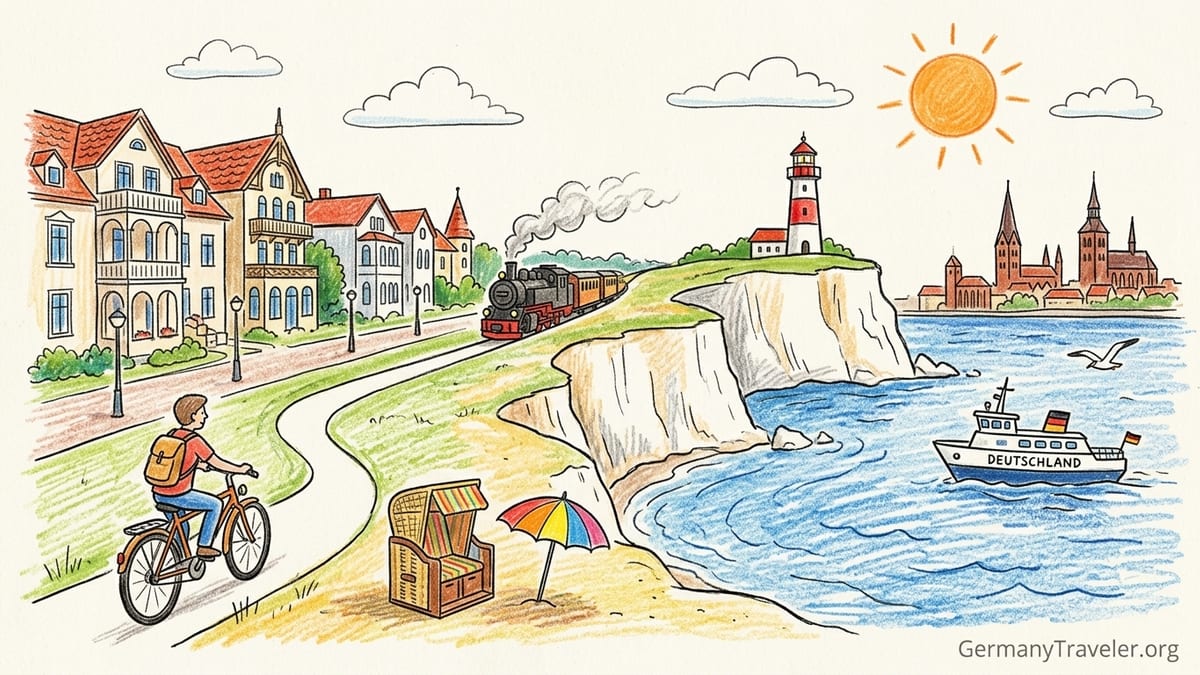
From west to east, the German Baltic Coast moves through subtly different landscapes and travel styles. Around Travemünde, Timmendorfer Strand and Fehmarn, the focus is classic seaside holidaying: long beaches, family-friendly attractions and easy day trips from Hamburg or Lübeck. Further east, Wismar and Kühlungsborn add more historical texture, with brick-gothic churches, old harbors and resort villas that recall the 19th century heyday of Baltic “Badekultur.”
Beyond Rostock and Warnemünde the scenery becomes wilder. The peninsula of Fischland-Darß-Zingst, much of it inside the Western Pomerania Lagoon Area National Park, combines wind-shaped beaches on the seaward side with shallow lagoons and reed beds on the landward side. Cyclists and birdwatchers ride forest tracks to remote stretches of sand with only a café or campground nearby. Stralsund, just across a causeway from Rügen, brings the coast back into the city, with maritime museums set in former warehouses and ferries departing right from its harbors.
Rügen and Usedom, the two large islands at the eastern end of the German Baltic, anchor many international itineraries. Both offer stately resort towns, excellent cycling and car-free mobility via island railways and bus networks. Yet Germany’s national tourism campaigns also highlight the mainland Hanseatic cities as a distinct attraction. A balanced trip might mean three nights on an island, two in a resort town such as Kühlungsborn or Warnemünde, and two in a city like Lübeck, Wismar or Stralsund to experience the region’s brick-gothic architecture and maritime history.
Prices vary but are broadly comparable across the coast. In high summer a mid-range double room in a well-rated seaside hotel often runs in the region of 140 to 220 euros per night, rising in top locations on Rügen and Usedom. Budget-conscious travelers will find better value in spring and autumn shoulder seasons and by choosing guesthouses in second-row streets rather than directly on the promenade.
Classic Baltic Seaside Resorts and Beach Time
If your priority is a traditional Baltic resort feel with promenades, beach chairs and ice cream stands, Travemünde, Timmendorfer Strand, Kühlungsborn, Warnemünde and the main resort towns on Rügen and Usedom stand out. Travemünde, officially part of Lübeck, has a long spa beach lined by a promenade and a cluster of historic villas testifying to its history as one of Germany’s early seaside resorts. Behind the waterfront, the small old town feels distinct from the big city, with fish restaurants and harbor views but without the bustle of central Lübeck.
Just a short way up the Bay of Lübeck, Timmendorfer Strand takes the classic resort formula and adds an upscale polish. It markets itself as one of the country’s most fashionable Baltic resorts, with around seven kilometers of fine sandy beach, a lively Strandallee lined with cafés, boutique hotels and a large aquariums-and-play area at SEA LIFE. In peak season beach chairs can be rented for the day for a moderate fee, and many hotels include a reserved chair in room rates, which is convenient for families or couples planning full beach days.
Farther east in Mecklenburg-Vorpommern, Kühlungsborn is popular with German families who want a resort that feels sizable yet relaxed. Its long seaside promenade, a marina with cafés and the nostalgic Molli narrow-gauge steam railway connecting Kühlungsborn to Bad Doberan create an atmosphere that is both family-friendly and quietly romantic. Warnemünde, the seaside district of Rostock, has one of the widest beaches on the coast and a famously busy harbor entrance. Watching ferries and cruise ships glide past the lighthouse in the evening, with a fish sandwich from a stand on the Alter Strom canal, is a quintessential local experience.
On the islands, resorts such as Binz and Sellin on Rügen or Heringsdorf, Ahlbeck and Bansin on Usedom elevate the seaside ambience with restored villas in ornate resort architecture. Their piers stretch into the water with cafés and viewing platforms, and long promenades connect adjacent towns. Travelers who want a resort base with the widest choice of restaurants, spas and four-star hotels usually gravitate to these larger island resorts, especially in July and August when the mainland beaches can feel busier with day trippers.
Nature Hotspots and Coastal Landscapes
For travelers drawn more to wild coastline and nature than to resort life, three areas are particularly rewarding: Fischland-Darß-Zingst, the national park areas of Rügen, and the dunes and forests of Usedom. Fischland-Darß-Zingst forms a long peninsula between the open Baltic and the calmer Bodden lagoons. On its western side, around the Darß Forest and Weststrand, trails lead through beech and pine forest to a beach where fallen trees lie half-buried in sand and there are no hotels in view. Much of this lies within the Western Pomerania Lagoon Area National Park, so signage and infrastructure are deliberately minimal, although small guesthouses and campsites on the edge of the forest make comfortable bases.
On Rügen, Jasmund National Park is famous for its white chalk cliffs dropping to a narrow stone beach. Short waymarked walks lead through UNESCO-protected beech forest to viewpoints such as Königsstuhl, where visitors can see the contrast between bright cliffs, deep green trees and the typically muted blue of the Baltic Sea. On the narrower Mönchgut peninsula at the southeastern end of Rügen, low hills and thatched fishing villages like Groß Zicker show a more intimate side of the island, with views alternating between sandy coves and shallow lagoons.
Usedom offers a softer landscape but still feels close to nature. Outside the more developed Kaiserbäder resorts, the island is crisscrossed by flat cycling and walking paths through coastal forests and along sandy beaches that run for many kilometers without interruption. The back side of the island around the Achterwasser lagoon has small harbors, reed belts and birdlife, while the seaside side offers long beach walks from Zinnowitz through Zempin and Koserow with only occasional clusters of beach bars and lifeguard stations. In spring and autumn, when water temperatures are cool, these quieter stretches appeal to hikers more than swimmers.
Compared with the islands, Fehmarn has a more maritime, open feel, with large fields, wind farms and many kite and windsurfing schools along its varied coast. Birdwatchers visit its nature reserves, particularly during migration periods when geese and other waterfowl congregate. Nature-focused travelers often combine a few days on Fehmarn, which is connected to the mainland by a bridge, with a longer stay in a national park area further east for greater variety of landscapes.
Best Choices for Families and Multi-Generational Trips
Families with younger children often prioritize shallow water, playgrounds and indoor options for rainy days, while those traveling with teenagers may look for water sports, cycling or day trips. Timmendorfer Strand stands out for its combination of a gently shelving beach, playground areas on the sand and family-focused attractions such as SEA LIFE and nearby animal parks. Many hotels and holiday apartments specifically target families, with amenities like breakfast buffets, kids’ play rooms and loaner beach toys. In high summer it can feel busy, but for many families that sense of bustle is part of the holiday atmosphere.
Travemünde is another good family base, especially for those arriving by train via Lübeck. The main Kurstrand beach has lifeguard stations in season, and the flat promenade is suitable for strollers and scooters. The Priwall peninsula, a short ferry ride across the Trave River, offers a slightly quieter stretch of beach and a large holiday apartment complex with on-site pools and playgrounds, which can be convenient for multi-generational trips where some prefer to stay near the accommodation.
On the islands, Binz and Sellin on Rügen and Heringsdorf or Bansin on Usedom provide a classic family resort environment with a broad choice of ice cream parlors, mini-golf, boat trips and small amusement facilities. Many hotels along their promenades offer family rooms or suites, and sandy beaches slope gently into the sea. On days when the weather turns cool or windy, families can switch to indoor spas, adventure playgrounds or short rail excursions, such as riding the Rasender Roland steam train on Rügen or the island railway on Usedom.
Kühlungsborn and Warnemünde suit families who want the option of day trips into nearby cities. From Kühlungsborn, families can combine beach time with a ride on the Molli steam train to the cloister and historic center of Bad Doberan. From Warnemünde, frequent trains run into Rostock, where children can enjoy maritime museums, indoor play centers or simple harbor cruises. These options can make a week-long stay more varied when the weather is changeable.
Cycling the Coast and Islands
The German Baltic Coast is one of the country’s premier cycling regions, with long, generally flat routes and extensive investment in bike paths. Sections of the international Baltic Sea Cycle Route, sometimes referred to as EuroVelo 10, run through most of the places covered in this guide, often directly along the seawall or through coastal forest. In many resorts it is common to see families and older couples commuting to the beach by bicycle, and guesthouses usually offer bike rental or secure storage.
Fischland-Darß-Zingst is especially attractive for cyclists. With only one main road for cars and a dense network of paved or well-compacted forest and dyke paths, bikes are often the most convenient way to reach the quieter beaches and viewpoints on the lagoon side. Day renters can expect to pay in the region of 10 to 18 euros per day for a basic touring bike, with e-bikes costing more. Typical outings include a circuit from Prerow through the Darß Forest to the Weststrand and back via thatched villages, or a longer trip along the length of the peninsula from Wustrow to Zingst, with stops for coffee and cake in small harbors.
On Rügen, cycling infrastructure connects many of the island’s highlights. A popular route links the resorts of Binz and Sellin to the Mönchgut peninsula, passing through rolling countryside and coastal villages. Another follows quieter roads and cycle paths from the Jasmund area south toward Putbus and the Mönchgut, with the option to ride the Rasender Roland steam train for one leg and cycle the other. E-bikes are increasingly common, which helps visitors manage the island’s occasional hills and headwinds.
Usedom is among the flattest and most cycle-friendly parts of the Baltic Coast. A long, well-maintained promenade and cycle path links the Kaiserbäder resorts of Ahlbeck, Heringsdorf and Bansin and continues toward Swinemünde on the Polish side, while inland routes explore lakes and quiet villages. The island can almost be crossed end to end by bike, using the island railway as a backup for tired legs or bad weather. Families appreciate the ability to do short out-and-back rides between beach stops, while more ambitious cyclists can plan multi-day loops combining Usedom with mainland towns like Anklam or Greifswald.
Historic Hanseatic Towns and Cultural Stops
While many travelers come for beaches and nature, the Baltic Coast’s identity is also deeply tied to its Hanseatic brick cities. Wismar and Stralsund, both listed as UNESCO World Heritage sites, combine imposing gothic churches, gabled merchant houses and active harbors. Wismar’s compact old town lies just inland from its harbor, making it easy to explore on foot before or after a harbor cruise. Visitors can climb church towers for views across the red-tiled roofs to the Baltic, then return to the water for fresh fish from simple harbor-side stalls.
Stralsund, linked to Rügen by road and rail, is an especially good base for travelers who want historic atmosphere plus easy island access. Its old harbor warehouses now house major maritime museums and aquariums, and cyclists following the Baltic Sea Cycle Route often plan a rest day here to explore its narrow lanes and churches. From Stralsund station frequent trains and buses are available to various points on Rügen, and boat excursions run to nearby islands, making it possible to sample island landscapes in day trips if accommodation on Rügen is fully booked or more expensive.
Travemünde and Warnemünde act as gateways between resort life and city culture. From Travemünde, frequent trains and boats connect to Lübeck, where Holsten Gate, medieval alleyways and major churches tell the story of the Hanseatic League. From Warnemünde, local trains run in under half an hour to central Rostock, which has its own gothic architecture, university atmosphere and cultural calendar. This mix allows travelers to base themselves at the beach while still fitting in museums, concerts or city shopping days.
On a smaller scale, even resort towns express history through their architecture. Kühlungsborn’s seafront is lined with villas in resort style, while the Kaiserbäder on Usedom showcase particularly elaborate examples, with ornate balconies and facades. Strolling along these promenades is as much about admiring the historic buildings as about walking by the sea, and guided architecture walks are offered in several towns in high season, typically for a modest fee per person.
Traveling Without a Car
The German Baltic Coast is notably accessible for travelers without a car, particularly around the larger hubs and islands. Fast trains reach Lübeck, Rostock, Stralsund and other gateway cities from Hamburg or Berlin, and regional trains continue from there to coastal resorts and ferry piers. For example, Timmendorfer Strand and Travemünde are served by regular trains from Lübeck, making them straightforward weekend or short-break destinations even for visitors arriving by long-distance train or coach.
On Rügen, electrified railway lines connect the mainland via the Rügen Bridge to key points such as Bergen, Sassnitz and Binz, while branch lines and buses reach smaller towns. The narrow-gauge Rasender Roland steam train, though tourist-oriented, also functions as a practical link between seaside resorts like Binz, Sellin and Göhren, allowing car-free travelers to mix scenic rides with coastal walks. In summer, some buses are equipped with bike racks, which helps cyclists plan one-way rides with a return by public transport.
Usedom is similarly well set up for car-free visitors. The island railway runs along much of the coast, linking the Kaiserbäder with smaller resorts such as Zinnowitz and Koserow and connecting onward to the mainland. Many hotels offer pickup from local stations on request, and it is common for visitors to combine local trains with cycling to explore the island. On the mainland, Warnemünde and Kühlungsborn can both be reached by rail, with Kühlungsborn also accessible by changing onto the Molli steam railway from Bad Doberan.
For purely resort-based holidays focused on beach time and short excursions, a car is often optional. Travelers planning to combine remote national park areas, smaller villages and inland lakes may find a car more convenient, but it is still feasible to construct routes using regional trains, buses and occasional taxis. Planning ahead, especially for Sunday or off-season services, is sensible, and travelers should expect slightly longer transfer times than if they were driving, balanced by the ability to relax and enjoy the coastal scenery from the train window.
Rügen and Usedom in Focus
Rügen is Germany’s largest island and offers the widest range of landscapes and experiences in a compact area. The grand resort towns of Binz and Sellin, with their piers and white resort villas, appeal to visitors who enjoy promenades, spa hotels and evening dining. At the same time, quieter corners such as the Mönchgut peninsula or fishing villages near Schaprode show a more rural side, with thatched cottages and small harbors. Travelers with a week to spend can comfortably divide their stay between a larger resort and a more tranquil village, using local buses or bikes to explore.
Nature is a central part of Rügen’s appeal. In Jasmund National Park, the chalk cliffs and ancient beech forests are accessible by shuttle buses and marked trails. On the island’s southern and western shores, shallow lagoons and reed beds attract birdlife and offer calmer water for kayaking. The diversity of scenery means that on a single day visitors can hike in forest, sit on a sandy beach and end the day in a lively resort restaurant, which suits mixed-interest groups and families with teenagers.
Usedom, often marketed as one of Germany’s sunniest regions based on long-term sunshine statistics, presents a slightly more low-key but very cohesive experience. The three imperial resorts of Ahlbeck, Heringsdorf and Bansin form a nearly continuous stretch of promenade lined with villas, piers and well-equipped beaches with changing cabins and beach chair rentals. Just a few kilometers away, smaller resorts like Zinnowitz, Koserow and Zempin offer quieter beaches and a more village-like atmosphere, but with good access to cycling and walking paths.
For car-free travelers especially, Usedom can feel straightforward and relaxing. The island railway serves most key resorts, and local tourist offices and accommodations provide maps and suggested day routes for cycling and walking. A typical day might involve a relaxed breakfast in Heringsdorf, a bike ride along the promenade and coastal paths to Koserow for a fish lunch and a return journey by train if the wind picks up. This flexibility, combined with long beaches and a good mix of modest guesthouses and higher-end hotels, makes Usedom an attractive choice for couples and families alike.
Matching Destinations to Travel Styles
Choosing the right base along the German Baltic Coast depends on your priorities. Travelers seeking a polished resort atmosphere with shopping, restaurants and nightlife within walking distance tend to gravitate to Timmendorfer Strand, Kühlungsborn, Warnemünde and the larger island resorts like Binz or Heringsdorf. Those who prefer more understated seaside towns with easy access to countryside might favor Travemünde, smaller Usedom villages such as Zinnowitz, or areas around Mönchgut on Rügen.
Cyclists and hikers looking for extended routes through relatively untouched nature often highlight Fischland-Darß-Zingst, Jasmund National Park on Rügen and the inland side of Usedom around the Achterwasser lagoon. Here, guesthouses are used to visitors arriving by bike and can provide advice on routes, weather and ferry connections. In contrast, history enthusiasts may prefer to base themselves in Wismar or Stralsund and treat beach visits as day trips, using extra time to explore museums, churches and old town streets after day visitors have departed.
For couples, a combination of one city base and one island or resort base works well. A long weekend might pair Lübeck and Travemünde, while a week could combine Stralsund and Rügen or Rostock and Warnemünde. Families might prioritize resorts with comprehensive amenities and safe swimming, adding one or two day trips to Hanseatic cities or national park areas. Budget and season also matter: high summer brings the liveliest atmosphere and warmest water but also higher prices and more crowded beaches, while late May, June and September often balance milder weather with more availability and lower rates.
Ultimately, the German Baltic Coast is compact enough that you do not need to choose just one style. Trains and buses knit together resorts, islands and cities, and many visitors report that combining at least one island stay with time in a Hanseatic town deepens their understanding of the region. Whether your focus is beaches, nature, history or gentle cycling, the coast offers a configuration that can match your travel style without requiring long transfers.
The Takeaway
The German Baltic Coast rewards travelers who think in terms of combinations rather than single destinations. Travemünde and Timmendorfer Strand deliver classic beach-holiday energy close to major transport hubs, while Kühlungsborn and Warnemünde blend resort life with easy cultural day trips. Further east, Fischland-Darß-Zingst and the national parks on Rügen and around the Bodden lagoons offer wilder landscapes suited to walking and cycling, and Wismar and Stralsund showcase the brick architecture that underpinned the region’s trade and prosperity.
Rügen and Usedom deserve special attention for their variety of experiences, from stately resort architecture and long promenades to quiet villages, forests and lagoons. Yet they do not overshadow the mainland; instead, they complement it. A thoughtfully planned itinerary might include one island, one resort town and one Hanseatic city, each adding a distinct layer to your understanding of the Baltic Coast. With good public transport, extensive cycling routes and a wide range of accommodations, the region is well placed to welcome families, couples and solo travelers, regardless of whether they arrive with a car or a train ticket.
FAQ
Q1. Which German Baltic resort is best for a first-time visitor? For a first trip, Timmendorfer Strand or Warnemünde work well because they combine long beaches, plenty of restaurants and easy train access from larger cities, making logistics straightforward while still offering a classic Baltic atmosphere.
Q2. Is Rügen or Usedom better for families? Both islands suit families, but Rügen offers more varied landscapes and attractions such as steam trains and chalk cliffs, while Usedom is flatter and simpler to navigate with young children thanks to long promenades and an easy-to-use island railway.
Q3. Can I visit the German Baltic Coast without renting a car? Yes. Many resorts and islands are connected by regular regional trains and buses, and once there, promenades, local buses and bike rentals make it easy to get around, especially in places like Rügen, Usedom, Travemünde and Timmendorfer Strand.
Q4. What is the best time of year to travel? July and August bring the warmest water and liveliest beach life but also higher prices and more crowds, while late spring and early autumn often offer pleasant temperatures, fewer visitors and better value, especially for nature walks and cycling.
Q5. Where should cyclists base themselves on the Baltic Coast? Cyclists often favor Fischland-Darß-Zingst, Rügen and Usedom, where extensive, mostly flat cycle paths link beaches, villages and viewpoints, and many guesthouses provide bike rental or secure storage along with local route suggestions.
Q6. Are the beaches suitable for small children? Many Baltic beaches, including those at Travemünde, Timmendorfer Strand, Kühlungsborn and the main resorts on Rügen and Usedom, have gently shelving sand and seasonal lifeguards, making them generally suitable for supervised play and paddling.
Q7. Which destinations work best for couples seeking a relaxed break?Couples often appreciate the resort architecture and promenades of Binz, Sellin or the Kaiserbäder on Usedom, as well as smaller, quieter bases such as Kühlungsborn or parts of Fischland-Darß-Zingst where evenings focus on coastal walks and harbor dinners rather than nightlife.
Q8. How expensive is accommodation along the German Baltic Coast?Prices vary by season and location, but in high summer a mid-range double room near the promenade commonly costs in the region of 140 to 220 euros per night, with lower rates available in shoulder seasons or in guesthouses set a few streets back from the seafront.
Q9. Which places are best for combining beach time with historic sightseeing?Wismar, Stralsund, Travemünde and Warnemünde all make it easy to mix hours on the sand with visits to brick-gothic churches, old harbors and maritime museums, and good rail links allow day trips between seaside resorts and Hanseatic city centers.
Q10. Is it necessary to choose between mainland coast and islands?It is not necessary to choose; the region is compact enough that many visitors spend a few nights on Rügen or Usedom and a few nights in a mainland resort or city, gaining a broader sense of the Baltic Coast without long travel days.