


Germany’s Baltic coast has dozens of seaside resorts, but when travelers start comparing islands, the decision almost always narrows to two names: Rügen and Usedom. Both serve up long, pale sand beaches, grand old spa architecture and easy rail access from Berlin and Hamburg. Yet the character of a week on Rügen is very different from a week on Usedom. One leans toward varied landscapes, chalk cliffs and classic sightseeing loops by car or bike; the other toward an almost uninterrupted ribbon of sand and resort promenades where you can arrive by train and forget about driving altogether.
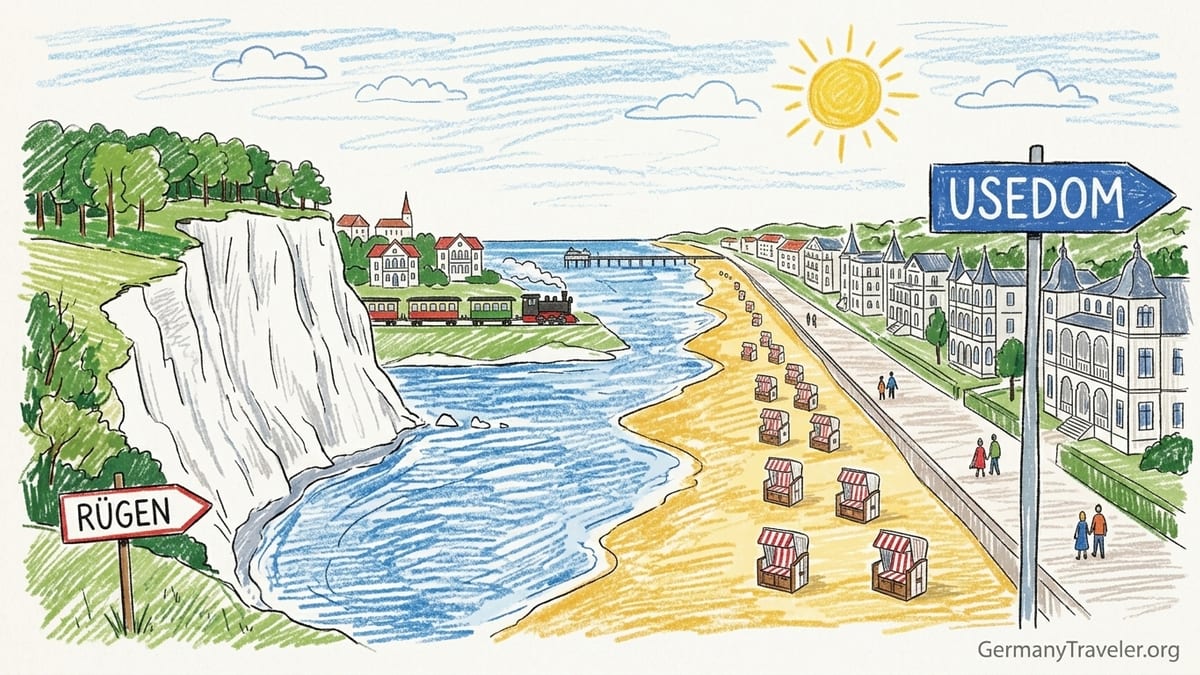
Rügen vs Usedom at a Glance
Rügen is Germany’s largest island and feels like a compact road trip region in its own right. You can spend a morning beneath the chalk cliffs in Jasmund National Park, have coffee among the resort villas in Binz in the afternoon and end the day watching sunset over the Schaprode harbor with views toward Hiddensee. The shoreline constantly shifts from cliff to bay to lagoon, and many visitors treat Rügen as a mini version of the wider Baltic coast, using a hire car or rental bikes to explore. Trains from Stralsund fan out across the island, but driving is often the fastest way to link smaller peninsulas.
Usedom, by contrast, is all about the beach. On the German side alone, around 40 kilometers of fine sand run almost continuously from Peenemünde in the northwest to Ahlbeck on the Polish border, with the Polish town of Świnoujście extending the strand further east. The famous Kaiserbäder of Ahlbeck, Heringsdorf and Bansin sit in the middle of this ribbon and are linked by Europe’s longest beach promenade and the Usedomer Bäderbahn coastal railway, making it easy to enjoy a car‑free stay focused on sea air, cafés and evening strolls.
In practical terms, Rügen is the better choice if you want varied scenery, classic hikes and a feeling of discovery as you cross causeways and peninsulas. Usedom usually wins for simple, beach‑centered holidays, especially if you like the idea of checking into a hotel in Heringsdorf or Bansin and spending most of your week between the promenade, the sand and the spa.
Beaches and Seaside Atmosphere
Both islands deliver the wide, pale sand that surprises many first‑time visitors to the German Baltic. On Rügen, standout beaches include the long curve at Prora and Binz, the family‑friendly strand at Sellin and the more open, breezy sands on the Schaabe between Glowe and Juliusruh. These beaches are often backed by pine forests and low dunes, with beach chair rentals and simple snack stands in high season. The impression is of individual coves and arcs of sand separated by headlands and lagoons, which suits travelers who enjoy a bit of exploration and do not mind using local buses or a car to hop between different stretches.
Usedom’s beaches feel more continuous. The so‑called Kaiserstrand runs roughly 12 kilometers from Bansin through Heringsdorf to Ahlbeck and on to Świnoujście, with a broad, gently shelving shore that works well for families and less confident swimmers. Here, the atmosphere is more classically resort‑like: long promenades lined with villas and hotels, historic piers reaching into the sea and plenty of cafés selling Fischbrötchen and ice cream just steps from the sand. In summer, this corridor can feel busy from morning to late evening, with live music on the piers and beach bars setting out deckchairs.
If your perfect Baltic holiday means choosing a single resort and spending most days on the same stretch of sand, Usedom around the Kaiserbäder usually feels more convenient. If you prefer to vary your swimming spots and enjoy beaches that alternate with forest and quiet lagoons, Rügen offers more contrast within a similar driving radius.
Scenery, Chalk Cliffs and Classic Sights
When it comes to headline scenery, Rügen has the clear edge. Jasmund National Park on the island’s northeast peninsula is one of Germany’s best known coastal landscapes, where white chalk cliffs plunge into the Baltic and ancient beech forests approach the edge. Lookout points like Königsstuhl and Victoria‑Sicht provide classic postcard views, and a loop walk from the visitor center can fill a half‑day for most travelers. Even if you are not an avid hiker, a short stroll along the cliff‑top path gives a sense of the scale and drama.
Beyond Jasmund, Rügen continues to surprise. The narrow spit of the Schaabe links peninsulas with open sea on one side and calmer Bodden lagoon on the other. In the south, the Zicker Alps on the Mönchgut peninsula offer rolling hills that feel almost Alpine in miniature, with pastures, small villages and views toward the mainland. The island’s interior mixes fields, lakes and avenues of old trees; simply driving the back roads between Putbus, Garz and the eastern bays becomes part of the sightseeing.
Usedom’s landscape is gentler but still attractive, especially if you appreciate quieter backwaters. Inland from the Kaiserbäder, small lakes like Gothensee and Schloonsee break up the dunes, and the Achterland behind the resorts is a patchwork of meadows, reed‑lined bays and small villages. There are scenic spots, such as the viewpoints above the Schmollensee or the harbor at Krummin, but nothing as instantly dramatic as Rügen’s chalk cliffs. For many visitors, the main “view” on Usedom is simply the horizon line over the Baltic and the ornate facades along the promenades.
If you are drawn to landscapes with obvious highlights for photography and hiking, Rügen is generally the better match. If your idea of scenery is a calm, wide beach framed by villas and gentle woodland, Usedom will feel quietly satisfying, particularly when early‑morning light hits the Kaiserbäder piers and the promenade is almost empty.
Resort Towns, Hotels and Trip Style
Rügen’s resort towns are more scattered and varied, which can be a plus if you enjoy mixing different atmospheres in one trip. Binz is the largest and best known, with a long sandy bay, an historic pier and streets of white resort villas now housing hotels, cafés and boutiques. Prices in July and August tend to be at the upper end for the island, but you can often find mid‑range doubles in smaller pensions a few blocks back from the seafront. Sellin offers a slightly quieter take on the same formula, anchored by its famous pier with a restaurant pavilion out over the water. Göhren feels more relaxed again and works well for families looking for rentals near the beach rather than large spa hotels.
Further afield, Sassnitz has a working‑harbor feel and is handy for Jasmund National Park, while smaller places like Baabe or Thiessow attract travelers who prefer holiday apartments on village streets to classic grand hotels. This diversity means that on a week‑long trip you might spend three nights in Binz for the beach and promenade, then shift to a cottage on Mönchgut for hiking and quieter coves. The trade‑off is more logistics and, often, a stronger need for a car, especially if you want to venture to less central peninsulas or to Hiddensee by ferry.
Usedom is dominated by the chain of established resorts along the north coast, and especially the three Kaiserbäder. Ahlbeck, Heringsdorf and Bansin form a continuous built‑up area where the main promenade runs for kilometers and is lined with classic Bäderarchitektur villas. Accommodation here ranges from grand spa hotels with indoor pools and saunas to smaller guesthouses and self‑catering apartments. Because the three towns blend into each other and are linked by local buses and the coastal railway, you can book a single base and still vary your days between different piers, cafés and beach sections without repacking.
Travelers who like a structured, resort‑style holiday with plenty of services, wellness facilities and evening strolls often gravitate to Usedom’s Kaiserbäder. Those who prefer a mix of seaside bustle and quiet rural corners usually find Rügen’s more dispersed towns a better fit, provided they are comfortable navigating between them.
Families, Cycling and Car‑Free Travel
Both Rügen and Usedom are family favorites within Germany, but they work slightly differently once you arrive. On Rügen, families often split their time between simple beach days and short excursions by car: a morning at the Binz beach, an afternoon drive up to the Jasmund cliffs, or a trip to the narrow‑gauge “Rasender Roland” steam railway that puffs between resorts like Putbus, Binz and Göhren. Many holiday apartments are geared to families with kitchens and extra bunks, and playgrounds are common near the promenades. The flipside is that if you stay in one corner, such as Göhren or the far south, day trips to the opposite end of the island can mean an hour or more in the car each way in summer traffic.
Usedom is particularly well suited to families who want to rely on trains, buses and bicycles instead of driving. The Usedomer Bäderbahn runs along the spine of the island, linking seaside resorts with inland stops, and visitors who pay the local resort tax usually receive a guest card that includes discounts and, in some cases, free use of certain bus lines. Bike paths are well developed, with an especially popular route running along or just behind the dunes from Bansin through Heringsdorf to Ahlbeck and onward toward Świnoujście. Families with older children often rent bikes for several days at a time and use them for everything from grocery runs to ice‑cream outings.
Cyclists will find good options on both islands. On Rügen, the mix of coastal stretches, forest tracks and quiet village roads offers plenty of variety, but routes can involve more hills and longer distances between sights. A typical day might see you riding from Binz to Sassnitz for a harbor lunch, then continuing into Jasmund National Park before looping back along quieter inland lanes. On Usedom, the riding is generally flatter and more straightforward, ideal for casual cyclists who like the idea of a half‑day spin along the Promenade of the Kaiserbäder or a longer but still easygoing trip into the Achterland around the Achterwasser lagoon.
If going car‑free is a priority, Usedom has the advantage of a simple, linear layout and a dense network of coastal transport. If you are happy to drive or do not mind occasionally longer public‑transport journeys in exchange for more varied landscapes, Rügen remains attractive even without a car, thanks to its rail lines and resort buses, but it benefits more from having your own wheels.
Nature, National Parks and Day Trips
For nature and day‑trip variety, Rügen stands out. In addition to Jasmund National Park, the island includes part of the Southeast Rügen Biosphere Reserve, where the Mönchgut peninsula protects a mosaic of lagoons, dunes and low hills. Waymarked trails wind past thatched‑roof villages and viewpoints, and it is easy to combine walks with swims in sheltered bays. From harbors like Schaprode or Breege, ferries run to the smaller island of Hiddensee, a largely car‑free outpost known for its dune landscapes and artists’ history, which makes an excellent full‑day excursion.
Historic towns just off Rügen also expand your options. Stralsund, connected to the island by a road and rail bridge, has a brick‑gothic old town and a major maritime museum and oceanography center that many families slot into cloudy days. Because the town is only a short train ride from Binz or Bergen, you can easily combine island time with a dose of Hanseatic history.
Usedom has fewer single “must see” landmarks but compensates with easy low‑key nature experiences. A day trip into the Achterland might include a walk through the woods near the Schmollensee, a stop at a small harbor on the Achterwasser for smoked fish and time on a quiet lakeside jetty. In the northwest, Peenemünde’s port area and historical sites appeal to visitors interested in 20th century history, while in the east, the German‑Polish border is almost invisible along the beach, and many travelers cross on foot from Ahlbeck to Świnoujście for a change of atmosphere and different restaurants.
For travelers who like to “collect” different landscapes and sights, Rügen’s combination of chalk cliffs, biosphere reserve, nearby islands and historic mainland towns usually makes it the stronger choice. Usedom offers a smaller but still satisfying palette of day trips that rarely require more than a short train, bus or bike ride from the main resorts, which can be appealing if you prefer to keep logistics simple.
Costs, Crowds and When to Go
Prices on both Rügen and Usedom have risen in recent summers, especially for peak‑season stays in prime resorts like Binz or the Kaiserbäder. Expect typical mid‑range hotel doubles in July and August to be noticeably higher than in inland German towns, with savings available if you book shoulder seasons such as late May, June or early September. Self‑catering apartments and pensions set a few streets back from the promenade can offer better value, particularly on Rügen, where there is a broader spread of villages and small towns away from the busiest strands.
In terms of crowds, both islands feel busy in school holidays, but the pattern is different. On Rügen, pressure concentrates around Binz, Sellin, Göhren and Jasmund’s main viewpoints; other corners of the island, such as some parts of Mönchgut or the rural interior, remain relatively quiet even in high summer. On Usedom, the density of visitors is more continuous along the main beach corridor around Zinnowitz and the Kaiserbäder, so the promenade and central sections of the beach can feel lively all day. If you prefer a sense of bustle with no real need to seek out “hidden corners,” this suits Usedom well. If you value the ability to escape the busiest spots within a short drive, Rügen has the advantage.
Weather patterns are similar on both islands, with mild to warm summers, changeable shoulder seasons and bracing but often atmospheric winters. Many hotels and restaurants in the main resorts now stay open year‑round or close only briefly, making autumn and winter stays an option. For a first visit focused on swimming and long beach days, late June to early September is still the most reliable window, but travelers interested in hiking through beech forests or cycling quiet promenades might find September or early October particularly pleasant, when the water remains relatively warm yet crowds thin out.
The Takeaway
Rügen and Usedom are not competing for the same type of holiday so much as offering two complementary versions of the German Baltic. Rügen is better if you want variety: chalk cliffs in Jasmund, forested biosphere reserves on Mönchgut, resort towns like Binz and Sellin and the possibility of island‑hopping to places like Hiddensee. You will see more distinct landscapes in a single week and have more options for classic sightseeing day trips, particularly if you are comfortable renting a car or planning a few longer public‑transport journeys.
Usedom, by contrast, excels as a straightforward, beach‑focused stay. The interconnected Kaiserbäder of Ahlbeck, Heringsdorf and Bansin function almost as one extended resort, with long promenades, ornate villas and a coastal railway that makes it easy to arrive by train and barely think about timetables once you are there. If your ideal week involves walking out of your hotel in the morning, grabbing a coffee on the promenade and spending most of the day between the sand, the spa and evening strolls, Usedom is hard to beat.
If you enjoy mixing landscapes, ticking off big‑name viewpoints and alternating between busy promenades and rural back roads, choose Rügen. If instead you want a largely car‑free holiday where the main decisions of the day involve which café to try and where to sit on the sand, choose Usedom, ideally around the Kaiserbäder. Many German travelers eventually visit both; for a first trip, deciding whether you are more drawn to varied scenery or to a long, elegant resort beach will usually point you to the right island.
FAQ
Q1. Which island is better for a first‑time visitor to the German Baltic?
For a first visit, choose Rügen if you want varied landscapes and classic sights like chalk cliffs and historic towns, or Usedom if you mainly want an easy, beach‑centered resort stay around the Kaiserbäder.
Q2. Is Rügen or Usedom better for traveling without a car?
Usedom is generally better without a car because the coastal train and buses link the main resorts along one corridor, making it simple to move between towns and beaches from a single hotel base.
Q3. Where will I find quieter areas in peak summer?
On Rügen, you can often escape crowds by staying away from Binz and Jasmund’s main viewpoints and focusing on Mönchgut or rural inland villages. On Usedom, you usually need to move away from the Kaiserbäder and the central north coast if you want noticeably quieter surroundings.
Q4. Which island is better for families with small children?
Both work well. Usedom’s wide, gently shelving beaches and easy promenades are very convenient with strollers, while Rügen offers more varied day trips, such as steam trains and short hikes, if your children enjoy different activities during a week’s stay.
Q5. Are there good cycling options on Rügen and Usedom?
Yes. Rügen offers more varied but sometimes hillier routes linking beaches, forests and villages, while Usedom has flatter, more straightforward paths, especially along the coast between the Kaiserbäder and into the inland Achterland.
Q6. How do accommodation prices compare between Rügen and Usedom?
Prices are broadly similar at the top end in popular spots like Binz and the Kaiserbäder, with both islands seeing higher rates in July and August. Rügen often has more budget‑friendly options in smaller inland villages and less famous resorts.
Q7. Which island is better outside the summer season?
Both have appeal off‑season. Rügen’s beech forests and chalk cliffs are particularly atmospheric in autumn, while Usedom’s promenades, spas and calmer beaches work well for off‑season wellness breaks and long walks in cooler weather.
Q8. Can I easily visit both Rügen and Usedom on one trip?
It is possible to visit both in one holiday by car or using regional trains through the mainland, but most travelers find that combining them makes sense only on longer trips of ten days or more.
Q9. Are the beaches free, or do I need to pay to access them?
Beach access is typically free on both islands, but resort towns charge a local visitor tax that is often added to your accommodation bill and helps fund services such as lifeguards, promenades and local transport discounts.
Q10. Which island offers more dramatic photography opportunities?
Rügen usually offers more instantly dramatic scenes, especially around the chalk cliffs of Jasmund and the rolling hills of Mönchgut, while Usedom’s strengths are its long horizon lines, historic piers and elegant resort facades along the Kaiserbäder promenade.