


The German Baltic coast is dotted with classic Ostseebäder that promise long sandy beaches, ornate spa architecture and leisurely seaside promenades. Yet each resort has its own character, price level and strengths. For travelers choosing between well known names like Timmendorfer Strand, Kühlungsborn, Binz, Sellin, Heringsdorf and newer favorites such as Zingst or Scharbeutz, the differences matter, especially if you care about beach quality, wellness hotels or arriving easily by train from Hamburg or Berlin.
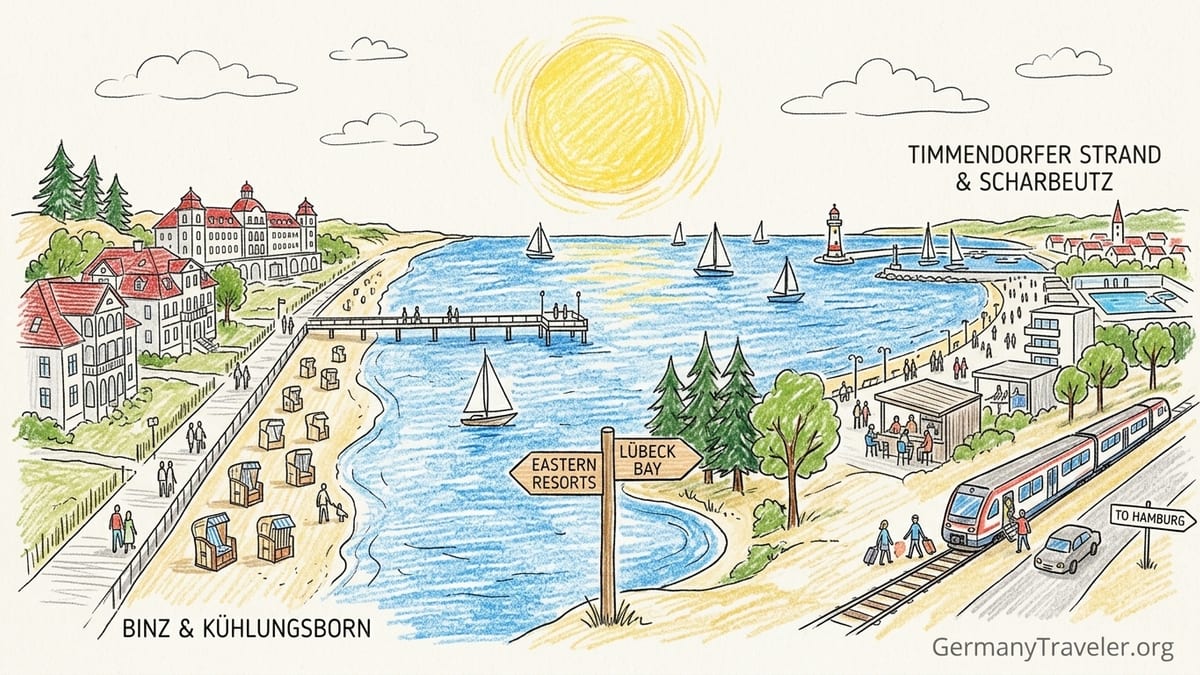
How the Baltic Sea Resorts Compare Overall
If your priority is the full classic Ostseebad experience with historic villas, a long promenade, plenty of hotels and a broad sandy beach, four names consistently stand out: Kühlungsborn, the Kaiserbäder Heringsdorf and Ahlbeck on Usedom, and Binz on Rügen. Kühlungsborn alone offers around 3 kilometers of promenade and an unusually high density of beachfront and near-beach wellness hotels, from the A-ROSA Ostseehotel Kühlungsborn to Hotel Vier Jahreszeiten and Villa Strandperle, all fronting or just behind the seafront alley of historic spa architecture.
Binz, Sellin and the two Usedom resorts are stronger for scenery and imperial flair. Binz spreads along a graceful bay backed by white villas, with a relatively compact center where you can step off the train and walk to seafront hotels such as the Dorint Strandhotel or travel-themed wellness houses within minutes. Heringsdorf and Ahlbeck form part of the 12 kilometer Kaiserstrand, a nearly continuous line of pale sand and piers that links three spa towns and carries the reputation of having one of the grandest promenades on the German Baltic coast.
Closer to Hamburg, Timmendorfer Strand, Scharbeutz, Grömitz and Travemünde cluster around the Lübeck Bay. These resorts are easy weekend escapes for city dwellers, and that convenience shapes their vibe: busy in summer, strong on family-friendly infrastructure and apartment rentals, with a solid but somewhat less dramatic spa-town look than the grand resorts further east. Zingst and Warnemünde sit between both worlds, offering long beaches and access by regional trains, but with slightly different atmospheres: Zingst as a gateway to the Darß-Zingst peninsula and its nature, Warnemünde as Rostock’s lively seaside district.
If you had to name an all-round ranking for classic Ostseebad atmosphere considering beach, promenade, hotel choice and wellness, Kühlungsborn, Binz and Heringsdorf would typically land in the top tier, followed by Ahlbeck, Sellin, Timmendorfer Strand and Zingst. Scharbeutz, Grömitz and Warnemünde are a close next group, popular and well-equipped but a touch less focused on ornate spa-era architecture and large wellness complexes.
Beach Quality: From Broad Kaiserstrand to Family Coves
Beach quality is a strong point almost everywhere on the Baltic, but subtle differences matter when you are choosing where to spend a week. The Kaiserbäder stretch from Bansin through Heringsdorf and Ahlbeck to the Polish resort of Świnoujście in a roughly 12 kilometer band of fine, pale sand known as the Kaiserstrand. The beach is wide enough in most sections for several rows of Strandkörbe, volleyball fields and still-quiet areas closer to the dunes, making it attractive for both families and couples who want space to walk for hours in either direction.
On Rügen, Binz has a gently curving bay with sheltered water and a beach that feels very classic in layout: a line of historic villas and hotels behind the promenade, then dunes, then a broad sandy strip ending in shallow sea perfect for cautious swimmers. Nearby Sellin offers two distinct beaches, including the photogenic setting below the iconic pier with its pavilion. The walk down via steep steps or the lift can be part of the charm, but travelers with strollers may find Binz more convenient for daily beach access.
Kühlungsborn’s beach is another strong contender. The town emphasizes its fine sand and good water quality, and beaches are divided into family sections, dog beaches and quieter stretches toward the edges. The line of dunes and the broadness of the beach mean you rarely feel enclosed, even in high season. Travelers often describe evening walks here as the highlight of their stay, especially when the Baltic turns gold and pink at sunset.
Around Lübeck Bay, beach quality is slightly more varied but still appealing. Timmendorfer Strand and Scharbeutz offer gently shelving sand and good swimming conditions, but summer crowds can be dense and many sections are structured with organized rows of beach chairs and rental stations. Grömitz and Zingst each have long sandy frontages as well, with Zingst often praised for feeling a bit more natural as you walk toward the adjacent national park areas.
Promenades and Piers: Where to Stroll and Be Seen
If promenading is a main vacation pleasure, you will likely be happiest in Kühlungsborn or along the Kaiserbäder strip. Kühlungsborn promotes its seafront as one of the longest beach promenades in Germany, measuring close to 4 kilometers of almost continuous walkway. Here you pass cafes, ice cream parlors, boutique hotels and access points to the sand every few meters. It is ideal for travelers who like to walk without a fixed plan, stopping wherever a Strandkorb, bar or sunset view looks inviting.
On Usedom, the promenade linking Heringsdorf, Ahlbeck and neighboring Bansin is even longer overall, around 12 kilometers when you include the section that continues across the border into Poland. It is paved and largely car free or traffic calmed, with classic spa villas, grand hotels and piers punctuating the route. A typical day here might involve walking from Heringsdorf’s pier past ornate facades and parkland to Ahlbeck, stopping for cake and coffee in a traditional Kurhaus before returning by local train or bus.
Rügen’s Binz and Sellin are more compact but intensely atmospheric. Binz has a central promenade lined with white villas in resort architecture style, small boutiques and cafes, and a pier that is especially popular at sunset. In Sellin, the star of the show is the timber pier with its restaurant pavilion perched above the water, reached by descending from the main street via the Seebrücke steps or the lift. Evening strolls to the illuminated pier are a ritual for many visitors, even those staying in Binz who come over by bus or car.
Warnemünde, as the seaside face of Rostock, has an especially lively promenade flanking the Alter Strom harbor and the beachfront. Street musicians, fish stands selling fresh Fischbrötchen and views of ferries and cruise ships lend it a different, more maritime-urban feel than the more purely resort-focused promenades elsewhere. Timmendorfer Strand, Scharbeutz, Grömitz and Zingst also have beachfront walks, but these are typically shorter and more segmented, mixing stretches of promenade with dike-top paths, beach access stairs and clusters of shops rather than one monumental walkway.
Hotels, Wellness and Spa Culture
For travelers seeking a true wellness break, Kühlungsborn is a standout. A cluster of four-star and higher hotels line or sit just behind the seafront, many with sizable spa areas that include pools, multiple saunas and a menu of treatments. The A-ROSA Ostseehotel Kühlungsborn faces directly onto the promenade and frames its spa as a pause carried by the sound of the waves, while the Hotel Vier Jahreszeiten and other beachfront properties pair indoor pools with sauna landscapes and relaxation rooms looking toward the sea. Several hotels emphasize multi-day wellness packages that bundle half-board dining with massages and skincare treatments.
Binz offers a similar level of choice, though spread across a more compact center. Here you find resort hotels with direct beach access as well as larger complexes slightly set back that focus on thermal pools and saunas. Heringsdorf and Ahlbeck on Usedom combine grand historic hotels, some housed in former imperial villas, with modern spa additions tucked discreetly behind original facades. Booking platforms show particularly large inventories of accommodation in Binz, Sellin, Zingst, Timmendorfer Strand, Kühlungsborn and Heringsdorf, which makes it easier to find midweek deals outside peak school holidays or to book specific room categories such as sea-view suites or family apartments.
Timmendorfer Strand and Scharbeutz are strong on mid to upper midrange hotels, apartments and smaller wellness houses, many offering access to the nearby Ostsee-Therme, a large thermal and pool complex at the border between the two resorts. This can be particularly convenient in cooler months, when you might spend the day alternating between sauna sessions and brief walks on the beach. Grömitz and Zingst also field a mix of family hotels, self-catering apartments and a smaller number of full-service spas, while Warnemünde caters heavily to short-breakers from Rostock and cruise passengers, with several mid to high-end hotels facing the water or the Alter Strom.
Price levels vary. The established flagship wellness hotels in Kühlungsborn, Binz and the Kaiserbäder typically command higher nightly rates in July and August, while shoulder seasons in May, June, September and early October can bring more accessible prices, often under mid three-figure sums per night for double rooms in quality four-star properties. Travelers on tighter budgets often choose self-catering apartments slightly inland or in neighboring villages, using local buses or bikes to reach the beach and spa facilities.
Food, Nightlife and Atmosphere for Couples
The culinary scene across these Ostseebäder is anchored by fresh fish, casual beach kiosks and hotel restaurants. Kühlungsborn and Binz stand out for the number of sit-down restaurants with sea views, ranging from casual Fischbrötchen stalls near the piers to upscale dining rooms in spa hotels. Couples can easily plan a different atmosphere each evening, starting with drinks on a hotel terrace overlooking the promenade before moving to a harbor-side restaurant for local Baltic fish or regional game dishes.
Heringsdorf and Ahlbeck, while slightly quieter after dark, are particularly romantic for evening walks. Their promenades are lit, but not overly bright, and the silhouettes of villas and piers against the Baltic create a classic spa-town image that feels distinctly turn-of-the-century. Many hotels here lean into half-board arrangements, with multi-course dinners served in-house, ideal for travelers who prefer to return to the same base each evening rather than browse restaurant menus along the promenade.
Timmendorfer Strand has the liveliest nightlife of the Lübeck Bay resorts, with a cluster of beach bars, cocktail lounges and late-opening cafes near the main beach access and around the center. Scharbeutz follows closely, its new promenade dotted with contemporary beach clubs and restaurants that attract a younger crowd in summer. Grömitz and Warnemünde also offer bars and occasional live music, but both feel slightly more relaxed and family oriented, particularly outside peak weekends.
Zingst and Sellin are generally quieter, with evenings focused on dinners, ice cream walks and perhaps a drink on a hotel terrace rather than clubs or dance floors. Couples who value peaceful nights and early morning walks on the beach often gravitate here or to smaller streets in Binz and Kühlungsborn set back from the main promenade. In these places, the entertainment is as much the changing light over the Baltic as anything organized.
Families and Practicalities: What Works With Kids
Families with small children often choose Timmendorfer Strand, Scharbeutz or Grömitz because of their straightforward access from Hamburg and the extensive family infrastructure. Beach sections are well signposted, and you find playgrounds, mini-golf, bicycle rentals with child trailers and plenty of casual dining. In Timmendorfer Strand, for example, many visitors pair time on the sand with trips to indoor attractions in case of bad weather, such as the local aquarium or the Ostsee-Therme complex just down the coast.
Kühlungsborn appeals to families who want more of a blend of nature and structure. The long promenade is perfect for stroller walks, and the adjacent forested Stadtwald provides shaded paths for hot days. The historic Molli narrow-gauge steam train linking Kühlungsborn, Heiligendamm and Bad Doberan is a hit with children and adds an easy rainy-day excursion without needing a car. Many hotels offer family rooms or apartments with kitchenettes, and there are designated dog beaches for those traveling with pets.
On Rügen, Binz offers perhaps the best combination of family-friendly beach and compact infrastructure, with playgrounds, shallow water and quick access from many accommodations to both the sand and the town center. Sellin’s steep access to some beach sections is manageable with older children but can be a consideration for strollers. Zingst, with its long sandy beach and proximity to nature reserves, is popular with outdoorsy families who enjoy cycling, birdwatching and longer walks combined with beach days.
Heringsdorf and Ahlbeck can work well for families who like to walk and use public transport. A network of local buses and the Usedomer Bäderbahn connects the Kaiserbäder with smaller villages and the island’s hinterland, so day trips to lakes, forests or the Polish side of the island are simple even without a car. Warnemünde is also attractive for children due to its harbor, lighthouse and the constant movement of ferries and ships, although the resort can feel busy on days with large cruise ship calls.
Getting There by Train: The Car-Free View
For travelers from Hamburg, Berlin or other major cities who prefer to avoid driving, rail connections are a crucial part of the decision. Timmendorfer Strand and Scharbeutz benefit from regular regional trains that run along the Lübeck Bay, making them popular day-trip destinations from Hamburg. From Hamburg’s main station, you can typically reach Timmendorfer Strand with a change in Lübeck in around two hours, then walk or take a short bus or taxi down to the main beach area.
Travemünde, while not in the main comparison list, acts as an additional access point to Lübeck Bay beaches and can sometimes offer easier station-to-beach transfers, which then connect onward by bus to Timmendorfer Strand, Scharbeutz or Grömitz. Grömitz itself is a bit less convenient by train, generally requiring a combination of rail to nearby towns and connecting buses for the last stretch.
Further east, train access improves again. Kühlungsborn is reachable by regional trains via Rostock or Bad Doberan, with the final leg on the heritage Molli steam railway from Bad Doberan to Kühlungsborn Ost or West. Though slower than a modern commuter line, this last section is part of the holiday experience for many. Warnemünde is arguably one of the easiest Baltic resorts to reach by train, as it sits directly on a branch line from Rostock, so you can step off the train and be at the waterfront in minutes.
On the islands, the spa resorts are also surprisingly rail-friendly. Binz has its own station on Rügen, with long-distance and regional trains connecting through Stralsund and often Berlin or Hamburg. Heringsdorf and Ahlbeck are served by the Usedomer Bäderbahn, which links the Kaiserbäder with the mainland and continues across the Polish border. Zingst has no direct rail station; visitors usually travel by train to Barth or Ribnitz-Damgarten and then take bus or taxi to the peninsula, which is fine for longer stays but less convenient for short breaks.
Which Resort Fits Which Traveler Type
For travelers who want the archetypal Ostseebad setting with grand villas, a long promenade, strong wellness options and a wide sandy beach, Kühlungsborn and Binz are excellent first choices. Kühlungsborn is slightly larger and more spread out, with its promenade lined by hotels and holiday apartments of various sizes, while Binz is more compact and intensely scenic, with the resort architecture making even short walks visually pleasing.
Couples looking for a romantic, slightly quieter stay may prefer Heringsdorf, Ahlbeck or Sellin. The Kaiserbäder are rich with early 20th century villas and have wide beaches that never feel completely packed, particularly outside peak school-holiday weeks. Sellin, with its pier and wooded setting a little removed from larger hubs, can feel particularly intimate in the evenings after day trippers leave.
Families and groups of friends from Hamburg or central Germany who want a straightforward journey and plenty of activities often find Timmendorfer Strand, Scharbeutz or Grömitz most practical. These resorts combine frequent rail connections with child-friendly infrastructure and a good choice of apartments and holiday parks. Nightlife is livelier here than in some of the more remote spa towns, especially in July and August when beach bars and promenade events are in full swing.
Zingst and Warnemünde are good options for travelers who want either more nature or more urban flavor. Zingst sits at the edge of the Darß-Zingst national park landscapes, so it suits hikers, cyclists and birdwatchers who still want a proper resort base. Warnemünde, by contrast, is perfect if you like the idea of hopping between a city and the beach, with Rostock’s cultural offerings just a short train ride away and the harborfront bustle providing a different sort of evening entertainment than the quiet spa promenades further east.
The Takeaway
The German Baltic coastline offers a spectrum of classic Ostseebäder, each promising sand, sea and that distinctive combination of spa-era architecture and modern leisure facilities. The challenge is less finding a good resort and more matching the right one to your style of travel, your budget and how you intend to arrive. If you value a majestic promenade, a large choice of wellness hotels and a strong sense of historical flair, Kühlungsborn, Binz and the Kaiserbäder on Usedom are hard to beat.
Travelers who place more importance on quick train access, family activities and a slightly livelier nightlife will likely be happiest around Lübeck Bay, particularly in Timmendorfer Strand, Scharbeutz or Grömitz, perhaps combined with a day trip to nearby Travemünde. Those seeking a quieter or more nature-focused stay can look closely at Zingst and Sellin, where the combination of beach, forest and nearby protected landscapes creates a more contemplative rhythm.
In practice, many visitors end up returning to this coast again and again, trying different resorts along the way. A first trip to a well-connected all-rounder like Kühlungsborn or Binz can give you a strong sense of the Ostseebad tradition. From there, you might branch out on future visits to the Kaiserbäder, the Darß-Zingst peninsula or the smaller villages between the best-known names. With careful planning around your priorities, any of these ten resorts can deliver the classic Baltic seaside holiday you have in mind.
FAQ
Q1. Which Baltic Sea resort is best for a first-time visitor to the German coast?
For a first trip, Kühlungsborn or Binz are ideal because they combine long sandy beaches, classic spa architecture, a lively promenade and a wide choice of hotels, apartments and restaurants, so you get an archetypal Ostseebad experience without needing a car.
Q2. If I am traveling by train from Berlin or Hamburg, which resorts are easiest to reach?
Warnemünde, Binz, the Kaiserbäder on Usedom and the Lübeck Bay resorts around Timmendorfer Strand and Scharbeutz are among the easiest. They are served by regional and in some cases long-distance trains, often with just one change, making them practical for weekend breaks without a car.
Q3. Where will I find the longest and widest beaches among these resorts?
The Kaiserstrand along Heringsdorf and Ahlbeck on Usedom offers a notably long, wide beach stretching for many kilometers, while Kühlungsborn, Binz and Zingst each have broad sandy bays that feel spacious even in high season.
Q4. Which resort is best for couples looking for a romantic atmosphere?
Heringsdorf, Ahlbeck, Sellin and Binz are particularly romantic, thanks to their historic villas, piers and promenades that invite evening walks. Many hotels there emphasize wellness, candlelit dinners and sea-view rooms that appeal to couples.
Q5. What are good choices for families with young children?
Timmendorfer Strand, Scharbeutz, Grömitz and Binz are very family friendly, with gently shelving beaches, playgrounds, mini-golf, aquariums or thermal complexes nearby and many family rooms or apartments. Zingst and Kühlungsborn also work well for families that enjoy cycling and nature.
Q6. Are there resorts with strong wellness and spa facilities directly by the beach?
Yes, Kühlungsborn and Binz are standout options, with several beachfront hotels featuring large spa areas, pools and saunas. The Kaiserbäder on Usedom and Timmendorfer Strand also have a mix of wellness hotels and access to thermal complexes that make off-season stays particularly appealing.
Q7. Where will I find the liveliest nightlife among these Baltic resorts?
Timmendorfer Strand and Scharbeutz have the liveliest nightlife in high season, with beach clubs, cocktail bars and late-opening cafes along or near the promenade. Warnemünde also offers a good selection of bars and harborfront venues, especially when cruise ships are in port.
Q8. Which resorts are better if I prefer a quieter, nature-focused escape?
Zingst, Sellin and parts of the Kaiserbäder are good fits if you value quieter evenings and access to nature. Zingst borders protected landscapes ideal for cycling and birdwatching, while Sellin and the surrounding Rügen countryside offer forests, cliffs and smaller bays to explore.
Q9. How far in advance should I book accommodation in these resorts?
For July and August, it is wise to book several months in advance, particularly in Kühlungsborn, Binz, Sellin, Zingst and the Kaiserbäder, where many properties fill early. In shoulder seasons such as May, June and September, you can often book quality accommodation a few weeks ahead and still find a good selection.
Q10. Is it possible to combine several Baltic resorts in one trip?
Yes, many travelers combine two or three resorts, for example starting in Lübeck Bay at Timmendorfer Strand or Scharbeutz, then moving on to Kühlungsborn or Warnemünde, and finishing on Rügen or Usedom. Regional trains and buses make these combinations feasible even without a car, especially outside peak traffic days.