

The German Baltic coast stretches for more than a thousand kilometers from the Danish border near Flensburg to the Polish border beyond Usedom. For first-time visitors it can feel like an endless blur of sand, piers and resort names, many better known to German families than to international travelers. This guide breaks the coast into manageable regions, explains how the beaches differ, and shows how to piece together a realistic itinerary by train, bike or car.
Understanding the German Baltic Coast at a Glance
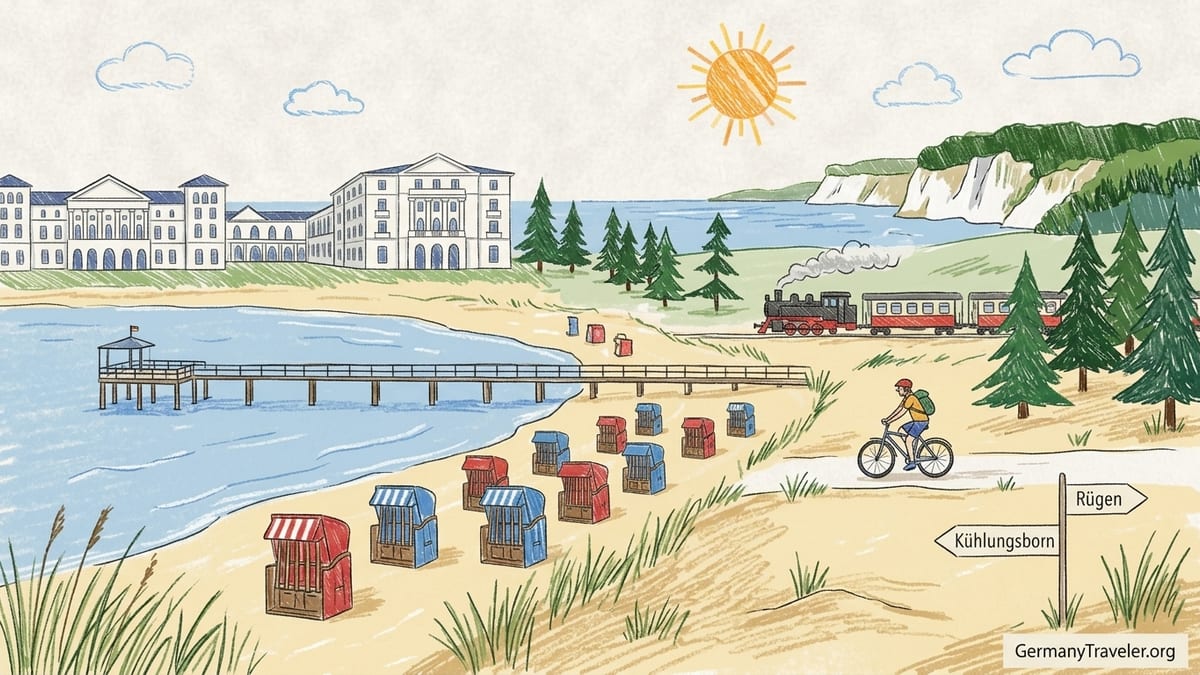
The German Baltic coast runs primarily through two states: Schleswig-Holstein in the west and Mecklenburg-Vorpommern in the east. Within this long sweep you find classic spa towns with white villas, family-focused camping beaches, wild national park dunes and three major holiday islands: Fehmarn, Rügen and Usedom. A typical first trip focuses on one or two regions for 4 to 7 nights rather than trying to drive the entire coastline from Flensburg to Usedom in a single go.
The feel of the Baltic is different from Germany’s North Sea. Tides are modest, beaches are usually gentler and the Baltic behaves more like a big lake than an ocean. Even in summer, water temperatures typically hover in the high teens Celsius, often around 18 to 20 degrees in July and August, a bit warmer in shallow bays and lagoons. Locals embrace this with heated hotel pools, saunas and lots of wind-protected beach chairs, so a Baltic holiday is as much about promenade life, cycling and cafés as it is about swimming.
Infrastructure is well developed. Frequent regional trains connect major hubs like Lübeck, Kiel, Rostock and Stralsund with seaside resorts. Car ferries, local buses and island railways cover the gaps. Many visitors from Hamburg or Berlin travel without a car, using regional day tickets that cap rail costs for families. Others arrive by car or campervan to hop between campgrounds directly behind the dunes, which is common around the Lübeck Bay, Fischland-Darß-Zingst and on Rügen and Usedom.
Prices along the Baltic tend to rise from west to east as you reach famous resorts in Mecklenburg-Vorpommern, with Binz on Rügen and the Kaiserbäder on Usedom among the most expensive options in peak school holidays. Smaller towns or inland bases like Grevesmühlen or Bad Doberan usually offer better value while still giving quick access to the beach by local train or bus. Booking well ahead is important for July and August, especially for family apartments and sea-view rooms.
Flensburg, Kiel and the Western Baltic
The northwestern stretch around Flensburg and Kiel is the easiest Baltic region to combine with Denmark or a trip through northern Germany. Flensburg sits at the end of a long fjord, with pastel harbor warehouses and a noticeable Danish influence. Day-trippers ride local buses or bikes to beaches at Glücksburg, where a moated castle, small marina and modest sandy bays give a gentle introduction to the Baltic. This area suits travelers who like a blend of small-city culture and scenic shoreline rather than endless dunes.
South along the coast, the Eckernförde Bay, Schlei fjord and Hohwacht Bay offer low-key resorts and camping. Eckernförde has a wide central beach backed by a promenade, playgrounds and a compact old town. In summer you will see rows of Strandkörbe, the iconic wicker beach chairs for rent by the day or half-day, which give shelter from wind and allow families to linger even when it is cool. Nearby Schlei, officially a long inlet rather than a fjord, has small bathing spots and marinas ideal for sailing and stand-up paddleboarding.
Kiel, capital of Schleswig-Holstein, is best known as a working port and university city, but its fjord is lined with popular beaches at Schilksee, Laboe and Schönberg. Laboe combines a long sandy shore with a U-boat memorial and naval museum, making it a useful stop for history-minded travelers. This entire western stretch is ideal if you prefer less crowded beaches, plan to travel with a dog, or want to use the Baltic coast as a side trip from a city break in Hamburg or Schleswig-Holstein’s inland lakes.
Connections are straightforward. Regional trains link Hamburg to Kiel in about 1.5 hours, and from Kiel local buses fan out along the fjord. Flensburg is on the main rail line to Denmark. Cyclists can ride sections of the Baltic Sea Coast Cycle Route, which is well signposted and often runs directly beside the water; many German riders tackle this area as a short 3 to 4 day trip from Flensburg to Kiel before continuing east another year.
Fehmarn and Lübeck Bay
Fehmarn is Germany’s third-largest island and the Baltic gateway between Schleswig-Holstein and Denmark. Reached via a causeway north of Lübeck, it has a laid-back, windswept feel and is particularly popular with windsurfers and kitesurfers. Beaches vary from pebble sections on the exposed north coast to flatter family sands in the south, such as around Burgtiefe. The island has several large camping and holiday park complexes where German families rent mobile homes or pitches right behind the dyke.
South of Fehmarn, Lübeck Bay forms a classic chain of seaside resorts within easy reach of Hamburg and Lübeck. Timmendorfer Strand and Scharbeutz have lively promenades lined with cafés, ice-cream parlors and beach fashion shops. Travemünde, technically a district of Lübeck, is one of the oldest Baltic resorts, with a working harbor, lighthouse and long beach backed by traditional spa hotels. A traveler staying in Lübeck can reach Travemünde by suburban train in around 30 minutes and treat it as a simple beach day trip.
The Lübeck Bay is renowned for fine, light sand and relatively warm water compared with some more open Baltic sections. Shallow entry makes places like Scharbeutz suitable for younger children, and many beaches here have supervised swimming zones in summer along with playgrounds in the sand. The trade-off is that this bay is very popular during Hamburg and Schleswig-Holstein school holidays, with parking lots filling quickly on sunny weekends and room rates around the bay generally higher than in quieter parts of Schleswig-Holstein.
For those traveling by train, the Bay works well for short holidays without a car. Direct regional trains from Hamburg reach Lübeck in under an hour, with onward services to Timmendorfer Strand and Travemünde. Cyclists can ride a scenic coastal strip from Travemünde toward Boltenhagen in Mecklenburg, using frequent regional trains to shorten individual stages. This is a good option for visitors who want a “classic beach holiday” feel with modern facilities, watersports rentals and evening promenade life.
Mecklenburg’s Historic Seaside Resorts and Rostock / Warnemünde
Crossing into Mecklenburg-Vorpommern, the coast becomes more classically “Baltic” in the German imagination: white spa architecture, long piers and grand hotels lining promenades. Between the Lübeck Bay and Rostock you pass resorts such as Boltenhagen, the island of Poel and Heiligendamm. Heiligendamm, often called the “White Town by the Sea,” is Germany’s oldest seaside resort, with a row of neoclassical buildings set just behind the shore. Boltenhagen offers a family-friendly central beach and a mix of holiday apartments and campsites on the cliffs and fields outside town.
Farther east, Kühlungsborn is one of the strongest all-round resorts. It stretches along a broad sandy bay with a multi-kilometer promenade, a marina and a preserved narrow-gauge railway, the Molli, which steams inland to Bad Doberan through fields and villages. Kühlungsborn suits travelers who want a car-free holiday focused on walking, cycling and spending long days on the sand, backed by plenty of restaurants and bakeries. Prices are moderate to high in peak season, but visiting in June or early September usually offers better availability and slightly lower rates.
Rostock is the largest city on the German Baltic and acts as a rail hub for the region. Its seaside district, Warnemünde, lies at the mouth of the Warnow River and is one of the easiest choices for visitors without a car. The train from Rostock’s main station to Warnemünde takes around 20 minutes, depositing you a short walk from one of the broadest beaches on the German Baltic coast. Warnemünde combines a working port, lighthouse and fish market atmosphere with a gently shelving beach ideal for families and casual swimmers.
The Rostock and Mecklenburg Bay area also work well for day trips away from the beach. Rostock’s brick Gothic churches and university quarter give a taste of Hanseatic history, while Wismar, farther west, has UNESCO-listed medieval architecture and a handsome harbor. From a family base in Kühlungsborn or Warnemünde, it is easy to plan one or two city days if weather turns cool or windy, using regional trains that allow inexpensive group tickets valid across a whole day.
Fischland-Darß-Zingst and the Bodden Coast
East of Rostock the coastline juts out into the Baltic in a series of narrow peninsulas known collectively as Fischland-Darß-Zingst. Much of this area lies within the Western Pomerania Lagoon Area National Park, combining wild dune forests, long sandy beaches and shallow inland waters known as Bodden. This region appeals to travelers seeking more nature and fewer big hotels, although classic resort villages such as Zingst and Prerow still get busy in July and August.
Prerow is famous for its fine white sand and the Weststrand, a wilder forest-backed beach that can be reached on foot or by bike. Zingst has a pier, a compact center and an active program of cultural events in summer, from photography festivals to concerts. Both towns have a wide range of holiday apartments and small hotels, plus several well-organized campgrounds almost directly behind the dunes. Many German families return here year after year for a relaxed mix of beach days, cycling through pine woods and boat trips on the Bodden waters.
The Bodden behind Fischland-Darß-Zingst are shallow and warm more quickly than the open Baltic, so in high summer they can reach several degrees higher than the sea, which makes them attractive for swimming with younger children or for beginners learning stand-up paddleboarding or kayaking. In spring and autumn, the area is known for birdwatching, especially the migration of tens of thousands of cranes that roost on the Bodden and fields, which provides a completely different kind of Baltic trip outside the typical beach season.
Access without a car involves some planning. Regional trains run to Ribnitz-Damgarten and Barth, from where buses and seasonal shuttle services connect to Wustrow, Ahrenshoop, Prerow and Zingst. Many visitors arrive by car and then switch to bikes or local buses once on the peninsula to avoid parking frustration near the most popular beach access points. Because accommodation in the main holiday weeks sells out early, flexible travelers often target late June or early September for milder weather, warm water and fewer crowds.
Rügen and Usedom: Big Islands, Big Choices
Rügen and Usedom are the stars of the eastern German Baltic and receive a significant share of overnight stays in Mecklenburg-Vorpommern. Both offer extensive sandy beaches, historic resort towns and a mix of quiet villages and busy promenades. Choosing between them for a first trip depends on what kind of atmosphere and activities you prefer, as well as how you plan to travel.
Rügen, Germany’s largest island, is known for the chalk cliffs of Jasmund National Park, seaside resorts such as Binz, Sellin and Göhren, and scenic rail journeys on the Rasender Roland steam railway that links several resorts with inland Putbus. Binz has a grand promenade lined with spa architecture, a long pier and one of the livelier evening scenes on the Baltic, while Sellin is famous for its picture-book pier building. The island’s eastern coast has long sandy bays, while the west and interior are more rural, with Bodden landscapes, thatched-roof villages and smaller harbors.
Usedom, shared between Germany and Poland, prides itself on high sunshine hours and nearly continuous sand from Peenemünde to Świnoujście. The German side features the three Kaiserbäder resorts of Ahlbeck, Heringsdorf and Bansin, connected by a long promenade suitable for walking and cycling. Further north, towns such as Zinnowitz and Ückeritz feel slightly less formal and are popular with families staying in holiday apartments or on wooded campgrounds close to the dunes. One advantage of Usedom is the ability to combine German and Polish seaside culture in a single trip by crossing the border in Świnoujście.
Both islands are very accessible by public transport. Trains from Berlin run to Stralsund and on to Rügen, with local branch lines and buses distributing visitors across the island. A separate regional line, the Usedomer Bäderbahn, runs along much of the German side of Usedom, making it easy to move between Kaiserbäder or to visit Peenemünde without a car. In peak season, many travelers book self-catering apartments for a week at a time, often Saturday to Saturday, so short stays can be trickier to arrange on short notice.
Because Rügen and Usedom are so popular, prices during July and August run high, especially for sea-view rooms in Binz or Heringsdorf. For a first trip, consider a June or early September visit, when water temperatures can still hover around the upper teens Celsius but crowds are lighter. Families often plan one or two non-beach days for trips to attractions such as the Ozeaneum aquarium in Stralsund, the historical rocket museum at Peenemünde or tree-top walking paths on Rügen, which are good options if wind or cooler weather makes swimming less appealing.
Climate, Water Temperatures and the Best Season
The Baltic coast has a temperate maritime climate. Summers are generally mild rather than hot, with many days in the low to mid 20s Celsius, although heatwaves do occur. Winters are cool and damp, with occasional cold spells that can bring snow and, in exceptional years, sea ice close to shore. Compared with inland Germany, the coast is usually a few degrees cooler in summer and a little milder in winter, with frequent breezes that have a big impact on how the beach feels.
For swimming, the main season runs roughly from late June through early September. Typical nearshore water temperatures along the German Baltic in high summer are around 17 to 20 degrees, sometimes a bit higher in sheltered bays and Bodden waters and slightly cooler on exposed coastlines. On very warm and calm stretches in July or August, shallow areas around resorts like Zingst, Warnemünde or Timmendorfer Strand can briefly reach the low 20s. However, wind shifts can quickly move warmer surface water offshore and bring cooler water in, so conditions can change from one week to the next.
Different seasons suit different types of trips. April and May bring quieter beaches, blooming rapeseed fields inland and ideal conditions for cycling stretches of the Baltic Sea Coast Cycle Route without intense heat. Accommodation prices are lower than in midsummer and you will share promenades mainly with locals and older visitors. September is a favorite month among Germans: the sea retains warmth from summer, families with school-age children have mostly left, and the light can be particularly beautiful.
October, especially around Fischland-Darß-Zingst and the Bodden coast, is prime time for nature-oriented trips, with crane migrations and autumn colors in coastal forests. Winter on the Baltic is a niche interest but has its fans: resorts run wellness programs with saunas, spa treatments and indoor pools, and long empty beaches invite bracing walks in heavy coats. If you choose winter, focus on larger resorts or towns like Kühlungsborn, Warnemünde, Binz or Heringsdorf where more restaurants and cafés remain open year-round.
Getting Around, Cycling and Family-Friendly Planning
Travel along the German Baltic works well both with and without a car. By rail, most itineraries start from Hamburg or Berlin, using intercity or regional trains to reach gateways such as Lübeck, Kiel, Rostock and Stralsund. From there, dense regional networks continue to coastal towns: for example, Lübeck to Travemünde or Timmendorfer Strand, Rostock to Warnemünde, or Stralsund across to Rügen. German regional day tickets allow up to five people to travel together at a fixed price, which keeps costs manageable for families who want to hop between towns over a couple of days.
Driving gives more flexibility to explore smaller bays, rural peninsulas and inland lakes. Highways A1, A20 and A19 form the main east-west spines, while smaller coastal roads wind through fields and villages. In peak season expect congested access roads to top resorts, especially on Saturdays when many rentals change guests. Parking near popular beaches is often paid, with machines that accept coins or local apps. To avoid frustration, many families book accommodation within walking or cycling distance of the sea and leave the car parked for most of the stay.
The Baltic Sea Coast Cycle Route runs more than a thousand kilometers between Flensburg and Usedom, but most visitors ride short sections as day trips rather than tackling the entire distance. Around Lübeck Bay, for instance, you can cycle from Travemünde toward Boltenhagen; on Fischland-Darß-Zingst there are dedicated bike paths through forest to the Weststrand; while on Usedom the long promenade between the Kaiserbäder is ideal for casual cycling with children. Bike rental shops are common in resort towns, typically providing city bikes, e-bikes and trailers or seats for kids.
Planning for families means balancing beach time with alternative activities and choosing the right base. Younger children often do well in resorts with playgrounds on or near the beach, shallow entry and amenities like mini-golf or small amusement rides, which you will find in places such as Grömitz, Kühlungsborn, Warnemünde or Zinnowitz. Many German families prefer holiday apartments with kitchenettes and separate bedrooms over hotel rooms, which can be more economical for stays of a week or longer and allow easy self-catering on days when everyone is tired from sun and wind.
The Takeaway
The German Baltic coast is not a single destination but a string of distinct regions, each with its own character. From the fjord-like inlets of Flensburg and Kiel through the classic holiday towns of Lübeck Bay, the white villas of Mecklenburg’s resorts, the wild dunes of Fischland-Darß-Zingst and the big islands of Rügen and Usedom, first-time visitors can choose the stretch that best matches their interests and travel style.
Water temperatures are refreshing rather than tropical, and the weather is naturally changeable, so the most satisfying Baltic holidays build in flexibility. Combine beach days with cycling, simple hikes through coastal forest, visits to Hanseatic old towns and perhaps a boat trip on the Bodden or to a lighthouse. Whether you arrive by regional train from Hamburg, drive up from Berlin or include the coast in a wider Germany itinerary, a well-planned first trip will reveal why many German families return year after year.
For an introductory stay, consider four to seven nights focused on a single area: perhaps Lübeck Bay if you like lively promenades, Kühlungsborn or Warnemünde for car-free comfort, Fischland-Darß-Zingst for nature, or Rügen and Usedom for island variety. Once you have a feel for one part of the coast, it becomes easier to return and explore new sections, piecing together your own mental map of this long, often understated shoreline.
FAQ
Q1. Is the German Baltic Sea warm enough for swimming in summer?
In July and August, nearshore water temperatures commonly reach about 17 to 20 degrees Celsius, slightly higher in shallow bays and Bodden waters, which many visitors find refreshing but cooler than Mediterranean seas.
Q2. When is the best time to visit the German Baltic coast for a beach holiday?
Late June through early September offers the best combination of warm air, reasonable water temperatures and open seasonal facilities, with September often providing warm water and fewer crowds.
Q3. Which area of the Baltic coast is best for a first-time visitor without a car?
Warnemünde via Rostock, Lübeck with day trips to Travemünde, and the resort of Kühlungsborn all work well without a car thanks to frequent regional trains and compact, walkable centers.
Q4. How many days should I plan for a first trip to the German Baltic?
Four to seven nights in one or two regions is a good starting point, giving time for several beach days plus at least one excursion inland or to a nearby city without feeling too rushed.
Q5. What is the difference between Rügen and Usedom for holidaymakers?
Rügen offers more varied landscapes, including chalk cliffs and scenic railways, while Usedom is known for long continuous beaches, high sunshine hours and elegant historic resorts linked by a promenade.
Q6. Is the Baltic coast suitable for families with young children?
Yes, many resorts have gently shelving beaches, playgrounds on the sand, lifeguarded areas and family-friendly apartments or campsites, making them popular with German families traveling with toddlers and school-age children.
Q7. Do I need to book accommodation far in advance for summer?
For July and August, especially in well-known resorts on Rügen, Usedom, Fischland-Darß-Zingst and Lübeck Bay, it is wise to book several months ahead to secure sea-close apartments or family rooms.
Q8. Can I cycle along the Baltic Sea coast even if I am not an experienced cyclist?
Yes, most popular stretches use dedicated or low-traffic paths that are relatively flat, and local rental shops offer comfortable city bikes and e-bikes suitable for relaxed half-day or day rides.
Q9. Are there things to do if the weather is too cool or windy for the beach?
Visitors often spend cooler days exploring Hanseatic old towns like Lübeck, Wismar or Rostock, visiting museums and aquariums, or enjoying wellness facilities and indoor pools at larger resorts.
Q10. Is it possible to visit both Germany and Poland on a Baltic trip?
Yes, the island of Usedom makes it easy to combine German resorts such as Ahlbeck and Heringsdorf with the Polish town of Świnoujście by simply walking or cycling along the shared beach and promenade.