


The Upper Middle Rhine Valley between Rüdesheim and Boppard is where the river becomes the Rhine of postcards: vine-covered slopes, castle-topped cliffs and half-timbered villages squeezed between rock and water. You do not need a week-long river cruise to experience it. In 2026, frequent scheduled boats from companies such as KD and Bingen-Rüdesheimer make it easy to build your own short, scenic cruise of two to six hours, combining boat, train and village stops along the way.
Understanding the Scenic Core: The UNESCO Rhine Gorge
The most dramatic stretch of the Rhine runs for roughly 65 kilometers between Rüdesheim/Bingen and Koblenz, a UNESCO World Heritage landscape marked by steep vineyards, tight bends and more than 20 major castles. For a short cruise, you do not need the full distance. The visual “sweet spot” is the central section between Rüdesheim or Bingen in the south and St. Goar or Boppard in the north, which comfortably fits into a half or full day.
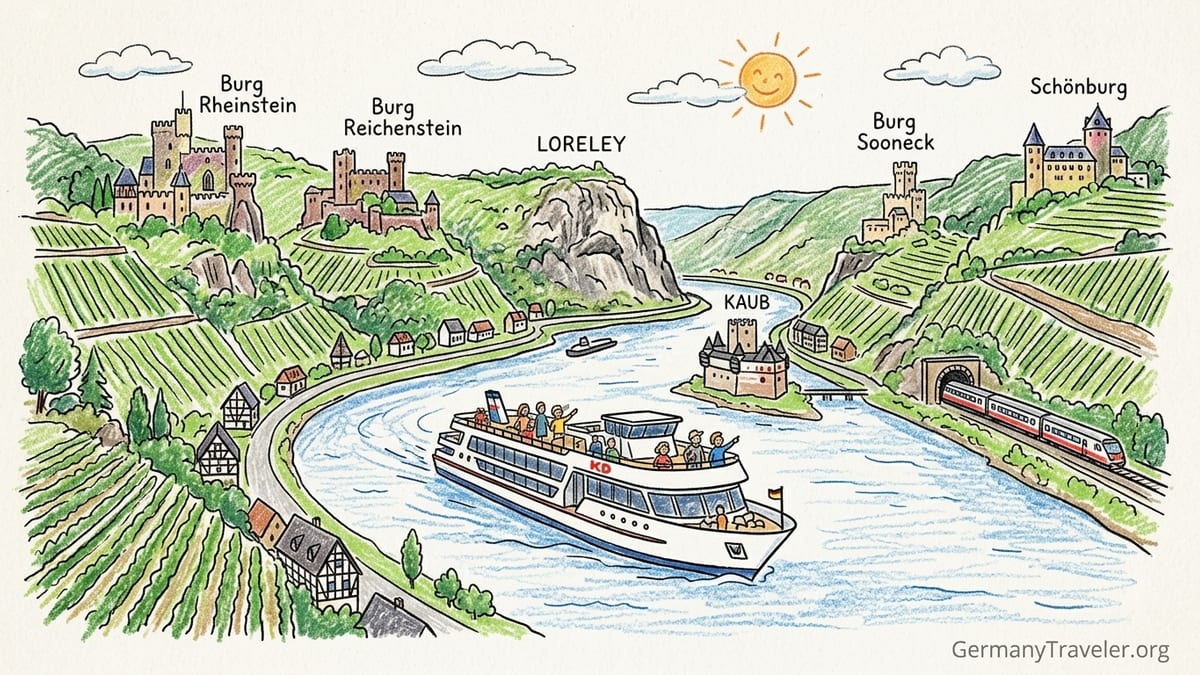
Key sights lie directly on this corridor. Northbound from Rüdesheim you pass Burg Rheinstein, Burg Reichenstein and Burg Sooneck above Trechtingshausen, then the Mouse Tower on an island opposite Bingen, Burg Stahleck above Bacharach and Schönburg above Oberwesel. Near Kaub, little Pfalzgrafenstein Castle sits like a stone ship in mid-river, and just beyond St. Goarshausen rises the Loreley rock, the tightest and most famous bend on the river. Traveling further toward Boppard, the valley opens slightly but remains lined with ruined keeps and terraced vines.
In practice, this means even a two-hour cruise between Rüdesheim and St. Goar or between Boppard and St. Goar covers the core castle zone and the Loreley cliffs. Longer rides simply add more castles and villages at either end. Understanding this geography helps you choose where to start and finish so you maximize scenery while keeping travel time manageable.
Upstream vs Downstream: How Direction Changes Your Day
On the Middle Rhine, the river flows from south to north, so anything heading from Rüdesheim or Bingen toward St. Goar and Boppard is moving downstream, with the current. Downstream boats are noticeably faster. For example, a 2026 KD Loreley cruise from Rüdesheim to St. Goar or St. Goarshausen typically takes about 2 hours, while the reverse upstream trip can take closer to 2.5 to 3 hours depending on stops and water levels.
From Bingen, which sits opposite Rüdesheim on the left bank, downstream timings are similar. A downstream cruise from Bingen to St. Goar with intermediate stops like Bacharach and Oberwesel is commonly sold as a roughly 2-hour sightseeing run, while an upstream return from St. Goar to Bingen can stretch to almost 3 hours when the current is strong. Local operators such as Bingen-Rüdesheimer explicitly label “direction of travel up the Rhine” or “down the Rhine” in their 2026 timetables to make this clear.
For many travelers, the most efficient pattern is to ride the boat downstream, when you are fresh and focused on views, then return upstream by train, which is not slowed by the current. For example, you might cruise downstream from Rüdesheim to St. Goar in the morning, spend a couple of hours exploring the village and Rheinfels Castle, then take a 30 to 40 minute regional train back along the same castle-studded river section in the afternoon for a different perspective.
Choosing Your Departure Port: Rüdesheim vs Bingen vs Bacharach vs St. Goar vs Boppard
Rüdesheim on the right bank is the most touristic starting point, with dense wine taverns, the Drosselgasse lane and easy bus or train links from Frankfurt via Wiesbaden. KD and other operators run multiple Loreley round-trips from here in 2026, typically marketed as Rüdesheim to St. Goar or St. Goarshausen and back, often with recorded commentary and simple food service on board. The town itself rewards an extra hour before or after your cruise for a cable car ride to the Niederwald Monument or a glass of Riesling on a shady terrace.
Bingen on the left bank faces Rüdesheim and is better connected by the mainline rail corridor between Mainz and Koblenz. If you are traveling on regional trains or using a Deutschlandticket, Bingen (Rhein) Stadt station puts you walking distance from the boat piers. Many independent travelers choose Bingen because you can arrive on an hourly RB or RE train from Mainz or Frankfurt, step straight onto a KD or Bingen-Rüdesheimer boat to Bacharach or St. Goar, and then later board a train further up the line back toward your base.
Bacharach is a smaller, atmospheric village roughly midway between Bingen and St. Goar. Its half-timbered houses and hillside youth hostel in Burg Stahleck have made it a long-time favorite for overnight stays. For a cruise, Bacharach is ideal as either a midpoint hop-on hop-off stop or a base where you begin with a short upstream or downstream trip. For instance, in 2026 you might check into a guesthouse in Bacharach, take a late-morning boat upstream to Oberwesel and St. Goar, then return by train in 15 to 20 minutes.
St. Goar and its twin town St. Goarshausen, facing each other across the river, sit just downstream from the Loreley rock. They are the natural turning point for many day cruises. From here you can walk uphill to the impressive ruins of Burg Rheinfels or take a bus to the Loreley plateau above the rock. Farther north, Boppard is a larger resort town on a wide S-bend of the Rhine and a convenient rail hub. KD and other operators offer frequent summer round-trips between Boppard and the Loreley area, making Boppard an excellent base if you are arriving from Cologne or Koblenz and want a shorter boat ride that still includes the gorge.
The Loreley Section and Castle Viewing: Where the Scenery Peaks
Almost every brochure for the Middle Rhine highlights the Loreley rock, a 132-meter slate cliff above a narrow river bend near St. Goarshausen. In 2026, KD and Bingen-Rüdesheimer both run dedicated Loreley cruises from Rüdesheim or Boppard that guarantee you pass this section, often timing departures so that the Loreley is reached at mid-cruise when passengers are settled on deck. On a clear day, you will see trains and trucks threading through tunnels below the rock while the boat eases carefully through the narrowed channel.
However, the scenic experience is not just about the Loreley itself. Between Rüdesheim/Bingen and St. Goar/Boppard, castles come in quick succession. South of Bacharach, Burg Rheinstein and Burg Reichenstein crown the cliffs near Trechtingshausen. North of Bacharach, Schönburg towers above Oberwesel, then Pfalzgrafenstein stands midstream near Kaub, followed by Burg Katz and Burg Maus near St. Goarshausen and Wellmich. Because boats travel more slowly than trains, you have time to photograph these landmarks and listen to onboard commentary pointing out names and stories.
For the most complete castle run, choose a route that covers either Rüdesheim or Bingen all the way through to St. Goar or Boppard. A shorter loop, such as Boppard to St. Goar and back, will still include several major sights, including the Loreley and Burg Katz, but will not show you the southern castles near Bingen. Travelers with limited time might accept this trade-off in favor of a 2-hour round-trip that starts and ends at the same pier.
Making Sense of 2026 Boat Schedules and Travel Times
In 2026, KD operates a regular “scheduled service” on the Middle Rhine, with multiple daily departures between Rüdesheim and St. Goar or St. Goarshausen during the main season. Typical morning boats leave Rüdesheim around 9:15 or 10:15, reaching Bingen about 10 to 15 minutes later, Bacharach after roughly 1 hour and St. Goar or St. Goarshausen in about 2 hours. Afternoon boats in the reverse direction take slightly longer upstream but follow similar stopping patterns. Exact times vary by date, and low-water periods can cause adjustments or cancellations, so checking the latest timetable shortly before travel is essential.
Local company Bingen-Rüdesheimer runs its own scheduled services between Bingen and St. Goar, including trips branded as “Loreley cruise” that stop at intermediate villages like Trechtingshausen, Niederheimbach, Bacharach and Oberwesel. A sample 2026 itinerary might have you boarding in Bingen at late morning, cruising past castles to St. Goar in a bit over 2 hours, enjoying a short land visit, then returning by a faster train. Round-trip packages are also offered that include a fixed stay in St. Goar without hop-off flexibility in between, which suit travelers who prefer a simple out-and-back day.
North of St. Goar, KD and other operators base ships in Boppard for shorter Loreley excursions, typically 2 to 2.5 hours round-trip. For example, a Boppard departure late morning can have you at St. Goar or St. Goarshausen around midday, with the Loreley just beyond, then back in Boppard for mid-afternoon coffee on the riverside promenade. These timings are especially attractive for travelers coming from Cologne or Koblenz on regional trains who want a cruise that fits neatly between morning and evening rail connections.
Hop-Off Flexibility and Train + Boat Combinations
One of the biggest advantages of choosing a short Rhine cruise over a packaged week-long river itinerary is flexibility. KD’s scheduled line boats function like a floating bus along the river, and many tickets allow you to disembark at intermediate stops such as Bacharach or Oberwesel and reboard a later boat in the same direction. Alternatively, you can complete your cruise in one direction and ride the train back, which often takes less than half the river time and runs at least hourly along both banks.
The left-bank rail line between Bingen and Koblenz serves Bingen, Bacharach, Oberwesel, St. Goar and Boppard with regional trains like the RB 26 or RB 32. These trains are included in the nationwide Deutschlandticket and most regional day passes, making combined rail and boat days both flexible and affordable. A very popular pattern in 2026 is to buy a rail ticket or use your Deutschlandticket to reach Bingen or Rüdesheim, purchase a one-way KD or Bingen-Rüdesheimer boat ticket downstream to St. Goar, then return by train with an optional stop in Bacharach for dinner.
If you are starting from Cologne, Koblenz or Bonn, another efficient strategy is to take a morning regional train to Boppard, board a midday cruise to the Loreley and St. Goar, then ride an afternoon train back. This loop gives you both perspectives: slow-motion castle viewing from the water and quick photo stops in two or three riverside towns. When comparing departure ports, think in terms of your rail access as much as the river itself; Bingen, Bacharach, St. Goar and Boppard all sit right on the key rail line, while Rüdesheim connects via ferry and right-bank line.
Suggested Sample Routes from Each Port
From Rüdesheim, a classic 2026 day trip starts with a late-morning KD Loreley cruise to St. Goarshausen. You board around 10:15, pass Bingen and the Mouse Tower minutes later, then thread between Burg Rheinstein, Reichenstein and Sooneck as vineyard terraces rise above you. After gliding below Burg Stahleck at Bacharach and Pfalzgrafenstein at Kaub, you reach St. Goarshausen early afternoon. Here you can either ride a bus up to the Loreley viewpoint or cross on the ferry to St. Goar to explore Rheinfels Castle, then take an evening train back via Bingen and Mainz.
From Bingen, a well-balanced route is to catch a mid-morning Bingen-Rüdesheimer boat to Bacharach, where you hop off for a 2-hour lunch and wander through the medieval streets, then reboard a later boat to St. Goar. This way you enjoy two separate river legs, see multiple castle groups at different times of day, and still have ample time to climb to a viewpoint or taste local Riesling. The return to Bingen on the regional train takes about 30 to 40 minutes, and from there you have frequent services back to Mainz, Frankfurt or Koblenz.
Bacharach itself works superbly as a base for shorter cruises. For example, couples on a relaxed weekend often check into a local inn on Friday night, take a Saturday morning boat north to Oberwesel and St. Goar, return by train in the afternoon and then on Sunday either ride south by boat to Bingen and Rüdesheim or rent bikes for the riverside trail. Similarly, from St. Goar you can do a concentrated Loreley circuit: morning visit to Rheinfels Castle, lunchtime boat ride south to Bacharach with castle views in full daylight, then an evening train back.
From Boppard, many travelers choose the simple Boppard–Loreley–Boppard round-trip. You step aboard mid-morning, settle on the sun deck as the ship heads upstream past vineyards and small villages like Hirzenach and Bad Salzig, then reach St. Goar with views of Burg Katz and the Loreley cliffs before turning back. This is ideal if you do not want to manage logistics or ferry crossings. More ambitious visitors might instead take a boat one way to St. Goar and return by train, allowing time to walk the promenade in both towns and perhaps ride Boppard’s chairlift up to the Vierseenblick viewpoint overlooking the Rhine loop.
Practical Tips for Tickets, Seating and Seasons
For boat tickets, you normally buy directly from the operator, either online in advance or at the pier kiosk on the day. In high summer and on public holidays, popular departures between Rüdesheim, Bacharach and St. Goar can become busy, especially around midday, so reserving a specific sailing a few days ahead is wise. Prices for a typical 2-hour one-way cruise in 2026 generally fall into the moderate range compared with other European attractions, but exact fares depend on route, company and any included extras such as commentary or meals.
On board, the best castle viewing is from the open top deck, ideally on the side facing the bank where most castles line the cliffs. Between Rüdesheim/Bingen and St. Goar, both banks are interesting, but many prominent castles like Stahleck, Schönburg and Rheinfels rise on the left side when you are heading downstream. Consider bringing a light jacket even in summer, as wind on the river can be cooler than in the villages, and sunglasses or a hat for the strong midday sun reflected off the water.
Seasonality matters. The main cruise season stretches roughly from April to October, with the densest schedules between May and September. In shoulder periods, some early or late sailings may not run daily, and by late autumn many operators switch to a reduced timetable with weekend-only Loreley trips. Low water on the Rhine can occasionally force cancelations or route changes, particularly in late summer, so checking operator websites the evening before your trip is sensible. Train services along the valley are more robust year-round, providing a safety net if a planned boat segment is disrupted.
Combination tickets and regional rail passes can help control costs. For example, visitors staying in Mainz or Frankfurt frequently use the Deutschlandticket or a Rhineland-Palatinate regional day ticket for unlimited regional trains to and from Bingen or Koblenz, then pay only for the boat segment. Families might look for discounted child or family fares on both rail and boat, while groups sometimes benefit from bundled day-cruise offers that include a set lunch or wine tasting on board.
The Takeaway
The Upper Middle Rhine between Rüdesheim and Boppard is perfectly suited to independent travelers who want a concentrated dose of riverside romance without committing to a multi-day river cruise. Scheduled boats in 2026 from KD and Bingen-Rüdesheimer, combined with frequent regional trains on both banks, make it easy to tailor a two- to six-hour cruise that fits your schedule and interests.
Choosing a departure port is mostly about how you want to balance scenery and logistics. Rüdesheim and Bingen work best if you are coming from Frankfurt or Mainz and want the full castle run past Bacharach, Oberwesel and the Loreley. Bacharach and St. Goar are ideal for quieter stays and mid-route hop-on hop-off flexibility. Boppard is the natural choice if you are arriving from Cologne or Koblenz and prefer a compact round-trip Loreley excursion.
Think in terms of direction, too. A downstream cruise from Rüdesheim or Bingen to St. Goar or Boppard delivers maximum views in less time, while an upstream return is better handled by train. With a little advance planning, you can enjoy deck-chair castle spotting, village strolls and vineyard views all in a single, well-structured day, and step off the boat having experienced the essence of the Rhine Valley at your own pace.
FAQ
Q1. How long should I plan for a short Rhine Valley cruise? Most travelers find that 2 to 4 hours on the river is enough for the key scenery, plus extra time in one or two villages, so a full day including train travel works well.
Q2. Is it better to start my cruise in Rüdesheim or Bingen? Rüdesheim has more tourist infrastructure and right-bank views, while Bingen offers easier left-bank rail access; both see the same core scenery, so choose based on your train connections.
Q3. Which direction gives the best views of the Loreley and castles? You will see the main sights in either direction, but cruising downstream from Rüdesheim or Bingen toward St. Goar or Boppard is faster and often feels more relaxed for first-time visitors.
Q4. Can I hop on and off boats at towns like Bacharach and Oberwesel? On scheduled line services such as KD, many tickets allow you to disembark at intermediate stops and reboard later, though you must respect timetable constraints and any ticket conditions.
Q5. How do I combine train and boat for a day trip? A common pattern is to take a morning train to Bingen or Boppard, cruise downstream past the castles to St. Goar or St. Goarshausen, then return upstream by regional train, optionally stopping in Bacharach.
Q6. Are reservations necessary for 2026 Rhine day cruises? In peak months and on weekends, advance booking is strongly recommended for popular Loreley sailings, while on quieter weekdays you can often buy tickets at the pier shortly before departure.
Q7. What happens if water levels are too low or high? In periods of extreme low or high water, operators may shorten routes, adjust schedules or cancel sailings, so it is important to check on the morning of travel and be ready to switch to trains if needed.
Q8. Is the Rhine Valley cruise suitable for children and older travelers? Yes, boats have indoor seating, restrooms and simple food, and the scenery appeals across ages; just be mindful of stairs between decks and the sometimes strong sun and wind on the upper deck.
Q9. Can I bring luggage on a short cruise if I am changing hotels? Most day-cruise boats accept small to medium luggage, and many travelers use them to move between bases such as Rüdesheim, Bacharach and Boppard, though very large suitcases can be inconvenient on busy sailings.
Q10. Are there audio guides or commentary on board? Many scheduled cruises include recorded multilingual commentary pointing out castles and villages, while some also provide printed maps or simple brochures to help you follow the route as you sail.