


The Middle Rhine Valley between Rüdesheim and Koblenz is one of Europe’s great short-trip destinations: steep vineyards, storybook castles and trains and boats linking a chain of compact riverside towns. What first-time visitors often underestimate is how different each town feels on the ground. Some are perfect for wine bars and nightlife, others for quiet castle views or easy train access. Choosing the right base can save you hours of backtracking and shape the entire character of your trip.
How to choose your perfect Rhine Valley base
All of the classic Rhine towns between Rüdesheim and Koblenz share the same core ingredients: the river, castles on surrounding hills and trains on both banks. Yet the experience of staying in a busy wine hub like Rüdesheim is very different from a quiet overnight in Kaub or Braubach. Before you book, think about what matters most: drinking local Riesling, waking up to castle silhouettes, riding boats, using the train as your main transport, or simply having an easy first taste of the region.
Practically speaking, most visitors arrive by train from Frankfurt or Cologne, or by car along the B42/B9 roads. Trains along the left bank link Rüdesheim’s opposite station in Bingen with Bacharach, Oberwesel, St. Goar, Boppard and Koblenz; the right bank line connects towns like Kaub, St. Goarshausen and Braubach. Local ferries, including the Loreley ferry between St. Goar and St. Goarshausen, make it easy to pair bases on one bank with day trips across the river without detours to the nearest bridge.
Accommodation and restaurant prices vary, but a midrange double room in a riverside hotel in 2026 typically runs from around 90 to 150 euros per night, with hostel bunks in castle hostels somewhat cheaper and boutique places in headline towns slightly higher. Boat cruises on the central gorge between Rüdesheim/Bingen and St. Goar or Boppard usually cost a few tens of euros for a one-way or round-trip ticket, and you can often hop off to explore a town then continue on a later boat.
This guide compares the main towns visitors consider for overnight stays: Rüdesheim, Bacharach, Oberwesel, St. Goar and St. Goarshausen, Kaub, Braubach, Boppard and Koblenz. For each, we will look at how they perform for wine, castles, river views, romantic stays, cruise stops, rail access and overall suitability for first-timers, with concrete examples of what you actually see and do on the ground.
Rüdesheim: wine hub and busy gateway
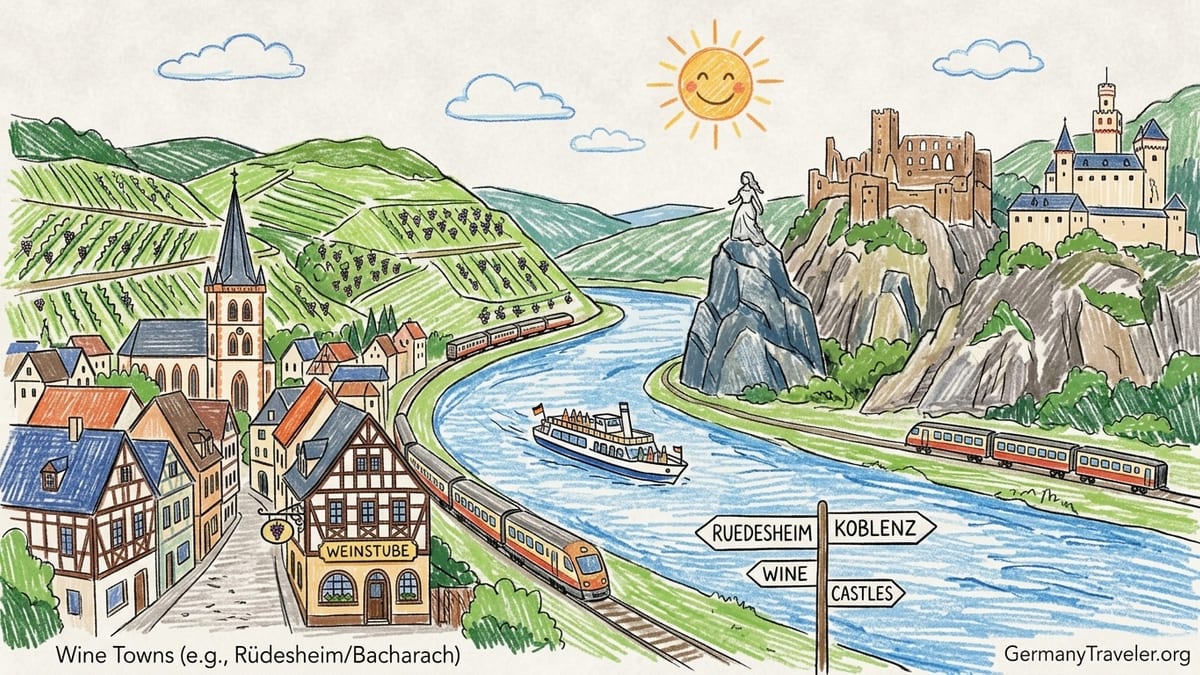
Rüdesheim am Rhein is the classic first stop at the southern end of the UNESCO-listed Upper Middle Rhine Valley. It is a small winemaking town but feels lively, especially in peak months and during wine festivals. In the old town, the narrow Drosselgasse is lined with traditional wine bars and taverns such as historic inns that specialize in local Riesling and live music well into the evening. For travelers who want to stroll from one Weinstube to the next without worrying about the last train, Rüdesheim is one of the most convenient base towns.
Beyond the famous lane, Rüdesheim works well for first-time visitors who want easy logistics. Trains from Frankfurt Airport connect via Wiesbaden and the opposite-bank station at Bingen, with frequent ferries linking Bingen and Rüdesheim. Short tourist trains and a cable car whisk visitors from the riverside up through the vineyards to the Niederwald monument, where panoramic views stretch across the Rhine and into the Rheingau wine region. From a practical standpoint, you can arrive around midday from Frankfurt, check into a riverside hotel, ride the cable car for sunset, and still be back in town in time for a late dinner.
The trade-off is that Rüdesheim is not the quietest place to sleep in high season. Cruise groups and day-trippers fill the lanes between late morning and early evening. If you are traveling with someone who prefers tranquil evenings or you want to sit on a balcony and hear mostly the river and church bells, smaller towns like Bacharach, Oberwesel or Braubach will feel more restful. Still, for wine-focused travelers who appreciate choice, nightlife and easy onward connections into the Rheingau, Rüdesheim is hard to beat.
For castles, Rüdesheim is more a convenient transport hub than a castle town. You will see hilltop ruins across the river near Bingen, but most classic fortresses such as Burg Rheinstein and Burg Reichenstein are reached on short boat or train trips rather than on foot from the old town. That works fine if you are happy to day-trip, but if you dream of a castle practically looming over your guesthouse, you may prefer Bacharach, St. Goar or Braubach.
Bacharach and Oberwesel: romantic small towns
Bacharach is often described as the quintessential Romantic Rhine town: compact, walkable and wrapped in half-timbered houses with a castle on the hill. Castle Stahleck, a 12th‑century fortress now operating in part as a hostel-style stay, crowns the ridge above the vineyards. You can hike up in around 20 to 30 minutes from the station and old town, and overnight guests wake to sweeping river views framed by crenellated walls. Down in the lanes, family-run wine hotels and small cafés give Bacharach a village feel despite its popularity with tour groups in midday.
Wine and river views are easy here. Terraced vineyards surround town on three sides, and many guesthouses have balconies or terraces facing the river traffic. Prices in Bacharach are generally moderate for the region: it is still possible to find simple doubles slightly under 100 euros in shoulder season, while atmospheric half-timbered hotels and riverside properties cluster higher. In the evening, after day-trippers leave, you may find yourself sharing a wine bar table with local winemakers or fellow hikers rather than bus tours, which adds to the charm for many travelers.
Just upriver, Oberwesel feels even more local and less visited, though it has outstanding medieval walls and towers that you can walk along for postcard views of the river bend. Many visitors appreciate Oberwesel as a quieter alternative to Bacharach, with enough restaurants and wine taverns to keep you fed and watered but fewer souvenir shops. From a practical angle, staying in Oberwesel often means less crowding around the station and easier last-minute hotel availability, especially outside peak weekends.
Both Bacharach and Oberwesel sit on the left bank main rail line and are regular stops for Rhine cruise boats. That makes them excellent for travelers who want to sample several towns without packing and unpacking. You might, for example, base in Bacharach for three nights, take a morning train to Boppard for the chairlift and Vierseenblick panorama, and return by late-afternoon boat that wanders past castle after castle. For couples looking for romantic stays with strong castle ambience, these two towns are among the best bases in the valley.
St. Goar, St. Goarshausen and the Loreley
St. Goar and its twin across the river, St. Goarshausen, sit almost exactly in the heart of the gorge section of the Rhine. Together they form the practical base for visiting the Loreley, the famous slate rock towering above a narrow river bend that has inspired legends and countless paintings. From St. Goarshausen, a shuttle bus or hiking trails lead up to the Loreley plateau, where viewing platforms look down on the river and trains threading both banks. The Loreley itself works best as a half-day or sunset excursion from a nearby town rather than as a standalone base, since accommodation on the plateau is limited and you will typically want easier access to restaurants and trains in the valley below.
Staying in St. Goar gives you front-row views of Burg Rheinfels, one of the most impressive castle ruins on the Middle Rhine. A walk up from the station and riverfront hotels takes around 20 minutes, and once at the fortress you can wander ramparts, explore tunnels and enjoy views across to the smaller castles opposite. St. Goar’s riverfront features a cluster of midrange hotels and guesthouses, some with balconies facing the shipping lane. Evening here is quieter than in Rüdesheim, with a handful of restaurants and wine bars rather than a continuous strip of nightlife.
On the opposite bank, St. Goarshausen feels more compact and steep, with houses pressed between the river and cliffs. Trains on the right bank line stop right in town, and the car and passenger ferry shuttles constantly between the two banks throughout the day, so you can easily stay on one side and dine or catch trains on the other. This flexibility makes the St. Goar area especially convenient if you want to combine boat travel with frequent rail use without worrying about long detours to a bridge, since the nearest bridges are many kilometers away.
For first-time visitors, basing in St. Goar or St. Goarshausen works well if your priorities are dramatic gorge scenery, easy access to the Loreley lookout and time inside a major castle ruin. Wine options are present but more limited than in Rüdesheim or Bacharach, with a handful of local taverns pouring Riesling from the surrounding slopes. If you value late-night variety, consider pairing one or two nights here with a night in a livelier wine town.
Kaub and Braubach: quiet bases with castle focus
Kaub is one of the smallest and quietest bases on the Rhine, but it sits opposite one of the river’s most distinctive sights: Pfalzgrafenstein Castle, a former toll station perched on a small island midstream. Small boats shuttle visitors across from Kaub’s riverside; the short crossing and visit can easily be slotted into a travel day between towns. Because Kaub has fewer hotels and restaurants than larger neighbors, prices can be a touch lower and the evenings especially calm, appealing to travelers who prioritize a peaceful, authentic-feeling base over a wide dining choice.
There is a practical trade-off, however. While regional trains serve Kaub on the right bank line, they are less frequent than in bigger towns, and some longer-distance services do not stop here. That means you will want to check train timetables carefully if you are planning day trips to cities like Koblenz or Mainz, or be comfortable using a combination of train and boat connections. For those with flexible schedules, Kaub can feel like a secret side door to the Rhine, rewarding visitors with uncrowded riverfront walks and a sense of living among residents rather than other tourists.
Further north on the right bank, Braubach is perhaps the best base on the valley for travelers who want a livable small town directly beneath a fully preserved hilltop castle. Marksburg Castle rises above Braubach’s old quarter and is one of the few Rhine castles that was never destroyed. Guided tours take you through furnished rooms, kitchens and defensive works, giving a stronger sense of medieval life than many ruins. From many guesthouse windows and restaurant terraces, Marksburg dominates the skyline, especially beautiful when lit at night.
Braubach’s advantages are a mix of atmosphere and practicality. It has its own station on the right bank line, with regular trains north to Koblenz and south toward Rüdesheim’s opposite bank. River cruise boats also stop here on their way through the gorge. Yet the town rarely feels as busy as Rüdesheim or Boppard. For travelers looking for romantic stays, a night or two in Braubach lets you combine castle visits, vineyard walks on the hills behind town and quiet dinners in half-timbered streets without sacrificing easy onward connections.
Boppard and Koblenz: central hubs and easy transport
Boppard, roughly halfway between St. Goar and Koblenz on the left bank, makes an excellent central base for travelers who want a blend of river scenery, gentle hiking and strong train connections. The town sits on a large bend in the Rhine, and a popular chairlift glides from the Mühltal up to the Vierseenblick viewpoint, where the river appears as four separate lakes between wooded slopes and vineyards. In practice, you can walk from a riverside hotel to the chairlift base in about 15 minutes, ride up for the panorama, have a drink at the hilltop café and be back in town in time for an evening boat cruise.
Boppard’s old town squares and waterfront promenade host a mix of hotels, wine bars and ice cream cafés. Compared with the smaller wine villages further south, it has a slightly more resort-like feel, with more accommodation capacity and frequent events, especially on summer weekends. That tends to keep prices competitive; you can often find midrange riverfront rooms at moderate rates even in busy months, particularly if you book a block or two back from the water. From Boppard station, local and regional trains run south to Oberwesel, Bacharach and Bingen, and north to Koblenz, Bonn and Cologne, making it ideal for travelers who plan multiple day trips in different directions.
Koblenz, at the northern end of the UNESCO stretch where the Rhine meets the Moselle, is the largest city in this guide and functions as a regional transport hub. For some visitors it feels too urban to match the romantic image of the Rhine, but it has significant advantages if you value choice and convenience. The city offers a full range of hotels from simple budget chains near the station to upscale riverfront properties, as well as a wide field of restaurants, shopping streets and indoor attractions that are useful on rainy days.
From a sightseeing perspective, Koblenz gives you quick access to the Ehrenbreitstein Fortress via a cable car crossing the Rhine, walks along the Deutsches Eck headland where the two rivers meet and easy onward connections to the Moselle wine towns, including day trips to Cochem by train. For first-time visitors to Germany or travelers with heavy luggage, arriving by long-distance train, checking into a hotel near Koblenz Hauptbahnhof and using regional trains for one or two day trips into the gorge can be a low-stress way to sample the scenery. The trade-off is that you return each evening to a city feel rather than a quiet riverside village.
Which town is best for wine, castles, views and first-timers
If your main goal is to drink local wine in traditional surroundings, Rüdesheim and Bacharach are the strongest bases, followed closely by Boppard and Oberwesel. Rüdesheim has the densest cluster of wine taverns within a few blocks, and you could easily spend two nights visiting different bars and restaurants that each specialize in Rheingau and Rhine Valley Riesling. Bacharach and Oberwesel feel more intimate; you might find yourself returning to the same favorite tavern more than once, but the vineyards press closer to town and vineyard walks start practically at the edge of the lanes.
For castles, St. Goar and Braubach are standout bases, with Burg Rheinfels and Marksburg Castle dominating their respective skylines and reachable on foot from town centers. Bacharach adds Castle Stahleck, which for many travelers offers a memorable overnight experience in a repurposed fortress hostel high above the river. Kaub’s Pfalzgrafenstein and the Loreley near St. Goarshausen are best treated as key attractions in a stay based somewhere central, since their immediate surroundings have fewer hotels and services. Wherever you base, it is straightforward to visit several castles in a two or three day window using a mix of boats, trains and short taxis.
River views and romantic atmosphere are strongest in Bacharach, Oberwesel, Boppard and Braubach. In these towns, many family-run hotels and guesthouses have balconies or terraces facing the river and passing cruise ships, and the streets behind them are lit more by lanterns and warm window light than by neon. Rüdesheim and Koblenz offer fine views too, but their busier waterfronts and larger scale change the mood. If you are celebrating an anniversary or simply want to slow down, look for a small inn on the water in Bacharach or Braubach and plan at least one slow lunch on the river promenade.
For first-time visitors with limited time, one of the best strategies is to combine a city base with one smaller-town stay. You might, for example, spend a night in Koblenz on arrival so you can explore Ehrenbreitstein Fortress and the Moselle junction without rushing, then move to Bacharach or Boppard for two or three nights focused on the gorge, castles and boat trips. Travelers nervous about changing hotels can instead choose a single base with excellent transport, such as Boppard or Rüdesheim, and do day trips by train and boat, knowing that you can usually return to your hotel by late evening without complicated transfers.
Train, cruise and itinerary tips for the Rhine Valley
The Rhine Valley is one of the easiest regions in Germany to explore without a car, which is a key reason it works so well for first-time visitors. Trains run on both banks of the river, with the left bank usually offering slightly more frequent services through Bacharach, Oberwesel, St. Goar and Boppard. When planning your base, it is worth looking at a current timetable for your intended travel days. For example, if your flight home leaves from Frankfurt Airport early in the morning, staying your last night in Rüdesheim or in Bingen on the opposite bank can simplify the final transfer.
River cruise boats, run by several companies, are more leisurely and scenic but less frequent than trains. In practice, most travelers use boats for one or two highlight segments and rely on trains for the rest. A common pattern is to take a mid-morning boat from Rüdesheim or Bingen to St. Goar or Boppard, spend a few hours exploring castles or viewpoints, then return to base by train. Tickets are often flexible, allowing you to board a later boat if you linger in a village longer than planned, but in high season it pays to arrive at the pier a bit early to choose seats on deck.
Ferries play an important connecting role, especially near the Loreley where bridges are far apart. The Loreley car and passenger ferry between St. Goar and St. Goarshausen, for example, operates repeatedly throughout the day in normal conditions, letting you combine a left bank base in St. Goar with right bank train connections and access to the Loreley plateau. Similar short ferries link Boppard to Kamp-Bornhofen and Rüdesheim to Bingen. In wet or windy weather, ferries and boats can adjust schedules, so keeping plans slightly flexible and checking local notices on the day is sensible.
When comparing towns, keep in mind your daily rhythm. If you like long, slow breakfasts and late starts, basing in a smaller town where the main sights are right outside your door, like Bacharach or Braubach, means you lose less time commuting. If you are an early riser who wants to stack multiple sights per day, a hub like Boppard or Koblenz with frequent departures in all directions can help you cover more ground. In every case, traveling carry-on light makes it much easier to switch bases once mid-trip if you discover that another town matches your style better.
The Takeaway
There is no single “best” place to stay in the Rhine Valley. Instead, each town offers a distinct balance of wine culture, castle access, river views, transport links and atmosphere. Rüdesheim is ideal if you want a lively wine-focused base with lots of evening options and straightforward access from Frankfurt. Bacharach and Oberwesel are the go-to choices for classic romantic scenery in a small-town setting, while St. Goar and St. Goarshausen put you at the heart of the Loreley gorge and within walking distance of one of the valley’s largest castles.
Kaub and Braubach reward travelers seeking quieter stays and strong connections to individual castles, especially Pfalzgrafenstein and Marksburg. Boppard and Koblenz suit visitors who prize transport convenience, with Boppard adding a relaxed resort feel and chairlift views over one of the Rhine’s most striking bends. Wherever you choose, the distances are short enough that you can easily combine two bases on a four- or five-night trip, gaining both a wine village and a small city perspective.
For many travelers, the most satisfying Rhine itinerary starts with a night or two in a city hub like Koblenz or Mainz, moves into the gorge for two or three nights in a village such as Bacharach, Boppard or Braubach, and includes at least one boat trip through the castle-lined stretch between Rüdesheim and St. Goar. With a little planning around what matters most to you, the Rhine Valley can feel at once surprisingly easy and richly atmospheric, delivering exactly the mix of wine, water, castles and romance you came for.
FAQ
Q1. Which Rhine Valley town is best for a first-time visitor without a car?
Boppard and Bacharach are excellent for first-timers without a car. Both sit on the main rail line, are regular cruise stops and have compact centers where you can walk from station to hotel in a few minutes. Boppard feels more like a small resort with many connections, while Bacharach is a smaller, more romantic village base.
Q2. If I only have one night, should I stay in Rüdesheim or Koblenz?
Choose Rüdesheim if your priority is wine taverns, old-town atmosphere and easy access to the scenic boat stretch toward St. Goar. Opt for Koblenz if you want straightforward long-distance train links, more hotel choice and the ability to visit Ehrenbreitstein Fortress and the Moselle junction on a tight schedule.
Q3. Where should I stay if I want to visit the Loreley rock?
The most convenient bases for the Loreley are St. Goar and St. Goarshausen. You can stay in either town, use the Loreley ferry to cross the river as needed, and take a bus or hike up to the Loreley plateau for the viewpoint. Many travelers visit on a half-day trip from a base in Boppard or Bacharach.
Q4. Which town is best for staying in or directly under a castle?
Bacharach is ideal if you want to sleep in a castle setting at Stahleck, which overlooks the town and river. Braubach is best for staying directly beneath an intact hilltop fortress, Marksburg Castle, which dominates the skyline and is reachable on foot from town.
Q5. Is Rüdesheim too touristy to use as a base?
Rüdesheim is busy, especially around the Drosselgasse during the day and in festival periods, but that also means a good choice of wine bars, restaurants and hotels. If you like energy and evening atmosphere, it works very well as a base. If you prefer quiet nights, consider Bacharach, Oberwesel or Braubach instead.
Q6. Which town offers the best combination of wine and river views?
Bacharach and Boppard probably offer the strongest mix. In both, you can stay in riverside hotels with balconies facing the water and walk a few minutes to family-run wine bars or tasting rooms. Rüdesheim also scores highly but feels more crowded.
Q7. How many nights should I plan in the Rhine Valley?
Two nights gives you one full day to ride a boat, visit at least one castle and stroll a town. Three to four nights lets you combine a wine village base such as Bacharach or Boppard with a city like Koblenz or Mainz and add side trips to the Moselle or Rheingau.
Q8. Is it better to explore the Rhine by train or by river cruise?
Trains are faster and more flexible, especially for day trips and connections to Frankfurt or Cologne. River cruises are slower but offer the classic scenic experience past cliffs and castles. Many travelers use trains for most movement and reserve a half-day boat ride between Rüdesheim or Bingen and St. Goar or Boppard as a highlight.
Q9. Are smaller towns like Kaub and Braubach suitable in winter?
They can be very atmospheric in winter, but services are more limited. Some hotels and restaurants close or reduce hours, and river cruise schedules are cut back. If you visit outside main season, it is wise to book accommodation with flexible terms and check opening times for castles and ferries in advance.
Q10. Can I comfortably visit both the Rhine and Moselle valleys in one trip?
Yes, if you base in Koblenz for at least one night. From there, frequent trains reach Rhine towns like Boppard and St. Goar, and also head up the Moselle to places such as Cochem. Combining one or two nights in Koblenz with two or three nights in a smaller Rhine village creates a balanced itinerary.