


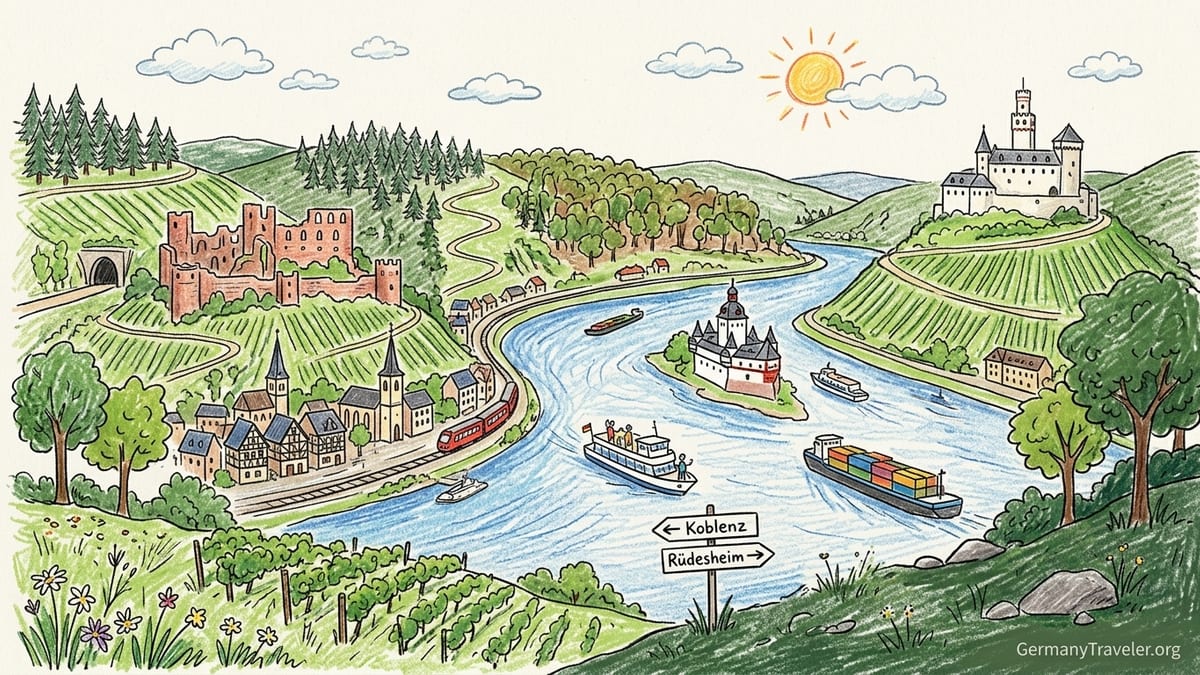
Between Koblenz and Bingen, the Upper Middle Rhine Valley squeezes between steep slate hills, vineyards and one of Europe’s busiest rivers. In this UNESCO World Heritage corridor, castles perch on almost every bend. Some are rugged ruins, others romantic 19th century rebuilds, and a few still feel like working fortresses. This guide focuses on nine of the most interesting sites for travelers: Marksburg, Rheinfels, Rheinstein, Reichenstein, Gutenfels, Katz, Maus, Stolzenfels and Pfalzgrafenstein. It explains which you can actually tour inside, which are mainly scenic viewpoints from the river, what to expect from the uphill walks, and how to link several castles in one unforgettable day.
Understanding the UNESCO Rhine Castle Corridor
The classic castle stretch of the Rhine runs between Koblenz and Bingen, often called the Upper Middle Rhine Valley. Trains hug both banks, boats shuttle constantly, and hilltops are crowned with watchtowers and fortresses. For visitors, this density is both a blessing and a challenge. You can see a dozen castles in a single 90 minute cruise, but you will have time to properly tour only a few. Planning around opening hours, hills, ferries and train schedules makes the difference between a frantic dash and a relaxed, memorable day.
In practical terms, most independent travelers use a regional train line such as the RB 10 that runs along the right bank between Frankfurt, Wiesbaden and Koblenz, or they arrive from Cologne and Bonn via Koblenz on the left bank. From there, you pair train stops like Braubach, St Goar, Bingen or Kaub with short walks, local buses or shuttle vans to reach specific castles. Day boats from large operators add another layer, letting you sail one direction and return by train.
Not every castle on the river is equally accessible. Some, such as Marksburg and Rheinstein, are developed visitor attractions with ticket offices, cafes and regular hours. Others, like Katz and Maus, are in private or institutional use and cannot be toured inside, though they are dramatic from the water or from opposite banks. When time is short, focusing on two or three fully visitable castles and treating the rest as scenic highlights from trains and boats is usually the smartest strategy.
Ticket prices along the Rhine vary but are broadly comparable. As of 2026, a typical self guided castle visit with access to the grounds and interiors might cost around 10 to 12 euros for adults, with discounts for children and families. Combination tickets are appearing too. At Rheinstein, for example, the published adult ticket price is 11 euros with family tickets available and an advertised combo saving for also visiting nearby Burg Sooneck. Travelers should always check the latest prices and shoulder season hours before setting out, as opening times can shift between winter and summer.
Marksburg: The Only Undestroyed Hilltop Fortress
Marksburg, above Braubach on the right bank south of Koblenz, is the only medieval hilltop castle on this stretch of the Rhine that was never destroyed. Rather than a romantic 19th century reconstruction, you walk through a fortress that evolved continuously from the 13th century onward. You enter through thick walls, pass a torture chamber, kitchen and armory, and climb rough cobbles into towers with commanding views of the river traffic below.
From Braubach train station, the walk to Marksburg takes roughly 30 to 40 minutes uphill. The path is well marked but steep, partly on paved lanes through the town and then on a forested track. Travelers with moderate fitness will be fine, but it is not an entirely casual stroll in hot weather. In season, some local taxis offer short transfers from the station or riverfront, which may appeal if you are carrying luggage or traveling with children. There is parking near the castle entrance for those with a car.
Historically, Marksburg could only be visited on a guided tour, and even today many interior spaces are still accessed with a guide who controls the flow through narrow passages and small rooms. Audio guides and multilingual printed materials are sometimes available, but you should expect at least a partially guided experience and set aside about an hour for the tour plus extra time on the terrace. Photography is generally allowed in the courtyard and from viewpoints but may be restricted in some interior rooms, especially where fragile furnishings or exhibits are on display.
For views of Marksburg itself, some of the best vantage points are actually from the opposite riverbank between Lahnstein and Koblenz, or from passing boats traveling between Boppard and Koblenz. An early evening cruise that passes Braubach gives you the classic postcard angle: the white-walled castle on its conical hill, vineyards below, and long freight trains gliding along the river’s edge. Combining Marksburg with a visit to nearby Stolzenfels, on the opposite bank just south of Koblenz, makes an excellent half or full day focused on the northern end of the corridor.
Rheinfels: Atmospheric Ruins Above St Goar
Rheinfels looms above the riverside town of St Goar on the left bank, roughly halfway between Koblenz and Bingen. Once the mightiest fortress on the Rhine, it was partially demolished in the late 18th century, leaving sprawling ruins, casemates and walls that you can wander today. Instead of furnished rooms, Rheinfels offers vaulted cellars, dark tunnels and panoramic battlements, ideal for travelers who prefer exploring open air ruins over guided interior tours.
Reaching Rheinfels from St Goar station involves a steady uphill walk of about 20 to 30 minutes. The route follows narrow streets and then the Schlossbergstrasse up through the town. Signs direct drivers and pedestrians alike towards the castle, and the ascent can feel surprisingly steep after a long train ride. To ease the climb, a seasonal Burg Rheinfels shuttle bus operates between St Goar and the castle parking area according to local timetables, which are updated annually. This shuttle is particularly useful if you are trying to fit multiple stops into one day or traveling with less mobile companions.
Admission at Rheinfels is typically in the same low teens of euros for adults. Once inside, you explore at your own pace. There are small exhibits on the castle’s history and excellent scale models showing how vast the complex once was. Families often bring flashlights for children to venture into some of the darker tunnels, though staying within signed, open areas is strongly advised. Photography is freely allowed outdoors, and the main terrace by the attached hotel and cafe offers a sweeping view south toward Oberwesel and north past the Loreley cliffs.
St Goar is a convenient base for castle hopping. From the promenade, you have frontal views of Burg Katz across the river and Maus slightly upstream. While these two are not easily toured, they create a spectacular skyline, especially at sunset when lights come on along the cliffs. Many travelers structure a day so they take a morning train or boat to St Goar, climb or shuttle up to Rheinfels for a few hours, then continue by train to Kaub or Bacharach for other castles in the afternoon.
Rheinstein and Reichenstein: Twin Highlights Near Bingen
Just upstream from Bingen on the left bank, Rheinstein and Reichenstein sit within a short taxi ride or moderate walk from riverside train stops. Both are classic examples of Rhine Romanticism, rebuilt in the 19th century with turrets, decorative details and landscaped courtyards. For many visitors based in Mainz or Rüdesheim, these are the easiest substantial castles to fit into a half day trip without too much logistical complexity.
Rheinstein was one of the first Rhine castles to be restored in the Romantic period. Today it is privately owned and run by a family who live on site. Latest published information lists adult admission at 11 euros, with family tickets and reduced prices for children and groups. The castle can usually be explored self guided, using a booklet or audio material. From the station at Trechtingshausen, it is around a 30 minute walk that begins nearly at river level and then climbs through vines and wooded paths to the entrance gate. The route is steep in parts, so sturdy shoes and water are sensible.
Reichenstein, slightly further upriver, is reached from the same general area. Some visitors walk between the two, while others use a short taxi ride or local bus, depending on schedules. Reichenstein houses a hotel and restaurant along with museum rooms, so interiors tend to mix historic displays with more polished, updated spaces. Admission is similar in price bracket to Rheinstein, and visits are typically self paced. From terraces and ramparts, you look down on the trains and boats threading the narrow valley, giving a strong sense of how strategically these castles controlled river traffic.
Because Rheinstein and Reichenstein share similar access points near Bingen and Trechtingshausen, they are among the easiest castles to combine in a single outing, especially if you are comfortable with hillside walks of 20 to 30 minutes at a time. A realistic plan from Frankfurt might involve an early train to Bingen or Trechtingshausen, a visit to Rheinstein before late morning, lunch at one of the castle cafes or in the village, and then an afternoon at Reichenstein before you return downstream by train or an evening cruise.
Gutenfels and Pfalzgrafenstein: A Perfect Pair at Kaub
Around the bend from St Goar, the small town of Kaub guards one of the Rhine’s tightest narrows. Here, two castles work as a pair: Gutenfels on the hill above the town and Pfalzgrafenstein, a former toll station built on a small rocky island mid stream. While Gutenfels currently operates mostly as a private or hospitality property without full scale public interior tours, Pfalzgrafenstein is open as a dedicated visitor attraction that vividly explains how tolls once controlled all shipping along the river.
To reach Kaub, travelers usually take a regional train on the right bank. From Frankfurt Hauptbahnhof, for example, the RB 10 service toward Koblenz typically reaches Kaub in just under two hours, with the station only a few minutes’ walk from the waterfront. As of mid 2026, there are temporary periods when segments of the right bank line near Kaub are under reconstruction and replacement buses are in use, so checking Deutsche Bahn schedules shortly before travel is essential. Once in Kaub, clear signs lead from the tracks to the ferry pier facing Pfalzgrafenstein’s white and red walls.
Pfalzgrafenstein is only accessible by a small passenger ferry that shuttles to the island during the castle’s opening hours. Recent official information lists a combined ticket for ferry ride and castle admission with adult prices around 8 euros, reduced tickets for children and concessions, and family tickets for one or two adults with multiple children. Because the castle sits low on the rock, disabled access is limited and staircases are unavoidable. Inside, rooms explain how cargo was inspected and tolls levied, and you can climb narrow stairs to viewing platforms that sit almost at eye level with passing barges.
Photography at Pfalzgrafenstein is one of the delights of the UNESCO corridor. From the island you have close up views of the main channel of the Rhine and of Gutenfels rising behind Kaub on its hill. Conversely, the best classic photographs of Pfalzgrafenstein itself are taken from the right bank promenade in Kaub, from trains that momentarily clear the trees, or from boats sailing past at mid river. For travelers with time and energy, a short but steep vineyard path climbs from town toward Gutenfels, giving elevated angles that show castle, river, island fortress and train line in one frame.
Katz, Maus and Stolzenfels: Castles Best Seen from Outside
Some of the most photogenic castles on the Rhine are not currently easy to tour in depth. Burg Katz sits directly above St Goarshausen on the right bank, almost opposite Rheinfels, while Burg Maus perches on a hillside a little further upstream near Wellmich. Both are striking landmarks, often illuminated in the evenings, but they are generally in private or institutional use and have limited or no regular public opening hours for casual drop in visitors.
For most travelers, Katz and Maus are therefore best treated as scenic highlights. You see Katz particularly well from the waterfront at St Goar and from the Rhine boats that pull in and out of the pier there. The view combines the pointed towers of Katz, vineyards stepping down the cliff and the curve of the river around the Loreley rock. Maus appears more isolated, but the approach by boat reveals its classic tall keep and surrounding walls set on a forested slope. Photographers often plan rides on slow moving day cruises precisely to capture these silhouettes from multiple angles.
Stolzenfels, by contrast, is both visitable and visually iconic. Located on the left bank just south of Koblenz, it was rebuilt as a 19th century palace in the Romantic style and set in terraced gardens. You cannot drive all the way up to the main gate. Instead, you walk from the riverside road or bus stop for about 20 to 30 minutes on a paved but steep path through woodland, emerging beneath high cream colored walls. Inside, guided tours lead through furnished rooms that show how the Prussian royal family used the castle as a summer residence, with period furniture and paintings.
Interior photography at Stolzenfels is often limited or prohibited to protect furnishings and ensure tours move smoothly through narrow corridors, though you can usually take photos in the courtyard and gardens. From the terraces, you look north toward Koblenz where the Moselle meets the Rhine and south along the valley toward Boppard. Because Stolzenfels lies close to both Koblenz city and Marksburg at Braubach just across the river, it is relatively easy to combine a visit here with another castle in a single day, connected by local trains and buses.
How to Combine Castles in One Day
With nine notable castles and many smaller towers along a short stretch of river, the temptation is to try to see everything in one go. In practice, the best days focus on depth at two or three sites, using trains and boats not just as transport but as moving viewpoints. A classic full day itinerary for first time visitors might be: morning at Marksburg, afternoon ruins at Rheinfels, and evening views of Katz and Maus from the river. You would start early from Koblenz, ride the train to Braubach, climb to Marksburg, then continue by train to St Goar for Rheinfels before finishing with a late afternoon cruise back to your base.
Another rewarding combination is the Bingen segment. Here you might visit Rheinstein in late morning, enjoy lunch either at the castle cafe or down by the river, then continue to Reichenstein for the afternoon. If you are staying in Mainz or Frankfurt, fast regional trains make Bingen and Trechtingshausen easy to reach, and the walks between station, castles and river are compact. Because both castles are on the same bank and roughly aligned, you avoid repeated river crossings and can use a single base for the day.
For travelers especially interested in river toll history and unique locations, pairing Rheinfels with Kaub is hard to beat. You could start in St Goar, explore the vast remains of Rheinfels in the morning, then ride a midday train down to Kaub. After a short walk from the station to the waterfront, you board the Pfalzgrafenstein ferry and spend an hour or two on the island learning how toll officers once linked Gutenfels and Pfalzgrafenstein to control shipping. In late afternoon, either return by train or board a boat towards Bingen or Koblenz to enjoy golden hour light on the cliffs.
When planning combinations, pay attention to uphill walking times and heat. Many Rhine castles involve at least 20 minutes of continuous ascent on surfaces that can be slippery in rain or tiring in summer sun. If you are traveling with younger children or older relatives, you might prefer to choose one physically demanding site like Marksburg or Rheinstein and pair it with a mainly riverside experience such as a cruise that passes Katz, Maus, Stolzenfels and other castles without requiring additional climbs. In shoulder seasons like April or October, daylight hours are shorter and some castles shift to reduced opening days, so always confirm operating calendars in advance.
Practical Tips: Trains, Boats, Tickets and Photography
Public transport is the backbone of a stress free Rhine castle trip. The regional trains on both banks accept most day passes issued by local transport associations and national rail discount cards. Trains typically run at least hourly between major stops like Koblenz, Boppard, St Goar, Oberwesel, Bacharach and Bingen, with smaller stops such as Braubach and Kaub served less frequently. On busy holiday weekends, standing room on some popular segments is normal, so it is wise to avoid the very last train of the evening when returning to your base city.
Boat services are seasonal but extensive. Large operators run long distance cruises between Koblenz and Rüdesheim or Bingen, allowing you to hop on in one town and off in another. A common strategy is to take a mid morning boat from Boppard or St Goar downstream, capturing views of Rheinfels, Katz, Maus, Gutenfels and Pfalzgrafenstein from the water, then use an afternoon train to get back upriver more quickly. Shorter ferry crossings link opposite banks at towns like St Goar, Kaub and Bingen, which is useful if your accommodation is on one side but your chosen castles are on the other.
Ticketing at the castles themselves is generally straightforward. Most sell admission at the entrance without needing advance reservations, except for special evening events or large group visits. Cash and cards are usually accepted, though smaller privately owned sites occasionally prefer cash. Family tickets at places like Rheinstein or Pfalzgrafenstein often provide good value if you are traveling with children. If you plan to visit several state run heritage sites in Rhineland Palatinate, it may be worth inquiring at the first ticket office about combined or regional passes that include Pfalzgrafenstein among other monuments.
Photography etiquette varies from castle to castle. Outdoor shots from courtyards, terraces and walls are almost always allowed and are one of the main reasons people come. Restrictions tend to focus on indoor rooms with delicate textiles, paintings or religious objects, where either no photography or no flash rules are posted. Tripods can be problematic on guided tours or narrow walkways. As a rule of thumb, ask staff before setting up serious equipment and be ready to move quickly so you do not block others. For the most iconic exterior views, remember that some of the best angles are distant: Marksburg seen from the opposite bank, Katz from St Goar waterfront, or Pfalzgrafenstein from a mid river boat or from Kaub’s promenade at sunrise.
The Takeaway
The Rhine Valley’s reputation as a land of castles is fully deserved. Between Koblenz and Bingen, hilltops and islands host fortresses in almost every style, from the intact medieval defenses of Marksburg to the broken ramparts of Rheinfels, the romantic restorations at Rheinstein and Reichenstein, and the improbable toll station of Pfalzgrafenstein marooned in mid stream. Adding Gutenfels, Katz, Maus and Stolzenfels to the mix only reinforces how dense and varied this UNESCO listed landscape really is.
For travelers, the key is to balance ambition with realism. Rather than ticking off names from train windows, pick a small handful of castles to explore properly inside and treat the rest as part of the ever changing scenery outside your carriage, boat or riverside cafe. Use regional trains and boats not just as ways of getting from A to B but as moving balconies with constantly shifting perspectives on the same walls and towers.
Whether you are based in Cologne, Frankfurt or Mainz, you can reach this corridor easily for a long day trip or, better yet, slow down for a night or two in riverside towns like St Goar, Bacharach or Boppard. There, you wake to the sound of barges and church bells, and evening walks reveal the castles lit against the dark slopes above. With a little planning around hill climbs, ferry times and opening hours, the Rhine’s castles become not just postcard images but lived experiences you move through room by room and courtyard by courtyard.
FAQ
Q1. Which Rhine Valley castles can I fully tour inside rather than just view from the river?
Marksburg, Rheinfels, Rheinstein, Reichenstein, Stolzenfels and Pfalzgrafenstein are the main sites with structured visitor access, ticket offices and regular opening hours, while Katz, Maus and often Gutenfels are mostly appreciated from outside as scenic highlights.
Q2. What are typical admission prices for Rhine Valley castles in 2026?
Most major castles charge roughly 8 to 12 euros for adults, with reduced rates for children and concessions and family tickets that bundle one or two adults with several children, as seen at Rheinstein and Pfalzgrafenstein.
Q3. How difficult are the uphill walks to castles like Marksburg and Rheinstein?
Expect about 20 to 40 minutes of steady uphill walking on a mix of paved lanes and forest paths. The climbs are manageable for reasonably fit travelers but can feel strenuous in hot weather, so comfortable shoes, water and unhurried timing are important.
Q4. Can I visit Rheinfels Castle if I do not want to walk up the hill from St Goar?
Yes, a seasonal shuttle bus typically runs between St Goar and Rheinfels, reducing the walk to just a few steps between the drop off point, ticket office and ruins, though you should check current timetables locally.
Q5. Is Pfalzgrafenstein Castle suitable for travelers with limited mobility?
Pfalzgrafenstein sits on a small rock island reached only by a passenger ferry and accessed via steps and narrow interiors, so it is unfortunately not well suited to wheelchairs or travelers who cannot manage stairs.
Q6. Which castles are easiest to combine in a single day trip from Frankfurt or Mainz?
Rheinstein and Reichenstein near Bingen work well together, as do Marksburg and Stolzenfels near Koblenz, while more ambitious days might pair Rheinfels with Pfalzgrafenstein at Kaub using regional trains.
Q7. Do I need guided tours, or can I explore castles independently?
Many sites, such as Rheinstein, Reichenstein, Rheinfels and Pfalzgrafenstein, allow self guided exploration with booklets or audio guides, while others like Marksburg and Stolzenfels rely more heavily on scheduled guided tours for their main interiors.
Q8. What is the best way to photograph Rhine castles without a car?
Use a mix of train windows, riverside promenades and boat decks as moving viewpoints, aiming for classic angles like Katz from St Goar waterfront, Marksburg from the opposite bank near Koblenz and Pfalzgrafenstein from Kaub’s shore or passing ferries.
Q9. Are Rhine castle visits suitable for children?
Yes, many families enjoy exploring ruins like Rheinfels, climbing towers at Rheinstein and riding the ferry to Pfalzgrafenstein, though parents should be prepared for uphill walks, uneven surfaces and safety rules around walls and drop offs.
Q10. When is the best season to visit the Rhine Valley castles?
Late spring and early autumn offer a good balance of long daylight, mild temperatures and full boat and castle schedules, while high summer brings more crowds and heat and winter sees reduced opening days and fewer cruise options.